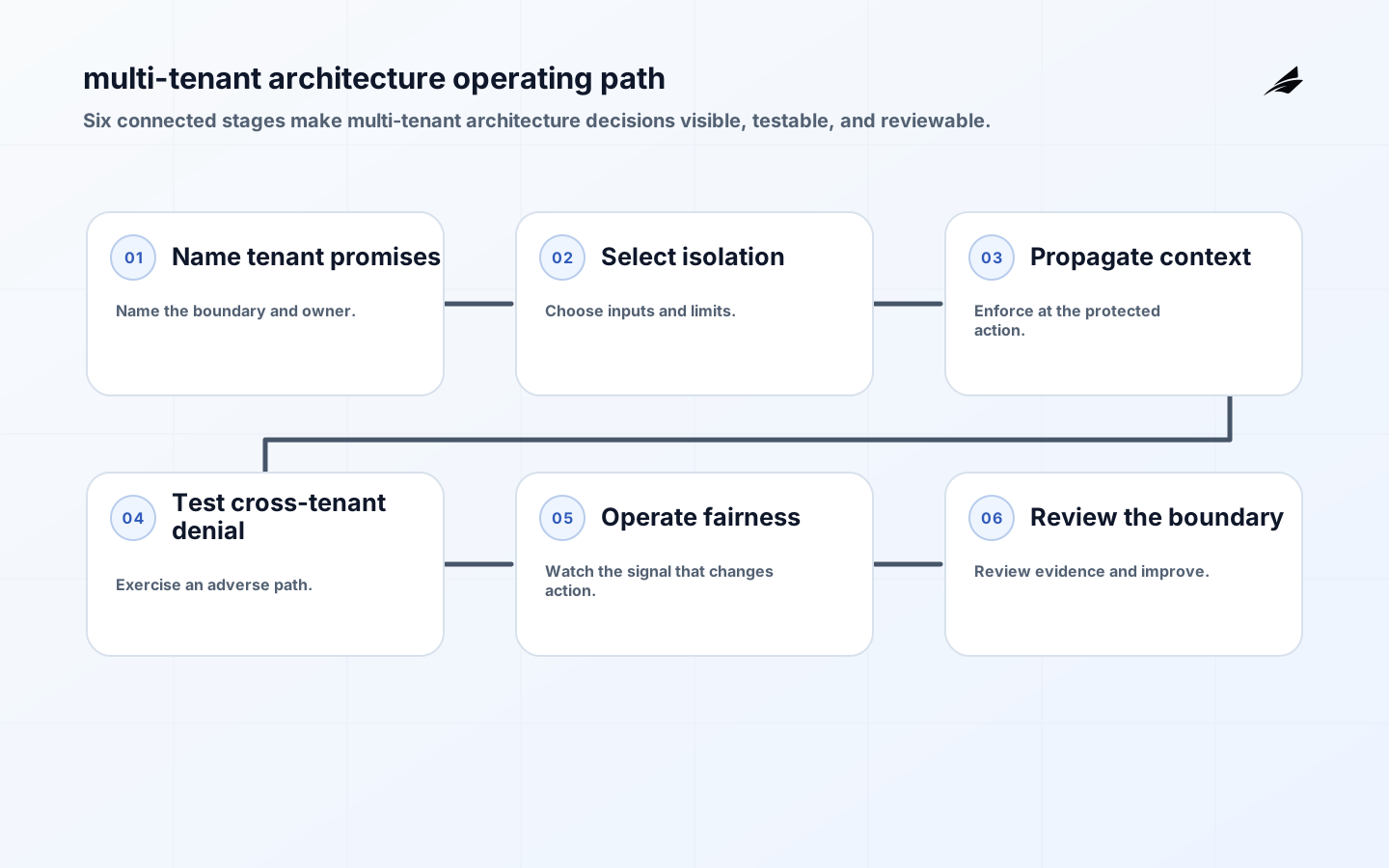
A multi-tenant architecture is a business and operating model expressed through software. The architecture decides how customers share capacity, how a request becomes tenant-aware, how a premium tier is delivered, and what a responder can see during an incident. Starting with a database pattern alone produces brittle answers, because tenant boundaries also run through identity, networking, background work, storage, deployment, metering, and support. The right first decision is not pool versus silo in the abstract; it is which risks, economics, and customer commitments the model must satisfy. This guide gives CTOs a practical way to set the boundary, design the controls, release safely, and keep improving from evidence.
Set the multi-tenant architecture boundary before implementation
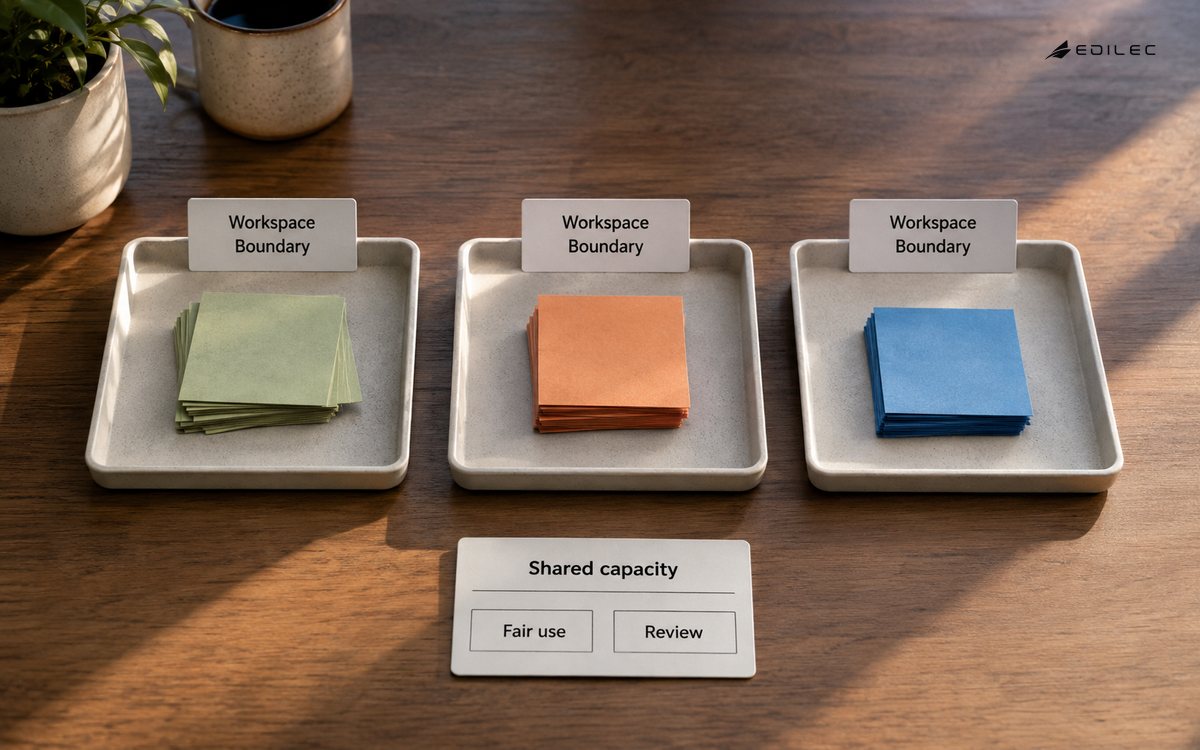
Describe the tenant profiles that matter: expected volume, sensitivity of data, residency, integration requirements, support model, and commercial tier. AWS notes that SaaS systems may mix pooled and siloed components where different services have different isolation and load profiles. That is often more realistic than forcing one global pattern. Write the tenant context contract early: how it is established, propagated, validated, logged, and used in authorization. A service that cannot articulate this contract is not ready to handle shared customer data. Before solution design, write down the outcome, the records involved, the actor who is accountable, and the evidence that proves a safe result This narrow statement makes tradeoffs visible: some work must be synchronous and confirmed immediately, while other work can be durable and asynchronous Treat the distinction as a product promise. A person should never have to infer whether a request completed, is pending, or requires another action — for multi-tenant architecture.
| Decision area | Question to settle | Evidence to retain |
|---|---|---|
| Scope | Which multi-tenant architecture outcome is being protected or improved? | Named owner and success condition |
| Authority | Which system or role may make the state change? | Policy version and decision record |
| Failure | What happens when a dependency or input is incomplete? | Visible status, retry rule, and responder |
| Review | Which signal changes the next product decision? | Threshold, cadence, and accountable team |
Design multi-tenant architecture as an explicit operational contract
Compare pooled, siloed, and bridge approaches against a concrete set of requirements. Pooling can improve unit economics and delivery consistency, while a silo can reduce blast radius or meet strict separation needs. A bridge model can isolate a sensitive component while keeping common services shared. In all cases, separate the control plane that manages tenants from the tenant-facing data plane. Make quotas and fairness policies explicit, because a tenant who consumes a queue or expensive query budget can affect others even when records are correctly isolated. Write acceptance criteria that include the unhappy path: a missing field, a duplicate action, a late response, an unavailable dependency, and a valid but unusual request The intent is not to predict every incident. It is to make the normal rules and safe fallback visible enough that a colleague can reason about a new case without relying on private knowledge — for multi-tenant architecture.
- Name the user-visible outcome and the state that confirms multi-tenant architecture is complete.
- Assign authority for each important record, transition, and exception.
- Keep a durable identifier for requests, events, and corrections that may be repeated — for multi-tenant architecture.
- Expose pending, failed, and completed states in language a customer can act on — for multi-tenant architecture.
- Test denied or invalid paths as carefully as the intended successful path — for multi-tenant architecture.
- Give every manual exception queue an owner, response expectation, and correction route — for multi-tenant architecture.
Release multi-tenant architecture with recovery and observability
Build a thin vertical path that provisions a tenant, establishes identity, performs a scoped operation, records tenant-aware telemetry, and removes access cleanly. Test onboarding bursts, a high-volume tenant, credential rotation, failed provisioning, and deletion or retention requests. Use infrastructure definitions that can reproduce the chosen footprint; a premium or regulated tier that requires manual snowflake configuration will be difficult to audit and evolve. Decide how version rollouts work across all tenants before the first exception customer arrives. Use a limited audience when the behavior or operating assumptions are new, but do not make the control itself contingent on a vague experiment Capture correlation identifiers at boundaries so support and engineering can trace one real item from input to outcome Confirm that a rollback preserves the ability to explain and correct records created during the release workspace model decisions is a useful adjacent decision when planning the customer-facing implications.
| Production risk | Practical control | Signal for review |
|---|---|---|
| Ambiguous state | Use an explicit lifecycle and durable identifiers | Conflicting or aged records |
| Unsafe retry | Make commands and event processing idempotent | Duplicate effects or corrections |
| Invisible exception | Create an owned queue and customer-facing status | Age of unresolved work |
| Uncontrolled change | Stage exposure and retain a rollback route | Unexpected outcome after release |
For adjacent controls, compare the ABAC checklist with production least privilege when tenant context affects authorization and recovery.
Operate multi-tenant architecture from decision-ready signals
Operate at two levels. Global signals show service health, capacity, and deployment status; tenant-aware signals reveal skew, unusual load, support impact, and cost attribution. Monitor fairness controls, throttling, quota breaches, and per-tenant error patterns alongside overall availability. A tenant dashboard should not become a path for unrelated tenants to be exposed, so apply the same access design to observability and support tools as to the product itself. Choose measures that lead to a named action: investigate a specific backlog, pause a rollout, contact affected customers, correct a record, or change a policy Review the oldest unresolved cases alongside aggregate rates. Averages are useful for trend, but they can make a single consequential failure disappear Keep event history proportionate to the need to reconstruct a decision and protect it with the same care as the workflow itself
Keep multi-tenant architecture changes reviewable
Architecture decisions need an expiry condition. Record the assumptions behind a pool or silo choice, the data classification it supports, the operational cost, and the event that triggers reassessment. Treat a new residency promise, contract requirement, product tier, or high-volume use case as an architecture review rather than a one-off implementation request. Keep the tenant boundary threat model current when new services, AI features, or third-party processors are introduced. Keep the record short enough to use: purpose, affected users and records, accountable owner, release condition, recovery method, and review date This is not ceremony for its own sake. It lets product, engineering, support, and operations distinguish a change in presentation from a change in authority, cost, or customer commitment Retire old exceptions and temporary rules deliberately; they are part of the production behavior even when no longer visible in the interface
Use authoritative guidance to check the design for multi-tenant architecture
The recommendations here are informed by Microsoft’s multitenant architecture considerations, the Azure multitenancy checklist, Kubernetes multi-tenancy guidance, and AWS’s tenant-isolation guidance. These sources provide durable reference points for isolation choices, workload boundaries, fairness controls, and tenant-aware operations. They do not replace customer research, contractual obligations, or domain-specific review Use them to challenge assumptions, then record the product-specific rule your team adopts and the evidence that will show whether it is working
Choose isolation per consequence, not by habit
A useful decision example is a document export service. The request API can remain pooled, but the export worker should carry a signed tenant context, write only to a tenant-scoped bucket prefix, and publish a completion event that contains an opaque job identifier rather than a cross-tenant object path. AWS distinguishes tenant isolation from ordinary authentication and authorization: an authenticated user can still reach another tenant’s resource unless tenant context is applied at the resource boundary. That distinction should appear in the acceptance test, not just in the architecture diagram.
Questions to answer before expanding multi-tenant architecture
The same example exposes why cost and isolation must be reviewed together. A premium customer may need a dedicated worker pool because of residency or throughput, while smaller tenants share a pool with strict queue quotas. The choice is sound only if provisioning, deployment, telemetry, and deletion are automated in both modes. During a review, ask an engineer to demonstrate one allowed read, one cross-tenant read that fails, a noisy-neighbor throttle, and a support investigation that reveals no unrelated customer data. Those four demonstrations produce more confidence than a label such as pooled or siloed.
| Concern | Pooled default | Escalate to a silo or bridge when |
|---|---|---|
| Data access | Tenant key is enforced at every query and object path. | A contract or classification requires stronger physical separation. |
| Capacity | Per-tenant quotas and fair scheduling protect shared workers. | One customer needs predictable capacity or unusual burst isolation. |
| Operations | One release path supports tenant-aware rollback and audit. | Residency, incident scope, or customer operations require a separate boundary. |
Key multi-tenant architecture takeaways
- Define multi-tenant architecture around a bounded customer outcome, not a feature inventory.
- Make ownership, state transitions, and exceptions explicit before expanding scope.
- Release with representative failure tests, traceable evidence, and a correction path.
- Use signals that trigger a concrete operational or product decision.
- Keep policy and change records understandable to the people who support the service — for multi-tenant architecture.
- Remove temporary controls once their decision has been made and verified.
Multi-tenant architecture FAQ
Can we start pooled and move to silo later? Sometimes, but only when tenant context, data ownership, and deployment automation are designed so a component can be separated without rewriting the product. Is a separate database always safer? It changes the boundary and blast radius but does not eliminate identity, application, export, or operator risks. What is a noisy neighbor control? A limit or scheduling policy that prevents one tenant’s demand from consuming shared capacity needed by others. Which team owns the model? Product, platform, security, and operations should own the decision together because it affects all four.
Conclusion: make multi-tenant architecture dependable in production
A durable multi-tenant architecture makes sharing intentional. Establish a tenant contract, select isolation per service, control fairness, and ensure the operating model can explain and change the choices as the business grows.