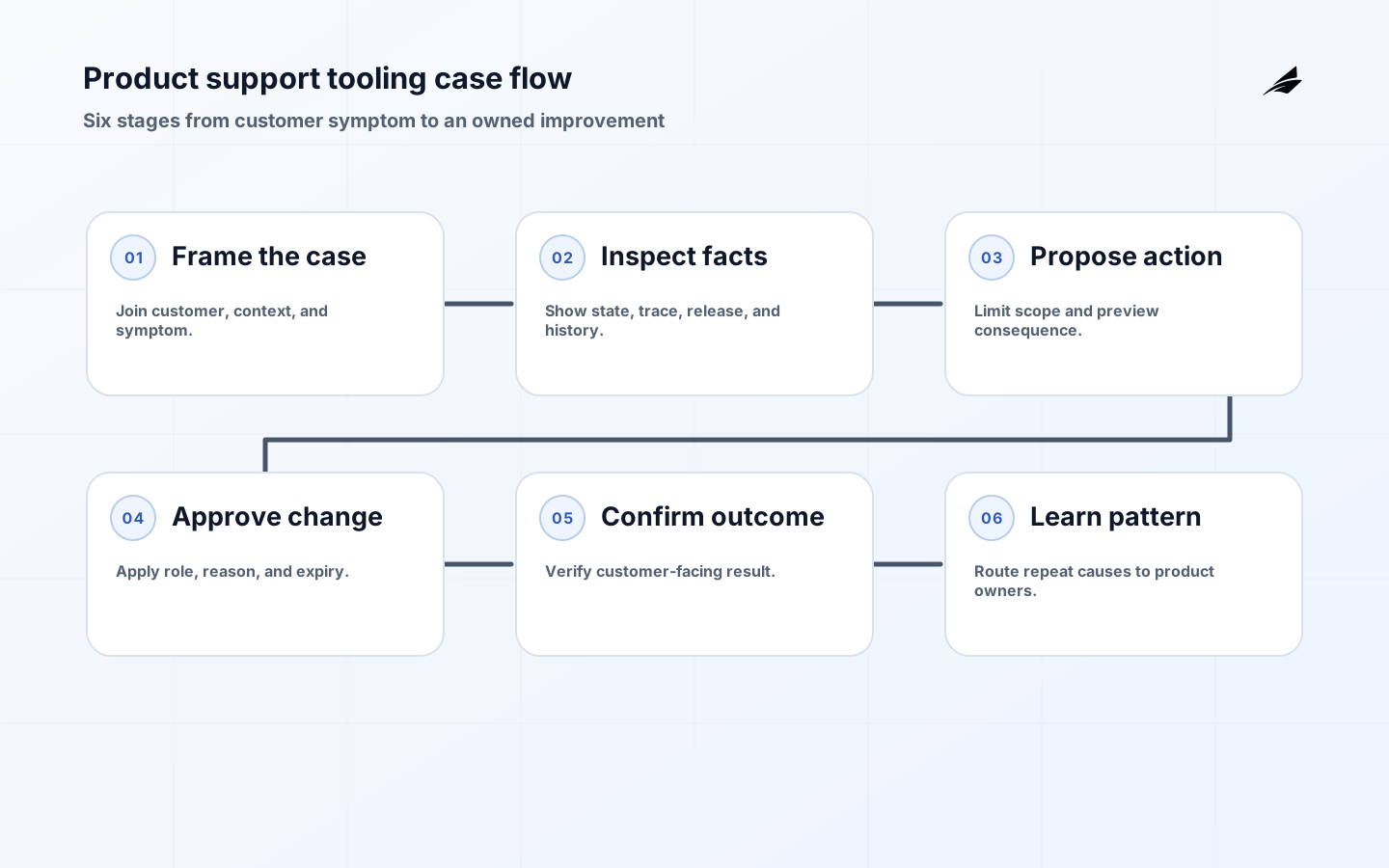
A founder does not need to fund a universal support console. The first decision is which recurring customer problem the team should be able to resolve without an engineer improvising a production change. Choose that problem, specify the evidence and allowed action, and fund the smallest workflow that can demonstrate a correct outcome. This guide produces a scope decision and an acceptance checklist for that first investment; the linked implementation guide covers how to build it.
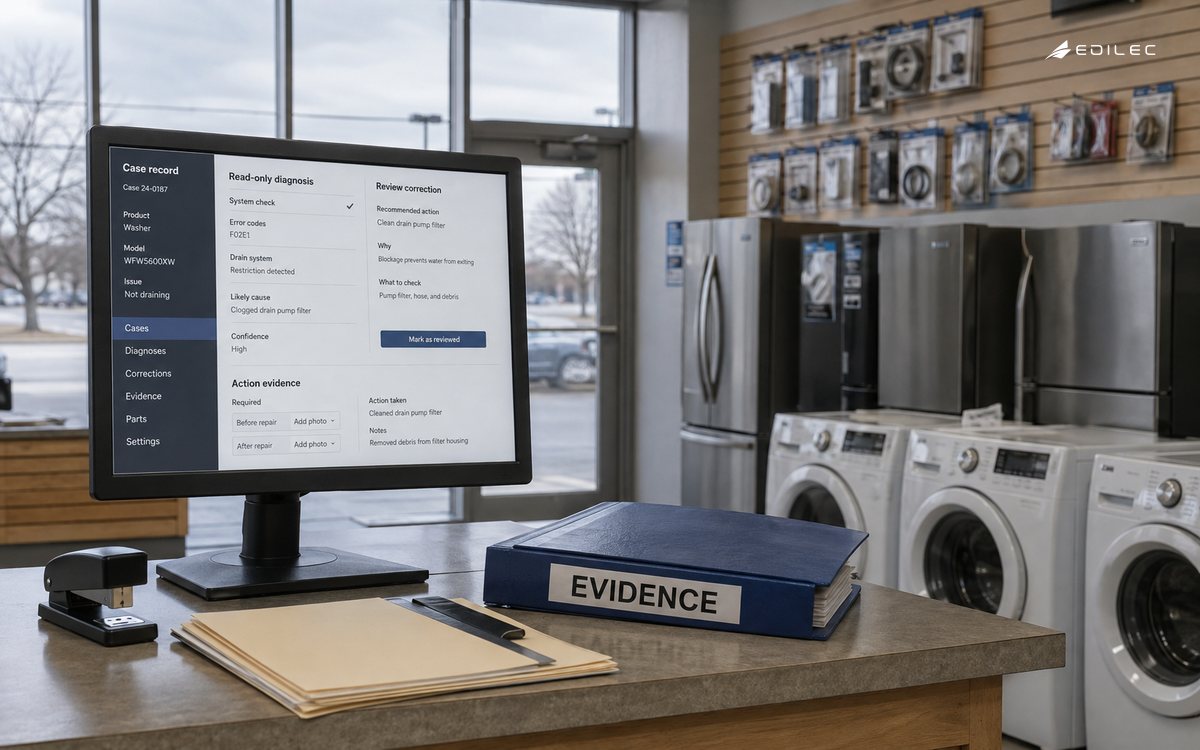
The accompanying photograph is a synthetic illustration. Its appliance case, diagnosis and repair details are fictional, not a record of Edilec customer work.
Choose the support outcome before choosing software
Review a bounded sample of recent support cases with the people who handle them. Record the customer question, the information they searched for, where a handoff occurred, and what finally resolved the problem. Separate missing information from a product defect or a commercial decision. Buying a better case queue will not repair an unreliable entitlement process; building another dashboard will not settle who can authorize a refund.
The GOV.UK user-support guidance recommends planning around enquiry types, channels, demand and performance, then using support feedback to improve the service. Apply that principle to your own case evidence. Do not borrow a handling-time target from another company and treat it as proof of what your team can deliver.
| Recurring case | First useful capability | Keep outside the first release |
|---|---|---|
| A customer cannot find a completed export | Show the job state, delivery destination and relevant event time | A general command runner for all background jobs |
| A customer reports missing product access | Compare the recorded product entitlement with the application state | An unrestricted permission or subscription editor |
| An invitation was not received | Show delivery evidence and offer an approved resend action | A bulk identity-management console |
| A customer disputes an invoice | Assemble the case and route it to the billing owner | An improvised refund decision based on a screenshot |
These are scoping examples, not a claim that every product needs those features. Choose a case with a defined owner and a result support can verify. If the proposed workflow still requires a founder to decide an undocumented policy on every ticket, define the policy before automating the action.
Decide what to buy, connect or build
Use the existing support system for case intake, conversation history and assignment when it already does those jobs adequately. Add links or a small read-only view when the bottleneck is finding product evidence. Consider a custom action only when there is a stable, repeated recovery that the product team can expose safely. A custom console also needs an owner for permissions, changing APIs, incident handling and retirement; that maintenance belongs in the funding decision.
| Option | Good reason to choose it | Evidence to request before approval |
|---|---|---|
| Configure the current helpdesk | The main problem is routing or missing case fields | An operator can complete the case and hand it to the right owner |
| Connect a read-only product view | Operators spend time reconciling scattered facts | The view names each source, its age and the correct customer scope |
| Expose one approved product action | A repeated correction has clear preconditions and an owner | A rehearsal shows authorization, a recorded result and a recovery path |
| Defer automation | Policy or source-of-truth ownership is unresolved | A documented manual route exists while the uncertainty is resolved |
Write the selected option and the rejected alternatives in the funding brief. Include the recurring case, owner, initial user group, excluded actions, maintenance responsibility and evidence required to expand. This makes a later request for broader access a new decision with visible consequences.
Specify the evidence that the operator must see
The case view should answer who is affected, which environment is involved, what the authoritative system currently says, when it was checked and what has already been tried. Show a source reference and observation time beside derived status. A case screenshot is useful context, but it should not silently replace the product record that decides access or money.
For a Stripe-backed product, Entitlements represents the features a customer can access. A support workflow should distinguish that product-access question from the customer saying that a payment succeeded. Treat the distinction as a design input: name the system that owns each fact, rather than letting the console infer a permission from a convenient billing label.
| Case field | Why it matters |
|---|---|
| Case reference and customer/workspace reference | Connect the conversation to the intended product scope |
| Environment, feature or job being investigated | Avoid confusing a test account, another workspace or an unrelated operation |
| Source record and observation time | Make stale or missing evidence visible |
| Action already attempted and its result | Avoid repeating a correction whose outcome is still unknown |
| Assigned owner and next customer update | Keep an unresolved case from becoming an unowned dashboard row |
Separate observation, correction and exceptions
Give the first release a written action policy. A read-only view, an ordinary approved correction and an exceptional intervention need different authority. OWASP’s authorization guidance supports least privilege, denial by default and permission checks on every request. Enforce those checks at the protected service action; hiding a button is not the authorization boundary.
For each correction, name the permitted role, customer scope, required evidence and condition that stops the action. Show the proposed scope and require a recorded reason before execution. Route exceptions to an accountable approver with a defined expiry when the exception is temporary. The founder’s role is to approve this operating boundary and its owner, not to grant permanent broad access whenever a ticket becomes urgent.
A repeated click or a timeout must not encourage operators to guess whether a change occurred. Ask the engineering team how an action is correlated, how a retry is distinguished from a new request, and how its result can be checked. Stripe’s idempotent-request documentation is one concrete example of an API contract for safe retries. A support console must verify the contract of the actual service it calls; adding a request identifier alone does not make every operation safe to repeat.
Worked example: a paid customer cannot use a feature
The following is a fictional design exercise, not a customer incident or a claim about observed performance. A customer reports that a paid feature is unavailable. The support workflow must resolve the discrepancy without turning a payment screenshot into an unrestricted access grant.
| Observation | Allowed next step | What closes this part of the case |
|---|---|---|
| The product entitlement includes the feature, but application access is missing | Capture the mismatch and use a documented reconciliation action if one is authorized; otherwise escalate | The product state is rechecked and the customer-visible result is recorded |
| The authoritative entitlement does not include the feature | Route the commercial question to the billing or account owner | The owner explains the decision or supplies a recorded authorized change |
| The entitlement source cannot be reached or the workspace is ambiguous | Keep the case pending and collect the missing evidence | The correct scope and source state are established before any correction |
| A reconciliation request times out | Check its recorded result before issuing another change | One known outcome is associated with the case and operation reference |
Rehearse the handoff as well as the correction. The next operator should be able to see the customer scope, observed facts, source times, decision, attempted action and unresolved question without asking the previous operator to reconstruct the story. If those fields are missing, the workflow is not ready merely because its main button works.
Measure resolution quality and decide what to fund next
Establish a baseline from the selected case type before claiming improvement. Record time spent finding evidence, time waiting for another team, total time to a verified outcome, reopened cases and cases that required an exception. Define the start and end of each measure so that a faster acknowledgement is not mistaken for a faster resolution. Do not set a target in this article’s example; choose one from your own demand, staffing and service commitments.
Review the case outcomes with support and product owners. Repeated missing evidence can justify a better integration. Repeated requests for the same correction can justify a narrow product action. Repeated confusion about the intended behavior may instead call for clearer product guidance or a product fix. The investment decision should name the failure that the next change will remove.
A funding and release checklist
- Name the recurring customer case and the outcome that counts as resolved.
- Choose configuration, a read-only integration, one controlled action, or a documented deferral.
- Assign owners for source facts, action policy, maintenance and exceptional decisions.
- Document normal handling, stale evidence, denied access and an unknown action result.
- Rehearse a shift handoff and confirm that the next operator can continue from the record.
- Agree which case evidence will justify expanding, changing or retiring the workflow.
For the implementation sequence, use the safe support-tooling checklist. For the broader case and telemetry architecture, use product support tooling for SaaS companies. This founder guide remains focused on choosing and governing the first investment.
Frequently asked questions
Should support tooling allow direct database edits?
Routine support workflows should use reviewed product actions with validation, a defined customer scope and a recorded reason. Treat a necessary emergency data repair as a separate engineering procedure with its own owner and verification, rather than a general capability in the everyday support console.
How can founders keep the first console small?
Choose one recurring case, list the evidence required to resolve it and approve only the actions that case needs. Keep unrelated administration and unresolved commercial decisions outside the first release.
What is the most useful support-tooling metric?
Use time to a verified resolution together with reopened cases and exceptional interventions. State when timing starts and what evidence closes the case; speed by itself cannot show whether the outcome was correct.
Should the company build a custom support console?
Build only the product-specific capability that an existing tool or a smaller integration cannot adequately provide. Include maintenance, authorization, changing product interfaces and incident ownership in the decision, not just the initial screen-development effort.
Approve a support outcome, not an open-ended console
A useful first investment leaves support with a clearer decision, a bounded action and a record the next person can trust. Approve that outcome and the evidence needed to expand it. Broader tooling can follow when real cases show what is still missing.