What Changes When Admin Consoles Move into Production
Admin consoles in production carry authority that an internal prototype may not reveal. An admin console can begin as an internal convenience and become a production control surface almost unnoticed. The change happens when an action can alter customer state, permissions, billing, data, service availability, or an operational record. At that point, a button is an authorization boundary, a confirmation is part of the failure model, and an audit entry is evidence rather than decoration. Production readiness means the console makes authority explicit, prevents unsafe partial changes, explains outcomes, supports recovery, and remains usable under pressure. The OWASP Authorization Cheat Sheet is a useful baseline for least privilege, deny-by-default, and server-side enforcement.
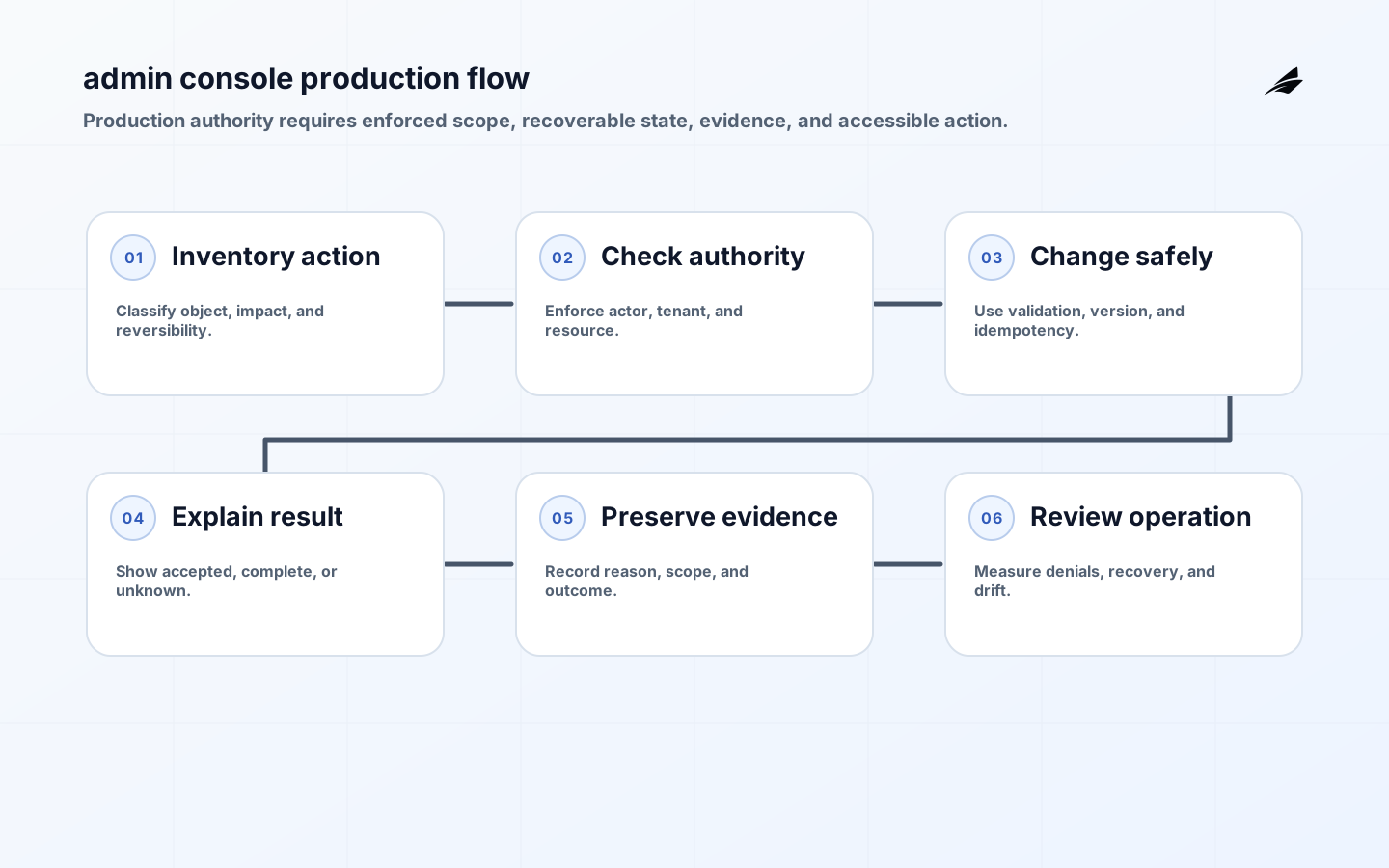
Inventory actions by consequence
List every read, search, export, impersonation, permission change, deletion, retry, refund, configuration change, and emergency override. Classify each action by affected object, reversibility, customer impact, data sensitivity, and required approver. A read-only customer lookup is not equivalent to changing a subscription or disabling an account. The inventory should name the API or service that enforces the action, the UI control that invokes it, and the evidence produced. Link to Admin Console Planning: Define Authority First when a new surface is still being scoped. Consequence, not menu location, should determine the control.
| Action class | Minimum control | Recovery question |
|---|---|---|
| Read sensitive data | Scope, purpose, masking, and access log. | Can exposure be investigated and limited? |
| Change customer state | Object check, validation, confirmation, and audit record. | Can the prior state be restored? |
| Change authority | Strong authentication, approval, and separation of duties. | Who can remove the grant? |
| Delete or disable | Explicit scope, impact preview, and tested recovery. | What is the safe rollback path? |
Enforce authorization on the server
The console should communicate authority, but the backend must enforce it on every request. Check the actor, tenant, role, target object, action, current state, and any approval or step-up requirement. Avoid trusting hidden fields, disabled buttons, URL patterns, or a role name supplied by the browser. The OWASP ASVS provides a structured way to turn security expectations into verification work. Test direct API calls, changed identifiers, stale sessions, cross-tenant objects, bulk actions, and concurrent edits. A successful UI review is not proof that the underlying resource authorization is correct.
Make state changes deliberate and recoverable
Production consoles need to handle retries, timeouts, partial completion, concurrent edits, and stale screens. Use idempotency keys for repeatable actions, optimistic concurrency or version checks for editable records, and clear result states such as accepted, completed, rejected, or needs review. Show the object scope and material impact before a high-consequence action. If a bulk operation can partially succeed, report each result and provide a safe reconciliation path. Do not make a user guess whether a timed-out request changed the record. Store the old and new state where policy permits, or link to a durable event that explains the transition.
Treat sessions and privileged access as risk
Admin sessions deserve a shorter and more explicit trust model than ordinary product browsing. Apply appropriate authentication, reauthentication or step-up for sensitive actions, idle and absolute timeouts, device or network policy where justified, and prompt revocation. NIST SP 800-207 frames access as a decision based on the user, resource, policy, and context rather than a permanent network location. Avoid broad impersonation. If support staff need to view a customer experience, use a bounded session with purpose, expiry, visible indication, and a record of the accessed scope.
| Risk | Console behavior | Test |
|---|---|---|
| Wrong tenant | Scope target on the server and show tenant context. | Change identifier and direct API request. |
| Stale record | Require version check and show conflict. | Edit same object in two sessions. |
| Bulk mistake | Preview scope, cap batch, and report per-item result. | Mixed valid and invalid records. |
| Privileged session | Use step-up, expiry, purpose, and visible state. | Timeout, revoke, and reopen test. |
Build an audit trail people can use
A production audit record should answer who acted, what they tried to do, which object and tenant were affected, when it happened, why it was permitted, what changed, and whether the action succeeded. OWASP’s Logging Cheat Sheet discusses event selection, attributes, protection, monitoring, and disposal. Do not log passwords, tokens, or unnecessary sensitive payloads. Protect audit data from unauthorized modification and make retention fit the business and legal need. Give support and incident responders a way to correlate the console action with service events, approval records, and customer-visible outcomes.
Make safe interaction accessible
A control that is hard to focus, label, read, or recover from is a production risk. Use WCAG 2.2 to guide keyboard access, visible focus, contrast, headings, labels, target size, error identification, and reauthentication behavior. Make destructive actions distinguishable without color alone. Preserve form input when validation fails, explain what changed after submission, and ensure dialogs do not trap users or hide the affected scope. Test a high-consequence workflow with keyboard-only navigation, zoom, screen-reader landmarks, slow network, and a session timeout.
Example: move a refund action into production
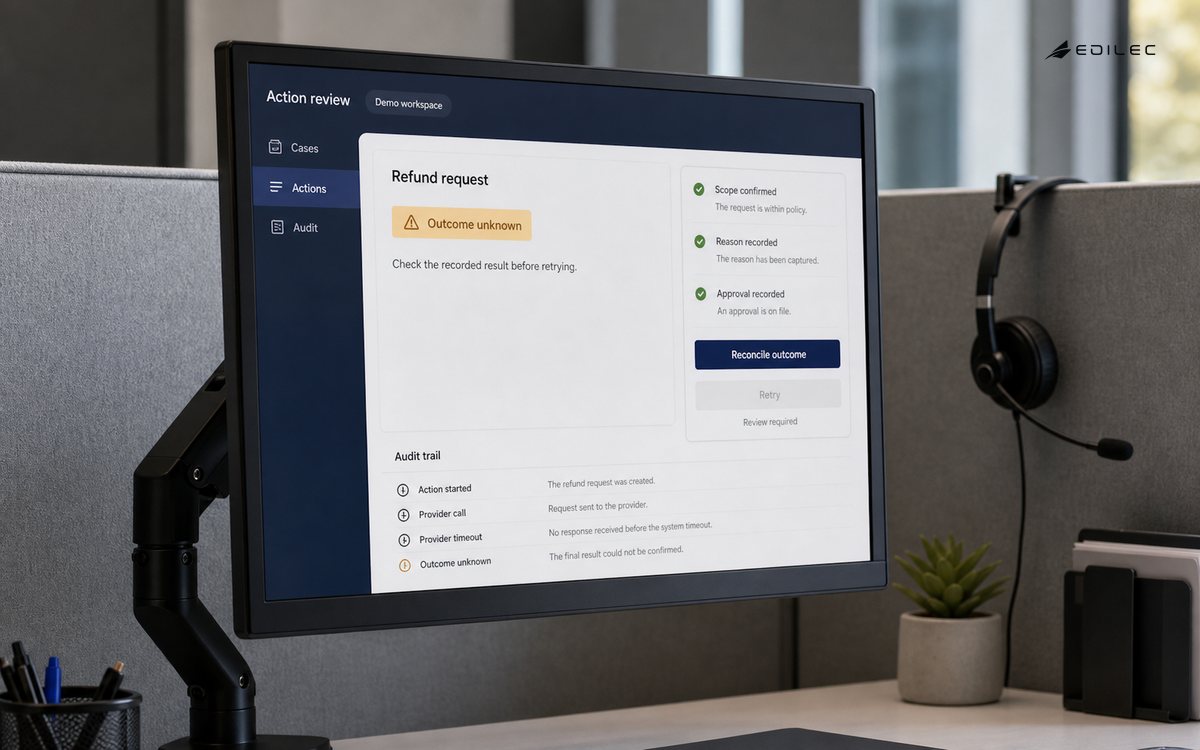
A support prototype lets an agent click Refund on an order. Production design first narrows the action to the correct tenant and order state, checks the agent’s role and refund limit, and requires a reason. The server uses an idempotency key and returns a durable result. The console previews amount, currency, customer, and downstream effect, then shows whether the request was accepted or completed. An audit entry captures actor, target, amount, reason, approval, and result without exposing payment secrets. A timeout presents an unknown state with a link to reconcile rather than inviting a second click. A test covers duplicate clicks, concurrent refund, revoked access, and partial provider failure.
Operate and review the console
Measure authorization denials, privileged sessions, failed and partial actions, bulk-operation size, reconciliation backlog, time to recovery, and unusual access patterns. Review high-consequence actions and role assignments with the owning team. Treat a rising rate of manual overrides or repeated failed confirmations as product feedback, not only user error. Version permissions, action contracts, confirmation copy, and recovery procedures. Connect deployment changes to observed behavior so an incident responder can identify when a control or policy changed. The console should make its own risk visible to the team that operates it.
Key takeaways
- Inventory actions by consequence, object, reversibility, and sensitivity.
- Enforce actor, tenant, object, action, state, and approval on the server.
- Use idempotency, version checks, scope previews, and explicit outcomes.
- Control privileged sessions with purpose, step-up, expiry, and revocation.
- Record useful, protected audit evidence that supports reconciliation.
- Test accessibility, failure, concurrency, bulk, and direct-request paths.
Frequently asked questions
Is impersonation acceptable for support?
It can be, but it should be bounded, visible, purpose-limited, time-limited, and fully recorded. Prefer a read-only or scoped support session when that solves the problem; never treat impersonation as a substitute for authorization.
What belongs in an admin audit trail?
Record actor, action, target, tenant or scope, time, reason or approval, old and new state where appropriate, and outcome. Exclude secrets and unnecessary sensitive payloads, and protect the record from tampering.
Create a production operating contract
Before release, write an action contract for every consequential console operation. Include actor and tenant scope, target resource, preconditions, validation, approval, idempotency, expected state transition, downstream dependencies, result states, audit fields, and recovery. The contract should be readable by support and testable by engineering. It should also state what the interface must never imply: a retry is not safe unless the server can prove idempotency, a hidden button is not protection, and a successful HTTP response may not mean a downstream business effect completed. This discipline makes later UI changes less likely to alter authority accidentally.
Run failure exercises with realistic roles and data. Have a support agent attempt a cross-tenant lookup, an administrator lose access during a bulk action, two operators edit the same record, and a downstream provider accept a request before the console times out. Ask whether the screen shows the correct state and whether the audit record permits reconciliation. Use admin console planning guidance to compare the production behavior with the original actor and resource model. A console is ready when its failure states guide a safe next step, not when every error becomes a red toast.
Make privileged work visible without making the console unusable. Show the active tenant, object, role, and consequence at the point of action. Use a strong confirmation for destructive or high-value changes, but do not turn confirmation into a substitute for authorization or validation. Support staff should see when they are in a bounded customer-view session and when an action requires approval. Provide a reconciliation link after asynchronous work. RBAC design for internal tools can help structure role decisions, while audit logs for SaaS platforms provides a companion perspective on evidence.
Review production behavior as part of product management. Examine denied requests, repeated retries, manual workarounds, access exceptions, and incomplete audit records. A rise in support overrides may mean the policy is wrong, the data is stale, or the interface hides a necessary context field. Put a named owner on each corrective action and record whether it changes policy, copy, API behavior, or operating procedure. When the product adds a new integration or data class, revisit the action inventory and failure model instead of assuming the existing console contract still holds.
Include a release checklist for the most dangerous console paths and run it against the deployed service, not a mock. Verify a user can see the correct tenant, that the server rejects a changed object identifier, that a stale version produces a conflict, that a retry does not duplicate the effect, and that the audit record is available without exposing secrets. Test revocation during an active session and confirm that a privileged support view expires. Then rehearse the recovery procedure with the business owner: restore a wrong state, reconcile a downstream timeout, and disable the action if a defect appears. These checks connect design intent to production behavior. The secure admin panel design guide and audit logs guide are useful companions when reviewing the control and evidence boundaries.
Make the production boundary visible in training and support documentation. An operator should know which actions are reversible, which require approval, which create an asynchronous result, and which must be escalated. Use concrete examples with the correct tenant and object scope, not generic screenshots. When an incident occurs, the team should be able to disable one action or role without taking down all read access. That granularity is a product design choice made before production, not a privilege the team can assume will appear later.
Treat release rollback as a control, not only a deployment operation. If a new action, policy, or confirmation path behaves unexpectedly, the team should be able to disable that capability, preserve evidence, and keep safe read access available. State who can trigger the disablement, what customers or operators will see, how pending work is reconciled, and when the action may return. This makes a production console resilient to both software defects and policy mistakes. A well-designed fallback lowers the pressure to keep a dangerous control live while the team investigates.
Conclusion: production is a higher authority contract
An admin console enters production when its controls can change real outcomes. Make authority explicit, enforce it at the resource, design state transitions for retries and recovery, preserve useful evidence, and test the workflow under imperfect conditions. The result is a safer operational product that helps authorized teams act without making accountability invisible.