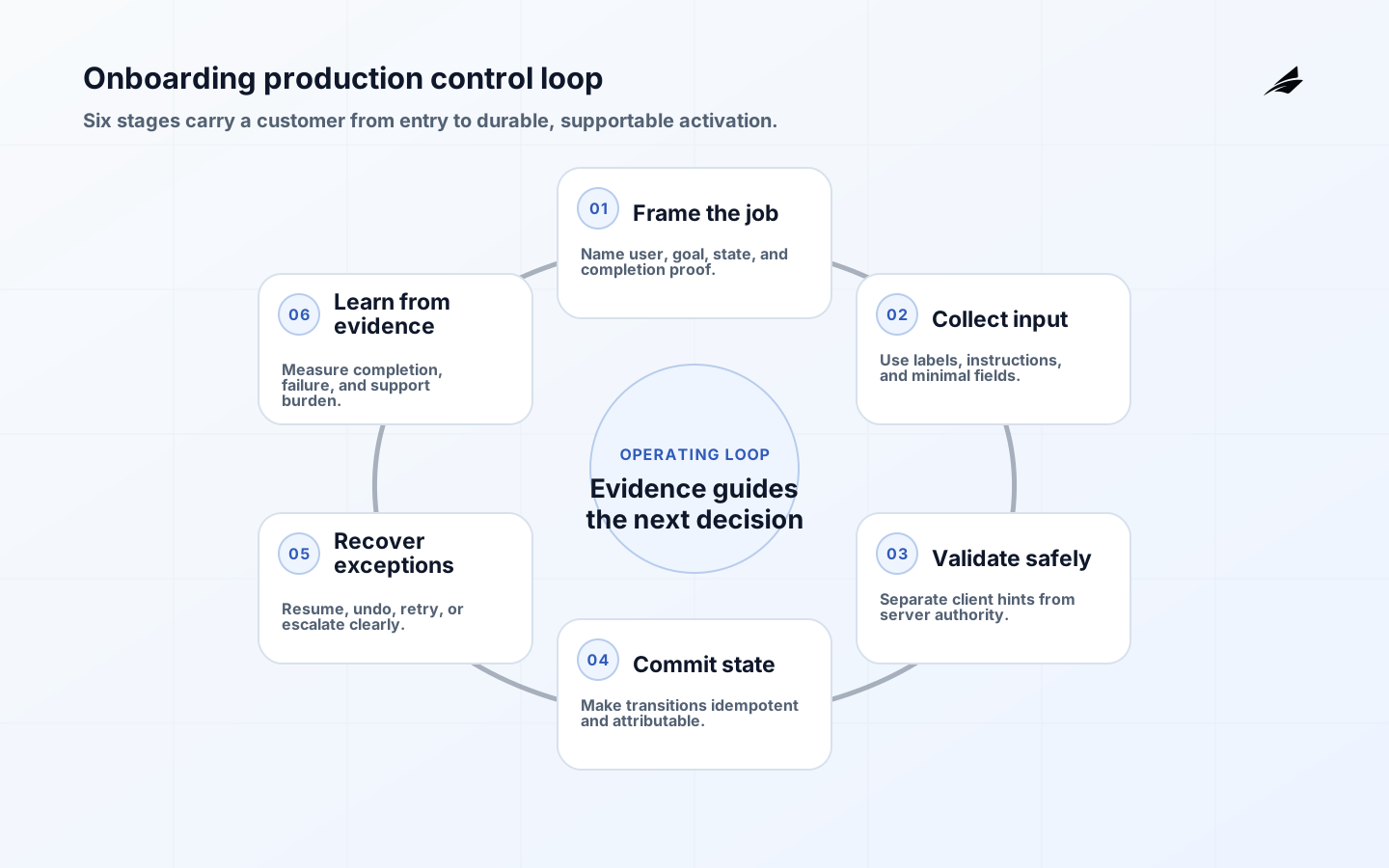
An onboarding flow can look finished when a new user reaches a welcome screen and a database row appears. Production changes the standard. Real users arrive with incomplete information, different devices, assistive technology, duplicate invitations, expired links, uncertain permissions, and reasons to leave halfway through. Multiple requests may retry, browsers may close, identity providers may respond slowly, and support may need to reconstruct what happened without asking the customer to repeat the entire story. WAI’s forms guidance treats labels, instructions, validation, notifications, and logical multi-page progress as part of the form itself. That is the right production mindset: onboarding is a stateful service with an accessible interface, a trustworthy server boundary, a recovery model, and an accountable owner.
Define what completion means in production
Write the onboarding outcome as a concrete business state. “User signed up” may mean an account exists, an email is verified, a workspace has an owner, a required role is assigned, a first project is created, or a regulated check is complete. Put the state, actor, evidence, and next permitted action in the definition. A progress bar is not proof of completion; a persisted transition with an audit reference may be. Decide which steps are optional, which may be resumed, and which require support or review. This makes the flow easier to test and stops product analytics from declaring success when the user cannot perform the job they came to do.
| State | Meaning | Evidence | Allowed next step |
|---|---|---|---|
| Started | User has initiated onboarding | Account or invitation ID and time | Collect only required context |
| Verified | Required identity or contact check passed | Provider result and audit event | Create or join scoped workspace |
| Configured | Minimum setup is complete | Configuration version and actor | Show first useful task |
| Activated | User completed the first valuable job | Domain record and outcome | Continue or invite others |
| Blocked | Progress cannot safely continue | Reason, owner, recovery path | Retry, correct, or escalate |
Design the input experience for real users
Ask only for information needed for the next decision, and explain why a sensitive field is required. Associate every control with a visible label, provide instructions before an error occurs, identify required fields without relying only on colour, and preserve entered values when validation fails. WAI recommends clear notifications and logical stages for multi-page forms; apply that advice to both visual and programmatic structure. Keep the browser experience helpful, but treat it as a hint layer. The server must validate type, length, format, authorization, uniqueness, and business rules again. Avoid making a user re-enter safe information because one later field was wrong. A resilient onboarding flow makes correction less costly than abandonment.
Make state changes safe to retry
Production requests are repeated. A mobile connection can drop after the server commits, the user can click twice, or a reverse proxy can retry a request. Assign an idempotency key or durable operation identity to state-changing steps, and make the server return the existing result when the same operation is received again. Do not use a client-generated progress flag as the source of truth. RFC 9110 distinguishes method semantics and describes when a request can be considered idempotent; use that vocabulary when deciding whether a retry is safe. For non-idempotent effects, create an explicit pending state and reconcile with the authoritative record before offering another action.
| Failure | Unsafe experience | Production design |
|---|---|---|
| Double click | Two workspaces or invitations | Operation identity and unique constraint |
| Network drop after commit | User assumes nothing happened | Query authoritative state and show outcome |
| Expired invitation | Generic error and dead end | Explain expiry and offer governed recovery |
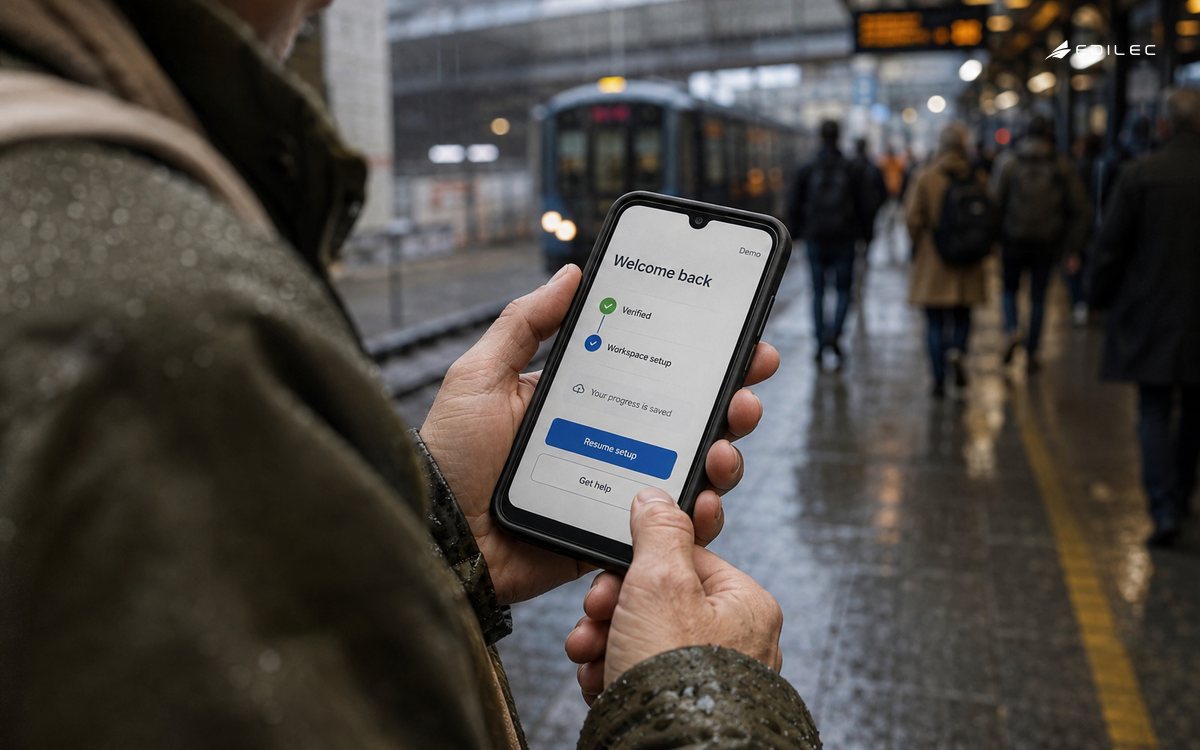
| Partial setup | Progress resets to zero | Persist stage, version, and resume path |
| Permission change | Old screen still succeeds | Server reauthorizes the current action |
Protect access and tenant data
Onboarding often creates the first account, workspace, role, or invitation, so it is a security boundary. Authorize the action on the server using the current user, tenant, resource, and state. Do not trust a workspace ID supplied by the browser or assume that a hidden button is a permission check. Validate invitation ownership, prevent cross-tenant references, protect tokens, expire links, and log high-value changes. OWASP ASVS remains useful as a verification lens because it asks teams to test authentication, session, access control, validation, and error handling rather than accepting a happy path. Keep sensitive fields out of analytics and support exports unless the purpose is explicit. Recovery should restore legitimate access without creating a shortcut around the same controls.
Design the operating routine
Give each exception a state and owner: detected, waiting for user, waiting for provider, blocked by policy, retriable, escalated, resolved, or abandoned. Support should be able to find the onboarding operation, current stage, last successful transition, error class, safe next action, and relevant correlation ID without viewing secrets. Instrument the journey with stable event names and context such as tenant, stage, outcome, client version, and latency. OpenTelemetry semantic conventions encourage consistent naming and attributes so teams can compare events across services. Use the onboarding decisions before the first build as a companion when a production incident reveals that the original state model was too vague.
Test real journeys, not only the demo path
Test keyboard and screen-reader navigation, small screens, slow networks, refreshes, back navigation, expired sessions, duplicate submissions, provider latency, invalid input, revoked invitations, tenant boundary attempts, and partial completion. Test the flow after a deployment changes the schema or permission model. Include support and customer-success people in scenario reviews because they know which “rare” cases become daily work. Capture the evidence that lets a reviewer tell whether the defect was in the interface, validation, authorization, persistence, or a dependency. A production-ready flow is not one with no errors; it is one where errors are understandable, bounded, recoverable, and measurable.
Measure value and operating burden
Track completion by stage, time to first useful outcome, abandonment reason, validation correction rate, invitation acceptance, duplicate operation rate, provider error rate, support contacts, and recovery success. Segment these measures by client, role, tenant size, and entry path so an average does not hide a broken experience for a meaningful group. Do not optimize completion by removing a control that protects access or data. Review whether users reach the promised job after onboarding and whether support can resolve failures without engineering intervention. The onboarding flows field guide is useful for connecting journey metrics to the team’s operating model.
A practical production rollout
- Define the durable states, actors, evidence, and next actions for the flow.
- Use accessible labels, instructions, progress, and error recovery for every stage.
- Validate input, authorization, tenant scope, and uniqueness on the server.
- Make state-changing operations safe to retry and observable across service boundaries.
- Test interruption, partial completion, provider failure, identity change, and support recovery.
- Expand traffic only when completion quality and exception ownership are visible.
Run a production decision review
Make the review concrete with representative records. Select a user who completes onboarding normally, one who leaves after a partial save, one whose invitation expires, and one whose permission changes while the browser is open. Compare the customer-facing state with the server record, event trail, notification, and support view. Check that a retry returns the existing result instead of creating a second workspace, invitation, or integration. Check that a denial explains enough to recover without revealing another tenant’s data. The onboarding decisions before the first build gives the team a useful reference for judging whether the production path still reflects the original first-value and identity decisions. Record which evidence proves completion and which evidence only proves an attempt.
Before widening an onboarding flow, review one normal journey and one interrupted journey with product, engineering, support, security, and a user-facing team. Ask the operator to show the durable state, the support owner to find the operation, and engineering to demonstrate the retry and authorization result. Check whether the interface, API, database, event stream, and email or notification agree. If they do not, decide which record is authoritative and how the user will be told. The onboarding field guide for growing teams helps connect this review to the role, support, and release layers that emerge as the product grows. Capture the smallest correction and its expected effect rather than adding another generic step.
Keep a short evidence record for each release: flow and schema version, roles tested, accessibility checks, interruption cases, duplicate-operation result, authorization result, support route, and unresolved risk. Revisit it after a meaningful change to identity, tenant model, dependency, or billing. A new user should be able to resume without guessing, and a new support owner should be able to explain why a request is waiting, blocked, or complete. When the same exception repeats, promote it into product work with an owner and measure whether the change reduces correction time and abandonment. That is how onboarding becomes a dependable service instead of a launch sequence that only the original builder understands.
Key takeaways
Use the release record to connect journey evidence to decisions. Record the tested roles, client versions, dependency outcomes, authorization results, accessible error states, support route, and unresolved recovery work. Revisit that record after changes to account creation, invitations, integrations, or billing. Ask a support owner to find a blocked request, an engineer to demonstrate a safe retry, and a product owner to explain what completion means. Compare the customer-facing message with the durable state and event trail. When the same exception returns, promote it to product work with an owner and a measure. This keeps onboarding understandable for future support after launch rather than preserving a demo path that only the original builder can explain.
Keep the result of the review in the release record, including tested roles, client versions, dependency outcomes, authorization decisions, accessible error states, and unresolved recovery work. Re-run it after changes to account creation, invitations, integrations, or billing. A user should not need to know which service failed in order to recover, but support should be able to find that fact and route it. The onboarding field guide ties this evidence to a growing team’s review rhythm.
When onboarding leads into a trial, keep the activation state distinct from the billing state. A user may complete the first job without being ready to pay, and a paid account may still need support to reach value. The trial conversion guide is a useful companion for keeping those states and messages honest.
The WAI Forms Tutorial grounds accessible labels and correction; RFC 9110 informs safe request and retry semantics; OpenTelemetry semantic conventions support consistent event context; and OWASP ASVS provides verification areas for validation, sessions, and authorization.
- Production onboarding is a stateful service, not a sequence of screens.
- Accessible input and clear correction reduce both user friction and support cost.
- The server owns validation, authorization, tenant boundaries, and durable state.
- Retries, partial completion, and recovery need explicit operation identities.
- Measure first useful value and exception burden, not only form completion.
Frequently asked questions
Should onboarding users be forced through every step?
Only when a step is required for the next safe or valuable action. Let users defer optional setup, but show the consequence and provide a reliable resume path. Mandatory steps should have a clear reason and accessible recovery.
What should the API return after a retry?
Return the authoritative result for the operation identity, including whether the transition completed, is pending, or failed with a recoverable reason. Avoid creating a second effect because the client did not receive the first response.
Which onboarding events should we track?
Track meaningful state transitions and outcomes with stage, actor or tenant scope, version, time, and reason. Avoid collecting sensitive field values simply because they are available. Each event should answer a product, support, or reliability question.
Conclusion
When onboarding flows move into production, the work shifts from arranging screens to managing state, trust, accessibility, retries, and recovery. Define completion precisely, make the server authoritative, preserve evidence, and test the journeys people actually take. The result is an onboarding service that earns activation rather than merely recording registration.