Subscription Access Control for Growing SaaS Teams
As a SaaS team grows, subscription access control moves from a few plan checks into a system that staff and customers depend on. It must handle upgrades, downgrades, usage, failed payment, renewal, multiple workspaces, member roles, support exceptions, and product releases. A field guide should make those relationships usable for operations leaders: what state exists, who owns it, how quickly it changes, what a customer sees, and how to recover when billing information is delayed or wrong. Stripe subscription documentation and Stripe Entitlements provide primary references for billing objects and capability mapping, but the product's entitlement and authorization model must remain explicit.
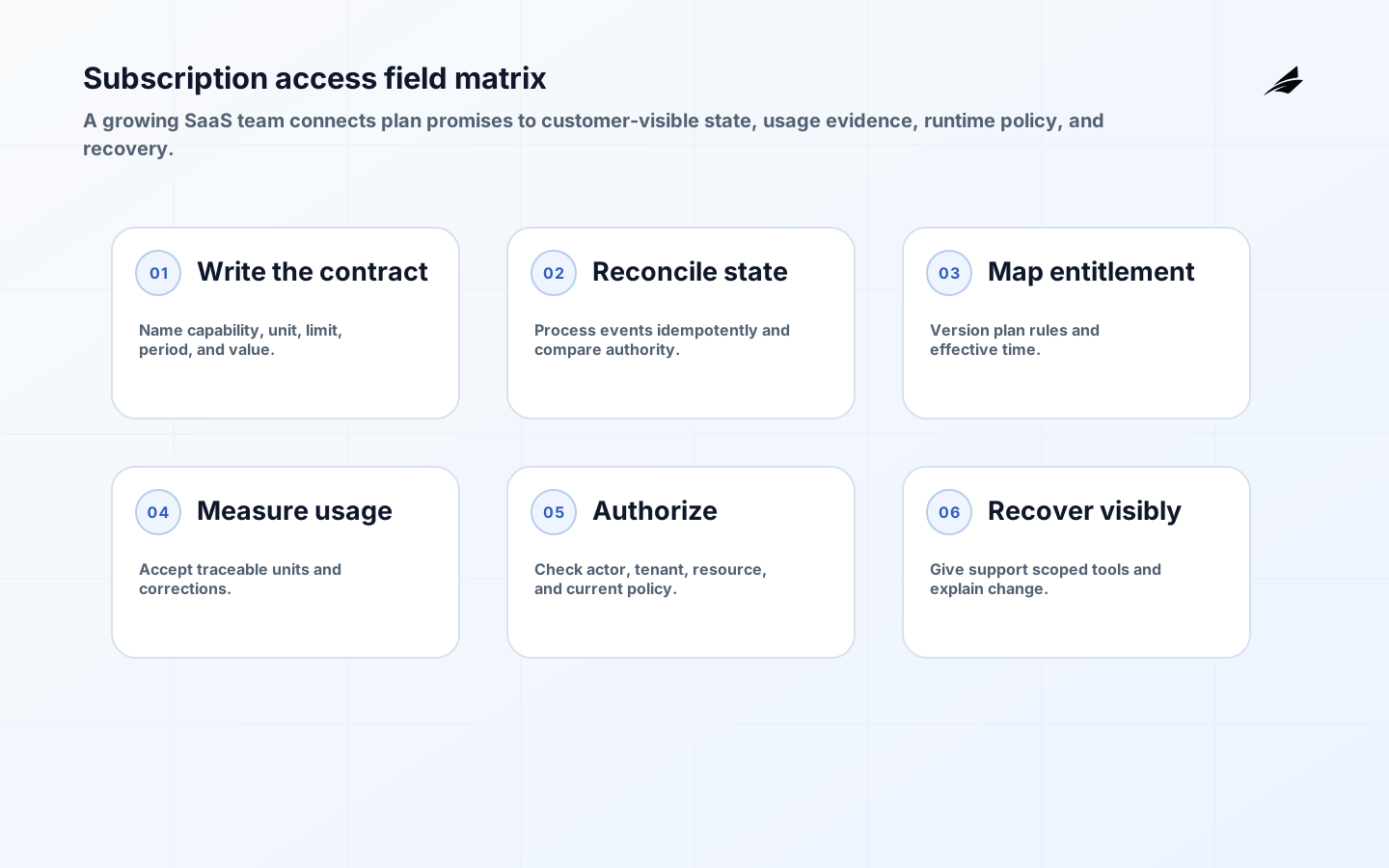
Write the access contract
For every paid capability, name the tenant or workspace that owns it, the member roles that can use it, the usage unit, the limit, the period, the effective time, and the behavior at the boundary. State the customer value in plain language. “Priority support” may be a response target, not a button. “Unlimited projects” may still depend on storage or fair-use rules. The Atlassian project management guide is a useful reminder to start from an outcome and user, not a technical flag. A contract that cannot be explained will be hard to support and harder to reconcile.
Keep the state layers separate
Billing status, entitlement, membership, usage, and authorization answer different questions. Billing says what commercial relationship exists. Entitlement says what the tenant's plan includes. Membership says whether a person belongs and with which role. Usage says how much of a metered unit has been consumed. Authorization says whether this actor may perform this action against this resource now. Keeping the layers separate allows a grace period or support review without losing history or granting every member the same authority.
| State layer | Operational question | Owner or evidence |
|---|---|---|
| Subscription | What plan, term, and payment state applies? | Provider record and effective event. |
| Entitlement | Which capabilities and limits are active? | Versioned mapping and source. |
| Membership | Which person or workload may participate? | Role, scope, and history. |
| Usage | What units have been accepted in the period? | Meter event and correction ledger. |
| Access | May this actor perform this action now? | Policy result, resource, and reason. |
Reconcile delayed commercial state
Provider webhooks can be delayed, duplicated, or delivered in an order that differs from the user's expectation. Process them idempotently, preserve event identity, and distinguish received, applied, rejected, and reconciled. Schedule a comparison with provider state for important records. Define the effect of a pending payment, failed retry, cancellation at period end, immediate downgrade, and renewal. A stale entitlement cache should have an explicit response. Do not solve every mismatch by granting permanent access; use a bounded grace policy and a route for correction.
- Every provider event has a stable identity and an idempotent processing result.
- Subscription and entitlement changes include effective time and policy version.
- Usage events identify unit, tenant, period, source, and correction behavior.
- Access checks run at protected services and include actor and resource scope.
- Customer messaging reflects pending, active, grace, restricted, and cancelled states.
- Support exceptions have approval, scope, expiry, and an automatic review path.
Make access decisions current and explainable
A runtime access decision should evaluate actor, tenant, member role, capability, resource, entitlement state, usage state, and any current safety or policy condition. Return a safe reason and, where possible, a next action such as upgrade, wait for reconciliation, request approval, or contact support. Never rely on a hidden front-end flag for enforcement. AWS SaaS tenant-isolation guidance provides useful SaaS operations context; the practical test is whether a support owner can reproduce why access was allowed or denied after the customer leaves the screen.

| Customer event | Good operating behavior | Evidence |
|---|---|---|
| Upgrade | New capability activates at a stated effective time. | Plan event, entitlement version, and access check. |
| Downgrade | Features and data are handled according to a published rule. | Affected resources and customer notice. |
| Payment failure | Grace or restriction follows contract without data loss. | State transition and recovery attempts. |
| Usage limit | Warn, cap, overage, or approval follows the plan. | Meter total, unit, and decision reason. |
| Support exception | Temporary access is narrow and visible. | Approver, scope, expiry, and outcome. |
Operate usage as a ledger
Counters are convenient but difficult to explain after retries, corrections, late events, or a change of plan. Define a meter contract and retain accepted events or a sufficient ledger. Use idempotency keys and record the source, period, unit, and acceptance result. Keep current usage separate from a corrected historical statement when the commercial policy requires it. A customer should be able to see why the meter changed. An operations team should be able to replay or reconcile it without silently rewriting the past.
Instrument the access journey
Use controlled telemetry for webhook lag, stale entitlement, incorrect allow or deny reports, usage correction, support overrides, upgrade activation, restriction recovery, and reconciliation mismatch. OpenTelemetry Metrics Specification offers useful conventions for correlating events across services. Keep payment secrets and sensitive content out of traces. Add dimensions only when they support an action, such as plan family, tenant cohort, capability, or provider state. An access-control dashboard should help staff answer “what changed, for whom, and what should we do?”
Release policy changes by cohort
A plan or entitlement change can affect thousands of tenants, so release it as a controlled product change. Run the new policy in shadow mode, compare decisions, inspect outliers, and test affected workflows. Use tenant or plan cohorts with a visible flag and a stop condition. Vercel deployment documentation gives deployment context, while the product needs its own evidence: which capabilities changed, which tenants saw them, what support messages are ready, and how to restore the previous decision if the mapping is wrong.
Example: seats, storage, and reports
Consider a team plan with 20 seats, 500 GB of storage, and 1,000 report runs per month. The tenant owns the entitlement, an administrator manages membership, and a viewer may run reports only if the role and capability allow it. A seat becomes consumed when a member is active under the contract's definition, not merely when an invitation is sent. Storage is measured from accepted objects and has a deletion or retention rule. Report runs are accepted with idempotency, and the product warns before the limit. A failed renewal creates a grace state with clear messaging; it does not erase the tenant's reports.
Give operations safe recovery tools
Support should be able to inspect current plan, entitlement version, membership, usage, last provider event, and reconciliation status without changing them. A correction tool should require a reason, scope, approval where appropriate, and a visible before-and-after record. Prefer a replay or reconciliation action over editing a counter. If a customer needs temporary access, make the override expire and create a follow-up. Operations leaders should review override age, frequency, and outcome; a growing exception queue signals a product or commercial policy problem.
Prepare for failure and dispute
Rehearse provider outage, duplicate event, out-of-order event, wrong plan mapping, usage dispute, member removal, stale cache, partial migration, and support override expiry. Decide whether to preserve current access, enter a grace state, or restrict a particular action. Keep customer communication aligned with the state shown in the product. A recovery record should identify the original event, applied decision, correction, affected scope, and prevention work. The goal is not to avoid every mismatch; it is to prevent an ambiguous mismatch from becoming a silent customer incident.
- Customers can see plan, relevant entitlements, usage, limits, and next actions.
- Support can explain a decision without editing production records or reading unnecessary secrets.
- Meter retries and provider events cannot silently double-count or double-apply.
- Downgrade, cancellation, grace, and recovery behavior are documented and tested.
- Access changes are server-enforced and visible in an audit or decision record.
- Overrides have an owner, expiry, review, and path to remove the underlying need.
Measure commercial state as a product experience
Track upgrade activation time, downgrade completion, payment-event lag, entitlement freshness, usage correction rate, incorrect access reports, support override age, restriction recovery time, and disputed meter events. Pair these with trial conversion, feature adoption, failed workflow, support effort, and churn. Review the worst tenant cohort rather than only the average. A technically correct restriction can still be a poor experience if the message lacks a next action. Measures should lead to a decision about policy, architecture, instrumentation, pricing, or support.
Subscription operations principles to retain
- Make plan capabilities and limits understandable before turning them into policy code.
- Keep subscription, entitlement, membership, usage, and access as separate but reconciled layers.
- Process provider events idempotently and retain enough evidence to explain corrections.
- Enforce decisions at services with current actor, tenant, resource, and usage context.
- Give support diagnostic and temporary correction tools with expiry and audit.
- Measure customer impact and recovery alongside technical event health.
Subscription access control field guide FAQ
What should be the source of truth?
Use the provider for its billing objects and your product for entitlement mapping, membership, usage, and authorization. Define reconciliation for every boundary rather than choosing one system for every question.
How can usage be made disputable but controlled?
Publish the unit and period, preserve accepted event evidence, make retries idempotent, and provide a correction process that records the reason and impact without deleting history.
What should an operations review cover?
Review stale state, failed or duplicate events, incorrect decisions, override age, customer messaging, recovery time, and whether the commercial policy still matches the product behavior.
Conclusion: make access a recoverable promise
Subscription operations work best when billing events, entitlements, membership, usage, and authorization can each be inspected without losing their relationships. Give staff a bounded correction path and give customers a message that matches the actual state. The product support tooling field guide, in-app guidance field guide, and pricing gates checklist extend the operating view. The strongest control is a recoverable promise: access is enforced consistently, exceptions expire, and every correction leaves a useful record.