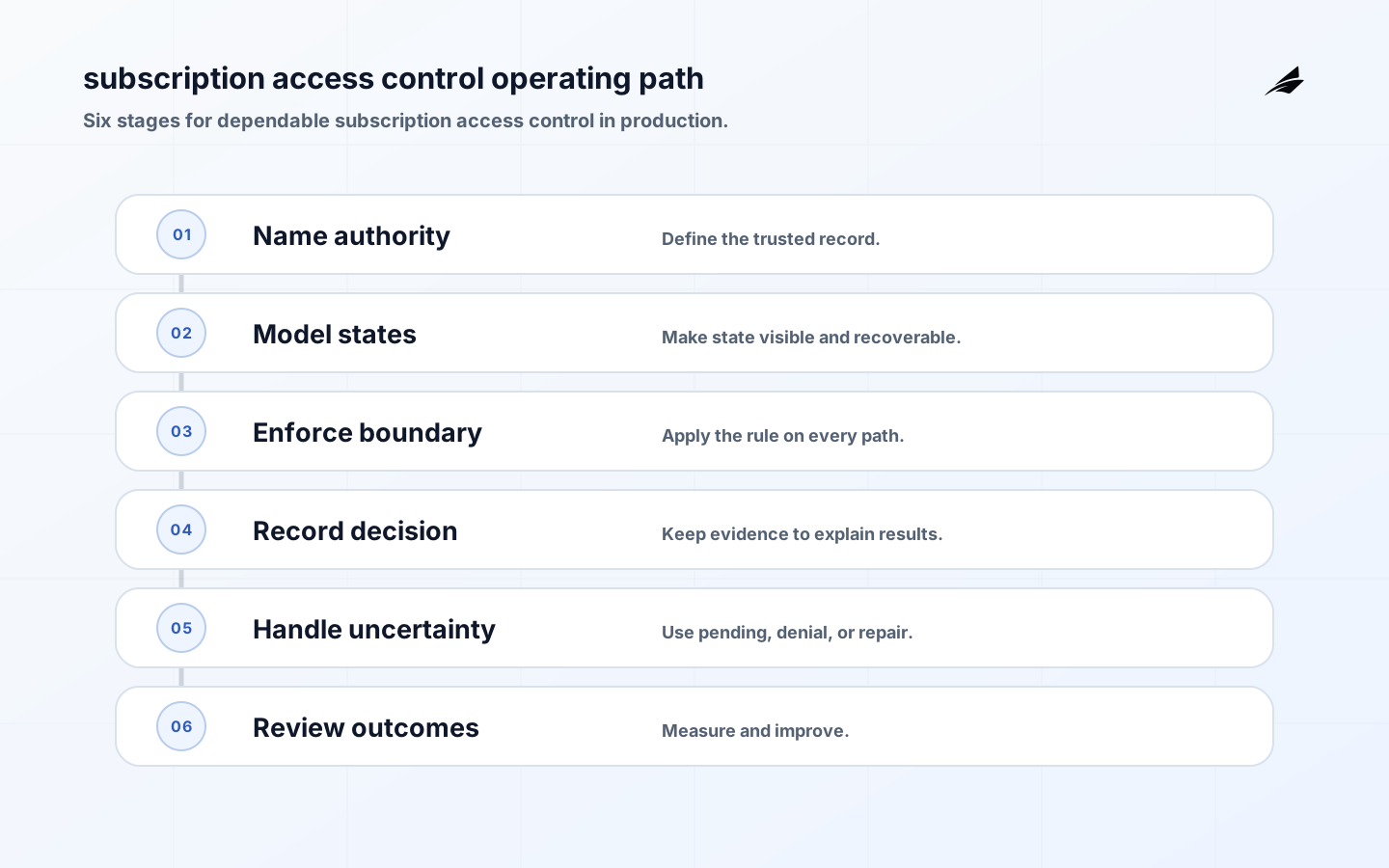
Moving subscription access control into production changes the problem from checking a plan name to protecting a live commercial relationship. A customer may be entitled through a paid subscription, a trial, an approved grace period, or a contract with an unusual billing arrangement. Those states can change while a request is in flight. Production access control therefore needs a trusted source, explicit transitions, and a response that remains understandable when billing, identity, application data, and support intervention disagree. The goal is not merely to deny an old account. It is to grant the right capability, to the right tenant and user, for the right period, with a record of how the decision was reached.
Review subscription access before release
Subscription access is ready for production only when commercial intent and application authorization resolve to the same tenant state. Review the evidence below before enabling a new plan, migration, or revocation path.
| Control point | Evidence to inspect | Release decision |
|---|---|---|
| Entitlement source | Plan, account, tenant, effective date, and the record that authorizes access. | Confirm one authoritative entitlement and an owner for corrections. |
| Activation path | Payment or contract result, provisioning event, policy evaluation, and user-visible state. | Release only when repeated and delayed events produce the same access result. |
| Billing disagreement | Invoice state, grace rule, support action, exception approval, and customer notice. | Route disputed cases without silently granting or removing consequential access. |
| Revocation and recovery | Expiry or cancellation event, session handling, retained data, and restoration path. | Verify revocation timing and a controlled way to correct an erroneous change. |
Key takeaways
- Make billing state and product entitlement different, but connected concepts.
- Choose one authoritative decision point and treat browser claims as hints.
- Design for delayed webhooks, duplicate events, reversals, and missing facts.
- Apply the same entitlement check to pages, APIs, jobs, exports, and support actions.
- Give customers a useful next step when access is pending, limited, or removed.
- Keep a traceable record of policy version, source event, actor, scope, and result.
Separate billing state from entitlement state
A payment provider can tell you about an invoice or subscription, but it does not automatically define every capability in your product. Model the translation explicitly. A subscription may be active while an add-on is absent, or an invoice may be late while a documented grace rule keeps a core workflow available. Record the plan, feature set, tenant, effective time, and source of the entitlement. Avoid deriving permission from a label displayed in the client or from a single cached payment response.
| Input state | Entitlement question | Customer-facing result | Operator evidence |
|---|---|---|---|
| Active subscription | Which product capabilities and seats are covered? | Allow the contracted scope. | Plan, tenant, effective time, policy version. |
| Trial or grace period | What is temporary, and when does it end? | Allow the stated scope with a clear date. | Eligibility rule and expiry. |
| Past due or disputed | Which restrictions apply, and who can restore access? | Explain the limit and provide a safe action. | Billing event, transition reason, owner. |
| Canceled or missing record | Is there another valid contract or pending update? | Deny or hold according to a documented rule. | Lookup result, timestamp, correlation id. |
Put authority at a trusted boundary
The server or a trusted worker should resolve the final entitlement. The browser may hide unavailable controls for clarity, but it must not be allowed to decide whether an API request succeeds. Define the subject, tenant, resource, action, subscription context, and policy version before the decision is made. The OWASP Authorization Cheat Sheet is useful here because it frames authorization as a deliberate server-side responsibility rather than a collection of interface conditions. The NIST Secure Software Development Framework also provides a useful reference for integrating security decisions into development and operations.
Make transitions replay-safe
Payment events arrive late, twice, and sometimes out of order. Persist the provider event identifier, received time, source version, and resulting state before downstream work relies on it. An update for a canceled subscription should not be able to overwrite a newer reactivation simply because a queue delivered it later. Use idempotent handlers, a defined ordering rule, and a reconciliation path for events that cannot be interpreted safely. Store effective time separately from processing time so an operator can explain what the customer was entitled to when a request occurred.
Enforce entitlements across the product
A production entitlement is a system property, not a route-level decoration. Check it at the API boundary, in background jobs, before generating exports, and inside administrative workflows. A scheduled report can leak a restricted feature just as surely as an interactive endpoint can. Pass tenant and user context deliberately, and ensure a worker cannot inherit the last request's scope. Return stable outcomes such as allowed, denied, pending, or review-required, with a customer-safe explanation and an internal reason code.
Design a humane recovery path
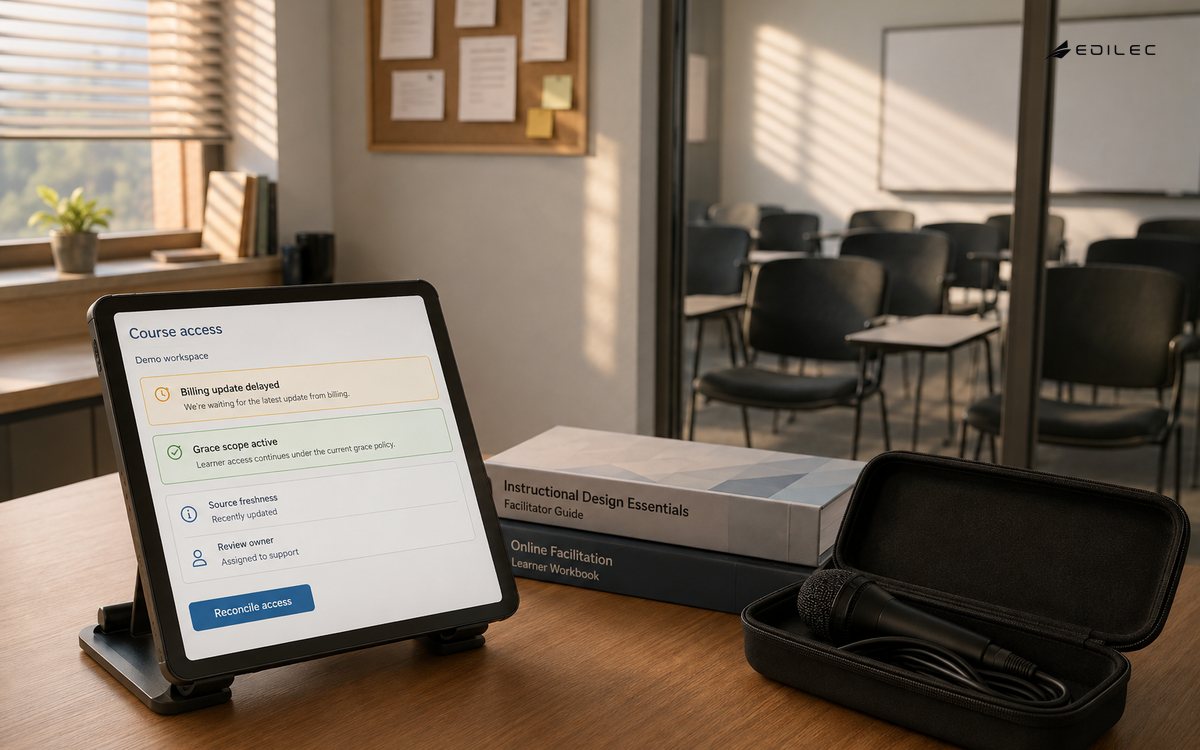
An access decision can be technically correct and still create an avoidable support incident. Tell the customer whether the account is waiting for a billing update, missing an administrator action, or outside the current contract. Provide one safe next step, such as retrying a status refresh after a delay or contacting an account owner. Support tools should allow a narrowly scoped, expiring intervention with a reason and approval where the impact is material. The intervention must not rewrite payment history or conceal the original denial.
Observe decisions without collecting secrets
Record the decision inputs that explain an entitlement without storing payment secrets or unnecessary personal data. Useful fields include tenant identifier, subject identifier, capability, source event, policy version, result, reason code, effective time, and correlation identifier. The OWASP Logging Cheat Sheet offers practical guidance on making records useful while protecting them. OpenTelemetry documentation can help connect a customer request, entitlement lookup, queue consumer, and final response across service boundaries.
Give support a bounded decision contract
Support needs more than a current plan label. It needs to see the source event, effective entitlement, last transition, pending work, and permitted repair. Show whether the account is waiting for a provider callback, a local reconciliation job, an administrator action, or a policy review. A clear panel can prevent an agent from granting access simply because a customer is persuasive or because a stale screen looks wrong. It can also expose a legitimate mismatch between the contract and the product so the issue reaches the right owner.
Keep temporary interventions narrow. Specify the capability, tenant, users or seats affected, start time, expiry, approver, and reason. Make the intervention visible to the authorization service and to the customer-facing explanation where appropriate. When the source of truth catches up, reconcile the temporary state instead of leaving two competing grants behind. This approach protects the account from an accidental permanent exception and gives finance, support, and engineering the same account of what happened.
- Display source freshness beside the effective entitlement.
- Distinguish an account correction from a commercial contract change.
- Expire emergency access automatically and notify its owner before expiry.
- Require a reconciliation result after a provider correction.
Test the failures that change trust
Test a subscription that expires during a request, a role removed while a job runs, a provider timeout, an event replay, a tenant with several subscriptions, and a customer returning after a correction. Decide in advance whether unknown state means deny, hold, or retain a limited capability. Verify that a cache cannot outlive the rule it represents, and that a manual repair is visible in the same evidence stream as an automated change. A healthy average can hide a serious problem for one plan, region, or account class, so inspect representative cases as well as aggregate signals.
Control policy changes deliberately
Entitlement rules change when plans are renamed, products are bundled, or a commercial team introduces a new exception. Treat a policy change as a versioned decision with an effective time, migration plan, and owner. Compare the old and new outcomes for representative accounts before activation, including accounts in grace, accounts with multiple subscriptions, and accounts with a temporary support grant. Decide whether historical decisions should remain explainable under the old policy or be recalculated under the new one.
Roll out a policy change with a way to compare decisions without changing the customer result unexpectedly. Sample differences, investigate unexpected denials and grants, and keep a disable path that does not erase the records created by the new version. Update support guidance at the same time as the rule so the people handling questions can explain the transition. A controlled policy change makes commercial evolution compatible with dependable access.
Frequently asked questions
Should the payment provider be the authorization service?
It should be an important source of billing facts, not the complete product policy. Your application still needs to translate contract state into capabilities, account scope, grace rules, and support behavior. Keep that translation explicit so a billing change cannot silently grant unrelated access.
What should be measured first?
Start with successful completion of the protected customer task, incorrect allow or deny findings from sampled cases, time spent in pending state, and recovery effort. Pair counts with decision records. A metric can show that access changed; a case review explains whether the change was justified.
For delivery teams working on subscription access control, this operating signal should connect customer outcomes, tenant state, entitlements, release controls, support actions, and operating cost to evidence an accountable owner can inspect. For adjacent decisions, continue with Edilec's Multi-tenant SaaS Architecture: Production Boundaries That Hold and Feature Flags in Production: Safe Release and Rollback. In this production review, move beyond the operating signal only after the owner can show the accepted result, the exception path, and the signal for another review.
Conclusion
Production subscription access control is a contract between billing facts, product capability, and customer trust. Establish a clear authority, represent transitions honestly, enforce the result everywhere, and make correction accountable. When the system can explain an entitlement and recover from an uncertain event, access control becomes a dependable product capability rather than a fragile collection of checks.