How CTOs Should Think About Admin Consoles
Admin consoles become a leadership concern when it changes who can act, what a customer experiences, and how the team explains a result under pressure. For admin consoles, record the state, evidence, and recovery path. It is whether the system makes privileged support work, controls, audit evidence, and safe recovery explicit enough to operate. The target is concrete: operators can resolve legitimate customer problems without turning a back-office tool into an unbounded bypass of product controls. Keep customer language aligned with the recorded state for admin consoles. Test admin consoles with normal, delayed, denied, and corrected workflow cases.
Make the admin consoles decision explicit
The central decision for admin consoles is that an admin console is a production security boundary and must be designed around high-impact actions. Review admin consoles evidence with product, engineering, and support for about admin consoles. Those details make disagreements tractable. The earlier related guide, product support tooling implementation checklist, is useful context when the work touches adjacent product operations, but it does not replace a decision record for this specific workflow.
| Decision area | Question to resolve | Evidence to keep |
|---|---|---|
| Authority | Which record can decide admin consoles now? | Owner, version, and effective time. |
| Boundary | Where is the rule enforced? | Policy result, actor, target, and reason. |
| Exception | Who may change the normal path? | Approver, expiry, and recovery action. |
| Review | How will drift be detected? | A trend tied to privileged writes, failed authorization, export volume, impersonation duration, and emergency access use. |
Build a Admin Consoles model people can explain
A practical model for admin consoles has three layers: a stable business definition, an enforceable system rule, and an observable operating loop. For admin consoles, name the decision boundary and its owner. Inventory the actions operators need rather than beginning with a generic dashboard. Separate read-only investigation, reversible remediation, irreversible changes, and emergency access. For each, define who may act, what customer scope is valid, what approval or justification is required, and what the customer-facing product should show afterward. The console should use the same authoritative services as the product where possible, not mutate a hidden parallel state.
Implement the smallest dependable Admin Consoles path
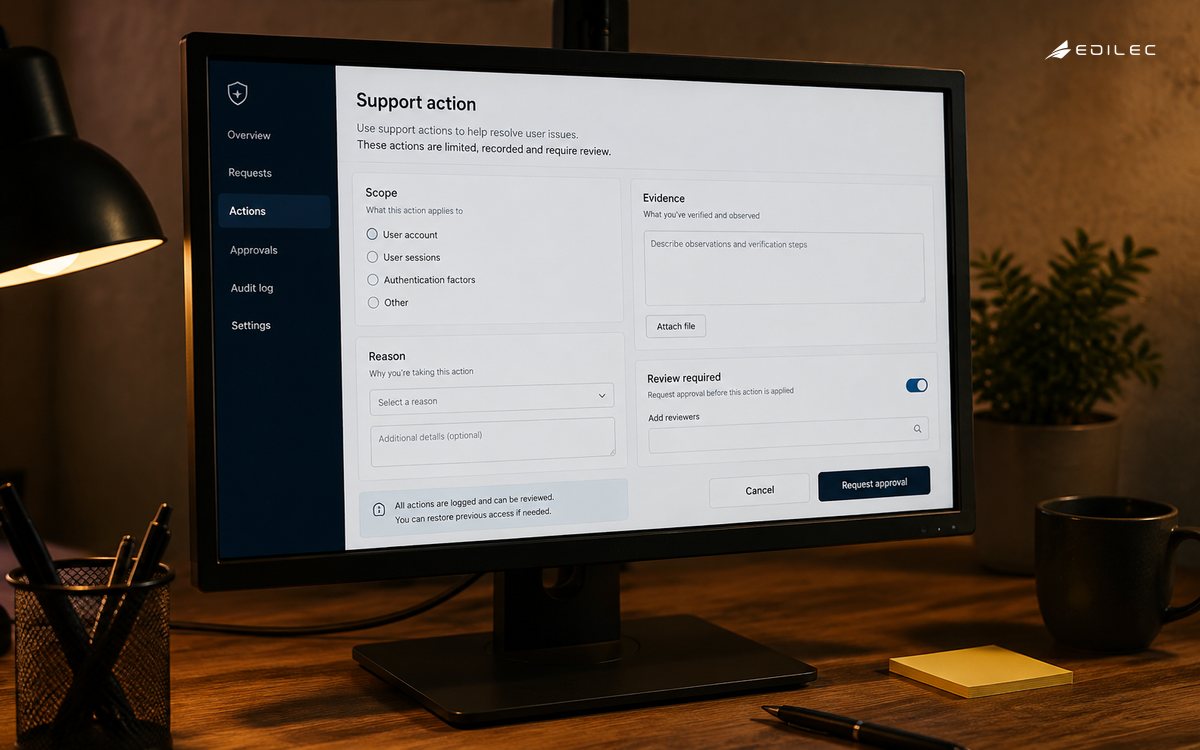
Add automated checks at the boundary where admin consoles can cause harm, and keep the customer-visible state aligned with the internal record. Require strong authentication, least privilege, server-side authorization, explicit tenant selection, and an audit event for each sensitive read or write. Design destructive actions as reviewable commands with clear consequences, idempotency where appropriate, and an escape route for mistakes. Mask sensitive fields by default and restrict bulk export. Build a controlled impersonation feature only when necessary: make the session conspicuous, scoped, time-limited, and recorded.
- Write the admin consoles rule in plain language before encoding it.
- Name the source of truth and the state transition owner The admin consoles owner can use that evidence to decide what changes next.
- Test a normal case, an invalid case, and a recovery case. The admin consoles owner can use that evidence to decide what changes next
- Keep customer-facing status aligned with the authoritative record
- Assign an expiry or review date to temporary exceptions
Operate Admin Consoles with evidence, not assumptions
Operating admin consoles requires a short, reviewable set of signals instead of a broad dashboard with no decision attached. Monitor privileged writes, failed authorization, export volume, impersonation duration, and emergency access use. Review privileged access, failed authorization, data exports, impersonation sessions, emergency roles, and unusually broad searches. Test the console in incident exercises and ensure the log answers what changed, by whom, under which authority, and what result followed. Retain useful evidence according to policy while avoiding the collection of unnecessary customer content in logs. A console that cannot explain their own actions make support slower and riskier.
| Signal | What it can reveal | First response |
|---|---|---|
| Unexpected denial or failure | A boundary, context, or data-quality problem. | Inspect the decision record and affected scope. |
| Manual override | A missing path or unclear responsibility. | Require a reason, expiry, and follow-up review. |
| Stale or inconsistent state | A delayed dependency or weak reconciliation. | Compare source evidence and replay safely. |
| Customer confusion | A mismatch between system state and explanation. | Improve the visible state before adding more controls. |
Admin consoles: Key takeaways for CTOs — think about admin consoles workflow
- Admin consoles should have a written business definition and a named owner.
- Enforce consequential decisions where the work happens, not only in the interface
- Record reasons, effective times, and expiry for exceptional handling
- Measure quality and recovery as well as completion or conversion
- Use customer evidence to refine the model after a controlled release
Frequently asked questions about admin consoles
Where should the Admin Consoles team start?
For admin consoles, a prototype is only persuasive when it uses representative identities, records, and failure conditions.
Who should own Admin Consoles?
Ownership for admin consoles is shared but not vague.
What should trigger a Admin Consoles review?
For admin consoles, Investigate any action that an operator cannot explain from its audit record, especially customer-data reads, exports, impersonation, permission changes, and destructive commands. Verify the effective role at the moment of action, the selected customer scope, the purpose or ticket reference, and the result returned by the authoritative service. A missing record may indicate an observability gap; a vague record may reveal that the console permits an overly broad operation. Tighten the command, require confirmation or approval where appropriate, and add an incident-exercise case. Avoid solving every support delay with a new privileged button. Often a better customer-facing recovery path, clearer state, or scoped troubleshooting tool reduces both risk and time to resolution. Regular access review should remove dormant emergency roles and test that break-glass access is time-bound and alerting.
Review an admin console with a real privileged action
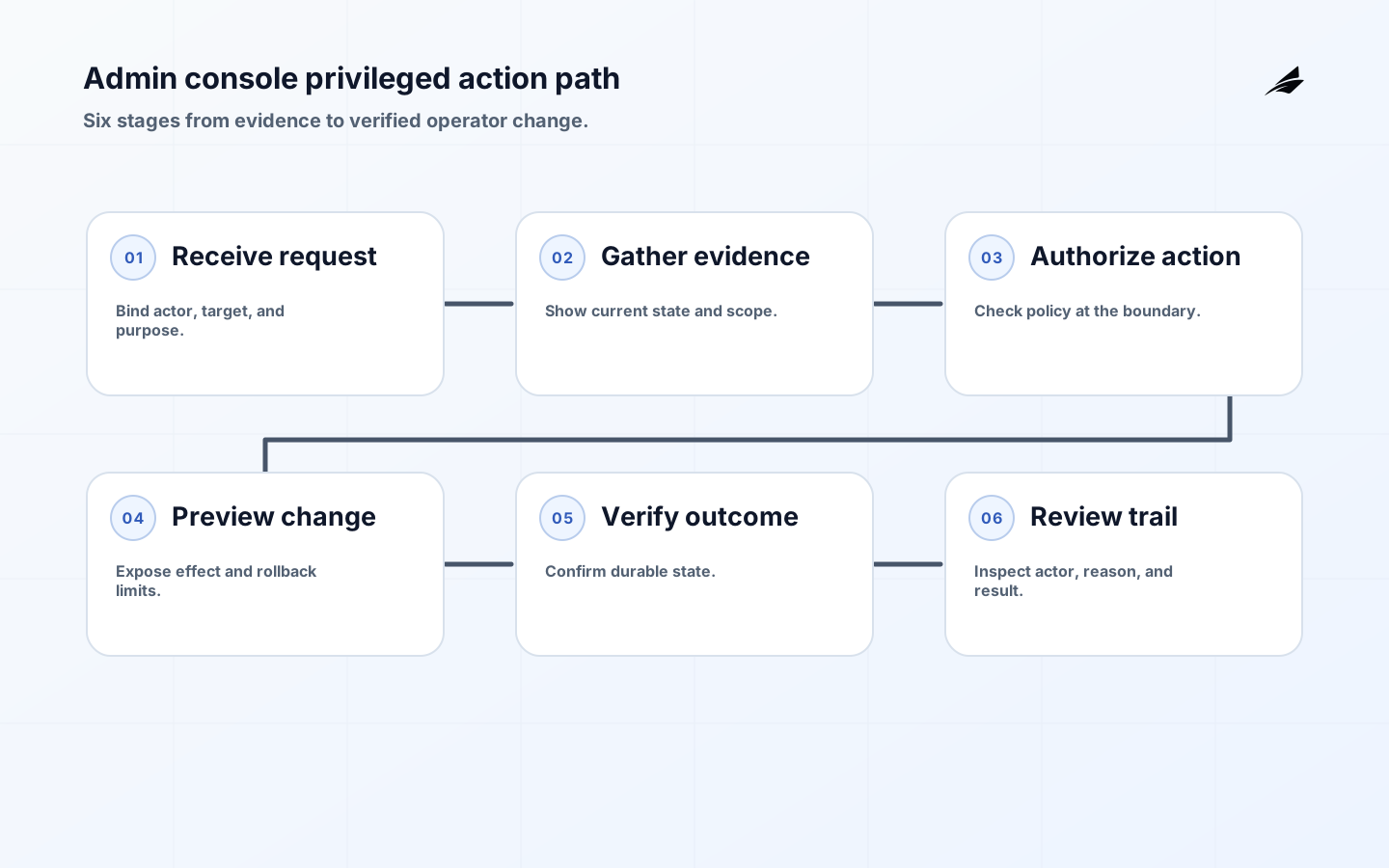
An admin console review becomes concrete when it traces one privileged action from request to durable result. Choose an action such as suspending a workspace, changing an entitlement, or rotating a connection. Record who can see the action, what evidence they need, which authorization check runs at the command boundary, what confirmation is required, and how a later investigator will distinguish an approved change from a failed attempt.
Build a safe preview before the write. Show the target, current state, proposed state, affected scope, reason, and rollback limits; then require a fresh authorization decision at execution time. The console should handle stale data, concurrent changes, and an unavailable downstream service without implying success. Link the decision to subscription access control, tenant isolation, and feature flag security review.
What is the first admin console capability to build?
Start with one frequent, bounded action that has a clear owner, authorization rule, preview, audit event, and recovery procedure.
Should administrators be able to search everything?
No. Search and record visibility should follow purpose, role, tenant scope, and data minimization rules; broad search is not a substitute for an operational need.
When does an action need two-person approval?
Use separation of duties when the action can expose sensitive data, alter billing or authorization, or create an irreversible customer or security consequence.
The measurement plan for how ctos should think about admin consoles should pair an outcome with a reason to investigate it. Make admin consoles corrections visible, scoped, and reversible during about admin consoles.
A durable operating note for how ctos should think about admin consoles records the assumptions that made the decision safe: the authoritative source, effective time, permitted actor, protected resource, and recovery route.
For how ctos should think about admin consoles, a good handoff ends with observable evidence rather than a verbal promise. For admin consoles, review the think about admin consoles scope during normal handling.
The smallest useful improvement to how ctos should think about admin consoles is often a sharper boundary, not another feature.
For Admin Consoles, OWASP Application Security Verification Standard defines scope; OWASP Authorization Cheat Sheet supports the control; NIST Glossary: Data Processing clarifies evidence; OpenTelemetry logs data model guides recovery.
For admin consoles, review the think about admin consoles recovery during a tenant boundary.
For admin consoles, review the think about admin consoles scope during a customer explanation. For admin consoles, review the think about admin consoles control during normal handling.
For admin consoles, review the think about admin consoles control during a customer explanation. For admin consoles, review the think about admin consoles evidence during normal handling.
A durable operating note for admin consoles records the authoritative source, effective time, permitted actor, protected resource, and recovery route.
For admin consoles, test a stale event before treating the first release as complete. For admin consoles, review the think about admin consoles scope during a tenant boundary.
A practical example for admin consoles is an incomplete setup. For admin consoles, review the think about admin consoles control during a tenant boundary.
For admin consoles, review the think about admin consoles ownership during a tenant boundary.
Compare a normal administrative action with a changed-permission case, and verify that authorization failures lead to an auditable recovery path.
When an administrative event is late or disputed, preserve the observed scope and owner before deciding how to correct it.
A concrete operating test for how ctos should think about admin consoles is to rehearse think about admin consoles during a recovery drill. For admin consoles, review the think about admin consoles control during a reconciliation pass. For admin consoles, review the think about admin consoles control during a reconciliation pass For admin consoles, review the think about admin consoles control during a reconciliation pass
Compare a normal administrative action with a support case, and verify that the owner can explain the decision and its audit evidence.
During a measured rollout, verify that the console records control outcomes, distinguishes delayed or disputed events, and supports a documented recovery action.
A concrete operating test for how ctos should think about admin consoles is to rehearse think about admin consoles during a dependency failure. For admin consoles, review the think about admin consoles evidence during a reconciliation pass. For admin consoles, review the think about admin consoles evidence during a reconciliation pass For admin consoles, review the think about admin consoles evidence during a reconciliation pass
Conclusion
Admin consoles earn trust when a customer, operator, and engineer can reach the same explanation of what happened and what should happen next. The result is not bureaucracy. Before adding an operational command, ask what the narrowest safe form of that command is and whether the customer-facing product can solve the recurring need instead. Then test authorization failure, accidental target selection, log completeness, and reversal. A restrained console with a strong audit trail helps responders act confidently without quietly widening the organization's permanent access.
Schedule access and audit-log review as part of console operations, especially after new support tooling or incidents. Check whether recent actions were necessary, scoped, and explainable, then turn repeated manual work into a safer product or workflow improvement. This protects customers while making the console more useful for the incidents it genuinely needs to resolve.
Sources for admin consoles
- OWASP Application Security Verification Standard
- OWASP Authorization Cheat Sheet
- NIST Privacy Framework
- OpenTelemetry logs data model
Evidence for “How CTOs Should Think About Admin Consoles” is grounded in OWASP Application Security Verification Standard, OWASP Authorization Cheat Sheet, NIST Glossary: Data Processing, OpenTelemetry logs data model; each source informs a specific decision, test, or operating trade-off described in this guide.