Tenant Isolation for SaaS Product Engineering: a Practical Guide
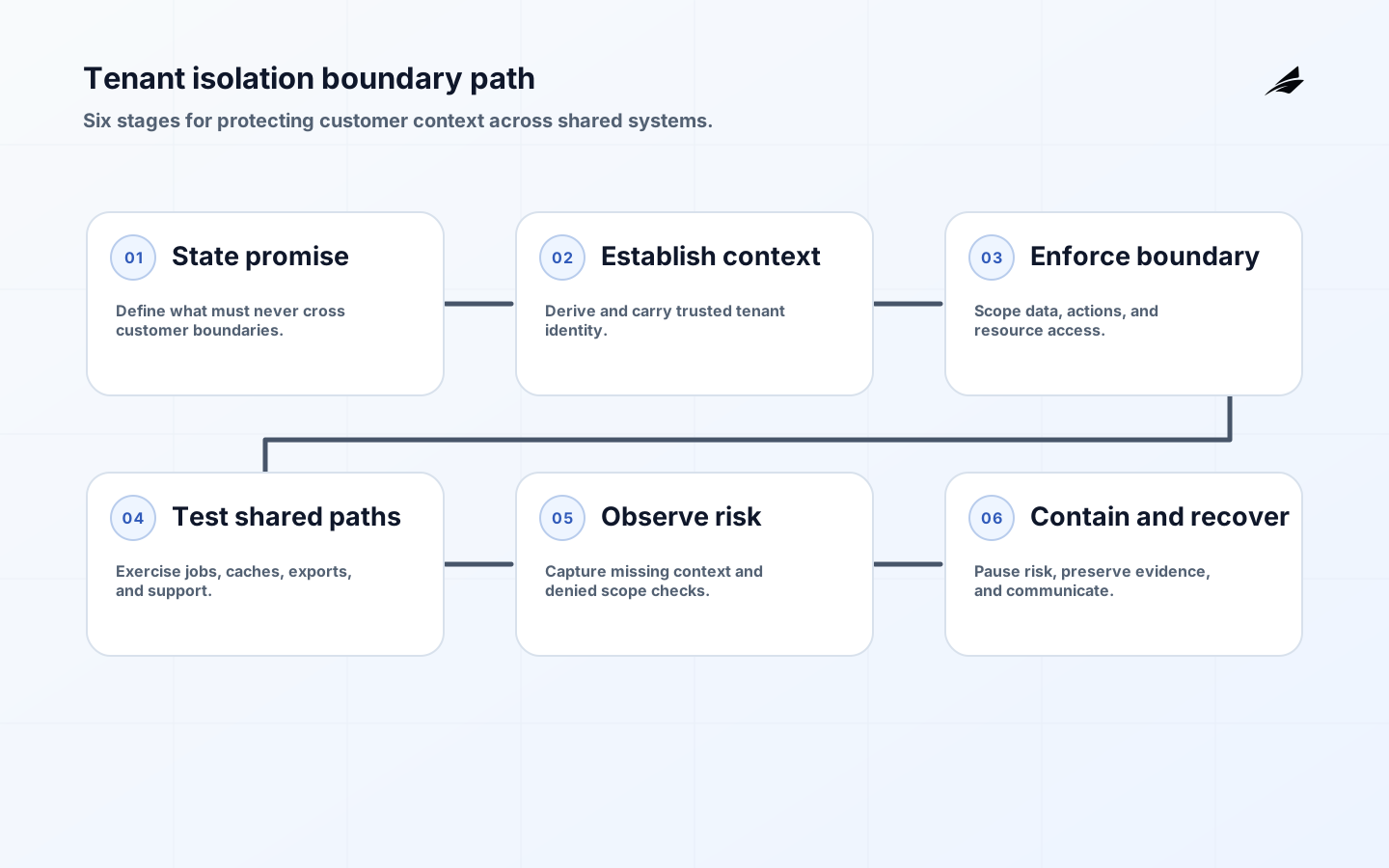
Tenant isolation is the product and engineering promise that one customer’s records, actions, and operational context remain inside the correct boundary. It is broader than adding a tenant_id column. A request, queue message, cache key, object path, export, notification, analytics query, and support action can all cross the boundary if context is missing or authorization is assumed. This guide helps SaaS product engineering teams choose an isolation model, propagate tenant context, test shared infrastructure, observe failures, and prepare a safe response when a boundary is uncertain.
State the isolation promise and consequence
Begin with what must never cross tenants and what may be aggregated safely. For one product, the boundary may protect customer records and administrative actions; for another, it also protects encryption keys, model indexes, billing details, support notes, or regional processing. Name the severe failure, such as a user seeing another account’s report, and the response objective. The AWS SaaS Lens foundations encourages teams to reason about tenant-aware architecture and operations. Use that as a prompt, then document the actual isolation contract, owners, exceptions, and evidence expected by customers.
| Boundary layer | Question | Control evidence |
|---|---|---|
| Request | How is tenant context established? | Authenticated identity, route, and policy decision |
| Data | Where is scope enforced? | Query policy, repository test, or database boundary |
| Async work | What travels with a job? | Tenant ID, actor, correlation, and consumer check |
| Operations | Who may inspect or repair? | Role, purpose, approval, and audit record |
Propagate tenant context as a required input
Derive context from a trusted identity and explicit resource relationship, then carry it through service calls, messages, caches, storage paths, and observability. Reject work that lacks context when the operation is tenant-scoped. Do not infer a tenant from a mutable browser setting or a free-form header supplied by an untrusted client. The OWASP Authorization Cheat Sheet supports deny-by-default, server-side checks, and testing authorization at the function that protects the resource. Use stable correlation IDs so an investigation can show which tenant a service believed it was handling.
- Require tenant context in domain commands and background payloads.
- Bind repository and storage helpers to a scoped context rather than optional filters.
- Partition cache keys and invalidate them when membership or policy changes.
- Carry tenant and actor context into exports, notifications, and analytics jobs.
- Redact or aggregate telemetry so troubleshooting does not create a new data leak.
Choose the boundary that matches risk and operations
Shared tables with enforced row scope, schema-per-tenant, database-per-tenant, and dedicated environments each have different isolation strength, cost, migration burden, and failure modes. A stronger physical boundary does not remove the need for identity and authorization; an application bug can still select the wrong customer’s database or expose an export. Choose based on data sensitivity, regulatory or contractual obligations, recovery needs, noisy-neighbor behavior, team capability, and evidence requirements. Document the downgrade or exception path if a tenant moves between models. Make the decision revisitable rather than hiding it inside an infrastructure diagram.
| Pattern | Useful when | Trade-off to test |
|---|---|---|
| Shared tables with policy | Many tenants and common operations | Query or policy omission can be severe |
| Schema per tenant | Logical separation is valuable | Migrations and tooling become more complex |
| Database per tenant | Strong operational separation is required | Provisioning, cost, and fleet management |
| Dedicated environment | Contract or risk demands isolation | Capacity, deployment, and recovery overhead |
Test queues, caches, exports, and support paths
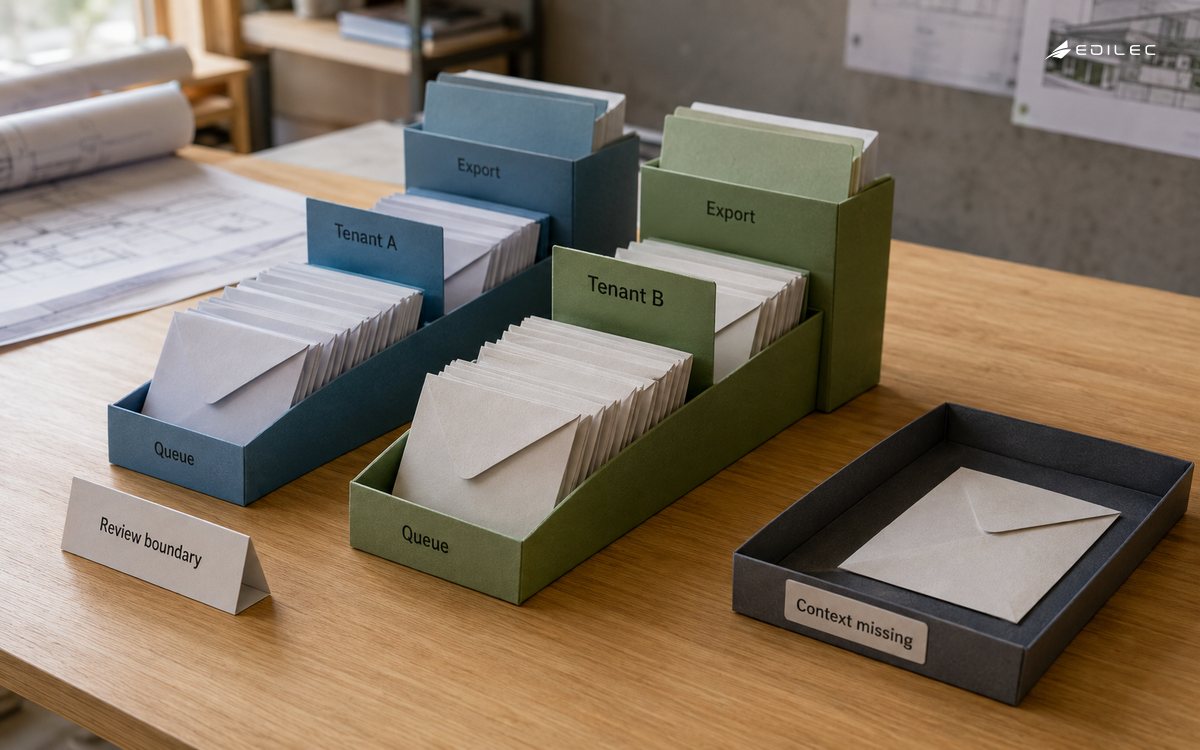
Interactive requests are only the beginning. Create two tenants with similarly named users, files, and resources. Run an export, schedule a report, retry a worker, warm a cache, send a notification, and inspect the support view. Revoke membership while work is pending and verify the consumer rechecks scope. Test error messages so a denial does not reveal another tenant’s identifiers. Include analytics and search indexes; copied data often loses the context that was present at the source. Keep these cases in the release gate whenever shared libraries, routing, authorization, or background processing changes.
Make boundary violations observable without leaking data
Record denied scope checks, missing context, unexpected tenant changes, cross-tenant lookup attempts, job failures, and export destinations. OpenTelemetry can connect traces, logs, and metrics around a correlation ID, but avoid putting sensitive records into general telemetry. Alert on severe signals and preserve enough evidence to identify affected tenants, time range, service version, and containment action. The NIST SSDF supports integrating threat modeling, testing, and response into development; use the same change record for a boundary review and its regression tests.
Prepare containment and customer-safe recovery
A suspected isolation problem needs a rehearsed first response: stop or narrow the risky path, preserve evidence, identify the affected scope, revoke or rotate exposed access where necessary, and assign customer communication. Avoid an improvised database edit that erases the original state. Build a reconciliation that can compare tenant context at request, job, storage, and notification boundaries. Give support a safe explanation and a route for account-specific review. Recovery is part of isolation design because customers and operators need to know what was affected and which action restored the boundary.
Run a boundary review before shared changes
Before changing a shared repository, cache, queue, search index, or support tool, write down where tenant context enters, how it is validated, and which downstream components receive it. Use a two-tenant fixture with similar names and permissions. Review both the success path and the error path; an error that includes another tenant’s identifier is still a boundary failure.
Inspect background work separately from request handling. List every producer and consumer, then check payload fields, retry behavior, authorization at execution, and destination keys. A service may be safe on the first attempt and unsafe on a retry that reconstructs context from a partial payload. Keep the test close to the queue or worker code so ownership is clear.
Practice the first hour of a suspected incident. Decide who pauses the feature, who preserves logs and traces, who identifies the affected tenant set, who approves access rotation, and who prepares the customer message. Do not wait for perfect attribution before containing a dangerous path. Record uncertainty as a state with an owner and update it as evidence arrives.
After a review or incident, fix the system and the operating evidence. Add a regression test, tighten a helper or policy, improve a missing correlation field, and check whether support can explain the result. A boundary that is technically repaired but operationally invisible remains difficult to trust. Revisit the isolation contract when architecture or customer obligations change.
Ask every service owner to name the tenant context their component trusts and the check it performs. “The gateway already checked it” is not enough for a worker, export service, cache, or support command that can be invoked through another path. The review should identify where context is re-established and what evidence proves it.
Treat tenant isolation as a customer-facing reliability property. A boundary failure affects confidentiality, support trust, incident response, and sometimes billing or legal commitments. Product leaders should know the promise, the pause condition, and the customer communication owner before the architecture is expanded.
Put the isolation promise into acceptance criteria for every shared component. A cache key, queue payload, object path, search document, or support query should make its tenant scope visible in code review and tests. If a component cannot carry scope, the design should explicitly prohibit tenant-specific work there or add a boundary before the data enters it.
Include tenant isolation in product readiness, not only security review. Product should confirm the customer promise, engineering should confirm enforcement and tests, operations should confirm containment, and support should confirm explanation. A boundary is ready for scale when all four groups can identify the first safe action after a suspicious result.
Document safe aggregation separately from tenant-level access. A company-wide reliability metric may combine tenants, while a support investigation may inspect one account under strict role and purpose controls. The system should make the distinction explicit so a dashboard query cannot become an accidental route to raw customer records.
Key takeaways
- Define the tenant isolation promise and the consequence of a boundary failure.
- Make context required across requests, data, queues, caches, exports, telemetry, and support tools.
- Choose a physical or logical pattern that the team can operate and test honestly.
- Use similar records in separate tenants to exercise asynchronous and non-UI paths.
- For related context, See multi-tenant architecture, workspace models, and tenant isolation for operations leaders. In this context, tenant isolation needs its own decision record.
Frequently asked questions
What does tenant isolation protect?
It protects the customer boundary around data, actions, jobs, caches, exports, notifications, search or analytics copies, and operator access. The exact promise should be explicit because a product may permit safe aggregate reporting while prohibiting customer-level disclosure or cross-tenant administration.
Is a separate database always required?
No. A shared model can be appropriate when policy enforcement, tests, operations, and evidence meet the product’s risk. Separate databases can reduce some failure modes but add provisioning and recovery complexity. Choose the boundary that the team can maintain, verify, and explain, then test the remaining application and operator paths.
How should a team test isolation?
Use similarly named resources in two tenants and exercise normal requests, denied requests, queued work, retries, caches, exports, notifications, analytics, and support repair. Change membership while work is pending and inspect both user-visible output and audit evidence. Keep the fixtures in regression tests so shared infrastructure changes cannot silently remove the boundary.
Conclusion: make the customer boundary a system property
Tenant isolation is dependable when context is explicit, enforcement is layered, shared paths are tested, and recovery is ready. Start with the customer promise and severe failure, then carry the boundary through every place work moves or is copied. The result is not a single security setting; it is an operating property that product, engineering, support, and operations can observe and defend.
For tenant isolation for saas product engineering, test an incomplete setup before treating the first release as complete. Measure tenant isolation outcomes alongside correction effort.
A practical example for tenant isolation for saas product engineering is support and engineering initially read different evidence. Make tenant isolation corrections visible, scoped, and reversible during a practical guide.
Ownership is clearer when tenant isolation for saas product engineering separates the promise from the mechanism. For tenant isolation, name the decision boundary and its owner.
Before widening tenant isolation for saas product engineering, run a small rehearsal with normal, denied, delayed, and corrected cases. Explain tenant isolation pending and denied states before expansion.
This decision also connects to Multi-tenant Architecture: A Practical SaaS Engineering Guide, Workspace Models for SaaS: Choose Tenant Boundaries That Scale, How Operations Leaders Should Think About Tenant Isolation. Review those boundaries together when tenant isolation for saas product engineering shares identity, data, billing, or support evidence with another workflow.
For tenant isolation, test an unexpected load spike and review the measurement before treating the first release as complete.
A practical example for tenant isolation is a delayed dependency; confirm ownership during the support review.
For tenant isolation, separate the customer promise from its mechanism and retain evidence during the measured rollout.
Evidence for “Tenant Isolation for SaaS Product Engineering: A Practical Guide” is grounded in Foundations - SaaS Lens, Authorization Cheat Sheet, Secure Software Development Framework (SSDF) Version 1.1, OpenTelemetry Observability Primer; each source informs a specific decision, test, or operating trade-off described in this guide.