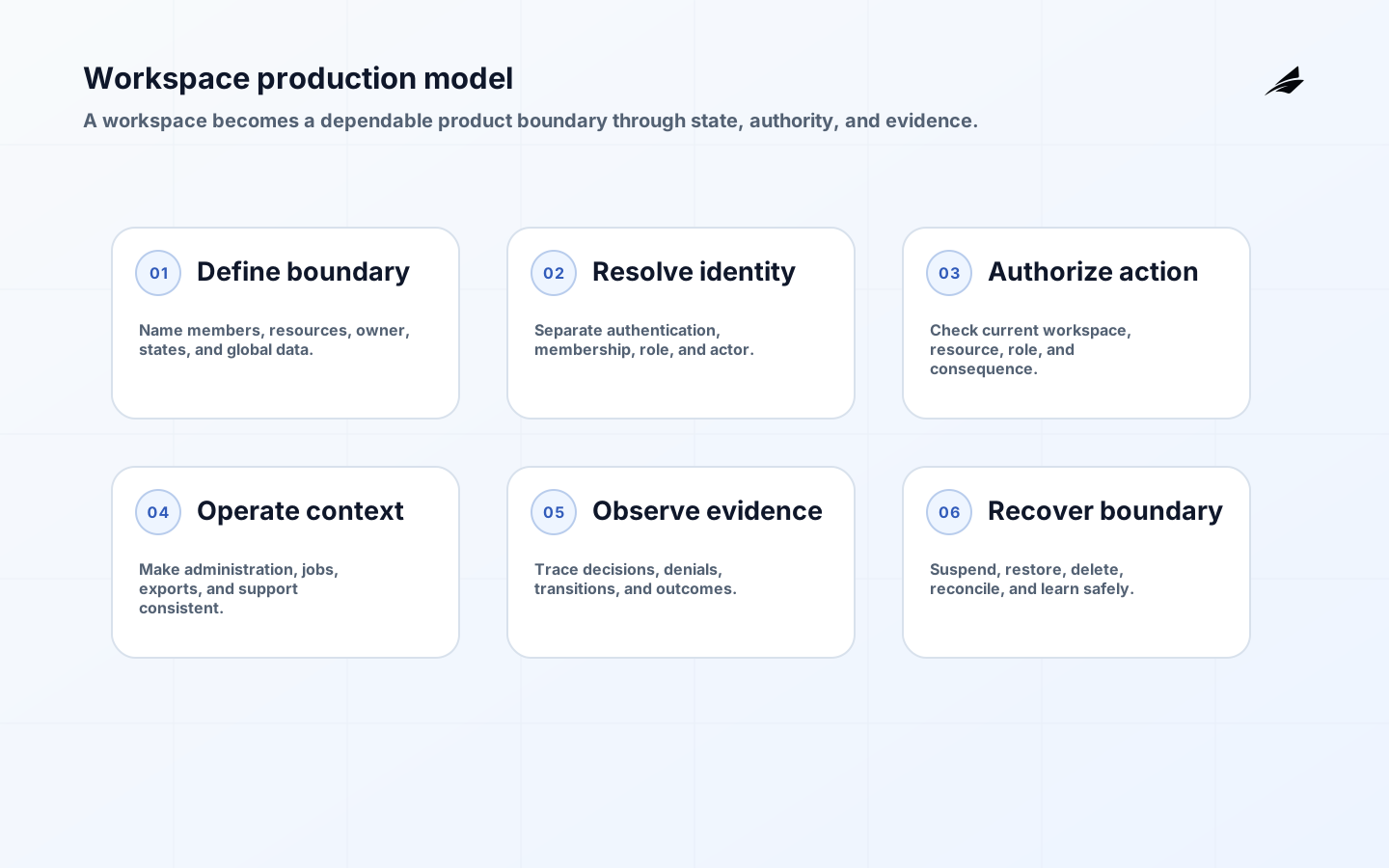
What Changes When Workspace Models Move into Production
A workspace model often begins as a convenient grouping of users, records, and settings. In production, it becomes a customer-facing contract. People expect a workspace to explain who belongs, what each member can do, which data is shared, how changes are audited, and what happens when the workspace is archived or transferred. The engineering challenge is not only storing a workspace row. It is applying the same boundary to APIs, background jobs, exports, search, notifications, support tools, and recovery paths without making the product impossible to use.
State what the workspace owns
Write the invariants first. Every resource should have a clear workspace relationship or an explicit reason to be global. Every request should resolve the authenticated actor, workspace context, resource identity, and requested action before a side effect. Membership changes should be attributable, role changes should have a history, and invitations should expire or be revoked. Decide what happens to records, integrations, billing, and exports when a workspace is suspended, merged, or deleted.
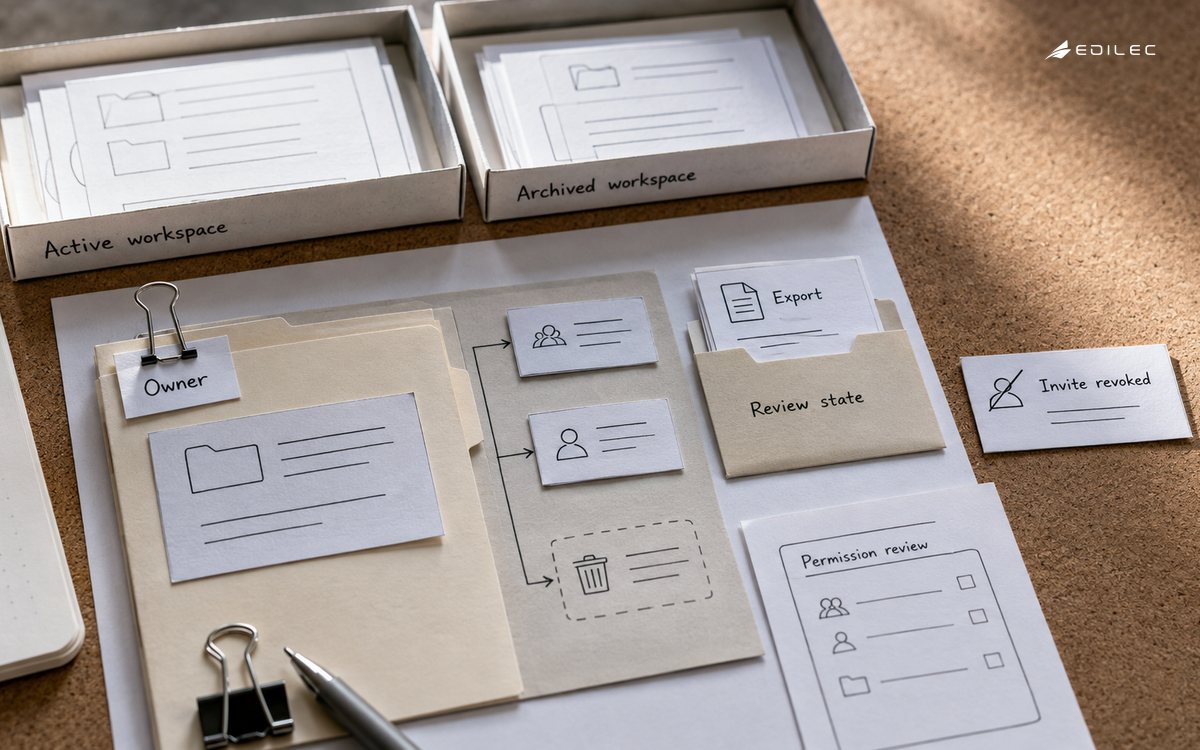
Use the OWASP authorization guidance as a control checklist, especially deny-by-default, server-side checks, least privilege, and tests for horizontal access. A workspace boundary enforced only in the browser is not a boundary. A query that accepts a workspace ID from a request without verifying the actor's membership is an access-control defect waiting for a guessed identifier.
| Workspace concern | Decision | Evidence |
|---|---|---|
| Membership | Who can join, invite, remove, or transfer ownership? | Role policy and audit record |
| Data boundary | Which resources are workspace-scoped or global? | Schema invariant and access tests |
| Lifecycle | What happens on suspend, archive, or delete? | State machine and recovery procedure |
| Administration | Which actions need step-up confirmation or approval? | Permission matrix and UI flow |
Give membership and workspace states a meaning
A production workspace needs more than active or inactive. Consider pending, active, suspended, archived, deletion-requested, and deleted states, with rules for transitions and retained evidence. A suspended workspace may block writes but still allow an owner to export or appeal. An archived workspace may be hidden from normal navigation but retained for contractual or operational reasons. State must be checked in synchronous requests and asynchronous jobs so a delayed task cannot revive or modify a closed boundary unexpectedly.
Use stable identifiers and durable state transitions. If an invitation is accepted after a role changed, evaluate the current policy rather than replaying the old assumption. If a background export starts before suspension, decide whether it completes, pauses, or is revoked. RFC 9110 is a useful reminder to make request and response semantics explicit; product state adds the domain rules that HTTP cannot provide on its own.
Enforce scope at reads, writes, jobs, and support
Build a permission matrix for user actions, service actions, support access, imports, exports, webhooks, and scheduled jobs. Resolve authorization from trusted identity and current workspace state, not from a model-generated or client-supplied label. Check both the workspace and the resource. A member who can read a project may not be allowed to export all projects; a support agent who can investigate may not be allowed to impersonate an owner; a worker may need a narrower service identity than the user who initiated it.
Test the negative space: guessed IDs, stale sessions, removed members, cross-workspace batch requests, direct object URLs, queued jobs, and support tools. Log the authorization decision with actor, workspace, action, resource class, policy version, and outcome, while minimizing sensitive content. Use NIST SP 800-53 as a control vocabulary, then preserve evidence from the workspace's actual resource paths: the denied request, the policy version, the test identity, and the review decision.
Make boundary-changing actions understandable
Workspace administration is a high-risk product surface. Make current workspace context obvious, explain how a role or lifecycle choice changes access and data, and provide accessible labels, errors, confirmation, and recovery. The W3C forms tutorial is relevant because an inaccessible membership or deletion form can cause both usability and authorization mistakes. Do not hide critical context in a hover state or rely on color alone to distinguish dangerous actions.
Use idempotent operations for invitations, role changes, and exports. Give asynchronous work a visible status and a way to cancel or expire it. A user should know whether an invite was sent, accepted, revoked, or expired, and which workspace it belongs to. The same clarity helps support and incident responders when a customer asks why a person gained or lost access.
| Path | Production risk | Design response |
|---|---|---|
| API request | Client changes workspace or resource identifier. | Resolve context server-side and authorize every object |
| Background job | State changes after membership or lifecycle changes. | Recheck policy and workspace state at execution |
| Export | Large or sensitive dataset leaves the boundary. | Scope, authorize, expire links, and audit delivery |
| Support tool | Privileged access bypasses normal product flows. | Separate role, reason, approval, and visible audit |
| Webhook | External retry repeats a workspace side effect. | Verify signature, bind tenant, and use idempotency |
Make scope failures and customer impact visible
Track workspace creation success, invitation acceptance, role-change failures, authorization denials, export completion, queue age, lifecycle transitions, and support overrides. Add workspace and actor context to traces and logs with care. OpenTelemetry semantic conventions can help align request and service fields, but do not place raw customer content in telemetry by default. Keep enough evidence to explain a material access or state decision without turning observability into an uncontrolled data copy.
Sample successful and denied cases. A low denial rate may mean good usability, or it may mean the system is not testing the boundary. Review access anomalies, membership churn, unexpected export volume, and repeated support interventions. These signals often reveal a product model that is too ambiguous before they become an incident.
Ship only after negative paths and recovery work
Before launch, exercise creation, invitation, role changes, resource access, suspension, restore, export, deletion, and support investigation through both UI and API. Include two workspaces, multiple roles, stale sessions, concurrent changes, retries, and delayed jobs. Verify that data, search, caches, notifications, and analytics respect the same boundary. A screenshot of the happy path is not sufficient evidence for a multi-tenant control.
Connect this work to Edilec's admin consoles buyer and CTO guide, customer feedback loops operations playbook, and product support tooling implementation checklist. Those internal guides help extend the workspace model into the administrative, feedback, and support paths where boundary defects often appear.
Make the workspace boundary visible in every high-consequence interaction. Show the selected workspace, customer, role, and target before a destructive or external action. For background work, show the same context in the job history. This protects against a common failure mode in which a technically valid request acts on the wrong customer because the user or worker carried stale context.
Design ownership transfer as a real workflow, not a database update. Identify the current owner, proposed owner, permissions that move, credentials that must rotate, integrations that need review, and actions that remain pending. Require confirmation proportional to the consequence and keep a record that support can explain. Ownership changes are often where assumptions about billing, access, and support meet.
Decide how the workspace behaves under partial failure. If search is down, can a user still edit a known record? If the directory is delayed, can an owner remove a member? If exports are unavailable, what promise does the product make? Degraded behavior should preserve the boundary and make the limitation clear. A graceful partial service is safer than a false success that creates untracked state.
Use customer questions as design evidence. Confusion about why a member can see a record, which workspace an export belongs to, or when deletion completes usually signals a missing product concept. Feed those questions into naming, navigation, permissions, and lifecycle. Support should not have to translate an opaque data model into a human explanation for every case.
Keep the workspace decision record close to the code and runbooks. Record why the boundary exists, which resources it includes, which roles can cross it, and how lifecycle changes affect jobs and integrations. New engineers and support operators should be able to understand the rule without reconstructing it from old incidents. This is especially important when a product adds an API, import, or administrative shortcut.
A production workspace model should make safe behavior predictable for customers and staff. If the product cannot explain a denial, a pending invite, a suspended state, or a delayed export, the model is not finished. Use those explanations as design tests. They often reveal missing states or authority boundaries earlier than automated tests do.
Treat migrations and integrations as part of the workspace model. A billing provider, directory, analytics pipeline, or support tool may introduce a second identity or state boundary. Define how records map, what happens on retry, how access is revoked, and how the customer can see the result. Keep reconciliation work explicit so a partial integration does not leave the workspace appearing active while an external system holds stale or incorrect authority.
Keep product and operational ownership aligned. Product decides what the workspace promises, engineering implements the invariant, security reviews the authority boundary, support explains and investigates, and operations owns recovery. Name a decision maker for conflicts. Without this alignment, each team can make a locally reasonable change that breaks the customer's understanding of the workspace as a whole.
Use a repair queue for records whose workspace relationship is missing, conflicting, or stale. Make the queue visible to an accountable team and prevent ambiguous records from silently entering broad search or export paths. A repair process lets the product handle historical data honestly while the team improves the model instead of hiding its gaps.
Keep the audit readable to both systems and people. A record should answer who acted, in which workspace, on what resource, under which policy, with what result, and whether follow-up remains. Do not retain every payload by default; retain the context needed to explain a material decision and protect it with the same boundary the action used. Make retention and access review explicit today.
Key takeaways
- Treat the workspace as a product contract covering membership, data, lifecycle, and authority.
- Resolve actor, workspace, resource, and action before every side effect.
- Apply the same boundary to APIs, workers, exports, search, notifications, and support tools.
- Model suspension, archive, deletion, and recovery as explicit states.
- Make administration accessible, contextual, idempotent, and auditable.
- Use cross-workspace negative tests and production-like evidence before expanding the model.
Frequently asked questions
Is a workspace the same as a tenant?
Sometimes, but the terms should not be assumed to mean the same thing. A workspace may be the collaboration boundary inside a larger customer account, while a tenant may own billing, identity, or data residency. Define the relationship explicitly and test it in every authorization and lifecycle path.
How should support access work?
Use a separate, least-privilege support role with a reason, scope, time limit, and visible audit. Do not make support impersonation an invisible bypass. Give the customer and internal reviewer enough evidence to understand what was accessed or changed.
Conclusion
Workspace models become dependable in production when the product explains membership, the system enforces current authority, every path respects lifecycle state, and operators can recover with evidence. Design the boundary as a shared contract rather than a database convention, and the workspace can scale with customer trust intact.