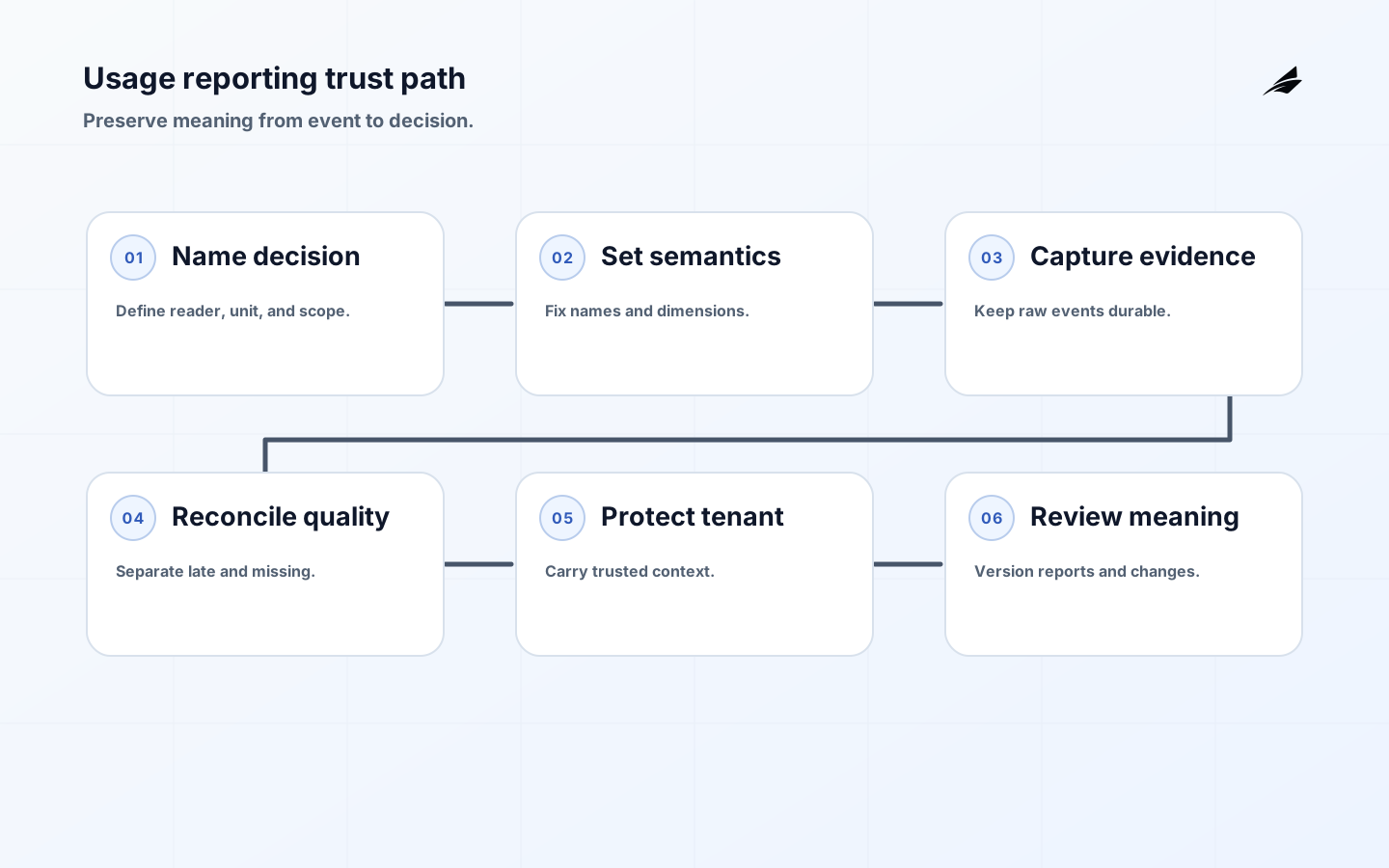
Usage reporting is trustworthy only when an engineer, product manager, finance partner, or customer can ask what a number means and receive the same answer later. The work begins before a dashboard: define the event, unit, scope, time semantics, source, and correction policy. Then make collection, aggregation, storage, and presentation preserve those decisions. A report that is visually persuasive but cannot explain late events, tenant boundaries, retries, or changed definitions is not an operating asset; it is a new source of disagreement.
The companion usage reporting planning guide, billing workflow fixes, and SaaS reliability playbook provide related implementation context. This article concentrates on the engineering choices that keep usage reporting useful across product analytics, customer visibility, and operational decisions.
Start with the decision the report must support
Name the reader, decision, time horizon, and acceptable uncertainty. A product team may need completed workflows per active workspace; finance may need billable units by invoice period; reliability may need successful requests by service and region. These are different measures even when they use the word usage. Define the unit of analysis and the exclusion rules before choosing a chart. If a report will trigger entitlement, billing, or customer communication, identify the authoritative source and reconciliation owner. A useful boundary prevents a general event stream from becoming an accidental contract.

| Reporting question | Definition to lock | Failure if vague |
|---|---|---|
| How much was used? | Event, unit, aggregation window, and actor. | Teams compare incompatible totals. |
| Who used it? | Tenant, workspace, user, or service identity. | Usage is attributed to the wrong customer. |
| When did it happen? | Event time, ingestion time, and billing cutoff. | Late data changes past decisions silently. |
| Can it be trusted? | Validation, correction, and freshness policy. | A number looks precise without evidence. |
Give every measure stable semantics
OpenTelemetry’s semantic conventions emphasize consistent names, attributes, units, and descriptions. Apply that discipline even when the report is internal. Choose a name that identifies the thing measured, keep units out of names when the telemetry system carries them, and use attributes that remain meaningful when aggregated. Prometheus models each metric and label set as a time series; a high-cardinality label such as an unbounded request ID can make the data expensive and difficult to query. Document allowed values, cardinality expectations, and whether a dimension is safe to expose to customers.
Separate raw events from reporting views
Keep a raw or append-only record that preserves the event identity, source version, observed time, tenant context, and ingestion outcome. Build derived aggregates from that record so corrections can be replayed without pretending the original observation never existed. Use a deduplication key for retried producers and make the aggregation job idempotent. Record the logic version that produced a customer-facing or billing-facing view. When a report changes, a reviewer should be able to tell whether the underlying usage changed, the data arrived late, or the calculation was corrected.
- Define event name, unit, timestamp, source, tenant context, and correction policy together.
- Keep producer and consumer versions visible in the data contract.
- Use bounded dimensions and review cardinality before adding a label.
- Make retries and duplicate deliveries safe.
- Preserve enough raw evidence to reproduce material reports.
Design for late, missing, and corrected data
A report needs a clear difference between zero usage, no event received, and data still processing. Show freshness and completeness where they affect a decision. Define a watermark or closing rule for a reporting period, then decide how late events are handled: revise the period, carry an adjustment, or hold the result for review. Reconciliation should compare independent counts or totals, not simply run the same transformation twice. For tenant-facing reports, expose a correction note or version when a material change would otherwise surprise the customer.
| Data condition | Reader-facing treatment | Engineering action |
|---|---|---|
| No usage | Show zero with the period and definition. | Verify the source was active. |
| No data | Show unavailable or incomplete. | Investigate collection and ownership. |
| Late event | Show freshness or revised period. | Apply watermark and replay rule. |
| Corrected event | Version the result and explain material change. | Retain adjustment reason and evidence. |
Keep tenant context intact across aggregation
Usage reporting for a SaaS product must preserve the boundary between tenants at collection, transport, storage, query, cache, export, and presentation. Derive tenant context from trusted request or service state; do not accept a customer-supplied label as the sole authority for billable usage. Test shared queues, partition keys, cache keys, batch jobs, and cross-tenant administrative views. A report can be numerically correct in aggregate while still exposing the wrong customer’s detail. Limit access to raw events and provide a separate, least-privilege view for customer-facing usage.
Connect reports to decisions and alerts
Google SRE’s SLO guidance starts from what users care about and works backward to indicators. Do the same for usage reporting. A dashboard does not need an alert for every change; it needs an owned response for a missing export, an unexpected billable spike, a broken ingestion path, or a tenant exceeding a documented limit. Define freshness, completeness, and anomaly thresholds with a response and a suppression rule. Link a signal to the data contract and the report version so an on-call engineer can distinguish a product change from a pipeline failure.
Roll out a report with parallel truth
For a new or changed report, Run the old and new calculation in parallel for a defined period. Compare representative tenants, quiet periods, busy periods, retries, corrections, and boundary dates. Set an acceptable variance for each measure and explain every difference. Use a small customer or internal cohort before changing a billing or entitlement decision. Keep the previous view available during the observation window and record the logic version with every discrepancy. A report is ready when the team can explain the differences, not when the charts look similar.
Operate the reporting contract
Assign owners for the event contract, collector, storage, transformation, report, and consumer decision. Review schema changes, metric definitions, cardinality, retention, and access on a cadence. Watch ingestion lag, duplicate rate, invalid events, aggregation delay, correction volume, query cost, and tenant-level anomalies. Keep a short changelog that states what changed, why, which reports are affected, and how to compare periods. When a measure repeatedly needs manual explanation, simplify the definition or improve the evidence instead of adding another dashboard annotation.
- Send a duplicate event and verify the aggregate does not double count.
- Delay an event across a reporting cutoff and inspect the correction path.
- Query two tenants with similar activity and verify context never crosses.
- Change an attribute vocabulary and confirm old reports remain interpretable.
- Ask a non-author to reproduce a customer-facing total from retained evidence.
Before publishing a usage report, ask a second engineer to reproduce one total from the event definition and retained evidence. Include a tenant with no usage, a tenant with retries, a late event, a corrected event, and a boundary timestamp. Compare the raw event count, deduplicated count, aggregate, and displayed result. This exercise tests semantics, not only pipeline uptime. It also gives customer support and finance a shared explanation for why a number may change after a period appears to have closed.
A reporting contract should include a small example for every unusual condition. Show a normal event, a duplicate, a late arrival, an invalid record, a correction, and a period with no source data. Examples make the definition reviewable by people who do not maintain the pipeline and give test authors concrete fixtures. They also protect customers from a silent semantic change when a new producer or aggregation job is introduced. Keep the examples versioned with the report definition and use them in release checks.
Key takeaways for usage reporting
- Start from a decision and define the unit, scope, time, and uncertainty.
- Use stable names, units, attributes, and bounded dimensions.
- Separate raw evidence from versioned reporting views.
- Distinguish zero, missing, late, and corrected data.
- Protect tenant context and assign owners for the full reporting contract.
Engineering Teams Build Usage Reporting FAQ
Good reports are small, explicit, and reproducible. These answers help teams review the quality of a measure before adding it to a customer or operational decision.
What makes usage reporting trustworthy?
Stable definitions, explicit units, tenant-aware dimensions, late-data handling, reconciliation, and a named decision owner. Reproducible evidence matters as much as a polished visualization.
How many metrics should a team publish?
Publish the smallest set that answers a known product or operational question. More metrics do not compensate for ambiguous semantics or missing ownership.
Should usage events be immutable?
Keep raw events or an equivalent audit trail immutable, then derive corrected views with versioned logic and visible adjustments. This preserves the history needed to explain change.
How should teams handle missing data?
Label it as missing or delayed, avoid silently treating it as zero, and route material gaps to an owner. The right response depends on the decision and its cutoff.
Usage reporting becomes trustworthy when its data contract survives retries, late events, corrections, and questions from customers. Separate raw events from normalized records and customer-facing summaries, and preserve the identifiers that let an operator trace one number back to its source. Decide which values are provisional, when they become final, and how a correction is communicated. Engineering teams should exercise the path with duplicate events, missing timestamps, replayed jobs, and a delayed provider response. Those cases reveal whether the report is a view over durable evidence or a convenient number that cannot be explained when billing or support needs an answer.
Conclusion: make numbers explainable
Usage reporting earns trust when its numbers retain meaning from event to decision. Define the measure before instrumenting it, preserve tenant and time context, make late data visible, and keep a reproducible record of corrections. Engineering teams do not need a dashboard for every event; they need a small reporting contract that product, operations, finance, and customers can use without guessing.
The smallest useful improvement to how engineering teams should build usage reporting they can trust is often a sharper boundary, not another feature. Reconcile how engineering teams should build usage reporting they can trust changes against the original record.
For how engineering teams should build usage reporting they can trust, test an unexpected load spike before treating the first release as complete. Measure how engineering teams should build usage reporting they can trust outcomes alongside correction effort.
A practical example for how engineering teams should build usage reporting they can trust is a customer-visible result remains pending. Give how engineering teams should build usage reporting they can trust a named owner and a review date for about usage reporting.
Ownership is clearer when how engineering teams should build usage reporting they can trust separates the promise from the mechanism. Treat how engineering teams should build usage reporting they can trust exceptions as evidence for the next decision.
For How Engineering Teams Should Build Usage Reporting They Can Trust, OpenTelemetry Metrics Semantic Conventions defines scope; Prometheus Data Model supports the control; Prometheus Instrumentation Practices clarifies evidence; Google SRE: Service Level Objectives guides recovery; AWS Operational Excellence Pillar frames review. For how engineering teams should build usage reporting they can trust, record the state, evidence, and recovery path.
Evidence for “How Engineering Teams Should Build Usage Reporting They Can Trust” is grounded in OpenTelemetry Metrics Semantic Conventions, Prometheus Data Model, Prometheus Instrumentation Practices, Google SRE: Service Level Objectives, AWS Operational Excellence Pillar; each source informs a specific decision, test, or operating trade-off described in this guide.