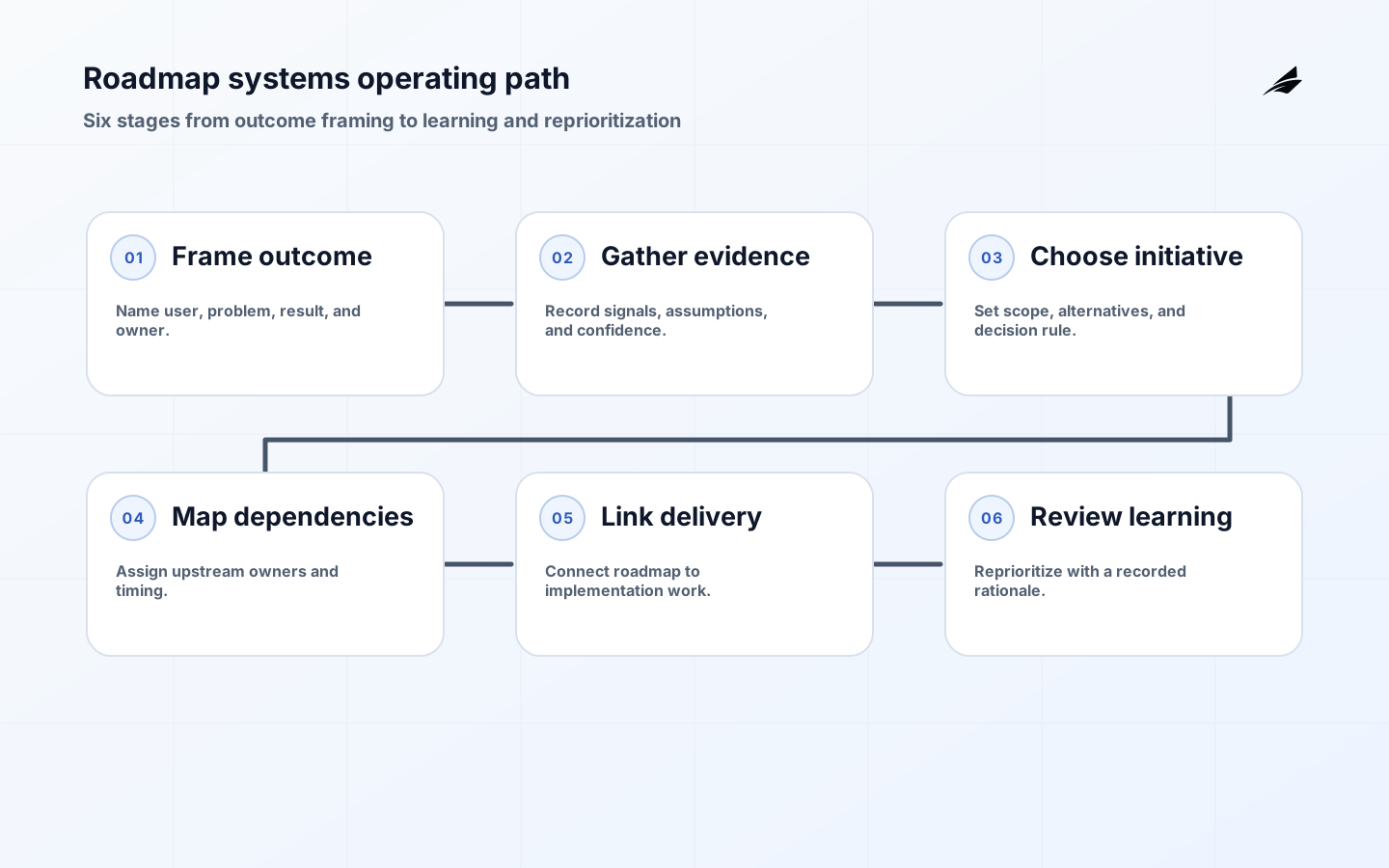
A roadmap system is more than a timeline of features. It is the operating mechanism that connects a customer or business outcome to evidence, a chosen initiative, engineering capacity, dependencies, delivery work, and the next review. Atlassian describes a product roadmap as shared context for vision, direction, priorities, and progress, while separating it from the detailed delivery plan. That distinction matters to engineering teams: a roadmap should explain why work is important and what direction is intended; sprint or project plans should explain how the team will execute. Edilec's roadmap systems checklist adds a practical control view to this guide.
Start with an outcome and decision
An initiative earns roadmap space when it changes a meaningful outcome or preserves an important capability. Write the decision in terms of user, problem, expected result, evidence, and owner. "Build export v2" is an output. "Reduce failed finance exports for workspaces with archived records" is a problem statement that can be tested. The outcome does not need to be perfectly quantifiable before discovery, but the team should know what evidence would increase confidence and what would make it stop. This avoids a roadmap filled with requests that no longer have a living reason to exist.
Keep evidence attached to the priority
Prioritization should leave a trail. Store customer evidence, product analytics, incidents, revenue or cost context, technical constraints, and the assumptions behind a score. A score without explanation is hard to challenge and easy to game. Make uncertainty visible: an initiative can be high impact but low confidence, or low urgency but necessary for a dependency. Use a short decision record when an item moves from discovery to commitment. It should name the evidence considered, the alternatives rejected, the constraint that shaped the choice, and the next point at which the decision will be revisited.
| Roadmap layer | Question it answers | Useful artifact |
|---|---|---|
| Outcome | What should improve or remain possible? | Metric, user journey, or risk statement. |
| Initiative | What coherent change could produce that result? | Scope boundary, hypothesis, and owner. |
| Dependency | What must happen elsewhere first? | Named team, decision, timing, and effect of delay. |
| Delivery | What work will implement the initiative? | Epic, milestone, or release link. |
| Learning | What evidence changes the next choice? | Review note, metric trend, or customer signal. |
Use horizons that match confidence
A near-term commitment can have more detail than a later opportunity because the evidence and constraints are better understood. Use quarters, months, or Now-Next-Later views for direction, and reserve exact dates for real commitments such as contractual milestones, regulatory deadlines, or coordinated migrations. An exact date on an uncertain item is often read as a promise even when the team intended it as a guess. Explain the confidence level and the condition that would move an item. This lets leaders discuss tradeoffs without forcing engineers to defend a calendar number that discovery has already invalidated.
Make dependencies decision-ready
A dependency is useful when it changes what the team can do. Record the upstream deliverable, owner, required interface or decision, latest safe date, and consequence of delay. Separate a hard dependency, such as an identity migration, from a coordination preference, such as sharing a release window. When two teams need the same platform capability, make the decision visible rather than hiding it in a status color. Link the roadmap initiative to delivery work so an engineering lead can trace the reason for a sequence and a product leader can see the implementation risk without opening every task. "
Create views for decisions, not for decoration
Leadership may need outcomes, investment, risk, and timing. An engineering team may need dependencies, interfaces, capacity, and decision owners. Customers may need a high-level direction without internal constraints. These are views of the same source, not separate roadmaps that drift apart. Atlassian's guidance separates roadmap communication from detailed plans and supports shared views with permissions. Apply the same principle locally: filter out irrelevant detail, retain provenance, and label uncertainty. If every audience sees the same crowded list, the roadmap becomes a database dump rather than a decision aid.
- Name the outcome and evidence before committing to an implementation shape.
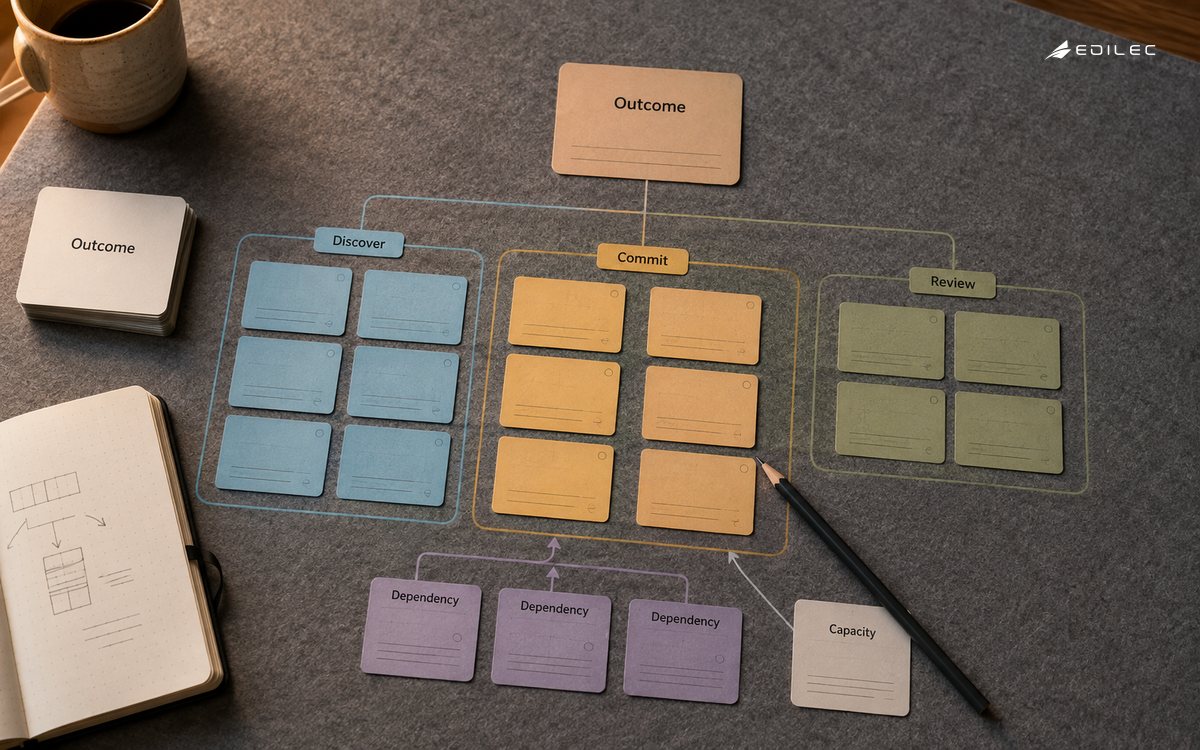
- Separate discovery, committed initiative, delivery work, and completed learning.
- Use confidence-aware horizons rather than false date precision.
- Record dependencies with an owner, decision, timing, and consequence.
- Publish audience-specific views from a source that preserves history and rationale.
Example: choose between reliability and a new surface
An engineering team has capacity for one major initiative. A sales request asks for a new reporting surface, while production evidence shows that export jobs fail for large workspaces. The roadmap record should compare the outcomes, not simply count request volume. The reporting initiative has strong customer interest but depends on a data model change; the export reliability work has a clear failure rate, owner, and recovery benefit. The decision may favor reliability first, with a discovery milestone for reporting and a dependency review after the data model work. This is not a permanent rejection. It is a reversible sequence with evidence and a next decision. "
| Decision signal | Reporting surface | Export reliability |
|---|---|---|
| Customer value | New visibility for selected roles. | More dependable existing finance workflow. |
| Confidence | Needs discovery and data-model validation. | Failure pattern and baseline already observed. |
| Dependency | Reporting model and permission design. | Job sizing, retries, and operational alerting. |
| Risk of delay | Opportunity cost and sales friction. | Repeated customer work and support escalation. |
| Next checkpoint | Validated prototype and user evidence. | Lower failure rate and tested recovery. |
Review without creating roadmap thrash
A roadmap should change when the decision context changes, not whenever a stakeholder asks for a different label. Set a review cadence for strategy and a faster path for urgent evidence such as a security issue or severe incident. When an item moves, preserve the reason: new customer evidence, changed constraint, dependency failure, capacity change, or completed learning. Communicate material changes in the same channel that established the earlier expectation. Frequent updates become credible when people can see the rule behind them; infrequent updates become dangerous when the roadmap stops reflecting reality.
Key takeaways
- A roadmap system connects strategy, evidence, initiatives, dependencies, delivery, and learning.
- Roadmap items should state why they matter and what would change the decision.
- Detailed engineering plans should link back to the roadmap without replacing it.
- Confidence-aware time horizons protect trust better than unsupported exact dates.
- Every reprioritization should preserve rationale and a next review point.
FAQ: Roadmap systems questions
FAQ: Should every engineering task appear on the roadmap?
No. The roadmap should contain coherent outcomes and initiatives that help people make priority or direction decisions. Link detailed epics, stories, and maintenance work to the relevant initiative without turning the high-level view into a task list.
FAQ: Are roadmap dates bad for agile teams?
Dates are useful when they represent a real constraint or commitment. They become misleading when an uncertain estimate is presented as a promise. Use ranges or horizons and explain confidence when discovery is incomplete.
FAQ: How should a team explain a roadmap change?
State what changed, why the evidence or constraint changed, what moves as a result, and when the decision will be reviewed again. This preserves trust even when the plan changes materially.
Connect roadmap choices to capacity and operating risk
A roadmap item is not feasible merely because an engineering team is assigned to it. Check the capacity needed for discovery, design, implementation, review, migration, support, and operational ownership. Include platform and security work that the initiative consumes, along with the cost of keeping existing reliability commitments. If an item requires a specialist who is already carrying an incident or migration, expose that constraint in the decision record. Capacity is not a reason to reduce every conversation to velocity; it is evidence about sequencing and the risk of promising work without the people needed to operate it.
Roadmap systems should also distinguish reversible learning from irreversible commitment. A prototype, instrumented spike, or customer interview can reduce uncertainty without promising a full build. A migration or public contract may require stronger evidence and an explicit rollback plan. Label the stage, decision owner, and next evidence so stakeholders know whether they are approving discovery, a bounded pilot, or a durable commitment. This prevents a research artifact from being read as a delivery promise and gives engineers room to learn before the roadmap hardens around an assumption.
For each roadmap review, Ask whether the evidence is still current, whether the initiative has a named decision owner, and whether the next delivery step remains the best use of capacity. Check the cost of delay for customers and operators, not only the effort to build. A roadmap system becomes credible when a team can explain why an item is now, next, later, paused, or removed in a sentence that points to evidence. Preserve that sentence with the item. It helps a new engineer understand the context and helps a leader compare a change in priority with the alternative work that was deferred.
A roadmap review is also a communication decision. Tell the teams whose sequencing, customer promise, or operational ownership changes, and keep the published view aligned with the decision record. Quiet changes create more thrash than visible changes with a reason.
A durable operating note for how engineering teams should think about roadmap systems records the assumptions that made the decision safe: the authoritative source, effective time, permitted actor, protected resource, and recovery route. For roadmap systems, review the think about roadmap systems control during normal handling.
For how engineering teams should think about roadmap systems, a good handoff ends with observable evidence rather than a verbal promise.
The smallest useful improvement to how engineering teams should think about roadmap systems is often a sharper boundary, not another feature.
For how engineering teams should think about roadmap systems, test a stale integration event before treating the first release as complete. Treat roadmap systems exceptions as evidence for the next decision.
A practical example for how engineering teams should think about roadmap systems is when a required input is absent at the moment of action. Give roadmap systems a named owner and a review date.
For Roadmap Systems, Product Roadmap Guide defines scope; Agile roadmaps supports the control; Create and manage Roadmaps clarifies evidence; Jira Product Discovery and Jira Plans guides recovery.
For roadmap systems, review the think about roadmap systems evidence during normal handling. For roadmap systems, review the think about roadmap systems scope during a dependency failure. The roadmap systems review applies this point to think about roadmap systems during a denied request.
For roadmap systems, review the think about roadmap systems ownership during a measured rollout. For roadmap systems, review the think about roadmap systems scope during normal handling.
For roadmap systems, review the think about roadmap systems scope during a measured rollout.
Conclusion
Engineering teams should think about roadmap systems as a connected decision practice, not a decorative schedule. Keep outcomes, evidence, dependencies, delivery links, confidence, and learning together, then create views that help each audience act. Edilec's release notes practical guide connects roadmap intent to shipped change, while the product support tooling guide helps bring customer evidence back into prioritization. A roadmap earns trust when it explains both where the team is going and why the next turn is justified.
Evidence for “How Engineering Teams Should Think About Roadmap Systems” is grounded in Product Roadmap Guide, Agile roadmaps, Create and manage Roadmaps, Jira Product Discovery and Jira Plans; each source informs a specific decision, test, or operating trade-off described in this guide.