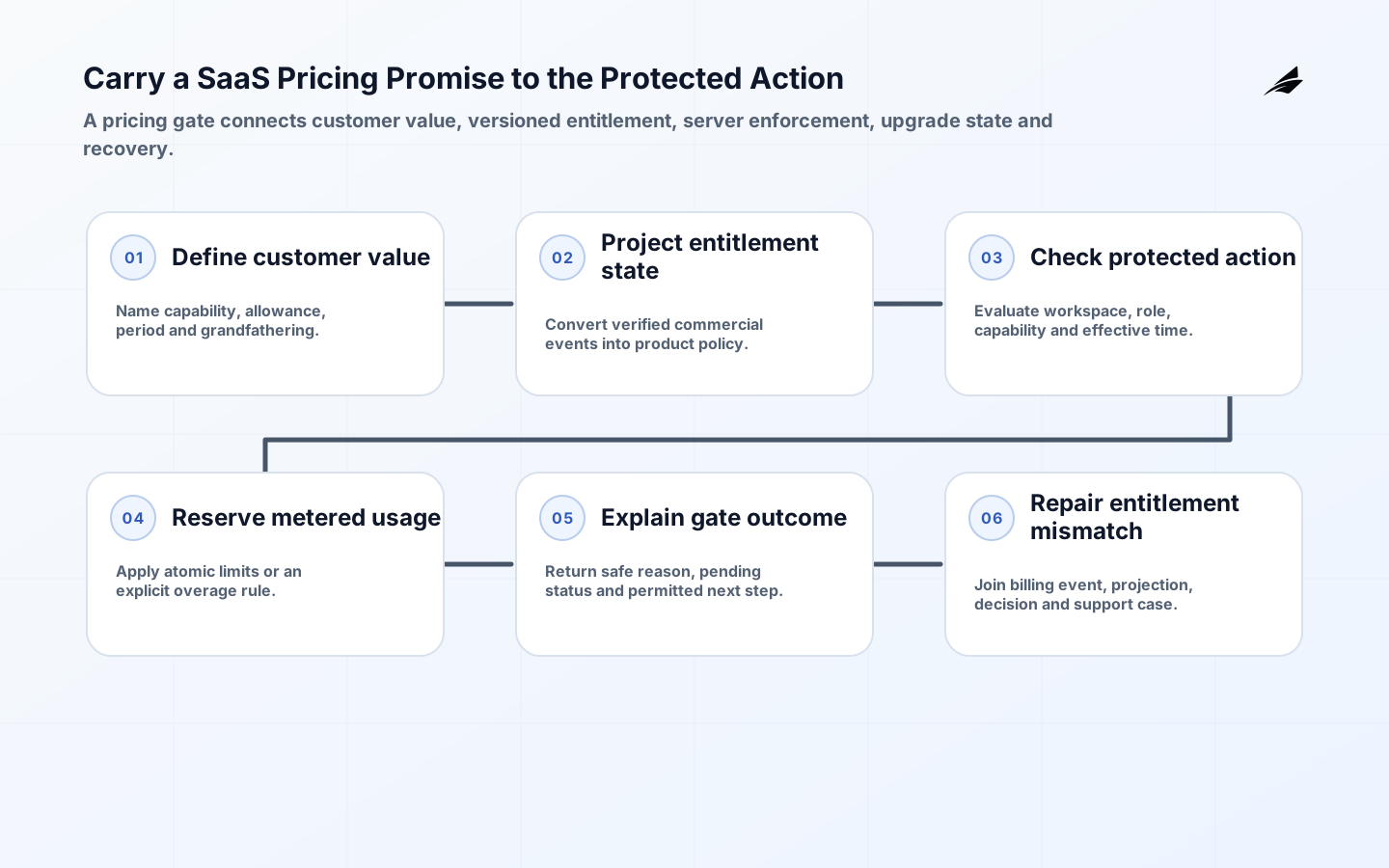
Pricing gates are the product behaviors that distinguish a plan, allowance, or add-on. They can make a valuable capability available, limit quantity, offer a trial, or direct a customer to an upgrade path. The gate is not just a locked button. It is a cross-system promise: product language should match the commercial offer, the server should enforce the actual rule, billing changes should update entitlement predictably, and support should be able to explain the decision without improvising.
Why Pricing Gates Matter
A poorly designed gate damages both conversion and trust. Customers may be surprised after investing time in a workflow, premium actions may be reachable through a direct API call, or an upgrade may succeed while the feature remains unavailable because systems disagree. The remedy is not to put every capability behind a modal. It is to decide where the customer receives value, which plan rule governs it, what happens at the limit, and how a qualified customer moves forward.
Start with the value boundary rather than a pricing-page category. A gate should align to a meaningful unit such as advanced collaboration, scheduled delivery, higher processing capacity, or regulatory controls. Do not price a hidden implementation detail that users cannot connect to an outcome. For each proposed gate, articulate the customer job, available alternative, plan or add-on rule, usage unit where applicable, and the support or recovery case. This makes the rule explainable before it becomes code.
Define the Value Boundary
Turn commercial language into a versioned entitlement policy. Rather than checking plan === premium, specify a capability key, audience, effective dates, limit, consumption rule, and any grandfathering terms. A workspace may have different rights from an individual user, so name the subject precisely. The policy should live independently of the interface and billing provider's raw status. This lets product services make a consistent server-side decision and lets the interface present the result clearly.

| Gate pattern | Customer value boundary | Implementation requirement |
|---|---|---|
| Capability gate | Access to a distinct advanced workflow. | Server verifies entitlement before protected work. |
| Quantity gate | A measured allowance such as active seats. | Atomic reservation or explicit overage policy. |
| Time gate | Trial or temporary access window. | Effective dates and expiry behavior are explicit. |
| Role gate | A plan includes controls for specific administrators. | Role and workspace entitlement are both evaluated. |
Design the customer experience around the moment of need. A disabled control can explain that the action is unavailable, but it should not expose sensitive capability details or misrepresent current entitlement. When an upgrade is appropriate, show the benefit, relevant plan, and the person who can purchase if the current user lacks authority. Preserve the person's work where possible. If an action cannot proceed, let them save a draft or export the information needed to continue after approval.
Enforce the Same Rule Everywhere
The resource-owning server must enforce a pricing gate before starting the consequential action. A client flag or navigation rule can improve clarity but cannot protect a direct request. Build a small entitlement decision interface that receives the workspace, actor, capability, requested quantity, and current time, then returns an allow, deny, or review outcome with a policy version. For costly work, reserve the allowance before dispatching a job and release it on a documented failure path.
Keep subscription events and policy evaluation separate. A verified billing event updates the entitlement projection, while the product checks that projected state at runtime. This avoids coupling every service to provider-specific status changes and gives teams a place to manage documented exceptions. An override should be attributable and expire. It must not silently change the plan catalogue or teach the customer that the gate can be bypassed through a support request.
Build Upgrade and Recovery Paths
An upgrade journey should state what changes, when it takes effect, and what the customer can do while it is processing. If the buyer is different from the active user, route the request with enough workspace context for a clean handoff. After payment, re-evaluate the entitlement on the server and refresh the relevant interface. Do not assume a redirect means access is active. For failures, show a pending or retryable state and give support a record of the commercial and product sides of the transaction.
| Customer situation | Product response | Back-end rule |
|---|---|---|
| Feature unavailable on current plan | Explain value and permitted next step. | Deny protected API action with a safe reason. |
| Limit nearly reached | Warn with current use and period details. | Measure from the authoritative meter. |
| Upgrade processing | Show pending state without a false success. | Wait for verified entitlement transition. |
| Entitlement mismatch | Offer support path with context. | Reconcile event, projection, policy, and action record. |
Test direct APIs, background jobs, simultaneous limit-consuming requests, plan changes, cancellation, refunds, paused subscriptions, manual concessions, and an unavailable billing dependency. Security tests should verify that a client cannot alter plan or limit inputs. Product tests should verify that a customer sees honest language and can recover their work. Finance and support tests should verify that a human can explain why a particular gate result occurred on a given date.
Review Pricing Behavior
Monitor denial reasons, upgrade starts and completions, time spent in pending state, limit-consumption errors, entitlement projection lag, temporary overrides, and support contacts attributed to a gate. Segment carefully by plan and customer type, but do not interpret a conversion change in isolation. A decline in upgrades may mean the gate is confusing, the value is weak, a release regressed the workflow, or customers found a legitimate alternative path. Combine metrics with customer research before changing commercial rules.
Example: Scheduled Reports
A product offers scheduled reports on a higher plan. The plan catalogue maps that benefit to a scheduled_reports capability and a maximum number of active schedules. The scheduling API evaluates workspace entitlement and atomically reserves an allowance before storing a schedule. A user without purchase authority sees the benefit and can request an upgrade from the workspace owner; their report configuration is retained. A verified billing event updates entitlement, and the API rechecks it before activation. Support can grant a documented temporary exception that expires automatically.
The subscription access control guide is helpful when pricing gates need a durable policy boundary. Review one existing gate across the interface, API, billing event, support tool, and customer message. Any difference in outcome is a concrete improvement target.
Review Pricing Policy in Production
Review a sample of gate outcomes after each pricing or entitlement change. Include new purchases, renewals, cancellations, customers with legacy terms, limit-bound workspaces, and support-granted exceptions. Compare the catalogue language, billing event history, entitlement record, server decision, and customer-visible state. This small audit makes differences concrete: a rule may be correct in one service but stale in an export worker, or a help message may promise immediate access while the policy correctly waits for verification.
Pricing policy also needs change ownership. Product owns the value proposition, finance owns commercial correctness, engineering owns reliable enforcement, and support owns an explainable recovery experience. Put one person in charge of the policy contract and require cross-functional review for material changes. Repeated exceptions, unexpected denials, or confusing upgrade paths are not merely support metrics. They are evidence that the product's commercial rule needs clarification, simplification, or a more durable implementation.
Keep entitlement evaluation observable without making it a new source of sensitive data. Log a decision identifier, capability, policy version, outcome, and safe reason code; restrict the detailed inputs to authorized diagnostic systems. This lets engineers compare a customer report with the exact policy applied, and lets product teams see where gates cause friction, while limiting exposure of billing or identity data. Make the decision record part of the support workflow so explanations are evidence-based rather than reconstructed from several disconnected systems.
Avoid making every gate a binary denial. Some value boundaries are better served by a read-only state, a lower-cost alternative, a saved draft, a request-to-purchase handoff, or a temporary usage warning. The correct response depends on the job and commercial rule, but it should be intentional. A respectful alternative can preserve customer progress and make the offer understandable, while the server still protects the capability that requires entitlement.
Test pricing messages with the people who encounter them. A buyer, workspace owner, contributor, and support agent may all see different states around the same gate. Check that each understands the value, current status, authority boundary, and next permitted step. Feedback from those tests often reveals a mismatch between a commercially correct rule and an opaque product experience. Fixing that mismatch is not merely conversion work; it reduces avoidable support, unsafe workarounds, and customer frustration.
Key Takeaways
- Base each gate on an understandable customer value boundary.
- Represent plan rules as versioned entitlements rather than client-side plan checks.
- Enforce gates beside the protected server action and build a clear recovery path.
- Review gate behavior using product outcomes, entitlement health, and customer context together.
Frequently Asked Questions
Should every premium feature show a locked state? No. Show a gate where it helps a user understand a relevant option; avoid cluttering the product with unavailable controls. Can a feature flag manage pricing? It can coordinate a rollout, but the durable commercial rule should be an entitlement policy enforced by the server and synchronized with billing.
Conclusion
Pricing gates work when they express a coherent product promise from plan design to protected action. Clear value boundaries, consistent entitlement enforcement, honest upgrade states, and reviewable exceptions let a SaaS business monetize responsibly without making the product feel arbitrary or unsafe.
Sources
Check integration details in Stripe Billing and Stripe webhooks, then use the OWASP ASVS and NIST SP 800-207 to review enforcement and access decisions.