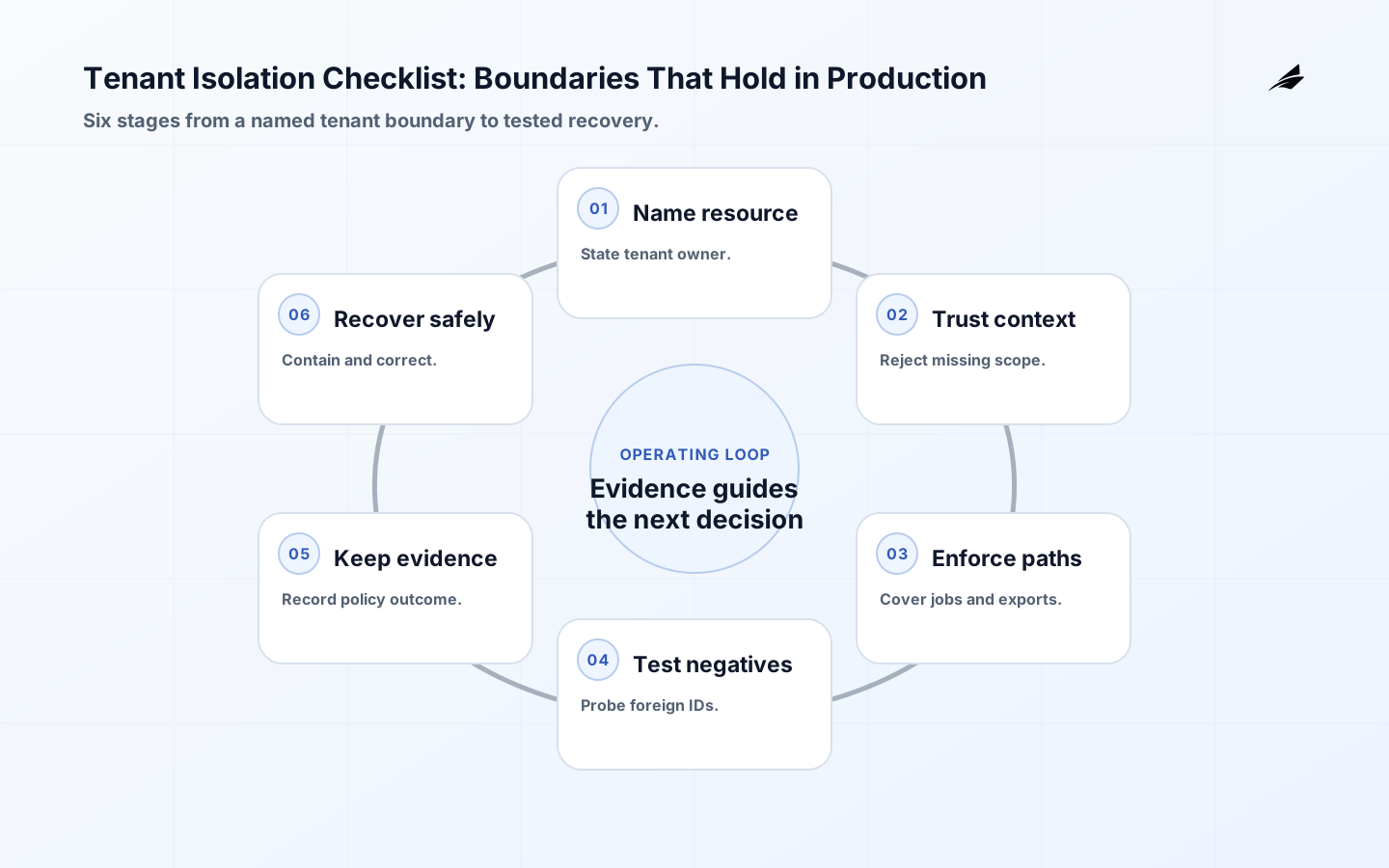
A tenant isolation checklist is a reliability and security tool, not a database naming exercise. In a multi-tenant product, one request can touch an API, queue, cache, object store, export job, admin console, and support workflow. A boundary that works only at login is incomplete. This guide turns the concern into decisions a product and engineering team can review: what belongs to a tenant, where context comes from, which layer enforces it, how failures are tested, and what an operator can prove after an incident. Use it alongside the plain-language guide to workspace models and the multi-tenant architecture production guide. Keep isolation checklist digital visible when the normal path changes.
Start the tenant isolation checklist with a named boundary
Write the protected resource before choosing a partitioning technique. It may be a workspace record, uploaded file, report, job, billing object, or a derived search result. For each resource, state the tenant context, the allowed action, the actor or service making the request, and the consequence of a wrong decision. AWS describes tenant isolation as preventing one tenant from accessing another tenant's resources, while also noting that the right approach depends on the domain, compliance needs, deployment model, and services in use. That is a useful starting point: the checklist should preserve the business boundary even when the infrastructure changes.

| Boundary question | Decision to record | Evidence that survives a review |
|---|---|---|
| What is protected? | Named resource and tenant owner | Resource identifier, tenant identifier, classification |
| Who may act? | Actor, service role, and permitted operation | Policy version and decision reason |
| Where is context found? | Trusted session, token, route, or server lookup | Source, freshness, and validation result |
| What happens on uncertainty? | Deny, quarantine, or request correction | Safe response, alert, and recovery owner |
Choose an isolation shape without confusing it for enforcement
A silo gives a tenant a dedicated slice of infrastructure; a pool shares infrastructure while applying logical or policy-based boundaries; a bridge combines the two. The choice changes cost, scaling, blast radius, migration effort, and the evidence needed to satisfy a customer. It does not eliminate the need for request-level checks. AWS explicitly warns that authentication and authorization are not equal to isolation, and that shared resources require especially deliberate controls. Record the reason for the chosen shape so a future team does not mistake a convenient deployment topology for a complete security argument.
Enforce tenant context at every execution path
Centralise the rule where it can cover ordinary and less visible work. A server-side policy or data-access boundary should require tenant context instead of allowing each feature developer to remember a filter. Apply the same discipline to REST and GraphQL requests, asynchronous consumers, scheduled jobs, file downloads, full-text search, caches, and internal tools. Client-side hiding can improve the interface but cannot make an authorization decision. OWASP recommends least privilege, deny by default, checking permissions on every request, and handling failed checks safely. Translate those principles into a small set of shared primitives and make their absence a test failure.
- Derive tenant context from a trusted source and reject a missing or conflicting value.
- Keep tenant scope in repository and query interfaces so a caller cannot silently omit it.
- Partition object-store keys, cache keys, event subjects, and export destinations consistently.
- Use separate support permissions for viewing metadata, content, and recovery actions.
- Log a policy decision with tenant, actor, resource class, outcome, and correlation identifier without recording unnecessary sensitive data.
Test negative paths, not only the happy path
Isolation defects often hide in code that is not part of the first user journey. Build a test matrix around guessed identifiers, stale sessions, tenant switching, replayed jobs, duplicated events, bulk exports, deleted workspaces, and privileged support access. For each case, assert both the visible result and the side effects: no foreign record in a response, no cross-tenant cache hit, no leaked filename, no event routed to the wrong consumer, and no audit entry that suggests success. Keep two synthetic tenants in every integration environment and run the matrix after changes to authorization, routing, storage, or background processing.
| Scenario | Expected outcome | Useful signal |
|---|---|---|
| User changes a resource ID | Request is denied or looks not found without data leakage | Denied decision and response class |
| Worker receives a stale tenant context | Job stops safely and enters a repair queue | Rejected job with correlation ID |
| Export includes mixed records | Export is blocked before delivery | Preflight scope mismatch |
| Support agent requests recovery | Narrow permission and reason are required | Expiring elevated-access event |
Give operators tenant-aware evidence
A boundary is easier to maintain when an operator can explain what the product believed at the time of a decision. Expose tenant-aware latency, error, queue, export, and authorization signals without turning every customer field into a dashboard dimension. Keep a correlation identifier across the request, event, job, and repair record. When a support report arrives, the first question should be answerable from the system: which tenant, which resource, which policy version, which actor, and which outcome? NIST's secure development framework is useful here because it treats repeatable practice and communication as part of reducing risk, not as documentation after the build.
Design recovery before a cross-tenant incident
The safest recovery path stops further propagation, preserves the original evidence, identifies the affected tenant set, and uses a reversible correction. Do not overwrite a bad relationship and discard the old value; record the source, decision, correction authority, and effective time. If a queue or cache is suspected, pause the affected consumer or invalidate the narrow scope before performing a broad restart. Prepare customer communication separately from technical repair: a clear acknowledgement can be honest about investigation status without exposing another tenant's information. A recovery rehearsal should include an incomplete record and a human decision, not only a clean rollback.
Roll out the checklist in an order teams can sustain
Start with the highest-consequence resource and one representative read and write workflow. Establish the shared context primitive, add negative tests, then extend the rule to background and administrative paths. Measure rejected calls, test coverage, repair age, privileged-access duration, and cross-tenant regression results. A low number of denials is not proof of safety; it may mean the checks are bypassed or the tests are too narrow. Review sampled cases with product, engineering, security, and support before expanding to more resources. This makes the checklist a living operating agreement rather than a one-time sign-off.
Run a practical tenant isolation review
A review is most useful when it follows one resource through the whole system. Pick a report, file, or job and write down how the tenant scope enters, where it is checked, which downstream calls inherit it, and how an operator would investigate a dispute. Then repeat the exercise for a path that starts without a logged-in person, such as a scheduled export or queue consumer. Ask what happens if the scope is missing, stale, duplicated, or deliberately changed. Capture the answer as a test or a control owner, not as a meeting note. This review also exposes boundary gaps caused by convenience features: a global search index, a shared cache, a bulk support action, or a migration script may use a different access path than the main application. The goal is a small, repeatable examination that can run before a release and after a material architecture change.
Keep the checklist close to change management. A new cache, export format, reporting query, or support shortcut can create a new tenant path even when the visible feature looks unchanged. Add a boundary question to design review, a negative test to the release gate, and a recovery owner to the runbook. When a test fails, preserve the failing tenant pair and resource class so the regression can be reproduced. This small habit makes isolation a property of the product's evolution rather than a document that describes only the original architecture.
One practical acceptance example is a report request that is copied from a valid tenant into a second tenant's URL, then repeated through a background export. Both paths should fail without revealing whether the foreign report exists. The operator record should show a denied decision and a correlation key, while the customer message should remain general and actionable. Keeping the same example across API, worker, and download tests makes gaps visible when a new path is introduced.
Key takeaways
- Name the resource and consequence before selecting silo, pool, or bridge isolation.
- Treat tenant context as a required input across APIs, jobs, storage, exports, and operator tools.
- Use server-side deny-by-default checks and test guessed identifiers as deliberately as normal requests.
- Keep decision evidence and recovery authority narrow, attributable, and reversible.
- For related planning, See the trial conversion checklist and the plain-language guide to roadmap systems. Apply the rule to isolation checklist digital before widening the rollout.
Frequently asked questions
Is an opaque identifier a tenant isolation control?
No. Hard-to-guess IDs reduce casual enumeration but do not authorise access. The server must check the relationship between the actor, tenant, resource, and requested operation on every relevant request.
When is a separate database justified?
Use a separate database when contractual, regulatory, operational, or blast-radius requirements make a shared model inappropriate. Document the trade-off and keep common request and recovery controls; a silo still needs correct identity, permissions, jobs, and exports.
What evidence should a release review include?
Include the boundary statement, policy owner, changed paths, negative-test results, sample authorization events, rollout limits, and a rehearsed recovery action. The reviewer should be able to trace one resource from request to decision without relying on a developer's memory.
Conclusion: make the boundary ordinary and testable
Reliable tenant isolation is the result of many small, consistent decisions: trusted context, central enforcement, negative tests, narrow support access, tenant-aware evidence, and rehearsed recovery. The infrastructure model matters, but the durable promise is simpler: one customer's resource is never treated as another customer's resource. Start with the boundary that carries the greatest consequence, make it visible in code and operations, and expand only when the evidence shows the control behaves under real workload and failure.
For tenant isolation checklist, a good handoff ends with observable evidence rather than a verbal promise. For tenant isolation checklist, name the decision boundary and its owner.
The smallest useful improvement to tenant isolation checklist is often a sharper boundary, not another feature. Keep customer language aligned with the recorded state for tenant isolation checklist.
For tenant isolation checklist, test a duplicated request before treating the first release as complete. Make tenant isolation checklist corrections visible, scoped, and reversible during reliable digital operations.
A practical example for tenant isolation checklist is an operator loses access during a handoff. Measure tenant isolation checklist outcomes alongside correction effort.
This decision also connects to Trial Conversion Checklist for Reliable Digital Operations, The Plain-language Guide to Workspace Models, Plain-language Roadmap Systems for Better Decisions. Review those boundaries together when tenant isolation checklist shares identity, data, billing, or support evidence with another workflow.
For Tenant Isolation Checklist, Tenant Isolation - SaaS Lens defines scope; The isolation mindset - SaaS Lens supports the control; Authorization Cheat Sheet clarifies evidence; Secure Software Development Framework (SSDF) Version 1. 1 guides recovery.
For tenant isolation checklist, test an unexpected load spike before treating the first release as complete. For tenant isolation checklist, review the for reliable digital operations scope during a dependency failure.
A practical example for tenant isolation checklist is a delayed dependency. For tenant isolation checklist, review the for reliable digital operations evidence during a measured rollout.
Ownership for tenant isolation checklist is clearer when the customer promise is separated from the mechanism. For tenant isolation checklist, review the for reliable digital operations ownership during a measured rollout.
Evidence for “Tenant Isolation Checklist: Boundaries That Hold in Production” is grounded in Tenant Isolation - SaaS Lens, The isolation mindset - SaaS Lens, Authorization Cheat Sheet, Secure Software Development Framework (SSDF) Version 1.1; each source informs a specific decision, test, or operating trade-off described in this guide.