How Engineering Teams Should Think About Workspace Models
Workspace models determine which organization a person is acting for, which records belong together, and who can change the relationship. A workspace is therefore more than a navigation label. It is a business boundary with membership, invitations, ownership, lifecycle, and recovery rules. Engineering teams should make those rules explicit before adding domain features, because every later resource will inherit the workspace decision. The target is a model that a user can understand, an API can enforce, and an operator can repair without guessing from browser state.
Make the workspace models decision explicit
The central decision for workspace models is that a workspace is a business boundary with a lifecycle, not just a navigation switcher. Those details make disagreements tractable. The earlier related guide, subscription access control architecture guide, is useful context when the work touches adjacent product operations, but it does not replace a decision record for this specific workflow.
| Decision area | Question to resolve | Evidence to keep |
|---|---|---|
| Authority | Which record can decide workspace models now? | Owner, version, and effective time. |
| Boundary | Where is the rule enforced? | Policy result, actor, target, and reason. |
| Exception | Who may change the normal path? | Approver, expiry, and recovery action. |
| Review | How will drift be detected? | A trend tied to expired invitations, orphaned workspaces, role-change failures, and authorization denials. |
Build a Workspace Models model people can explain
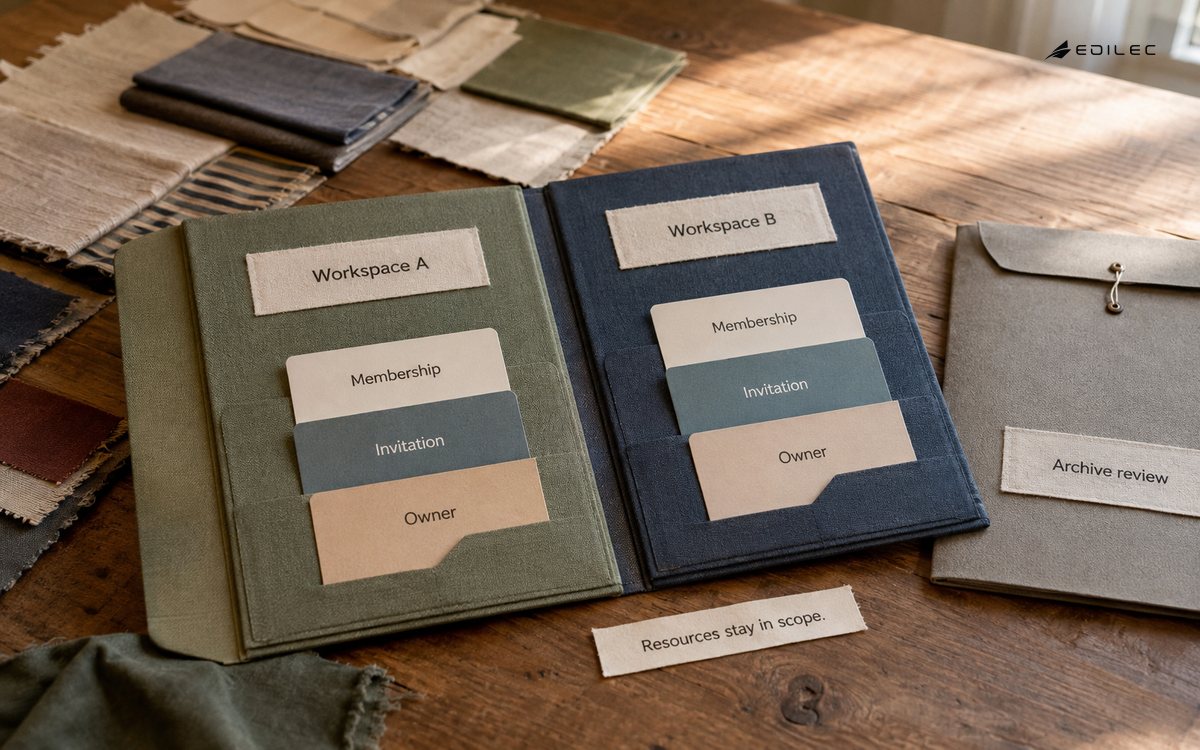
A practical model for workspace models have three layers: a stable business definition, an enforceable system rule, and an observable operating loop. Treat the workspace as the container that gives meaning to memberships, records, roles, billing relationships, and audit history. Decide whether people can belong to several workspaces, whether email-domain matching is advisory or authoritative, and how a person proves they may accept an invitation. The system should be able to answer which workspace a request targets without inferring it from a remembered browser state.
Implement the smallest dependable Workspace Models path
Add automated checks at the boundary where workspace models can cause harm, and keep the customer-visible state aligned with the internal record. Define durable identifiers for workspace, member, invitation, role grant, and ownership transfer. Model pending, accepted, suspended, and removed memberships separately so a failed invite cannot be mistaken for an active right. Server-side authorization must compare the requested workspace with the resource's workspace on every action. Test role changes and account merges as carefully as initial enrollment, because those lifecycle transitions produce the most confusing access bugs.
- Write the workspace models rule in plain language before encoding it.
- Name the source of truth and the state transition owner
- Test a normal case, an invalid case, and a recovery case.
- Keep customer-facing status aligned with the authoritative record
- Assign an expiry or review date to temporary exceptions
Operate Workspace Models with evidence, not assumptions
Operating workspace models requires a short, reviewable set of signals instead of a broad dashboard with no decision attached. Monitor expired invitations, orphaned workspaces, role-change failures, and authorization denials. Review guest accounts, invitations past their expiry, owners who have left the company, and integrations that use service identities. Keep a support path for recovering a locked-out legitimate owner without making an informal support request an unlogged privilege escalation. Workspace-level telemetry should show invitation acceptance, membership changes, authorization failures, and administrative changes while avoiding unnecessary personal data in event attributes.
| Signal | What it can reveal | First response |
|---|---|---|
| Unexpected denial or failure | A boundary, context, or data-quality problem. | Inspect the decision record and affected scope. |
| Manual override | A missing path or unclear responsibility. | Require a reason, expiry, and follow-up review. |
| Stale or inconsistent state | A delayed dependency or weak reconciliation. | Compare source evidence and replay safely. |
| Customer confusion | A mismatch between system state and explanation. | Improve the visible state before adding more controls. |
Treat workspace membership as a lifecycle
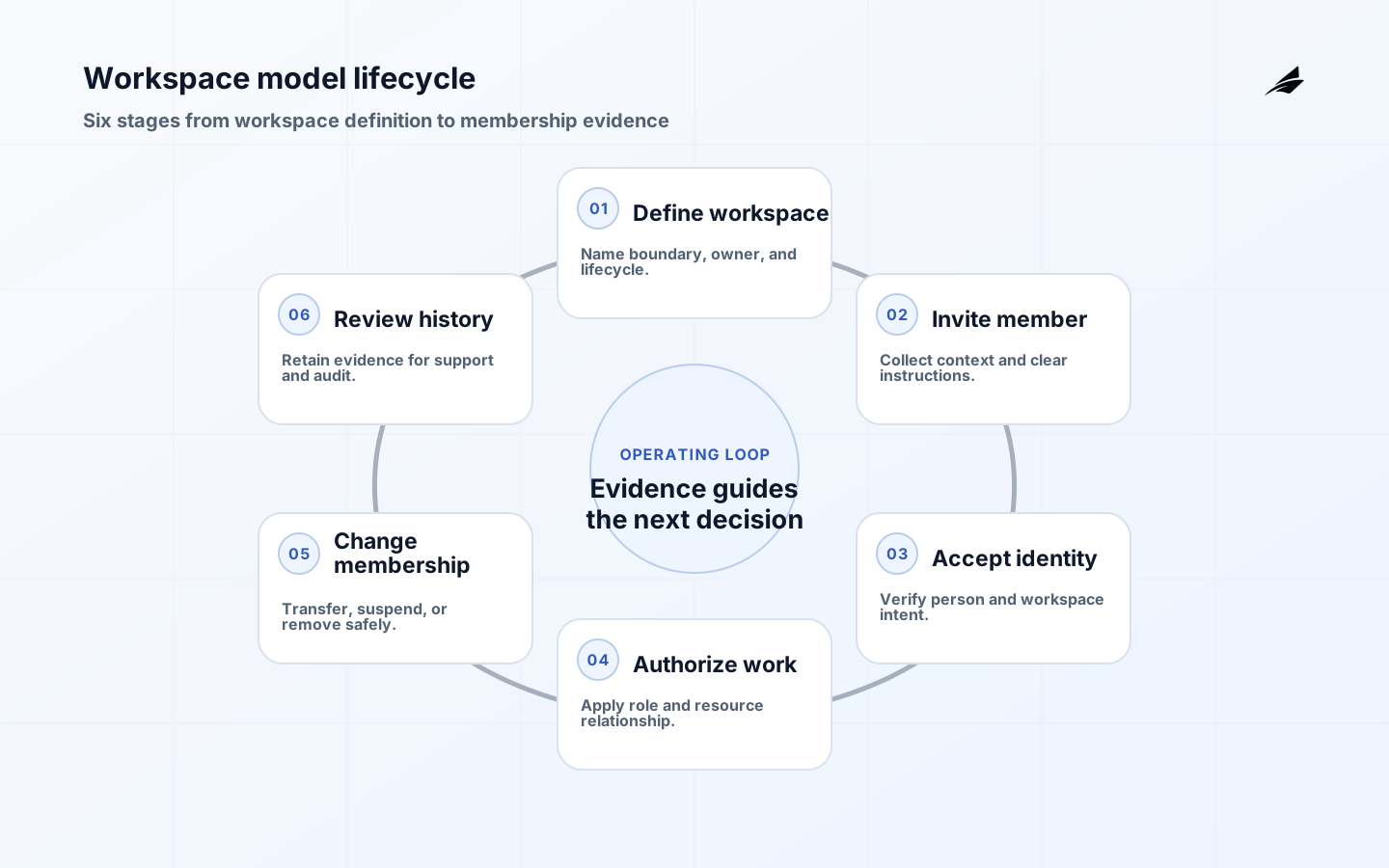
Model invitation, acceptance, role change, suspension, transfer, and deletion as separate transitions. For each one, identify the actor, proof, affected resources, notification, and reversal. Email-domain matching may help discover a workspace but should not silently prove membership. A person who belongs to several workspaces needs an explicit active context, and every consequential request should carry or resolve that context at the service boundary.
Ownership is where workspace models often fail. If the original creator leaves, the system needs a transfer policy, an eligible replacement, and a record of the decision. If a workspace is suspended, decide whether members can export, view history, or contact support. If membership is removed during a long request, define whether the operation completes, is cancelled, or is rechecked before the side effect. These details turn a model into a dependable product rule.
| Decision point | Required record | Safe review question |
|---|---|---|
| Boundary | Actor, resource, scope, and policy | Can the service decide without guessing? |
| State | Current value, effective time, and source | What does the customer see and why? |
| Recovery | Owner, reason, expiry, and result | Can the team correct or contain it safely? |
Evidence that changes Workspace Models
The current NIST SP 800-63-4 digital identity guidelines emphasize risk-based identity, privacy, and redress. The W3C forms tutorial provides practical guidance for invitations and membership forms, including labels, instructions, validation, and useful error feedback. OWASP authorization guidance supports least privilege and per-request checks, and OpenTelemetry semantic conventions help keep workspace, actor, and outcome fields consistent across telemetry.
Connect the model to the workspace models implementation checklist, subscription access control architecture guide, and product analytics production guide. The links are useful when a workspace boundary affects permissions, paid capability, or event interpretation.
Workspace Models: practical questions before rollout
Can one person belong to multiple workspaces?
Yes, when the product supports it, but the active workspace must be explicit and authorization must resolve the requested workspace from trusted context. Do not rely on a remembered client selection for a sensitive action.
Should email-domain matching automatically add a person to a workspace?
Usually no. It can suggest or route an invitation, but membership should follow an explicit invitation, approval, or identity-provider rule that the organization understands.
What is the first workspace model to implement?
Implement one bounded workflow covering creation, invitation, acceptance, role change, and removal. Include an ownership-transfer case and an audit record before adding complex hierarchy or cross-workspace sharing.
Key takeaways for engineering teams
- Workspace models should have a written business definition and a named owner.
- For How Engineering Teams Should Think About Workspace Models, Keep the recovery evidence explicit.
- Record reasons, effective times, and expiry for exceptional handling
- For How Engineering Teams Should Think About Workspace Models, Keep the recovery evidence explicit
- For How Engineering Teams Should Think About Workspace Models, Keep the recovery evidence explicit
Frequently asked questions about workspace models
Where should the Workspace Models team start?
For workspace models, a prototype is only persuasive when it uses representative identities, records, and failure conditions.
Who should own Workspace Models?
Ownership for workspace models is shared but not vague. Keep workspace models observable, owned, and recoverable through the next review.
What should trigger a Workspace Models review?
For workspace models, Investigate when a legitimate person cannot reach the workspace they should own, or when a departed person retains a role through an old invitation, group sync, or service account. Trace the membership lifecycle rather than changing a role in place: who issued the invitation, what identity accepted it, which organization was selected, and which policy calculated the effective permission? The repair may require an expiry rule, an ownership-transfer flow, a clearer switcher, or a stronger server-side comparison between resource and workspace. Add regression cases for duplicate emails, merged accounts, expired invites, and an owner leaving before a handoff is complete. A workspace is usually where a team stores durable customer work, so recovery should be deliberate and logged. Fast support is important, but a support agent should not need broad standing access merely to help a verified owner regain the correct context.
A durable operating note for how engineering teams should think about workspace models records the assumptions that made the decision safe: the authoritative source, effective time, permitted actor, protected resource, and recovery route. Make workspace models corrections visible, scoped, and reversible during about workspace models.
For how engineering teams should think about workspace models, a good handoff ends with observable evidence rather than a verbal promise.
The smallest useful improvement to how engineering teams should think about workspace models is often a sharper boundary, not another feature.
For Workspace Models, NIST SP 800-63-4 Digital Identity Guidelines defines scope. Explain workspace models pending and denied states before expansion.
For workspace models, review the think about workspace models scope during a measured rollout.
Measure the outcome alongside correction effort and unresolved exceptions.
Document the cited control, its scope, and the conditions for expansion.
Rehearse the control and evidence path before release.
A practical workspace-model example is a membership change that arrives after a user has begun an action. Reconcile the current tenant state, preserve the event history, and document the recovery decision.
Ownership for workspace models is clearer when the customer promise is separated from the mechanism. Name the owner for membership, tenant boundaries, and support recovery.
Teams building workspace models should compare a successful member action with a changed-permission case. Review the workspace, actor, and authorization evidence with product, engineering, and support before expansion.
The review discipline. Keep the recorded state aligned with the explanation given to customers.
Test a workspace-membership change with realistic account and tenant identifiers. Confirm the owner, resulting authorization state, and recovery action in the record.
Teams building workspace models should compare a successful member action with a support-handled interruption. Compare the normal and interrupted states before release and confirm that both preserve tenant context.
Conclusion
Workspace models earn trust when a customer, operator, and engineer can reach the same explanation of what happened and what should happen next. The result is not bureaucracy. Before widening self-service membership, test the full lifecycle with realistic company changes: an invite sent to the wrong address, an expired invitation, a user moving between workspaces, a departing owner, and a support recovery request. The outcome should make it clear which membership is active, who can transfer responsibility, and which action is recorded. Good workspace design makes collaboration easy without making organizational context a guess.
A quarterly access review should include a short list of workspaces with unusual ownership, dormant members, or pending invitations. Resolve each state through the normal lifecycle rather than a database fix. The resulting evidence helps teams simplify the model and lets customers trust that organization changes will not quietly strand their work.
Sources for workspace models
- OWASP Authorization Cheat Sheet
- NIST Digital Identity Guidelines
- W3C Forms Tutorial
- OpenTelemetry semantic conventions
Evidence for “How Engineering Teams Should Think About Workspace Models” is grounded in NIST SP 800-63-4 Digital Identity Guidelines, OWASP Authorization Cheat Sheet, WAI Forms Tutorial, OpenTelemetry Semantic Conventions; each source informs a specific decision, test, or operating trade-off described in this guide.