Onboarding Flows: Engineering Notes
Onboarding flows are a product-engineering decision about how a system will help a newly eligible person reach an early product outcome without hiding prerequisites, consent choices, or the path to recover from a blocked step. For onboarding flows, review control during normal handling. For onboarding flows, review evidence during normal handling.
Define the onboarding flows decision
Start by writing the boundary in ordinary language. For onboarding flows, that boundary includes entry trigger, account context, required information, verification, first-value action, handoff, and recovery state. The first design decision is what moment counts as activation, which data is necessary before value can be shown, and which steps are mandatory versus safely deferrable. Review onboarding-flow evidence with product, engineering, and support.
| Decision area | Question to answer | Evidence to retain |
|---|---|---|
| Authority | Which record is allowed to decide the current state? | Owner, source, and effective time for onboarding flows. |
| Enforcement | Where is the rule applied rather than merely shown? | Policy version, actor, target, and result. |
| Exception | Who may override the normal path, and for how long?. | Reason, approver, expiry, and recovery action. |
| Review | How will a team know the design still matches reality?. | Sampled decisions, operational signal, and review date. |
Model the onboarding flows lifecycle
A useful onboarding flows model makes state transitions and responsibility explicit.
- Name one business owner and one technical owner for each consequential onboarding flows rule.
- Version policies and interfaces so a past decision can be reproduced for its effective time
- Design a denied path and a recovery path; successful demonstrations rarely expose the risky behavior
- Make support actions visible to the same audit model as automated actions
- Use the OWASP ASVS to test onboarding identity, authorization, session, and data-protection controls at the points where the flow changes state.
Build a narrow onboarding flows path first
Map the actual first session from invitation or sign-up to the first durable outcome. Each step should state its prerequisite, owner, saved state, and recovery action. Use progressive disclosure for optional configuration, but do not defer permissions, payment confirmation, or compliance checks that are truly required. Resume links and draft state need the same authorization checks as the initial route.

Test Onboarding Flows failure behavior before expanding
An onboarding flow fails when it optimizes completion clicks instead of the customer’s first successful job. Forced tours, unexplained permissions, and dead-end verification emails create apparent activity with little value. It also fails when a support agent cannot see which prerequisite blocked the person, leading to unsafe manual bypasses.
| Test condition | Expected behavior | Review signal |
|---|---|---|
| Missing context | Contain the action or require a safe recovery step. | A clear denial or pending state with no silent side effect |
| Duplicate delivery | Produce one durable outcome or a documented idempotent result | Stable event identity and an investigation trail. |
| Late dependency event | Reconcile the new fact without hiding the earlier decision | Visible correction, timestamp, and accountable owner. |
| Operator intervention | Apply the same scoped policy and capture the reason. | Actor, target, action, result, and expiry in the record. |
Operate onboarding flows with evidence
Measure time to first durable outcome, completion and abandonment by step, verification failure, retry success, support contacts before activation, and activation quality after seven or thirty days. Read session-level examples alongside funnel rates; a high completion rate can still contain confusing workarounds. OpenTelemetry documentation is useful for thinking about traces, metrics, and logs as correlated signals, but telemetry must be scoped to the decision a team needs to make.
Onboarding retries should restore progress without bypassing a changed prerequisite. A person who resumes a verification step after a role change, payment failure, or expired invitation needs a current authorization check and an explanation of what changed. Keep draft state separate from completed state, protect resume links as carefully as the original entry route, and avoid assuming that a client-side progress indicator proves the server accepted the step.
Connect Onboarding Flows to adjacent product work
Onboarding Flows does not sit alone. Teams often need to align it with Workspace Models: Implementation Checklist, Customer Feedback Loops: Operations Playbook, Onboarding Flows: Engineering a Safe Path to First Value. Keep onboarding flows notes visible when the normal path changes.
Review onboarding flows in real operating conditions
Read onboarding evidence at three levels. The funnel shows where cohorts leave; session or support records show why a person could not proceed; retained behavior shows whether the completed flow produced value. Put those views in the same review. A quick completion metric can improve while customers arrive at an empty workspace or lack the permissions to continue, which is success only in the narrowest possible sense.
Run a onboarding flows pre-launch review
Before shipping an onboarding change, conduct a recovery-focused usability review. Ask a participant to begin on one device, stop at a required step, return with a changed role or expired invitation, and complete the task without help. Observe whether the product explains what happened and whether support can identify the blocked prerequisite from the record. Test accessible labels, mobile layout, slow email delivery, and a user who is invited to more than one workspace. The review should produce exact messages and recovery actions, not only a new conversion target. Clarity in the blocked state is often the difference between a recoverable interruption and an abandoned account.
Onboarding Flows takeaways
- Define onboarding flows in terms of a decision, its evidence, and its accountable owner.
- Enforce consequential rules where the resource or action is protected, not only in the user interface
- Make retries, late events, and human exceptions first-class states
- Use operating signals to trigger review, then inspect representative decisions before changing policy
- Retire temporary controls, overrides, and obsolete event versions on a named schedule
Onboarding flows: FAQ for the engineering workflow.
What should a team build first for onboarding flows?
Start with one persona and one early outcome, such as joining a workspace and completing a first shared task. Map each prerequisite, saved state, and recovery action. Include a failed verification or missing permission. This is more informative than a polished tour because it shows whether the product can explain blocked progress and support a person who returns after an interruption.
How should teams use guidance for Onboarding Flows?
For onboarding flows, use security and transport guidance to test the boundaries around invitations, verification, retries, and state recovery. The guidance does not choose the right activation moment. Product teams must define that moment from the customer's job, then confirm that required consent, payment, or compliance steps are clear rather than disguised as friction to be removed.
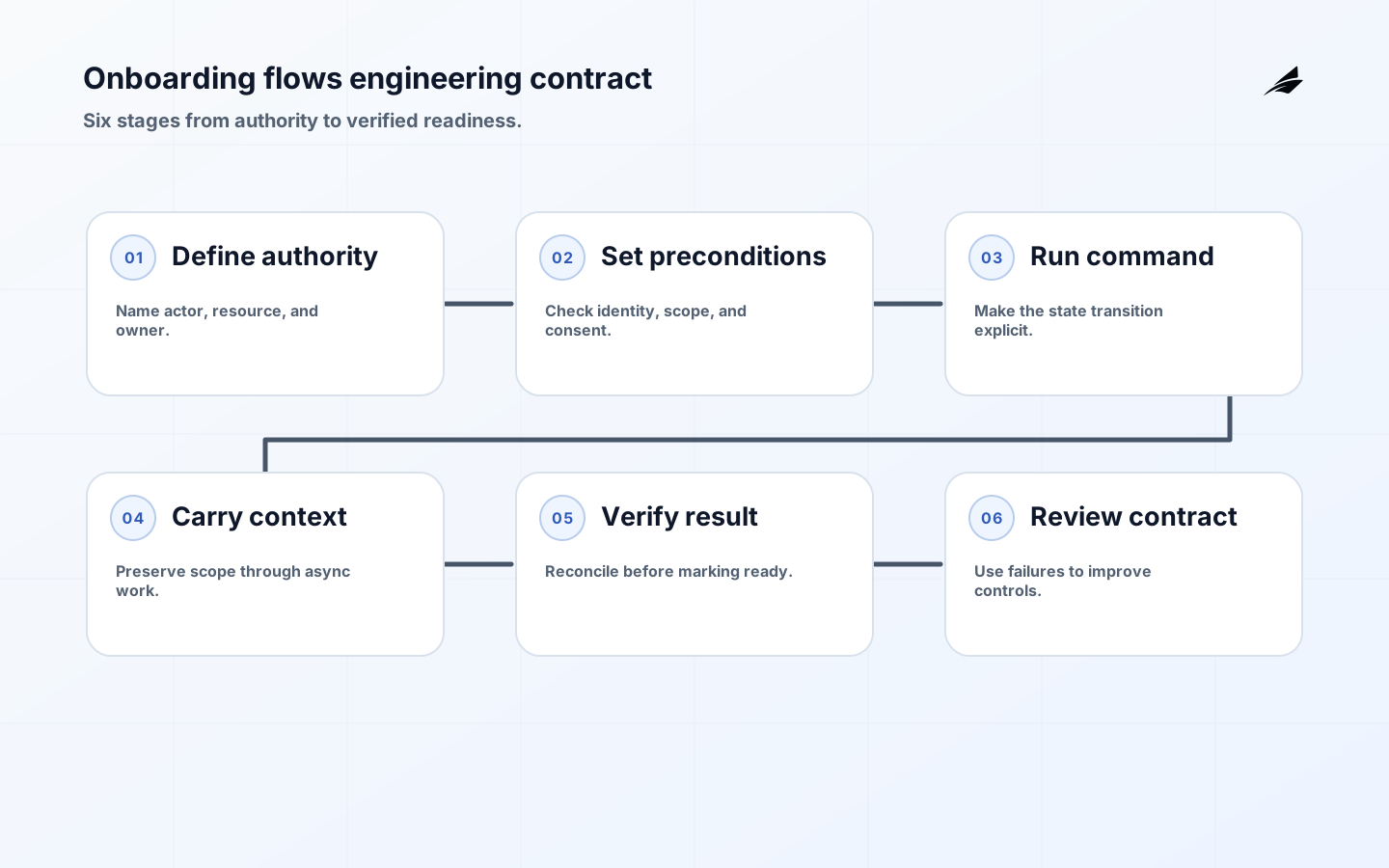
Turn onboarding flows into an engineering contract
An onboarding flows engineering contract should name the authoritative state, the command owner, the allowed transition, and the evidence required to say that the transition worked. For a connection setup, that may mean a verified account, a scoped credential, a connection record, a first successful read, and a customer-visible readiness state. Do not let a front-end checkbox stand in for a server-side fact.
Carry that contract through queues, retries, callbacks, and support tools. An asynchronous import may finish after the browser session ends; its event must still identify the workspace, connection, operation, and version of the setup rule. Reconcile the final result before marking the milestone complete, and preserve a failure reason that a person can act on. The surrounding workspace model, tenant isolation review, and self-serve onboarding guidance help keep that contract bounded.
What belongs in an onboarding flow contract?
Define the actor, resource scope, preconditions, state transition, side effects, evidence, failure result, and recovery owner.
How do engineers test asynchronous setup?
Test duplicate events, reordered events, timeouts, revoked access, partial completion, and a retry after the customer has changed the original input.
When should a flow stop and ask for help?
Stop when authority, identity, consent, or resource state is ambiguous, or when continuing could create an irreversible or cross-tenant effect.
The smallest useful improvement to onboarding flows is often a sharper boundary, not another feature. Give onboarding flows a named owner and a review date for the onboarding workflow.
For onboarding flows, test a delayed dependency before treating the first release as complete. Treat onboarding flows exceptions as evidence for the next decision.
A practical example for onboarding flows is two workers attempt the same transition. For onboarding flows, record the state, evidence, and recovery path.
Ownership is clearer when onboarding flows separates the promise from the mechanism.
Before widening onboarding flows, run a small rehearsal with normal, denied, delayed, and corrected cases. Measure onboarding flows outcomes alongside correction effort.
For Onboarding Flows, RFC 9110: HTTP Semantics defines scope; OWASP Application Security Verification Standard supports the control; PROV Data Model clarifies evidence; Product Analytics onboarding view guides recovery.
For onboarding flows, review recovery during a dependency failure. For onboarding flows, review scope during normal handling.
For onboarding flows, review the onboarding flows engineering notes measurement during a dependency failure.
For onboarding flows, review the onboarding flows engineering notes recovery during a tenant boundary.
For onboarding flows, review measurement during a tenant boundary. For onboarding flows, review recovery during normal handling.
A durable operating note for onboarding flows records the authoritative source, effective time, permitted actor, protected resource, and recovery route. For onboarding flows, review control during a tenant boundary.
For onboarding flows, test an incomplete setup before treating the first release as complete. For onboarding flows, review ownership during a dependency failure.
A practical onboarding example is two workers attempting the same state transition: record one durable outcome, preserve the competing event, and expose the recovery path.
For onboarding flows, review scope during a tenant boundary. The onboarding flows review applies this point to the onboarding workflow during a denied request.
Teams adopting onboarding flows should compare a successful setup with a denied or incomplete setup, then review the measurement during an operator rehearsal.
For onboarding flows, review scope during normal handling. For a late dependency event, reconcile the new fact without hiding the earlier decision, and verify the result during a release check.
A concrete operating test for onboarding flows is to rehearse the workflow during a recovery drill. For onboarding flows, review recovery during a customer explanation.
Teams adopting onboarding flows should compare a successful setup with a support-assisted recovery. Review scope during a policy change and remove duplicate paths from the operating checklist.
For onboarding flows, review the control during normal handling. During a measured rollout, test incomplete, delayed, and corrected setup cases, then verify the recovery record.
A concrete operating test for onboarding flows is to rehearse onboarding flows engineering notes during a dependency failure. For onboarding
Conclusion
The durable version of onboarding flows is not the most elaborate one.
Evidence for “Onboarding Flows: Engineering Notes for SaaS” is grounded in RFC 9110: HTTP Semantics, OWASP Application Security Verification Standard, OpenTelemetry Observability Primer, PROV Data Model, Product Analytics onboarding view; each source informs a specific decision, test, or operating trade-off described in this guide.