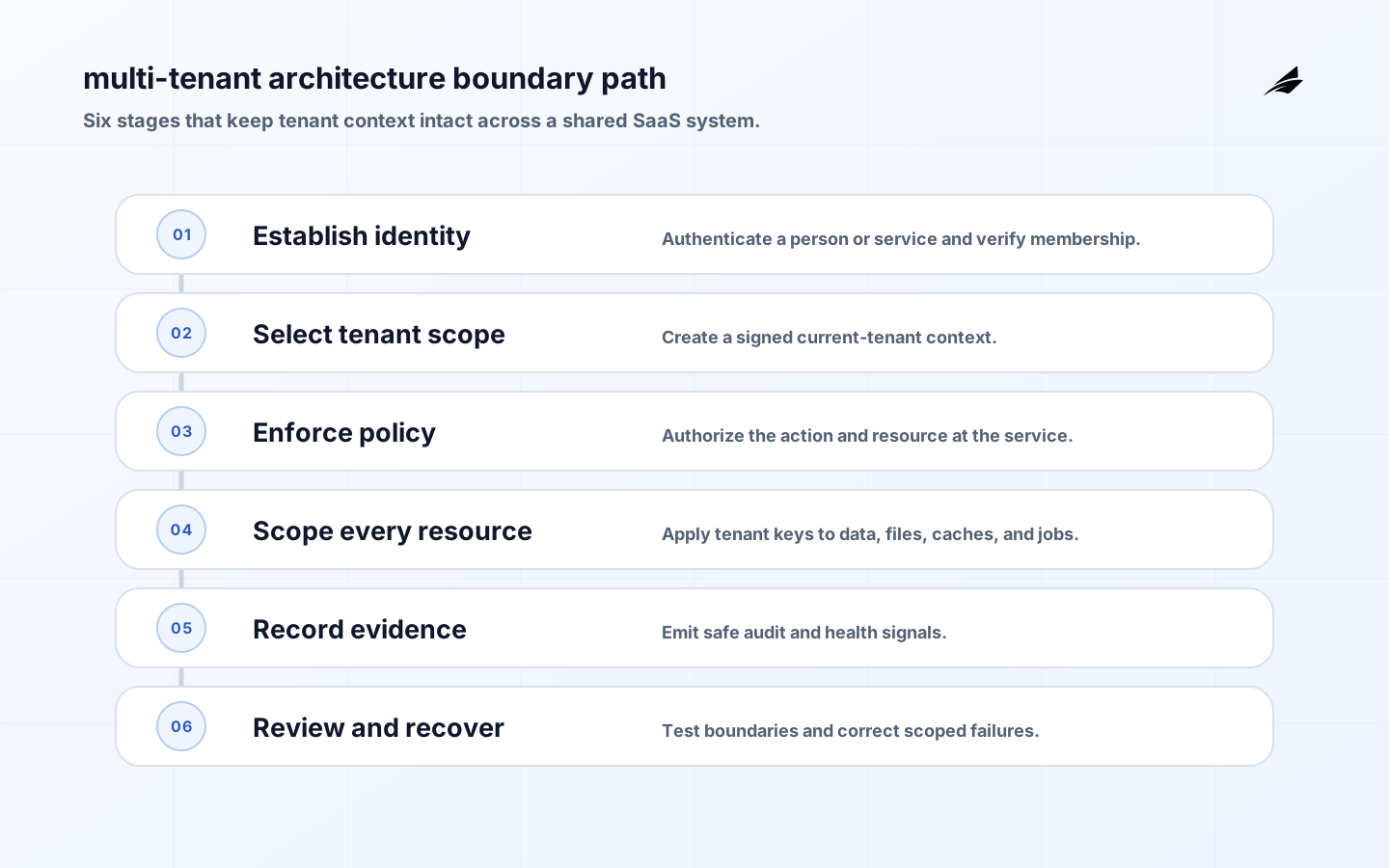
Multi-tenant architecture is not a database choice with a few extra columns. It is the discipline of carrying a customer boundary through identity, authorization, data access, background work, observability, and support. A shared deployment can be economical and still be unsafe when one code path trusts a client-supplied workspace ID, one scheduled job omits a filter, or one dashboard exposes a cross-customer aggregate. The architecture must make the correct scope the easiest scope to use.
Why Multi-tenant Architecture Matters
The central risk is not merely an attacker guessing an identifier. Ordinary engineering shortcuts can cross a boundary: a cache key without the tenant, a bulk export written before authorization, a queue message that loses its context, or a support query copied from a production incident. AWS distinguishes tenant isolation from ordinary authentication because an authenticated user can still reach the wrong tenant's resource if the application does not apply tenant context at each relevant boundary.
Start with a plain statement of what a tenant is in this product. It may be a customer account, regulated legal entity, franchise, or workspace. Record which resources belong to it, which people can act for it, and which cross-tenant operations are legitimate. That model informs a pooled design, a dedicated stack, or a mixed approach. The important property is not the hosting pattern's label; it is evidence that the system consistently rejects a request outside the active tenant.
Define Tenant Boundaries
Create one signed server-side tenant context after authentication. It should include a stable tenant identifier, actor identity, roles, and a narrowly defined request lifetime. Product services should derive filters and authorization decisions from that context, not from an unchecked query parameter. Where a person belongs to several organizations, require an explicit current-organization selection and validate the membership again at the service boundary. Ambiguity is a security defect, not a convenience feature.

| Boundary | Question to settle | Concrete control |
|---|---|---|
| Identity | Which tenant is active for this request? | Verify membership and issue tenant-scoped claims. |
| Data | Can a query omit the tenant predicate? | Use repository methods or row policies that require scope. |
| Async work | How does a job recover its owner? | Include immutable tenant context and validate it on consumption. |
| Support | Can staff inspect data safely? | Use attributable, time-bounded impersonation with audit events. |
Data partitioning follows the boundary model. A shared table can work when every read, write, index, cache key, object path, and search document carries tenant scope. Dedicated databases simplify some blast-radius concerns but still need authorization around APIs, admin tooling, and data movement. Do not assume a network or deployment boundary proves application isolation. Test the exact service methods that list, update, export, and delete customer records, including background paths that do not begin with a browser session.
Design Enforcement Points
Put tenant enforcement close to the protected resource. A gateway may reject an obviously invalid token, but a service that owns invoices, files, or reports must still authorize the tenant for the requested record. This is a useful zero-trust habit: each decision uses the current subject, action, resource, and context instead of inheriting an earlier assumption. For storage and analytics systems, use platform policies where they can express the rule and application checks where they cannot.
Treat internal administrative flows as first-class product flows. A support engineer might need a narrow diagnostic view, while a migration worker may need carefully controlled cross-tenant access. Give those cases distinct service identities and permissions rather than a hidden bypass. Their requests should state why the wider access exists, log the resources touched, and expire. That makes the exceptional path inspectable without normalizing it for everyday application code.
Implement and Test the Boundary
Inventory entry points before changing schema or infrastructure: HTTP endpoints, GraphQL resolvers, scheduled jobs, event consumers, search, object downloads, cache reads, and internal scripts. For each, write a negative test: tenant A must not retrieve, mutate, infer, or receive a link to tenant B's record. Include direct API calls because user-interface restrictions prove little. Seed two tenants with deliberately distinctive fixtures so failures are obvious in tests and traces.
| Test case | Expected result | Failure signal |
|---|---|---|
| Forged tenant parameter | Server uses the authenticated tenant or denies. | A response contains another tenant's fixture. |
| Queued retry | Consumer restores and verifies original scope. | A job runs with missing or default scope. |
| Shared cache lookup | Key includes tenant and policy-relevant inputs. | Tenant B sees a warmed value from tenant A. |
| Bulk export | Authorization occurs before job creation and delivery. | An export can be requested by ID alone. |
Roll out the new boundary in observation mode when replacing older checks. Log the old and proposed authorization outcomes with sensitive values redacted, then investigate every mismatch. A mismatch can reveal legacy data ownership, a missing membership rule, or a product behavior nobody has specified. Once enforcement is enabled, keep a kill path for the new policy implementation, not a global bypass of tenant isolation. A recovery procedure should narrow risk while engineers diagnose the defect.
Operate With Evidence
Measure boundary health with more than security alerts. Track authorization denials by route and reason, missing-tenant-context failures, cross-tenant test results, privileged support sessions, and queue messages rejected for scope mismatch. Review noisy-neighbor signals too, such as one tenant's jobs consuming disproportionate worker time or storage. These signals turn multi-tenant architecture into an operating capability rather than an architecture diagram drawn at launch.
A Practical Design Example
Imagine a reporting product with pooled compute and one shared analytics store. The report request accepts a report definition but not a trusted tenant ID; the API derives scope from the session and persists it in the job. The worker reads that scope, applies it to every source query, writes files under a tenant-prefixed path, and emits tenant-tagged metrics. A download endpoint re-authorizes the requester before generating a short-lived URL. This modest chain closes several common leakage paths at once.
Teams planning a broader platform can compare this design with the multi-tenant architecture guide. The useful next decision is which boundary has the weakest evidence today: a data query, a worker, an administrator tool, or an export. Improve that path, prove it with a negative test, then extend the same contract instead of scattering custom tenant checks through the codebase.
Review Before Scaling
Before adding customers or regions, run a boundary review against one representative workflow. Trace a request from sign-in through authorization, persistence, cache, asynchronous processing, retrieval, and support diagnosis. At each handoff, identify the tenant value, the component that verifies it, and the evidence retained if the check fails. This exercise often discovers scope lost in a message schema, a metric label that groups unrelated customers, or a repair script that assumes broad access. Fix the contract once at the shared boundary rather than adding a fragile condition only to the incident path.
Also define how migration changes preserve isolation. A tenant move, restore from backup, or account merge needs a source and destination scope, a reconciliation record, and a way to prevent normal traffic from seeing a half-moved state. Validate backups and exports with the same rigor as live reads. Operations teams should be able to tell which tenant owns every retained object, which policy applied at the time, and who may initiate a recovery. That is the practical standard for a multi-tenant architecture that can grow safely.
Document the boundary in the interfaces engineers actually use. Repository APIs can require a tenant context argument, event schemas can mark it required, cache helpers can construct keys from a scoped object, and administrative tooling can refuse a request without a target tenant and purpose. These conventions reduce the chance that a new feature begins life with an unscoped escape hatch. Review new dependencies too: a search service, analytics connector, or AI provider can become a new data path where tenant filtering and retention rules need explicit verification.
Finally, make isolation part of delivery ownership. Architecture review should identify the tenant-bearing resource, threat scenarios, and negative tests for a change. Release checklists should include validation for new exports, search indexes, webhook payloads, and third-party integrations. When an incident occurs, classify whether the failure involved authentication, authorization, tenant isolation, or observability; these are related but not interchangeable. This vocabulary prevents a superficial fix and makes it easier to invest in the shared mechanism that protects the next feature too.
Key Takeaways
- Define tenant identity and ownership before choosing partitions.
- Enforce tenant scope at the resource-owning service, not only in the interface.
- Carry and validate scope through jobs, caches, search, files, and support tools.
- Test attempted cross-tenant access as a routine release condition.
Frequently Asked Questions
Must every SaaS product use a separate database per customer? No. Shared infrastructure can be appropriate when resource access is reliably tenant-scoped and tested. Dedicated infrastructure can reduce certain operational risks, but it does not replace authorization. What should be fixed first? Start with the highest-consequence read or write path, then inspect every way it can be reached outside the normal interface, including workers and support tooling.
Conclusion
Strong multi-tenant architecture makes customer boundaries explicit, enforced, observable, and recoverable. The design should let a reviewer trace an action from the actor to the tenant-scoped resource and explain why a neighboring tenant could not influence it. That clarity improves security, support, cost control, and confidence as the product grows.
Sources
For implementation detail, consult AWS tenant isolation guidance, the AWS Well-Architected SaaS Lens, NIST SP 800-207, and the OWASP ASVS. Apply their controls to the product's own data model and threat profile.