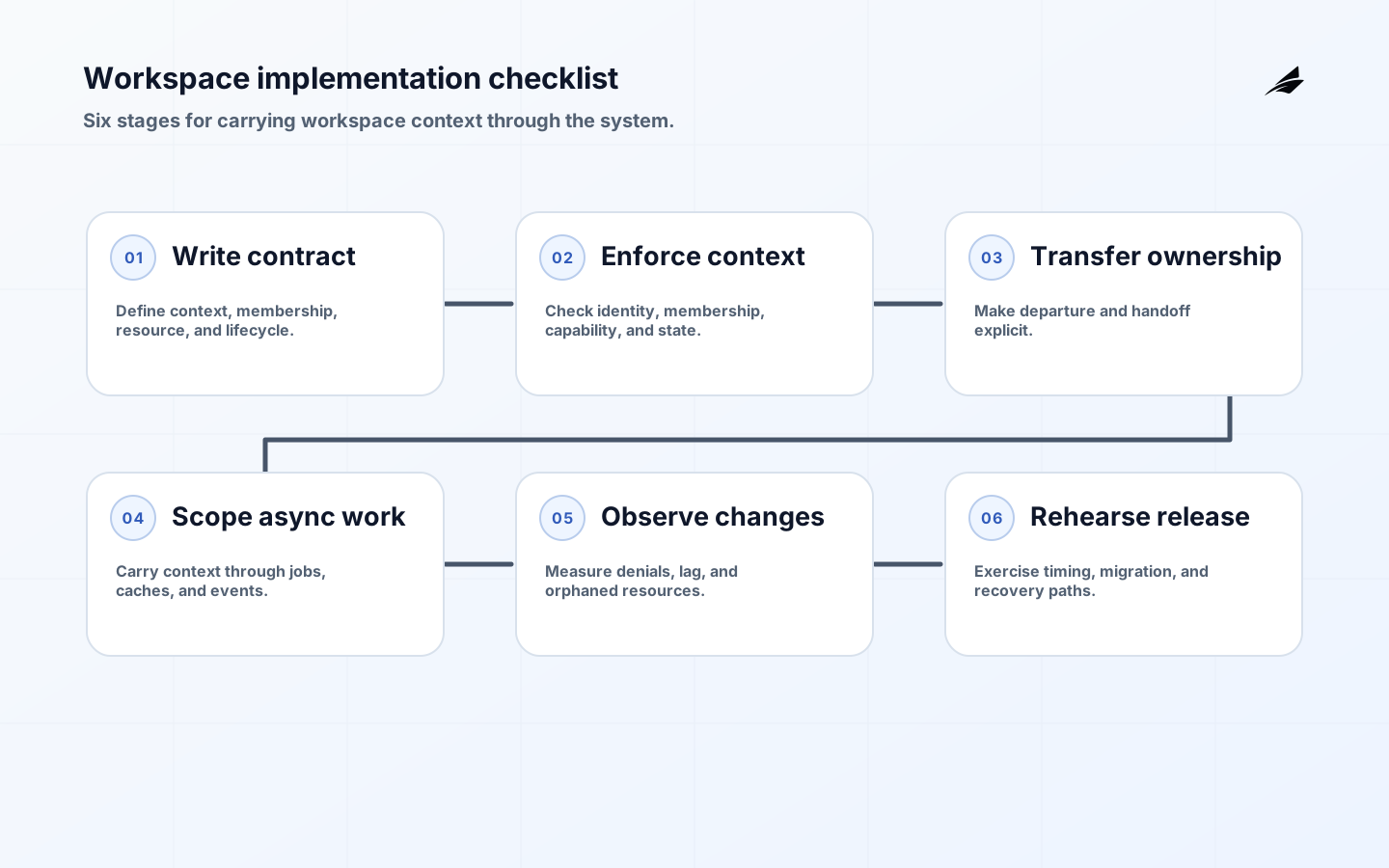
Workspace Models: Implementation Checklist
Implementing workspace models is an exercise in making context dependable. The system must know which workspace a request concerns, whether the actor belongs there, which role applies, and who owns the target resource. It must also survive ordinary change: invitations arrive late, people switch between workspaces, owners leave, and background jobs continue after a membership update. This checklist is for teams moving from a plausible data model to an operable product. It emphasizes explicit boundaries, server-side checks, lifecycle evidence, and tests that reveal problems outside the visible navigation.
Write the contract before the schema
Define workspace, member, role, resource, invitation, service identity, and lifecycle event in terms a support person can use. State whether a resource is owned by the workspace or merely visible there. State whether a member may belong to many workspaces and whether a guest may cross project boundaries. For each protected action, write the actor, context, target, precondition, result, and correction route. This contract should cover a normal invitation, a rejected invitation, a suspended member, and a user whose workspace membership changes while a request is in flight. Only then should table names and token claims become implementation details.

| Checklist item | Implementation decision | Verification |
|---|---|---|
| Context | How is workspace ID established? | A request cannot silently use a browser default |
| Membership | Where is current membership checked? | Allowed and denied role tests |
| Resource scope | How is ownership or sharing resolved? | Cross-workspace fixture tests |
| Lifecycle | Which events change access or ownership? | Replay and reconciliation test |
Separate the enforcement points
Use a layered model. Authentication establishes an identity; membership establishes a relationship to a workspace; authorization evaluates a capability against a resource and current state; the domain operation enforces its own invariants. Do not rely on a client-selected workspace, a cached role, or a token claim alone. RFC 9110 provides the HTTP semantics that clients and services expect, but status codes do not replace a product authorization rule. Return consistent outcomes, avoid leaking whether another workspace owns a resource, and record the policy decision where a later investigation can find it.
- Pass workspace context explicitly through APIs, jobs, events, caches, and storage paths.
- Recheck membership when a sensitive command executes, not only when a page loads.
- Use stable resource identifiers plus an ownership or sharing lookup.
- Invalidate sessions or permissions predictably after removal or role reduction.
- Make denied actions observable without exposing confidential resource existence.
Implement ownership and transfer as first-class flows
An owner field is not enough if the owner can disappear. Build a transfer workflow with an eligible recipient, confirmation, effective time, notification, and a safe failure state. For integrations and scheduled jobs, decide whether the workspace, a service identity, or a person owns execution. When a member leaves, revoke interactive access and review durable credentials, queued work, exports, and webhooks. Represent the old and new owner in the event history. Provenance ideas from the W3C PROV-DM recommendation are useful for naming the entity, activity, and responsible agent behind a change.
| Lifecycle change | Risk | Control to implement |
|---|---|---|
| Invitation accepted | Wrong person or workspace | Single-use token, context confirmation, audit event |
| Role reduced | Existing session keeps power | Server check and session invalidation |
| Owner leaves | Resource becomes orphaned | Transfer, archival, or named service owner |
| Workspace merged | References point to old context | Alias map, migration log, reconciliation |
Test asynchronous paths and caches
The most expensive workspace bugs often occur after the page has finished. A queued export may run after access is revoked; a cache may return a previous role; a notification may expose a resource to a former guest; a retry may create a duplicate membership event. Put workspace ID, actor or service identity, policy version, and correlation ID into asynchronous payloads. Check authorization again at the consumer and make retries idempotent. Clear or scope caches by workspace and role. Use similar-looking records in two workspaces so a test fails loudly when a query forgets the context filter.
Instrument changes that affect access
Measure invitation acceptance time, role-change propagation time, stale-permission incidents, transfer age, denied-action rate by reason, and cross-workspace lookup failures. Connect these signals to the event that changed membership or policy. OpenTelemetry can standardize the relationship between traces, logs, and metrics; the product decision is which fields are safe, durable, and actionable. Alert on severe outcomes such as an export after revocation or a job with missing workspace context. Review a sample of successful and denied decisions to catch a metric that looks healthy while customers still experience confusing access.
Run a prelaunch rehearsal with real timing
Create two workspaces with similar resources and different members. Invite a user to one, switch contexts, change the role while a request is open, revoke access while a job is queued, transfer ownership, and archive the workspace. Verify UI language, API results, background behavior, notifications, audit records, and support recovery at each step. Include a migration rehearsal if existing accounts are being mapped into the model. The team is ready when it can explain both an allowed and a denied path without opening raw databases, and when it knows which action pauses a risky workflow if evidence is incomplete.
Turn the checklist into executable scenarios
Create fixtures for two workspaces with the same resource names, one owner, one administrator, one member, and one guest. Exercise every action with the correct and incorrect context. The test should inspect more than the HTTP status: check returned records, emitted events, cache entries, notifications, and audit rows. A passing page-level test can still hide a cross-workspace export or a worker that forgot to carry scope.
Add timing to the fixtures. Remove a member while an export is queued, reduce a role while an administrator has a page open, and retry an invitation after the workspace is archived. These cases reveal whether authorization is checked when work is accepted, when it is executed, or both. The intended answer should be written into the contract, not left to whichever service happens to fail first.
Make migration and recovery visible in deployment practice. Rehearse a partial workspace merge, a failed ownership transfer, and a duplicate lifecycle event. Confirm that aliases remain usable, that retries do not create new owners, and that operators can identify incomplete work. Keep a small reconciliation command or report that can be run after release without granting broad editing power.
Review the implementation with a teammate who did not design the schema. Ask them to explain why a request is allowed, where the workspace context came from, and what happens after removal. If the answer depends on a hidden framework default or a copied role claim, add an explicit check and a test. A checklist is valuable when it leaves behind repeatable evidence.
Keep the checklist close to the code that enforces context. A review document can name the intended rule, but a scoped repository helper, policy test, and worker assertion make omission harder. When the model changes, update the contract, fixtures, telemetry, and support explanation in the same delivery slice.
Do not postpone operator behavior until after launch. Ask who handles an orphaned resource, a failed transfer, a stale invitation, and a job that outlives membership. The answer should be a named workflow with a bounded permission, not a general database credential shared by the team.
Keep an implementation ledger for context decisions. Record how a request establishes workspace, how a resource resolves ownership, how a job carries scope, how caches expire, and how operators recover an exception. This ledger gives code review and incident response the same reference point. It also makes a future migration safer because the team can identify which assumptions are contractual and which are replaceable.
For every implementation change, Keep one visible example of the permitted path and one of the denied path. Include the request context, resolved resource, role, policy result, and audit event. Examples make reviews concrete and help support understand what customers will see when the workspace model changes.
If a workspace action cannot be represented as a clear state transition, pause the feature and resolve the ambiguity first. “Removed,” “suspended,” “archived,” and “transferred” should each have an owner, effective time, visible consequence, and recovery route. Precise states prevent both accidental access and confusing support explanations.
Key takeaways
- Turn workspace context, membership, ownership, and lifecycle into explicit contracts.
- Enforce permission at every synchronous and asynchronous boundary.
- Treat owner departure, role reduction, merge, and archive as product workflows.
- Test similar records in separate workspaces and verify caches, jobs, exports, and notifications.
- For related product decisions, See multi-tenant architecture, admin consoles, and subscription access control.
Frequently asked questions
What should be implemented first?
Implement an explicit context, a current membership check, one resource ownership rule, and a complete invitation-to-revocation journey. This slice exposes whether the model is coherent before the product accumulates dozens of roles and cross-workspace features.
How should APIs handle a switched workspace?
Require context explicitly or derive it from a trusted resource relationship, then verify membership and capability on the server. A client-selected workspace can improve navigation, but it is not an authorization decision. Return a stable denial and a safe next action when context is missing or no longer valid.
Which Workspace Models signal matters most?
Choose the metric that represents the promised workflow, such as successful collaboration or time to remove access. Pair it with failure age, denied reasons, stale permissions, and sampled cases. A single completion rate can hide unsafe shortcuts or a growing manual recovery queue.
Conclusion: implement context as a system property
Workspace models hold together only when context travels with the work. Make it explicit in requests, jobs, resources, caches, events, and audit evidence; enforce the decision at the boundary that matters; and rehearse the lifecycle changes customers will actually encounter. A small, testable model is stronger than a broad role catalog that cannot explain its own exceptions.
Before widening workspace models, run a small rehearsal with normal, denied, delayed, and corrected cases. Reconcile workspace models changes against the original record.
For workspace models, review the workspace models implementation checklist evidence during normal handling. Measure workspace models outcomes alongside correction effort.
A durable operating note for workspace models records the assumptions that made the decision safe: the authoritative source, effective time, permitted actor, protected resource, and recovery route.
For workspace models, a good handoff ends with observable evidence rather than a verbal promise.
This decision also connects to Multi-tenant Architecture: Architecture Guide, Admin Consoles: A Buyer and CTO Decision Guide, Billing Workflows: Mistakes and Fixes. Review those boundaries together when workspace models shares identity, data, billing, or support evidence with another workflow.
For Workspace Models, OWASP Application Security Verification Standard defines scope; Azure Tenancy Models for a Multitenant Solution supports the control.
For workspace models, review the workspace models implementation checklist control during a dependency failure. For workspace models, review the workspace models implementation checklist scope during normal handling.
For workspace models, review the workspace models implementation checklist recovery during normal handling. For workspace models, review the workspace models implementation checklist scope during a dependency failure. For workspace models, review the workspace models implementation checklist control during normal handling.
For workspace models, review the workspace models implementation checklist control during a measured rollout.
Evidence for “Workspace Models: Implementation Checklist” is grounded in RFC 9110: HTTP Semantics, OWASP Application Security Verification Standard, OpenTelemetry Observability Primer, PROV-DM: The PROV Data Model, Azure Tenancy Models for a Multitenant Solution; each source informs a specific decision, test, or operating trade-off described in this guide.