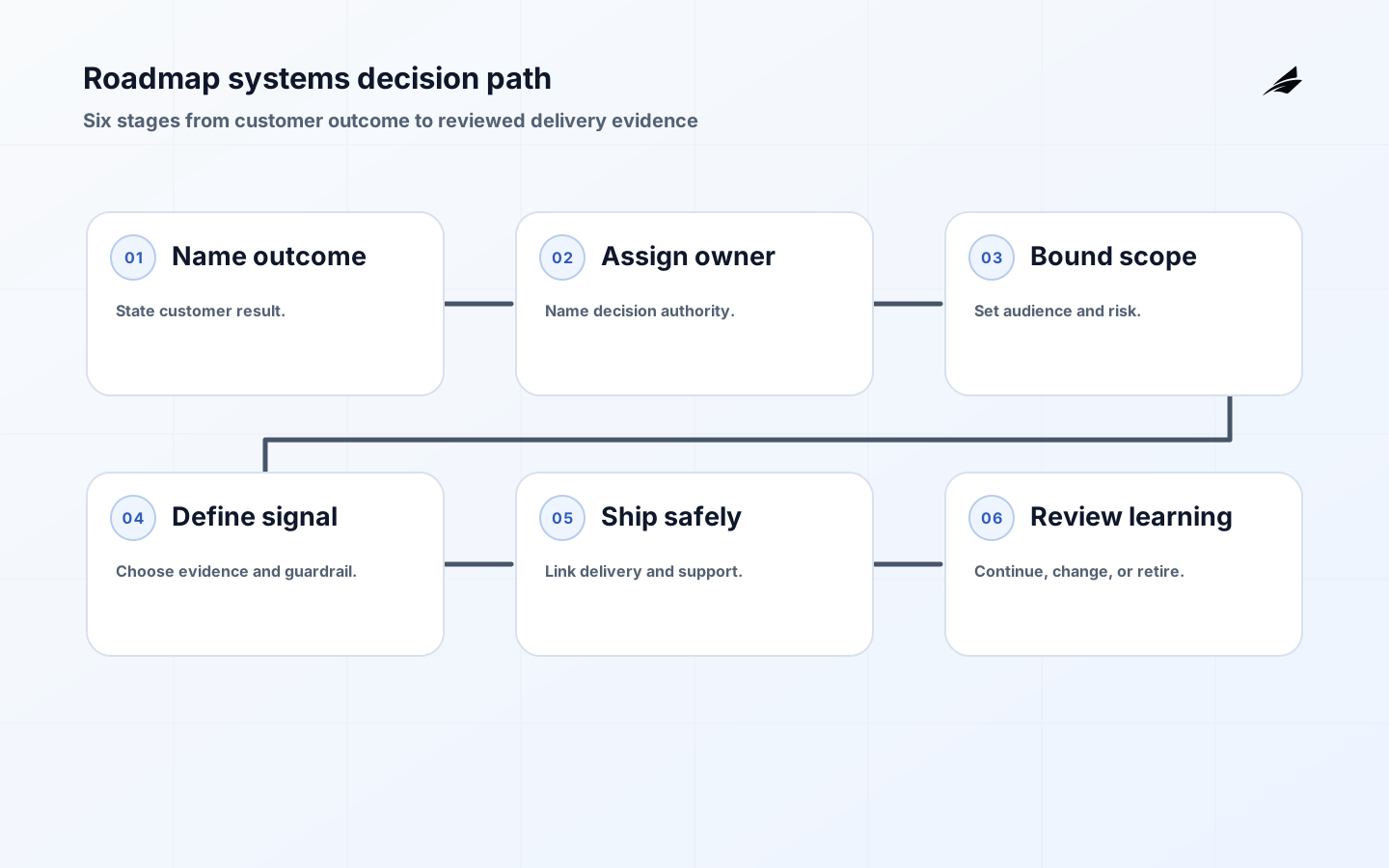
A roadmap systems checklist is useful when a product team needs to decide what deserves investment, explain why it matters, and learn whether the shipped change helped. A list of themes or dates is not enough. Reliable digital operations need a decision record with a customer outcome, accountable owner, evidence, risk, delivery boundary, and review date. The system should preserve the reasoning without turning planning into a second ticket tracker. It should also make uncertainty visible: an assumption is not a result, and a release is not proof of value. This guide turns roadmap systems into a practical operating loop for product, engineering, support, and leadership.
Start with the decision, not the roadmap view
Write the decision in a sentence a customer could recognize: reduce the time needed to reconcile a report, make invitations recoverable after an interrupted setup, or prevent a high-risk export from being available to the wrong role. Then name the person who can accept, reject, or defer the work. This makes the roadmap a decision surface rather than a decorative calendar. The decision record should link to discovery notes, technical constraints, and customer evidence, but keep the summary short enough to review in a planning meeting.

A useful first slice is one product area with a recurring planning meeting. Capture the problem, intended outcome, confidence, dependencies, and a disconfirming signal. If the team believes a workflow change will reduce support contacts, record the baseline window, the event that represents completion, and the possibility that contacts could fall because customers abandoned the workflow. That distinction keeps teams from rewarding a lower number that actually represents a worse experience. The GOV. UK guidance on performance metrics similarly emphasizes meaning, hypotheses, data sources, context, and iteration.
| Decision field | Practical question | Evidence to retain |
|---|---|---|
| Outcome | What changes for a user or operator? | Before-and-after task or service measure |
| Owner | Who can make the decision and revisit it? | Named role and review date |
| Scope | Which users, workflow, and release boundary apply? | Cohort, surface, dependency list |
| Risk | What could make the change harmful or misleading? | Failure case and mitigation |
| Signal | What would confirm or challenge the bet? | Metric definition and qualitative input |
Choose a small model that can survive change
Keep strategy, roadmap, delivery status, and operational evidence related but separate. Strategy describes direction. The roadmap holds decisions and expected outcomes. Delivery tools show work in progress. Telemetry, support data, and research show what happened. When all four are collapsed into a status field, the team loses the ability to explain whether a delayed initiative is still valuable, whether a completed initiative failed to help, or whether a dependency changed the original scope.
Give each initiative a stable identifier and an explicit lifecycle such as proposed, shaped, committed, delivering, learning, accepted, or retired. A lifecycle state should have an entry condition and an owner, not just a color. For example, an item becomes committed when the team has identified a customer outcome, an implementation boundary, and capacity; it becomes accepted only after the review window contains enough evidence to make a decision. This allows a small team to automate reminders without pretending that software can replace judgment.
| Layer | Owns | Common mistake |
|---|---|---|
| Strategy | Direction and constraints | Treating a theme as a promise |
| Roadmap | Prioritized decisions and outcomes | Ranking ideas without a decision owner |
| Delivery | Tasks, dependencies, and release readiness | Using ticket completion as value evidence |
| Operations | Observed behavior, incidents, and support signals | Ignoring qualitative or off-platform evidence |
| Review | Continue, change, pause, or retire | Leaving a shipped item permanently active |
Design the workflow for normal and difficult cases
A roadmap system should tell a person what to do when an item changes shape. Add a dependency, narrow the audience, split the initiative, record a security concern, or pause the work without destroying the original rationale. Version meaningful changes so a later reviewer can see which assumption moved. Preserve the previous owner and decision time, while allowing the current owner to be different after an organizational change. The NIST Secure Software Development Framework is a useful reminder that secure practices need to be integrated into the development lifecycle rather than bolted on after a release decision.
Accessibility matters even for internal planning surfaces. Use headings, labels, keyboard-accessible controls, readable tables, and explicit status text so a product manager can review an initiative without relying on color or hover behavior. The WCAG 2. 2 recommendation treats accessibility as testable requirements across devices and user needs. In practice, a clear “paused because dependency unavailable” state is also better operational communication than a red badge whose meaning lives in one teammate’s memory.
Connect roadmap decisions to evidence
Define the smallest event or observation that can test the decision. Name the subject, action, result, time, version, and relevant scope. Avoid collecting every possible click before the team knows which decision the data will inform. The OpenTelemetry semantic conventions show why shared names for operations and data help teams correlate signals across traces, metrics, logs, and resources. Apply that principle to product evidence: use a stable vocabulary for workflow start, meaningful completion, failure, manual recovery, and customer-reported outcome.
Combine quantitative and qualitative evidence. A completion rate can show that a funnel changed, while a support transcript or usability session can explain why. Record the measurement window and segmentation rules. If a change is limited to administrators in large workspaces, do not compare its result with all users and call the difference decisive. A review note should say what happened, what the team believes caused it, what remains uncertain, and which action follows. That makes the roadmap a learning record instead of a museum of past promises.
Roll out the checklist through a real planning cadence
Introduce the checklist in one quarterly or monthly planning cycle. Ask every initiative owner to complete only the required fields, then review where the form creates ambiguity. If people cannot agree on the outcome, that is discovery work. If they cannot name the authoritative data, that is an instrumentation or ownership gap. If the dependency list is unbounded, narrow the first release before committing to a date. The objective is a better decision, not a more elaborate template.
Set review triggers beyond the calendar: a new data class, an authorization change, a material incident, a customer segment expansion, or a failed assumption. Retire records that no longer represent active work, but preserve their decision history. An initiative that is paused should remain discoverable with its reason and next condition, not silently disappear. Connect the roadmap to delivery and support with canonical links, while keeping each system responsible for the facts it owns.
A practical review can use a one-page decision card: outcome, audience, owner, current evidence, confidence, risk, dependency, release boundary, success signal, guardrail, and next review. Keep the card stable while linking to changing detail in the source systems. When the team disagrees, record the disagreement as a decision question with an owner and date instead of hiding it in a comment thread. That small habit makes unresolved uncertainty visible before it becomes a schedule surprise.
Use the same card during a support or incident review. Ask whether the live customer behavior still matches the original scope, whether a manual workaround has become a hidden requirement, and whether the recovery path is safe for every affected role. If not, create a follow-up item with a clear owner. Roadmap systems are strongest when they make operational learning flow back into prioritization rather than leaving it in an incident document that no planner reads.
Key takeaways
- Describe a customer or operator outcome before ranking work.
- Keep strategy, roadmap decisions, delivery status, and observed evidence as connected but distinct layers.
- Give every meaningful initiative an owner, scope, risk, signal, lifecycle, and review trigger.
- Use a shared vocabulary for evidence and combine metrics with research and support context.
- Make pause, split, rollback, and retirement normal states rather than exceptional failures.
- For adjacent delivery decisions, See feature flags, product analytics, and self-serve onboarding.
Frequently asked questions
Is a roadmap systems checklist only for large companies?
No. A small team benefits because a compact decision record prevents context from living in one founder’s head or one planning meeting. Start with a few fields and one review rhythm. Add complexity only when a repeated failure shows that a missing field or state is costing the team time or creating customer risk.
How does it relate to a backlog?
The roadmap explains why a meaningful outcome deserves attention; the backlog coordinates the implementation work. One roadmap item can map to many tasks, and one task can support several operational concerns. Keeping those layers distinct lets engineering update delivery status without accidentally changing the product decision.
Which metrics belong in the first version?
Choose one outcome measure, one quality or safety guardrail, and one operational signal that shows whether the workflow is working. For example, pair successful report completion with correction rate and support contacts. Define the event and time window before the release so the team does not invent an interpretation after seeing the result.
When should security change the roadmap decision?
Security should affect scope whenever the initiative changes identity, authorization, sensitive data, external exposure, or recovery behavior. Record the risk, control owner, residual concern, and trigger for another review. This gives leadership a visible trade-off instead of leaving security as an undocumented promise to revisit later.
Conclusion: make planning explainable
A roadmap systems checklist earns trust when it helps a team make a smaller, clearer decision and then learn from what happened. Name the outcome, separate planning from delivery, connect the choice to evidence, and keep pause and retirement available. With those controls in place, a roadmap can guide reliable digital operations without becoming another opaque system that merely reports activity.
Before widening roadmap systems checklist for reliable digital operations, run a small rehearsal with normal, denied, delayed, and corrected cases. Measure roadmap systems checklist for reliable digital operations outcomes alongside correction effort.
The measurement plan for roadmap systems checklist for reliable digital operations should pair an outcome with a reason to investigate it. Review roadmap systems checklist for reliable digital operations evidence with product, engineering, and support for reliable digital operations.
A durable operating note for roadmap systems checklist for reliable digital operations records the assumptions that made the decision safe: the authoritative source, effective time, permitted actor, protected resource, and recovery route. Keep customer language aligned with the recorded state for roadmap systems checklist for reliable digital operations.
For roadmap systems checklist for reliable digital operations, a good handoff ends with observable evidence rather than a verbal promise.
This decision also connects to Plain-language Feature Flags for Safer Releases, how IT managers should think About Product Analytics, A Field Guide to In-app Guidance for Growing Teams. Review those boundaries together when roadmap systems checklist for reliable digital operations shares identity, data, billing, or support evidence with another workflow.
Evidence for “Roadmap Systems Checklist for Reliable Digital Operations” is grounded in NIST Secure Software Development Framework, OpenTelemetry Semantic Conventions, Web Content Accessibility Guidelines 2.2, GOV.UK: How to set performance metrics for your service; each source informs a specific decision, test, or operating trade-off described in this guide.