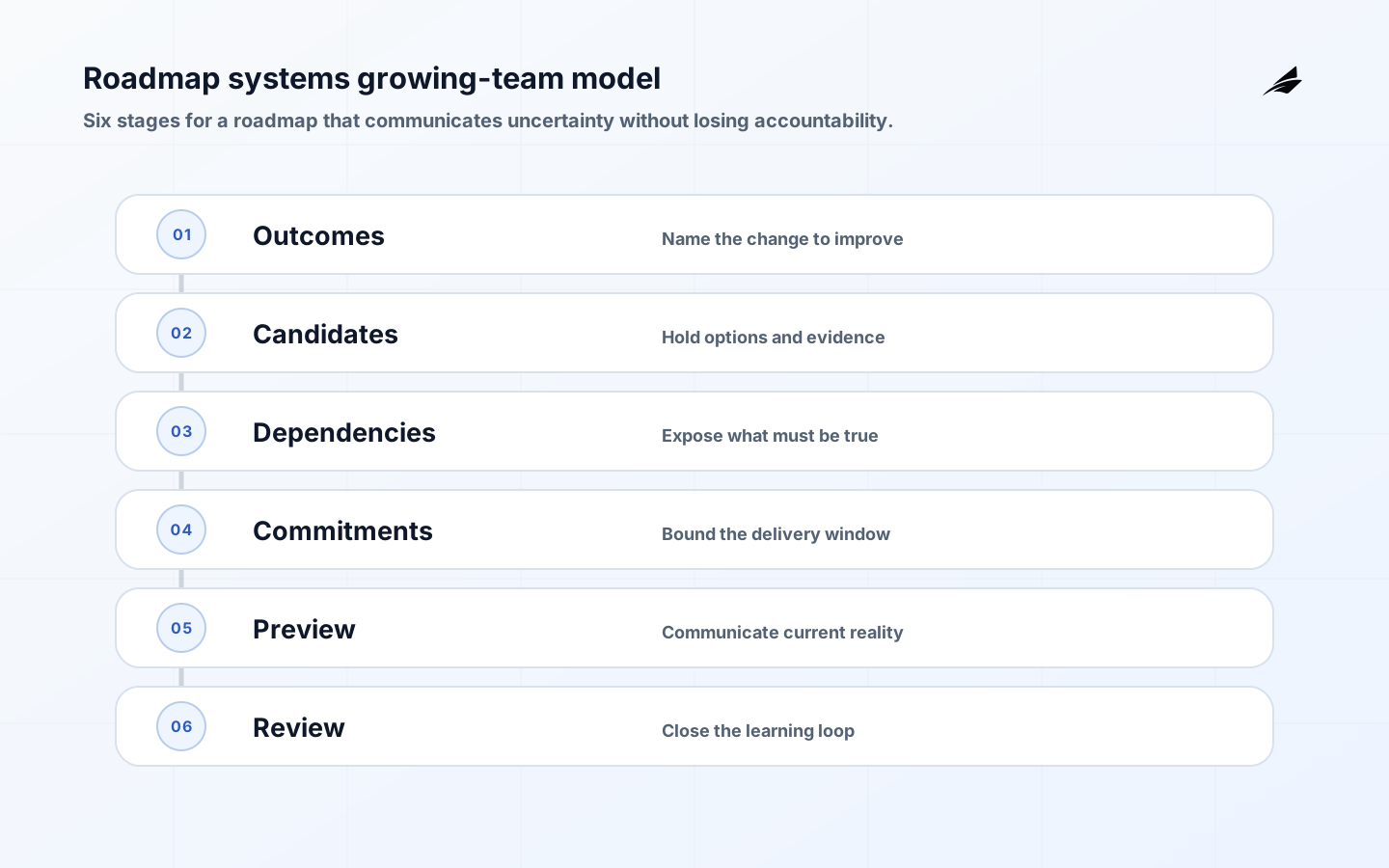
Roadmap systems are decision systems, not decorative timelines. A growing company needs a way to turn customer signals, operational constraints, and technical risk into a small number of commitments that can survive contact with real capacity. The useful question is not “what features are on the roadmap?” but “what outcome are we buying with this work, and what evidence would make us change our mind?” For founders, roadmap planning begins with one accountable decision: which outcomes deserve capacity now, which assumptions must be tested, and what the team will deliberately defer. For growing-team roadmap planning, the design should make that decision understandable to a customer, enforceable by services, and explainable by the people who support it.
Name the allocation decision and its audience
Before choosing screens or vendors, write down the decision in ordinary language and name its actors: the founder, product lead, engineering lead, customer-facing team, finance owner, and delivery team. Then list the records that make the answer defensible: the outcome, customer evidence, option, dependency, capacity assumption, decision date, and review result. For growing-team roadmap planning, this exercise exposes disagreements that otherwise surface as inconsistent product behavior. For growing-team roadmap planning, a person operating the system should be able to answer who requested the action, what authority applies, which fact is current, and what changes when that fact is disputed.
| Question | Design choice | Evidence to retain |
|---|---|---|
| Scope | Which account, actor, and action does roadmap systems cover? | Named boundary and current owner. |
| Authority | Which service or approved record decides the state? | Source identifier, timestamp, and change history. |
| Exception | When can a person override or reroute the normal path? | Reason, approver, expiry, and follow-up. |
| Completion | What proves the customer outcome was achieved? | Outcome event and visible confirmation. |
Show commitment, confidence, and change authority
Give every roadmap item a state that describes the decision: exploring, committed, in delivery, measuring, or stopped. This prevents a research idea from being reported as a promise. The state should carry the owner, intended outcome, confidence, dependency, and next review rather than a vague percentage complete. For growing-team roadmap planning, keep the presentation layer honest about uncertainty: if a dependency is delayed or a policy cannot be evaluated, say so rather than showing a definitive outcome. For growing-team roadmap planning, in distributed products, a customer-facing state is often assembled from multiple services, so the system needs an explicit freshness rule and a safe response when it cannot meet that rule.
Authorization and isolation deserve particular attention whenever the roadmap system touches account data or consequential actions. For growing-team roadmap planning, the OWASP Authorization Cheat Sheet recommends server-side, per-request authorization and least privilege. For growing-team roadmap planning, its practical implication is simple: a role, tenant, plan, or UI state supplied by the browser is context to verify, not a verdict to trust.
Pilot one planning forum with real evidence
Build the first system around a monthly decision forum and a single product area. Capture three options, the evidence behind each, and the capacity trade-off. A narrow forum makes it easier to see when a supposedly strategic item is really an unexamined request from the loudest customer. For growing-team roadmap planning, define the unhappy path at the same time as the normal one. For growing-team roadmap planning, include a missing record, duplicated request, delayed dependency, reassigned owner, and a customer who needs an explanation. For growing-team roadmap planning, a narrow path with recovery tells a team more than a broad demonstration because it reveals whether the information model and accountability are actually usable.
| Release element | Minimum behavior | Failure signal |
|---|---|---|
| Intake | Validate the required context and state what is missing. | Repeated correction or abandoned work. |
| Decision | Apply an explicit rule and record the result. | Conflicting state or unexplained outcome. |
| Handoff | Assign a next owner with a due expectation. | Unowned queue or manual chase. |
| Recovery | Retry, compensate, or escalate without duplicating work. | Lost context, duplicate action, or stale state. |
Keep dependency risk and support in view
A roadmap becomes misleading when it treats dates as certainty while hiding dependencies. Keep a separate risk view for external approvals, platform work, security review, and customer migration. When an assumption fails, record the change and the reason; otherwise teams relearn the same constraint in every planning cycle. For growing-team roadmap planning, treat support as part of the product boundary. For growing-team roadmap planning, a support person needs a constrained view of relevant account facts, a way to see what the customer saw, and a documented route to involve the right owner. For growing-team roadmap planning, they should not need broad production access or private knowledge to answer a routine question.
For roadmap systems, telemetry is evidence about outcomes rather than a scoreboard for teams. The OpenTelemetry observability primer provides a useful vocabulary for observing system behavior; pair those signals with customer research and service records before changing priority. A roadmap review should be able to trace an intended outcome to the workflow signals that test it, while avoiding the false certainty of a dashboard metric detached from customer context.
Measure whether planning changes outcomes
Track time from decision to first evidence, work stopped before full delivery, dependency-related slips, and the share of committed items that reached their intended outcome. Do not reward a stable timeline if it was achieved by quietly lowering the promised result. For growing-team roadmap planning, establish a short review cadence with the people who own the customer outcome, not only the system dashboards. For growing-team roadmap planning, read complete and exceptional examples. For growing-team roadmap planning, ask whether the assigned person had enough context, whether the record matches reality, and whether a policy or product choice is creating repeated manual work. For growing-team roadmap planning, a measure is valuable when it changes a decision, not when it merely decorates a report.
Use standards to test the planning contract
For growing-team roadmap planning, the implementation will vary, but the underlying checks are stable. OpenTelemetry Observability Primer, Google SRE Workbook: Monitoring Systems, NIST Secure Software Development Framework, W3C Web Content Accessibility Guidelines Overview provide practical reference points for access boundaries, tenant context, observable service behavior, communication, accessibility, and secure development. For growing-team roadmap planning, use them to challenge the concrete workflow described here: what is the protected outcome, where is enforcement performed, how is failure detected, and how does the team recover without losing the customer’s context?
Review one commitment and one stopped item
At the end of each planning cycle, pick one committed item and one stopped item. Compare the evidence available when the decision was made with what was learned later. The goal is not to punish a forecast; it is to improve the quality of assumptions, options, and dependency checks. A roadmap system becomes trustworthy when stopping work is documented as a useful decision rather than hidden as a failure.
Separate internal options from customer promises
Customer-facing teams need a clear rule for translating roadmap state into external conversations. Share outcomes and direction when appropriate, but do not turn exploration into a delivery commitment. Record who may make a promise, what wording is approved, and how material changes are communicated. This protects both customer trust and engineering capacity from accidental contractual scope.
Give a growing team a reviewable roadmap model
A roadmap system earns its place as a team grows when it reduces repeated explanation without pretending to remove uncertainty. Define the audience, evidence standard, confidence language, change authority, dependency model, and review cadence. The Atlassian Product Roadmap Guide is a practical reference for communicating themes and outcomes; the Agile principles reinforce frequent learning and collaboration. Keep implementation evidence traceable with OpenTelemetry documentation where delivery signals cross services, and use explicit API contracts when roadmap commitments depend on integrations.
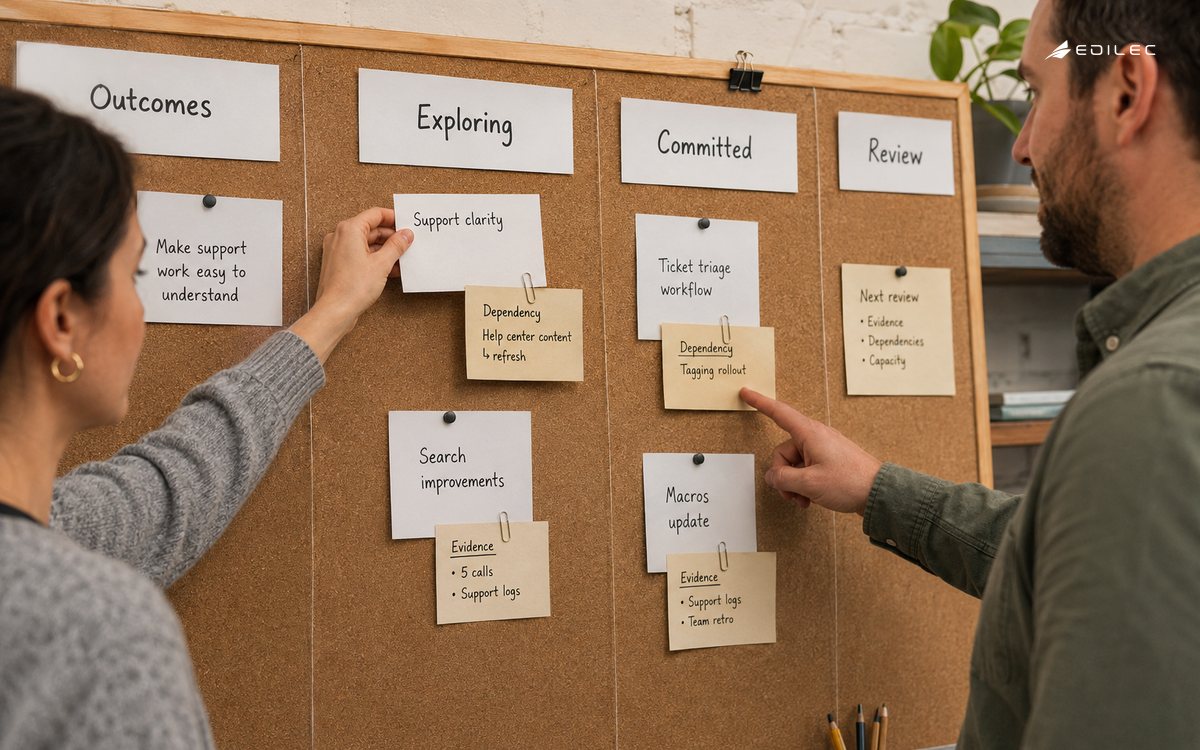
Example: a quarterly plan that can change
Start a quarter with three outcome themes, not a long list of promised features. Each theme can hold candidate work, confidence, dependencies, and a review date. When a customer, reliability, or compliance signal changes, update the decision record and explain the trade-off in the language of the affected audience. A delivery preview can show what is actually available, while a planning view can retain uncertain options. Keeping those views distinct prevents a draft from becoming a promise by accident.
| Roadmap layer | Purpose | Owner’s question |
|---|---|---|
| Outcome | State the customer or business change | What should improve? |
| Candidate | Hold options and evidence | Why might this be the next bet? |
| Commitment | Show bounded work for delivery | What is true for this window? |
| Review | Close the learning loop | What changed our confidence? |
For connected product context, read What Changes When Product Analytics Moves into Production on analytics, Billing Workflows Decisions That Matter before the First Build on billing workflows, and How Operations Leaders Should Think About Customer Feedback Loops on feedback loops. A field guide is strongest when it shows how roadmap choices meet the product’s actual evidence, dependencies, and customer conversations.
When a roadmap commitment depends on deployment behavior, verify environments, previews, and the boundary between planned work and what is actually available in the deployment platform’s current documentation. Record assumptions and ownership so availability claims remain tied to release evidence.
Growing-team roadmap takeaways
- Define roadmap systems around a decision and a customer outcome, not a list of interface features.
- Make authority, current state, and exception ownership visible in the record.
- Release one narrow path with an honest failure and recovery route.
- Use telemetry and support evidence to inspect the real operating result.
- Change the workflow only after the review shows which assumption failed.
Roadmap questions for growing teams
What is the first question to ask about roadmap systems? Ask which customer decision or job the system must support, what record authorizes it, and who owns an exception. For growing-team roadmap planning, those answers create a useful boundary for design and testing.
For growing-team roadmap planning, can a small team do this without a large platform? Yes. A roadmap system should expose uncertainty, not eliminate it. Commit to a decision cadence, owner, and desired outcome; describe dates as forecasts whose assumptions can be inspected. For growing-team roadmap planning, the first version needs explicit rules and a review habit more than it needs a complex stack.
Conclusion: make allocation choices explicit
A credible roadmap gives a founder a reversible way to allocate attention. It makes trade-offs visible early enough to change course before engineering work turns a guess into sunk cost. For adjacent planning, see Product Analytics: Build Decision-Grade Evidence, Not an Event Warehouse, Roadmap Systems: Security Review, and What Changes When Roadmap Systems Move into Production. For growing-team roadmap planning, these connected practices help a team keep customer value, engineering controls, and operational learning in the same conversation. At the next decision forum, make one trade-off explicit: what will not be funded this cycle, what evidence could reverse that choice, and when the team will inspect it again. This turns planning from a promise ledger into a repeatable allocation practice.