Multi-tenant Architecture: Architecture Guide
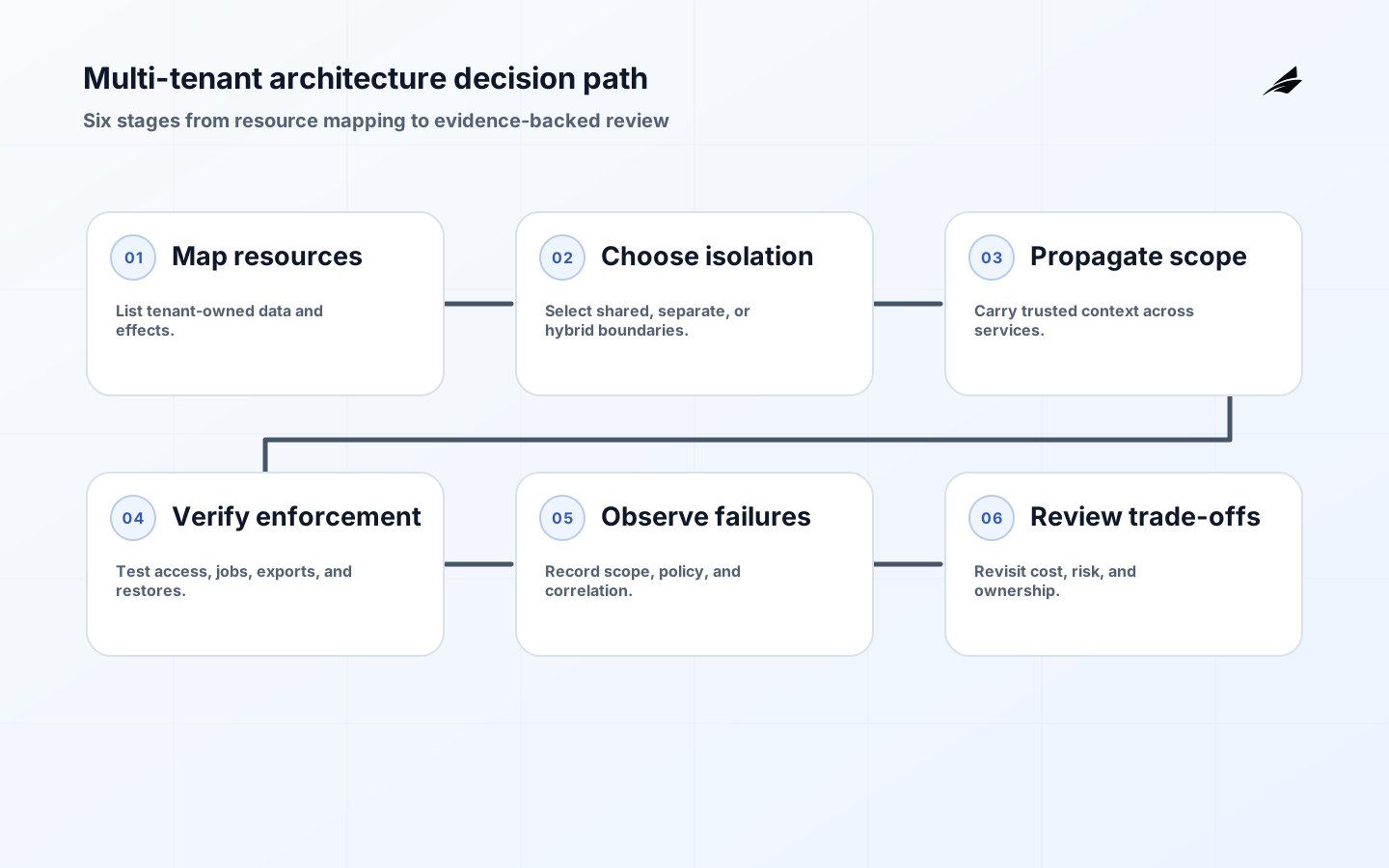
Multi-tenant architecture becomes an architecture discipline when the product has to survive more customers, more asynchronous work, and more operational roles than the original team imagined. The design is not complete when a request filter passes a test. It is complete when a team can explain tenant identity, resource ownership, authorization, limits, observability, export, restore, and support access as one coherent system. This guide is aimed at that review: a practical architecture path that makes trade-offs explicit and failures diagnosable before they become cross-tenant incidents.
Multi-tenant architecture: Define the tenant model and the decisions it must support before rollout.
Start by writing the boundary in ordinary language. For multi-tenant architecture, that boundary includes tenant identity, membership, resource ownership, entitlement, and lifecycle state. The first design decision is where tenant context is established, which service is authoritative for membership, and which resource paths must enforce scope. Keep customer language aligned with the recorded state for multi-tenant architecture. Review evidence from the tenant architecture guide during normal handling.
| Decision area | Question to answer | Evidence to retain |
|---|---|---|
| Authority | Which record is allowed to decide the current state? | Owner, source, and effective time for multi-tenant architecture. |
| Enforcement | Where is the rule applied rather than merely shown? | Policy version, actor, target, and result. |
| Exception | Who may override the normal path, and for how long?. | Reason, approver, expiry, and recovery action. |
| Review | How will a team know the design still matches reality?. | Sampled decisions, operational signal, and review date. |
Model the multi-tenant architecture lifecycle
A useful multi-tenant architecture model makes state transitions and responsibility explicit.
- Name one business owner and one technical owner for each consequential multi-tenant architecture rule.
- Version policies and interfaces so a past decision can be reproduced for its effective time
- Design a denied path and a recovery path; successful demonstrations rarely expose the risky behavior
- Make support actions visible to the same audit model as automated actions
- Use the OWASP ASVS to challenge tenant-boundary enforcement across APIs, sessions, and administrative paths.
Build a narrow multi-tenant architecture path first
Create two test tenants with deliberately similar users and records. Pass tenant context through the browser, API, cache key, object path, queue message, worker, and support tool. A request should derive scope from trusted identity; a client-provided tenant parameter is only an input to validate, never authority.
Test Multi-tenant Architecture failure behavior before expanding
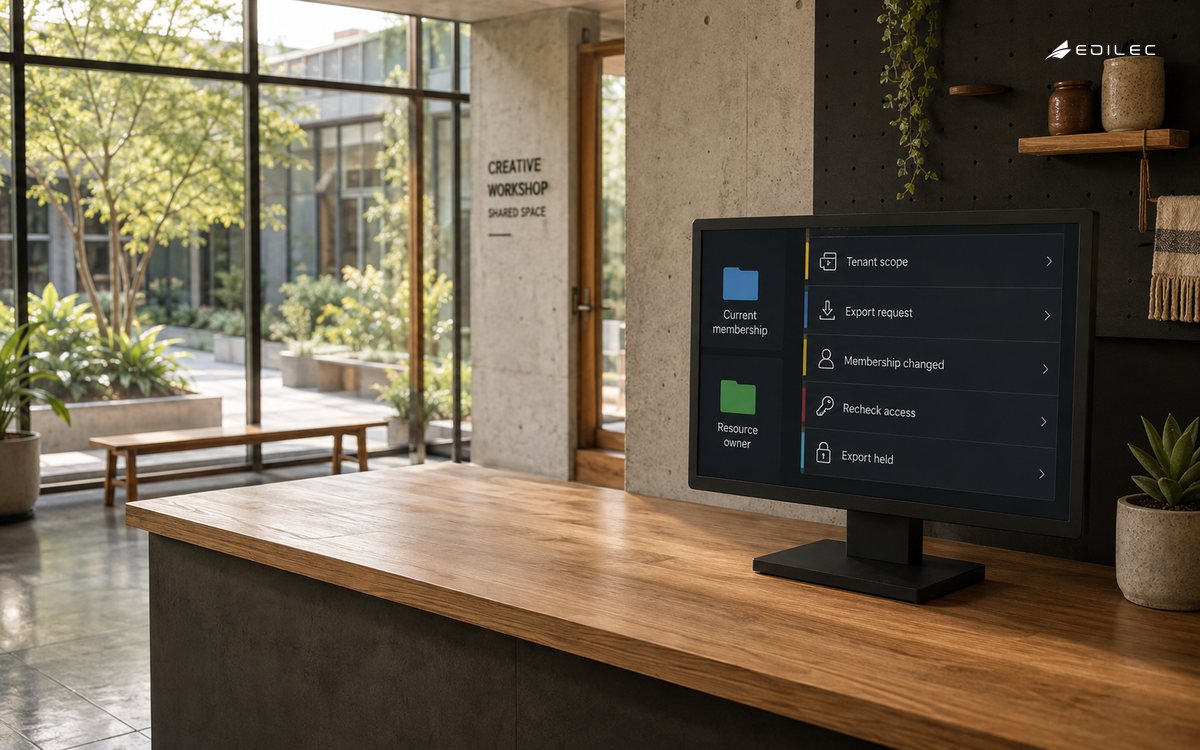
A common incident is a “correct” screen backed by an unscoped query, cache entry, export, or background job. The visible route looks safe while an alternate path leaks data or performs work for the wrong account. Tests must include denied cross-tenant reads, duplicate job delivery, support impersonation, and a tenant that is suspended between enqueue and execution.
| Test condition | Expected behavior | Review signal |
|---|---|---|
| Missing context | Contain the action or require a safe recovery step. | A clear denial or pending state with no silent side effect |
| Duplicate delivery | Produce one durable outcome or a documented idempotent result | Stable event identity and an investigation trail. |
| Late dependency event | Reconcile the new fact without hiding the earlier decision | Visible correction, timestamp, and accountable owner. |
| Operator intervention | Apply the same scoped policy and capture the reason. | Actor, target, action, result, and expiry in the record. |
Multi-tenant architecture: Operate the tenant model with evidence for ownership, isolation, access, and recovery.
Track denied cross-tenant attempts, missing-context events, tenant-level queue delay, support-access approvals, and the age of any isolation exception. Review a sample of successful and denied decisions, because an absence of alerts does not demonstrate that every access route is scoped. OpenTelemetry documentation is useful for thinking about traces, metrics, and logs as correlated signals, but telemetry must be scoped to the decision a team needs to make
A tenant-scoped retry must preserve the tenant that owned the original command and re-evaluate whether that tenant is still active. A worker should not infer context from a recycled connection, a queue partition, or the current support session. Store a correlation identifier with the tenant and resource reference, then reject a replay that would cross scope. This matters especially for exports and restores: an idempotency key prevents duplicate effects only when the key is itself scoped to the tenant and action.
Connect Multi-tenant Architecture to adjacent product work
Multi-tenant Architecture does not sit alone. Teams often need to align it with Workspace Models: Implementation Checklist, Tenant Isolation: Cost and Scaling Guide, and Subscription Access Control Architecture: Entitlements, Events and Safe Provisioning. This creates a concrete recovery and review path for multi-tenant architecture.
Review multi-tenant architecture in real operating conditions
Before a migration, inventory every place a tenant identifier is created or consumed: identity claims, API routes, query builders, caches, object names, search documents, telemetry, queues, analytics, and staff tools. Run the inventory with an adversarial question: could this component return a plausible result even if it received the wrong tenant? The answers often uncover cross-account cache keys, report exports, and asynchronous handlers that were omitted from the original design.
Run a multi-tenant architecture pre-launch review
Before releasing a multi-tenant path, perform a boundary walk with engineers, support, and a security reviewer. Follow one tenant through creation, sign-in, normal work, search, export, background processing, suspension, and deletion. At every step, ask what trusted fact establishes scope, what resource is touched, and what log would explain the decision later. Include one support scenario that needs elevated access. The review should result in a short list of tested invariants, such as “a worker never processes a message without tenant context” and “an export is authorized again when generated. ” Those invariants are more useful than a one-time architecture approval because they can become tests and production alerts.
Use an architecture decision record for every boundary
For each boundary, Record the resource, isolation pattern, trusted scope, enforcement layer, failure result, owner, and evidence. Include the reasons a shared or separated pattern was selected, because the reasoning is often what an incident responder needs when the original author is unavailable. Link the record to migration and test plans. A diagram without these operational details can hide a dangerous assumption: that a downstream service or staff tool will infer the same scope as the request handler.
Review the architecture with adversarial paths and ordinary paths together. Use a tenant with high volume, one with a suspended account, one with a long-running export, and one whose membership changes during a request. Exercise retries, delayed jobs, cache invalidation, partial restores, and support impersonation. Measure not only whether access was blocked, but whether the event explains which scope was evaluated, which policy version applied, and who owns the next action.
| Decision point | Required record | Safe review question |
|---|---|---|
| Boundary | Actor, resource, scope, and policy | Can the service decide without guessing? |
| State | Current value, effective time, and source | What does the customer see and why? |
| Recovery | Owner, reason, expiry, and result | Can the team correct or contain it safely? |
Multi-tenant architecture: Record the evidence that changes the tenant model, including ownership, isolation, access, and recovery.
Use RFC 9110 for the semantics of request handling and safe failure, OWASP ASVS for verification questions, OpenTelemetry documentation for cross-service trace context, and the W3C PROV model for provenance. The architecture should turn those ideas into tenant-aware tests, fields, and runbooks rather than citing them as compliance decoration.
For implementation detail, See the workspace models checklist, tenant isolation cost and scaling guide, and subscription access control architecture guide. These related routes help connect tenancy to membership, cost, and entitlement.
Multi-tenant architecture: Practical questions to answer before rollout.
When should multi-tenant architecture use separate databases?
Use separate stores when residency, restore boundaries, customer-specific controls, or blast radius justify the operational cost. Keep the decision resource-specific; a single product may use shared services and separate storage for selected data.
How do background jobs preserve tenant safety?
Carry a trusted tenant identifier and resource identifier in the job payload, validate both before work, and make missing or contradictory scope fail safely. Log the decision with a correlation identifier.
What evidence should an architecture review require?
Require a boundary map, access tests, job and export coverage, restore assumptions, support-access rules, representative traces, and an owner for each exception. Evidence should show both permitted work and rejected cross-tenant attempts.
Multi-tenant Architecture takeaways
- Define multi-tenant architecture in terms of a decision, its evidence, and its accountable owner.
- Enforce consequential rules where the resource or action is protected, not only in the user interface
- Make retries, late events, and human exceptions first-class states
- Use operating signals to trigger review, then inspect representative decisions before changing policy
- Retire temporary controls, overrides, and obsolete event versions on a named schedule
Multi-tenant architecture: Frequently asked questions about tenant architecture.
What should a team build first for multi-tenant architecture?
Begin with a two-tenant vertical slice: create membership, write a scoped record, read it through another route, and run a background job. Include an attempted cross-tenant read and a suspended tenant. The goal is to prove that tenant context survives every boundary, not to decide between shared tables and separate databases before the access model is real.
How should teams use guidance for Multi-tenant Architecture?
For multi-tenant architecture, Use guidance to test a specific boundary. ASVS can inform verification of access control; HTTP semantics clarify retry expectations; provenance concepts help document a support intervention. None of these sources chooses an isolation pattern for a product. That choice follows the data sensitivity, blast radius, residency needs, operational skill, and the ability to test every path that touches tenant data.
For multi-tenant architecture, test a disputed customer result before treating the first release as complete. For multi-tenant architecture, record the state, evidence, and recovery path.
A practical example for multi-tenant architecture is a policy or commercial state changes at a known time.
Measure multi-tenant architecture outcomes alongside correction effort. The review should also name the multi-tenant architecture signal for a denied request.
For Multi-tenant Architecture, RFC 9110: HTTP Semantics defines scope; OWASP Application Security Verification Standard supports the control. Treat multi-tenant architecture exceptions as evidence for the next decision.
For multi-tenant architecture, review tenant scope during normal handling and during a support review.
For multi-tenant architecture, review recovery during a support review and verify the control during normal handling.
For multi-tenant architecture, rehearse recovery during a recovery drill, then review the recovery path during normal handling.
For multi-tenant architecture, review evidence during a recovery drill.
For multi-tenant architecture, review the control during a recovery drill.
For a tenant-boundary failure, verify that requests retain tenant context through the dependency call, that stale or incomplete data cannot cross accounts, and that the recovery owner can reconcile the final state.
Conclusion
The durable version of multi-tenant architecture is not the most elaborate one.
Evidence for “Multi-tenant Architecture: Architecture Guide” is grounded in RFC 9110: HTTP Semantics, OWASP Application Security Verification Standard, OpenTelemetry Observability Primer, PROV Data Model; each source informs a specific decision, test, or operating trade-off described in this guide.