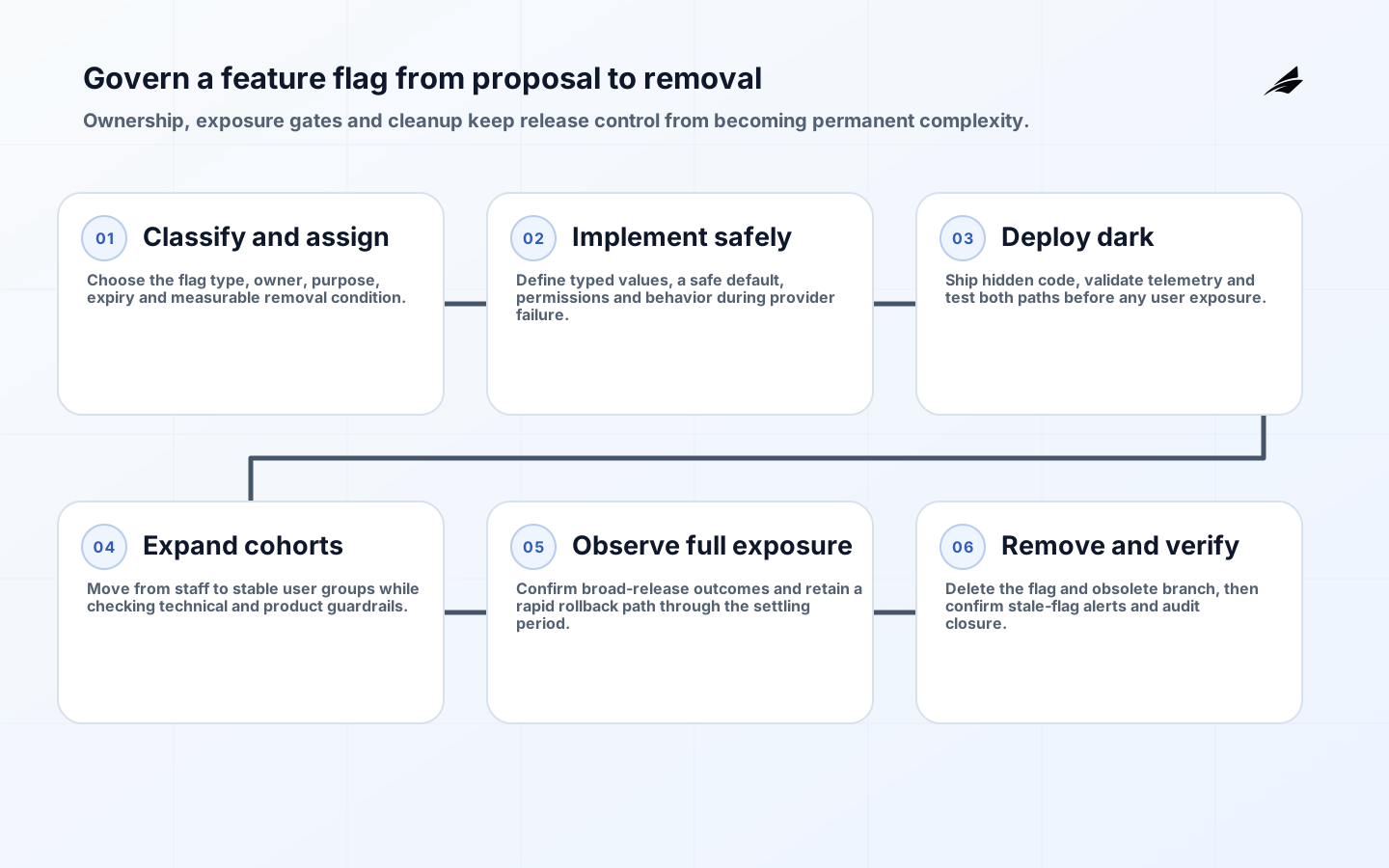
A feature flag separates deploying code from exposing behavior. That can reduce release risk, support controlled experiments and provide a fast operational control, but every flag adds states that must be tested and operated. A strategy therefore covers purpose, targeting, evaluation, telemetry, permissions, failure behavior and removal. Without that lifecycle, flags become permanent hidden configuration and rollback confidence becomes illusory.
The first design artifact should state the operating outcome: Release changes progressively, observe real behavior, stop exposure quickly and remove temporary complexity on schedule. Translate that promise into named records, decisions, controls and measures. Tool selection becomes easier when vendors and implementation teams must demonstrate the difficult exception, the unavailable dependency and the recovery path rather than only the happy path.
Define scope in business and risk terms
Interview product, engineering, analytics, reliability and support teams about recent releases that needed staged exposure or emergency disablement. Classify the decision each proposed flag will control and identify affected code paths, data writes and cohorts. Bound the first rollout to a change with clear guardrails and reversible exposure. Record assumptions about provider availability, targeting stability and old-path compatibility.
- Classify flags as release, experiment, operational, permission or long-lived configuration.
- Assign an owner, purpose, creation date, review date and removal condition.
- Define typed values, safe defaults and behavior when the provider is unavailable.
- Use stable targeting keys and minimize personal data in evaluation context.
- Test important combinations and both sides of every release flag.
- Audit changes, rehearse rollback and remove flags with the old code path.
Design the lifecycle, decisions and boundaries
Model a release flag through proposed, implemented, dark, limited, expanding, fully exposed and removed states. Evaluate close to the controlled behavior and use one stable result throughout a transaction where consistency matters. Typed defaults must be deliberate when the provider is unavailable. Configuration changes need audit and propagation visibility; data-changing paths require idempotency or compatibility beyond a simple on-off evaluation.

| Area | Question | Practical design |
|---|---|---|
| Release flag | Decouple deployment from exposure | Short; remove after full rollout |
| Experiment flag | Compare defined variants and outcomes | Until decision and analysis close |
| Operational flag | Reduce load or disable a risky function | Longer, with incident ownership and drills |
| Permission flag | Represent an entitlement | Long-lived; govern as authorization, not casual targeting |
| Configuration | Tune behavior with typed values | Long-lived; validate and version like other config |
Resolve implementation details early
Assign an owner, purpose, flag type, creation date, review date and removal condition to every flag. Separate production change permissions from development experimentation and avoid copying sensitive targeting data into lower environments. Define SDK and provider versions, cache and bootstrap behavior, evaluation telemetry, privacy rules, regional dependencies and what clients do with stale configuration or no connection.
A new search ranking path is deployed dark. Internal users receive it first, then a small stable cohort. The team compares error rate, latency and a pre-agreed product outcome while checking for segment harm. An automatic or human stop condition returns evaluation to the old path. After full exposure and a stable observation period, code for the old path and the flag are removed together.
Build security, privacy and accessibility into acceptance
Threat-model unauthorized flag changes, targeting-data leakage, client-side tampering and a provider outage that activates the unsafe path. Limit change permissions, require review for broad exposure and audit configuration history. Do not use a presentation-layer flag as authorization. Minimize evaluation context and protect stable cohort keys. Administrative overrides need expiration and must remain visible to incident responders.
Roll out with observable gates
- Baseline the current outcome, delay, failure demand and risk before changing the process.
- Build a thin end-to-end path and test contracts, permissions, telemetry and recovery.
- Run in simulation, shadow or limited-production mode where the control permits it.
- Release to a named cohort with an owner, support coverage, stop conditions and rollback steps.
- Review technical signals and business outcomes together; investigate segment differences.
- Expand only when exceptions are handled reliably and operating documentation matches reality.
- Retire the previous path, credentials, jobs and access after evidence and retention needs are satisfied.
A progressive-release gate should require healthy technical guardrails and the pre-agreed product evidence for the current cohort. Test provider failure, stale clients, conflicting flags and immediate disablement under load. Confirm the old path still works and has capacity. If the new path writes incompatible data or triggers external effects, define forward compatibility and compensation because toggling off cannot reverse completed actions.
Risks and measures
| Risk | Response | Evidence to watch |
|---|---|---|
| Wrong targeting | Stable keys, rule review and preview | Unexpected cohort membership |
| Provider failure | Local safe default and resilience test | Evaluation errors and latency |
| Combinatorial states | Limit concurrent flags and test interactions | Escaped flag-state defects |
| Stale flags | Expiry, inventory and removal work | Flags past review date |
| Misleading experiment | Predefined hypothesis and guardrails | Decision quality and segment outcomes |
Track evaluation errors and latency, default use, cohort assignment stability, exposure by variant, technical guardrails, product outcomes, overdue review dates and flags per code path. A favorable aggregate can hide harm in one cohort; excessive segmentation can produce noisy conclusions. Pair quantitative results with support feedback, and distinguish release health from experiment inference before deciding to expand.
Operate the capability after launch
Give each flag an accountable team and maintain a searchable inventory across services and clients. Review permission changes, operational flags, stale experiments, failed evaluations and removal backlog. Exercise provider outage, accidental full exposure, emergency disablement and rollback after a schema change. Update SDK defaults, runbooks and compatibility patterns when the exercise shows the switch is not sufficient.
Operational details that determine reliability
Put evaluation close enough to the behavior that all entry paths receive the same decision. A user-interface-only flag does not protect an API, scheduled job or cached client. For consequential server behavior, evaluate on the server and pass an explicit result where downstream consistency matters. Avoid evaluating the same flag repeatedly during one transaction if configuration could change mid-flight and produce contradictory behavior.
Targeting data is part of the product’s data governance. Use stable pseudonymous keys for percentage rollout, document every attribute, and avoid sending unnecessary personal or sensitive data to a flag service. Cohorts should remain stable so one user does not oscillate between paths. When organization-level consistency matters, target the organization rather than individual users and test membership changes.
A rollback flag can stop new exposure, but it cannot undo data already written, messages sent or irreversible external actions. Design compatibility between old and new paths during the rollout. Use expand-and-contract database changes, versioned events and compensation where needed. Rehearse disabling the flag under load and verify that the old path still has capacity, dependencies and current configuration.
Flag retirement is delivery work, not housekeeping. Remove targeting rules, code branches, tests that exist only for the old state, metrics, dashboards and configuration entries. Search for evaluations across services and clients before deletion. A removal pull request should prove which state became permanent. Track age and overdue review dates at team level so temporary controls do not quietly become architecture.
Procurement and architecture review should use scenario-based evidence for feature flags, product releases, progressive delivery. Ask each proposed solution to perform the representative case, reject an unauthorized action, survive an unavailable dependency, expose an understandable status, produce investigation evidence and export the owned data. Record configuration and integration work needed to achieve the demonstration. A feature visible in a product list is not proof that the complete control or journey will operate in the organization’s environment.
Acceptance should connect design claims to repeatable evidence. For release flag, retain tests or records that show short; remove after full rollout. For the risk of wrong targeting, assign the response before launch and review unexpected cohort membership. Add load, recovery, permission and accessibility evidence in proportion to impact. The release decision should identify residual risks, their owners and the conditions that would pause further rollout.
Key takeaways
- Start from a complete business outcome and the evidence needed to trust it.
- Make identity, authority, state, exception handling and ownership explicit.
- Design failure, recovery and reconciliation before expanding volume.
- Roll out to controlled cohorts with measurable gates and practiced rollback.
- Treat configuration, policy, access and retirement as continuing product work.
FAQ
Should we buy a product or build?
Compare feature-management platforms on SDK quality, evaluation semantics, audit, permissions, propagation, offline behavior, experimentation needs, data governance and export. A small internal library may suit simple release flags but still needs ownership and observability. Include migration of flag keys and targeting rules, behavior during dual running, vendor failure modes and the effort to remove the integration.
What belongs in the first release?
Choose one releasable change with both paths production-ready and measurable guardrails. Deploy it dark, expose staff or a stable small cohort, observe, expand and then remove the old branch and flag. Test evaluation failure and emergency disablement at every stage. Avoid choosing a first pilot whose database change or external side effect makes exposure effectively irreversible.
How should success be measured?
Measure release outcomes with error, latency and saturation guardrails plus a specific product result. Add evaluation failures, use of defaults, cohort consistency, rollback time, stale-flag age and cleanup completion. Deployment frequency alone does not prove progressive delivery is safer. Define the decision window and owner before exposure so teams do not keep an ambiguous flag running indefinitely.
When can the old process be retired?
Retire a release flag after full exposure is stable, no supported client needs the old behavior and rollback no longer depends on the branch. Remove evaluations, old code, targeted rules, tests and dashboards that exist solely for the split. Search across repositories and telemetry for remaining key use, then delete the control-plane entry and record the permanent behavior.
Conclusion
A sound feature flag strategy treats every flag as temporary or explicitly governed production configuration. Typed evaluation, stable cohorts, safe defaults, observable guardrails and practiced disablement make progressive release useful; compatibility and cleanup keep it honest. Teams should finish each release by removing obsolete paths, so the next rollout is not layered onto an expanding set of hidden states.