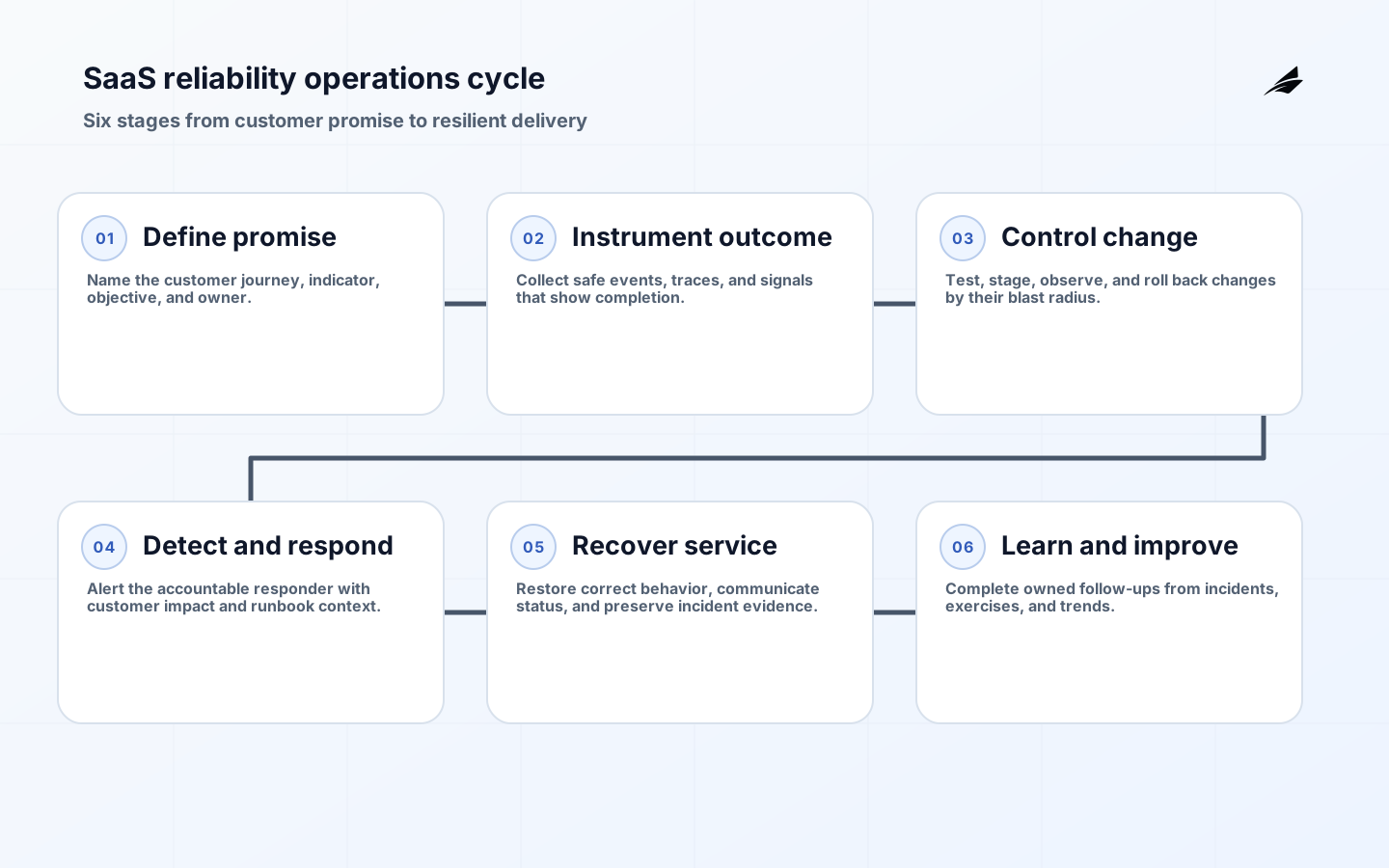
SaaS reliability is not the absence of incidents. It is the ability to make and keep a clear customer promise when software changes, dependencies slow down, demand spikes, and people have to recover under pressure. An uptime percentage by itself does not tell a customer whether they can complete payroll, submit an order, invite a user, or retrieve a report when it matters. Start by identifying the important service journeys and the failure modes customers experience. Then build an operating system around those journeys: service ownership, measurable objectives, instrumentation, change controls, incident response, recovery evidence, and learning. The hard work is choosing what to protect first. A small team that protects a few critical paths honestly will usually deliver more value than one that publishes ambitious reliability claims with no way to observe or defend them.
Define the customer reliability promise
Describe reliability in terms of user outcomes. “A signed-in administrator can create a user and the invitation arrives within five minutes” is more useful than “the API is available.” Establish the user population, measurement window, dependencies, acceptable latency, and consequence of failure. Separate availability, correctness, durability, and recoverability; a service can answer quickly while returning stale or wrong data. Select a small set of service level indicators from events that represent completed work, not only infrastructure health. Then set objectives that reflect customer impact and operational capacity. An error budget is useful only when it changes a decision, such as slowing risky releases, prioritizing a dependency fix, or adding capacity. Share the promise with support and product so their customer communication matches the engineering model.

| Journey | Useful indicator | Failure signal |
|---|---|---|
| Authentication | Successful completed sign-ins. | Credential or identity-provider errors by cause. |
| Core write | Accepted and durable customer action. | Timeout, validation, and persistence failures. |
| Async processing | Work completed within the promised time. | Queue age, retry exhaustion, and poison messages. |
| Export or report | Correct file delivered to an authorized requester. | Generation error, delay, or access denial spike. |
Make services observable by design
Observability should help a responder answer what is failing, who is affected, when it began, and what changed. Instrument services with consistent request, trace, tenant-safe correlation, dependency, and outcome fields. Use structured events that distinguish expected denials from unexpected errors, and protect logs from secrets and unneeded customer content. Dashboards should show the service journey alongside resource signals: a healthy CPU graph does not prove a customer can complete an import. Alerts need a clear owner, meaningful threshold, and a runbook that starts with customer impact rather than a guess about the component at fault. Test monitoring during a planned failure or game day. An alert that arrives after customers report the problem, or that pages someone with no useful diagnostic path, is a clue that the system is being observed for infrastructure convenience rather than operational response.
Control change, dependencies, and capacity
Most reliability regressions enter through change: an application release, infrastructure adjustment, feature flag, schema migration, certificate renewal, or third-party dependency behavior. Classify changes by blast radius and reversibility, then require proportionate testing, review, rollout, and rollback evidence. A gradual deployment is valuable only when the team watches the signals that would make it stop. For dependencies, document the service contract, timeouts, retry policy, idempotency behavior, fallback, and customer message if the dependency fails. Avoid retries that multiply load during an outage, and bound queues so a recovery does not turn into an uncontrolled replay. Capacity planning should consider peak traffic, workload mix, tenant concentration, and recovery load. Planned scaling is cheaper than discovering a hard limit during a customer deadline.
| Operational risk | Prepared control | Evidence to retain |
|---|---|---|
| Bad release | Canary, health checks, and documented rollback. | Rollout decision and observed journey metrics. |
| Dependency outage | Timeout, fallback, and clear degradation mode. | Dependency status, failed requests, and customer impact. |
| Queue backlog | Rate limit, retry cap, and safe replay plan. | Age distribution and processed-versus-failed work. |
| Data mistake | Scoped restore and reconciliation procedure. | Recovery test results and owner confirmation. |
Respond, recover, and learn without blame
An incident process should make the next useful action obvious. Define roles for incident coordination, technical investigation, customer communication, and note-taking; one person may hold several roles in a small team, but the responsibilities should remain visible. State when a customer-facing status update is required, how often it will be refreshed, and who approves a material claim. Preserve a timeline while the facts are fresh, including decisions, hypotheses, mitigations, and observed effects. After recovery, review the system conditions that allowed the problem and the controls that slowed detection or repair. Assign follow-up work with owners and dates, then verify completion. A blameless review does not mean vague review; it means examining the design, context, and signals rather than reducing a complex failure to an individual mistake.
- Write reliability promises around completed customer journeys.
- Use outcome events, traces, and safe logs to support diagnosis.
- Make rollout, dependency, and capacity decisions observable and reversible.
- Give incidents explicit coordination, communication, and recovery roles.
- Turn incident findings into tracked engineering and operational changes.
Exercise reliability before the emergency
Practice the failure modes that matter before customers depend on a response. Run small, controlled exercises for an expired credential, an unavailable dependency, a queue backlog, a bad configuration, and a restore of non-production data. The objective is not to create drama; it is to check whether monitoring detects the condition, the runbook starts with the right facts, access is available to the responder, and the team can communicate clearly. Record what took too long or required tribal knowledge. A well-designed exercise often exposes mundane gaps such as an unowned alert, a missing dashboard permission, or a customer status template that nobody has approved.
Reliability also benefits from product decisions that limit the size of a failure. Make long-running work cancellable where possible, design retries to be idempotent, provide read-only or queued modes when full service is unavailable, and keep critical user data recoverable. Explain degradation choices to customers in terms of the work they can still do. After an exercise or incident, prioritize improvements by customer impact and likelihood, then confirm they are actually deployed and understood. A postmortem document that never changes code, configuration, or practice is only a record of good intentions.
Make reliability ownership legible outside engineering. Product managers need to know which journeys have limited change capacity, support needs a concise way to identify customer impact, and leadership needs to understand the trade-off when an error budget or recovery finding delays a feature. Create a regular service review that looks at objectives, incidents, dependency changes, capacity risks, and promised follow-up work. Keep it practical: a graph without a decision is decoration. The value of the review is the decision to accept a known risk, reduce it, pause a rollout, or fund a reliability improvement before it becomes an urgent customer problem.
Set expectations for routine maintenance as well as unplanned failure. Tell customers which activities may affect service, the notice channel, the expected window, and the fallback behavior. Internally, confirm that maintenance changes have an owner, monitoring plan, rollback option, and post-change verification of the customer journey. Planned work is a chance to demonstrate reliability discipline: the service should return with evidence that its important functions still work, not merely a deployment marked complete. Clear maintenance practice also prevents support teams from treating foreseeable change as a mysterious incident.
Define a dependency ownership map for each important journey. It should show the internal service, external provider, data store, identity system, queue, and notification path involved, together with the behavior expected when each is slow or unavailable. Keep this map compact enough to be useful during planning and incidents, then update it when a dependency or fallback changes. It helps teams avoid a misleading reliability objective that measures only the service they own while ignoring the identity provider or delivery channel that determines the customer outcome. It also makes vendor reviews more concrete: resilience requirements can be stated as timeouts, recovery options, observability, and tested degradation rather than a generic request for “high availability.”
- Measure completed customer work rather than only resource health.
- Keep trace and event references safe for support to use.
- Stage risky changes and decide rollback from observed journey signals.
- Bound retries and queues so a dependency failure cannot multiply load.
- Assign incident coordination, technical response, communication, and timeline responsibilities.
- Exercise recovery and maintenance procedures before customers need them.
Key takeaways
- Reliability is a customer promise maintained through operations.
- A service can be technically up while a key customer journey is failing.
- Observability must lead to a clear response, not more dashboards.
- Controlled change and dependency design reduce avoidable incidents.
- Learning is useful when it produces owned, verified follow-up work.
Frequently asked questions
Do small SaaS teams need service level objectives?
Yes, but start small. One or two important customer journeys with simple indicators are more useful than a comprehensive program nobody can operate. The objective should guide a real delivery or incident decision.
When should we publish a customer status update?
Publish when a meaningful customer journey is materially affected or a customer needs to take action. Share what is known, the scope, the current mitigation, and the next update time; avoid speculating about root cause before evidence is available.
Conclusion: operate the promise you sell
Reliable SaaS delivery is disciplined attention to the journeys customers depend on. Define the promise, observe its outcomes, control the changes that threaten it, and make recovery a practiced operation. When reliability is treated as everyday product work rather than a separate emergency function, customers receive a service that remains useful when conditions are imperfect.