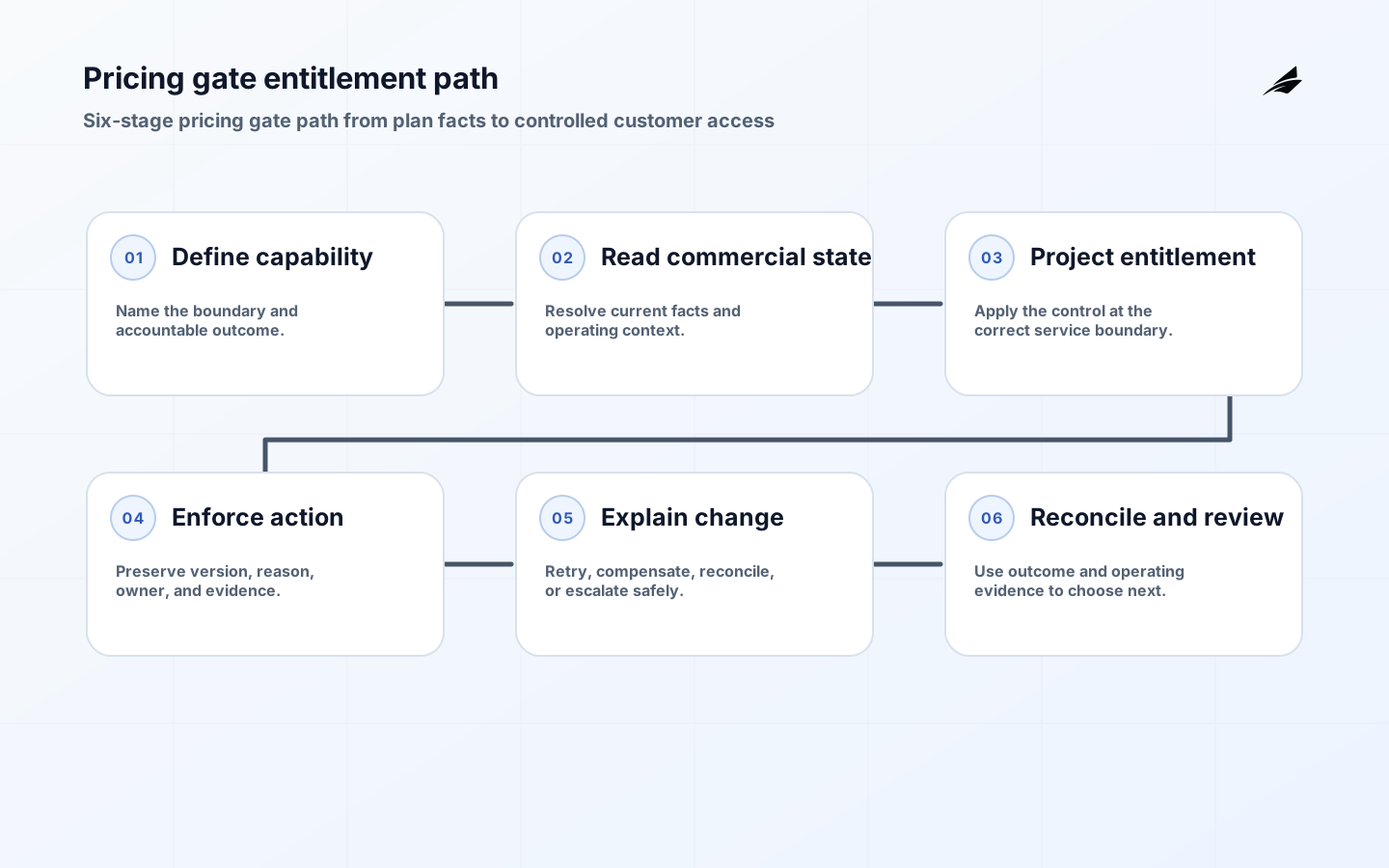
Pricing gates that turn commercial facts into predictable access begins with a bounded operating question. Test pricing gates without surprise with normal, delayed, denied, and corrected workflow cases. For pricing gates without surprise, name the decision boundary and its owner.
Pricing gates translate a commercial offer into product behavior. They decide whether an account can use a feature, consume another unit, invite another member, or access a higher service level. A gate is not just a paywall component. It is an entitlement decision with customer, financial, support, and security consequences. Customers need to understand what is available and how to change it; services need a consistent answer even when requests come through APIs, background jobs, or staff tools. The first design task is to separate the catalog people browse from the authoritative entitlement state services enforce.
Define the pricing gates boundary
Name the protected capability and the unit of access. A plan may grant a binary feature, a quota, a time-limited trial, a regional option, or a contractual exception. For each, define the authoritative contract or subscription, effective time, grace behavior, allowed overage, and correction route. Decide which services must enforce the rule and what happens when the entitlement source is delayed. A browser can present an upgrade message, but it must not be the only barrier to a server-side operation. Make the difference between an access denial, a temporary technical problem, and a commercial restriction explicit so customers and support teams do not have to infer it from an error code.
| Decision area | Question to settle | Evidence to retain |
|---|---|---|
| Authoritative records | Which plan catalog, contract or subscription, entitlement, usage state, gate decision, exception, and customer notice establish the current state? | Source, steward, effective time, and correction path. |
| Protected actions | Who may perform evaluate eligibility, allow, limit, prompt upgrade, grant trial access, revoke, and reconcile? | Policy version, actor, target, and decision result. |
| Exception route | When may the normal rule be bypassed? | Named approver, reason, compensating control, and expiry. |
| Recovery | How is a wrong or incomplete result corrected? | Runbook, owner, verification signal, and review date. |
Model pricing gates as accountable decisions
Model pricing gates as evaluated policy with versioned inputs and a reasoned result. The result should contain an allow or deny decision, applicable entitlement or limit, reason code suitable for the caller, and a correlation reference for investigation. OpenFeature can provide a consistent evaluation interface when a product uses configuration-based targeting, but permanent commercial authorization belongs in an authoritative entitlement service or policy boundary. Keep experimentation flags separate from contractual gates so an experiment cannot silently alter a purchased right. OWASP ASVS reinforces that protected server actions need their own access-control verification, regardless of client presentation.
- Give each consequential pricing gates decision a business owner and a technical owner.
- The pricing gates owner can use that evidence to decide what changes next.
- The pricing gates owner can use that evidence to decide what changes next
- The pricing gates owner can use that evidence to decide what changes next
- Use reason-code volume, false-denial reports, propagation delay, quota accuracy, and exception age as operating signals, not as a substitute for reviewing representative cases.
Build and test the first pricing gates path
Choose one capability and implement the complete path: purchase or provision, entitlement creation, service enforcement, customer explanation, upgrade or support route, and audit trail. Test a new subscription, plan downgrade, expired trial, usage at the limit, concurrent requests near a quota, provider delay, manual exception, and a revoked account with an old session. Use idempotency for provisioning events; RFC 9110 provides the relevant semantics for safe retry expectations, while the application must protect its own state changes. Create clear reason codes so support can tell whether a request was denied by plan, quota, account state, or an internal dependency.
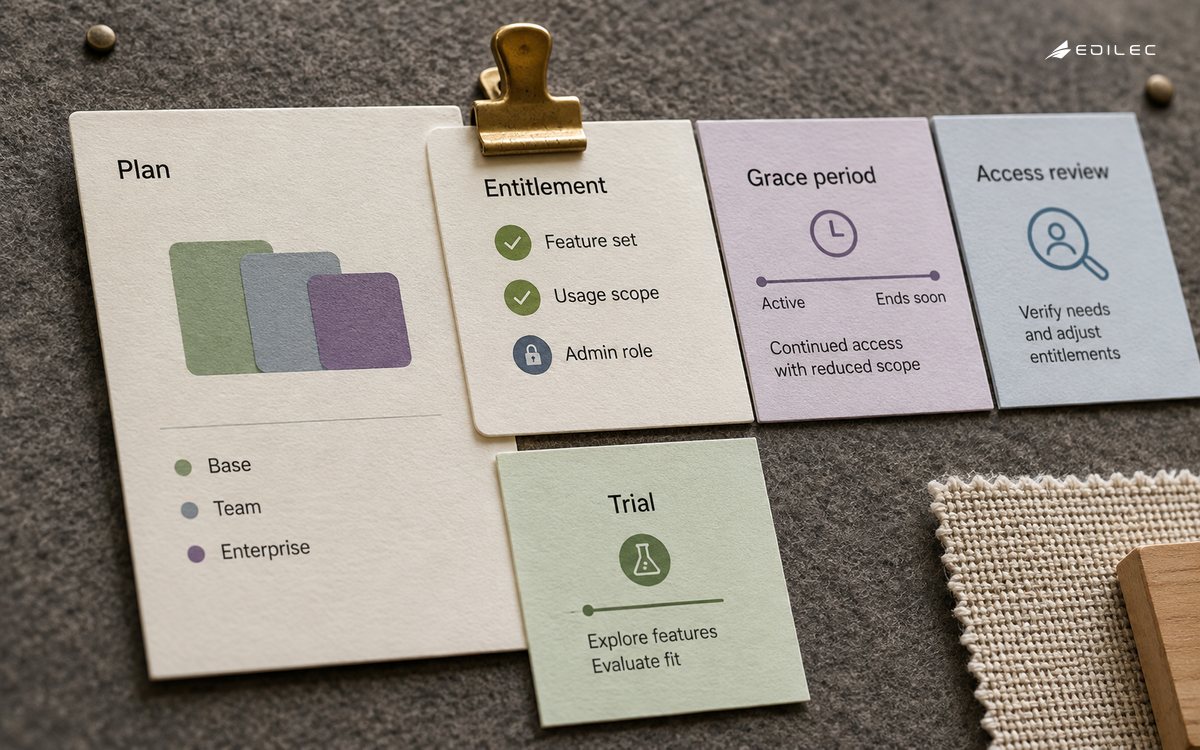
| Release step | What to exercise | Exit evidence |
|---|---|---|
| Representative input | Use ordinary and adverse examples involving plan catalog, contract or subscription, entitlement, usage state, gate decision, exception, and customer notice. | Expected result and owner-reviewed test record. |
| Dependency behavior | Simulate delay, retry, duplicate delivery, or unavailable context for evaluate eligibility, allow, limit, prompt upgrade, grant trial access, revoke, and reconcile. | Visible state, containment choice, and recovery action. |
| Permission boundary | For this evaluation, name the accountable owner, supporting evidence, exception route, and next measurable check. | Server-side decision and audit event match expectations |
| Operational handoff | Ask a second operator to investigate a realistic failure without private context. Within this evaluation, name the accountable owner, supporting evidence, exception route, and next measurable check. | Runbook works, escalation is reachable, and status is explainable |
Run a Pricing Gates Without Surprise operating review
Before expanding pricing gates, convene the business owner, engineering owner, support representative, and the person responsible for the source records. Walk one routine case and one uncomfortable case from plan catalog, contract or subscription, entitlement, usage state, gate decision, exception, and customer notice through evaluate eligibility, allow, limit, prompt upgrade, grant trial access, revoke, and reconcile. For pricing gates without surprise, record the state, evidence, and recovery path.
Measure pricing gates with context
Track gate evaluations by reason, false-denial reports, upgrade conversion after a limit, quota-consumption accuracy, exception age, entitlement propagation delay, and mismatches between product access and billing or contract records. Treat conversion carefully: a gate that produces revenue by confusing or blocking legitimate users is not healthy pricing. Review cohorts that repeatedly hit a limit and accounts that receive frequent manual exceptions; both may indicate a packaging problem or an unclear customer journey. For quota gates, measure the difference between the displayed remaining amount and the enforced amount, especially around late usage or concurrent consumption.
Control Pricing Gates Without Surprise failure modes
Pricing failures often appear as inconsistent channels. The web interface may deny a feature while an API or background process permits it; an upgrade may be paid for but not propagated; a refund may leave access active; or a support exception may never expire. Centralize the decision where possible, propagate changes through durable events, and make failures observable. PROV-DM helps retain the connection between a commercial change, entitlement update, gate result, and correction. During an incident, avoid broadly disabling controls without scope. Identify the affected capability and accounts, choose a temporary customer-safe policy, document it, and reconcile all dependent services afterward.
Pricing Gates Without Surprise: Use the underlying references
This guide is grounded in OpenFeature Specification, OWASP Application Security Verification Standard, RFC 9110: HTTP Semantics, PROV-DM: The PROV Data Model.
Pricing-gate review should reconcile one customer's commercial promise with every channel that can enforce or display it. Start with the contract or plan, then inspect entitlement publication, web behavior, API behavior, background jobs, staff console actions, usage calculation, and any upgrade or refund event. Repeat the test around a boundary such as a trial expiry, a quota limit, or a plan change during an active session. The expected result must be specific enough that support can distinguish a commercial restriction from a technical outage. This review uncovers cases where a polished upgrade screen conceals inconsistent enforcement elsewhere. It also protects the business: a temporary exception should have an owner and expiry, while a lasting packaging exception should become an explicit commercial decision rather than an invisible override.
Entitlement design review
Make the normal path and exception path explicit for pricing gates that turn commercial facts into predictable access.
Treat pricing gates that turn commercial facts into predictable access as an operating system rather than a screen.
Use a small scenario review before expansion.
Keep customer language aligned with system state for pricing gates without surprise.
| Decision area | Control to apply | Evidence to retain |
|---|---|---|
| Scope | Name the supported boundary for pricing gates that turn commercial facts into predictable access | Approved scope and exclusions |
| Authority | Use trusted facts and current context | Source, version, and timestamp |
| Action | Enforce at the service that commits the result | Allow or deny reason |
| Recovery | Retry, compensate, reconcile, or escalate | Correction and review record |
The primary references for this decision are Stripe Billing Entitlements, Stripe: Using webhooks with subscriptions, OWASP Application Security Verification Standard, OpenTelemetry observability primer. Apply the rule to pricing gates before widening the rollout.
For related planning, see The Plain-language Guide to Billing Workflows, The Plain-language Guide to Feature Flags, The Plain-language Guide to Usage Reporting. For pricing gates, retain the reason and effective time with the outcome.
Key takeaways
- Pricing gates work best when its decision boundary and record authority are explicit.
- Design corrections as visible, attributable actions rather than silent edits to a current-state field. When implementing this part of the system, name the accountable owner, supporting evidence, exception route, and next measurable check.
- Pilot one consequential path with normal, adverse, and recovery cases before expanding scope. Before releasing this part of the system, name the accountable owner, supporting evidence, exception route, and next measurable check.
- Review operational signals alongside examples, because aggregate numbers can hide a broken boundary. While operating this part of the system, name the accountable owner, supporting evidence, exception route, and next measurable check.
Pricing Gates Without Surprise FAQ
Are pricing gates the same as feature flags? No. Flags manage release or experimental behavior; pricing gates enforce a customer's current commercial entitlement. Can a quota be checked only in the UI? No. The service consuming the quota must enforce it under concurrency and retry. How should an exception work? It should be explicit, scoped to a capability or account, time-bound, attributable, and visible in the same decision path as ordinary entitlement. That makes it possible to support a customer without creating an invisible permanent bypass.
For pricing gates without surprise, review scope for pricing gates during normal handling. Give pricing gates without surprise a named owner and a review date for pricing gates.
For Pricing Gates Without Surprise, OWASP Application Security Verification Standard defines scope. Measure pricing gates without surprise outcomes alongside correction effort.
A practical example for pricing gates without surprise is an unexpected load spike. For pricing gates without surprise, review evidence for pricing gates during a corrected record.
Ownership for pricing gates without surprise is clearer when the customer promise is separated from the mechanism. For pricing gates without surprise, review ownership for pricing gates during a corrected record.
During normal handling, verify that each pricing gate resolves the current entitlement, plan version, and effective period before the protected action is allowed.
For pricing gates without surprise, test an incomplete setup before treating the first release as complete.
Use a disputed entitlement or delayed subscription event as the test case. Preserve the source billing event, show a limited or pending state where appropriate, and reconcile the recovery before restoring access.
A concrete operating test for pricing gates without surprise is to rehearse a recovery drill. Review ownership during a changed permission and confirm that the record is consistent.
In a support review, compare a successful entitlement change with an overdue, canceled, or downgraded subscription. Check the commercial record, authorization result, customer message, and audit evidence for the same effective period.
Conclusion
Pricing gates work when commercial commitments become consistent, explainable product decisions at every channel. They rely on billing evidence, benefit
Evidence for “Pricing Gates Without Surprise: A Practical Entitlement Design Guide” is grounded in Stripe Billing Entitlements, Stripe: Using webhooks with subscriptions, OWASP Application Security Verification Standard, OpenTelemetry observability primer; each source informs a specific decision, test, or operating trade-off described in this guide.