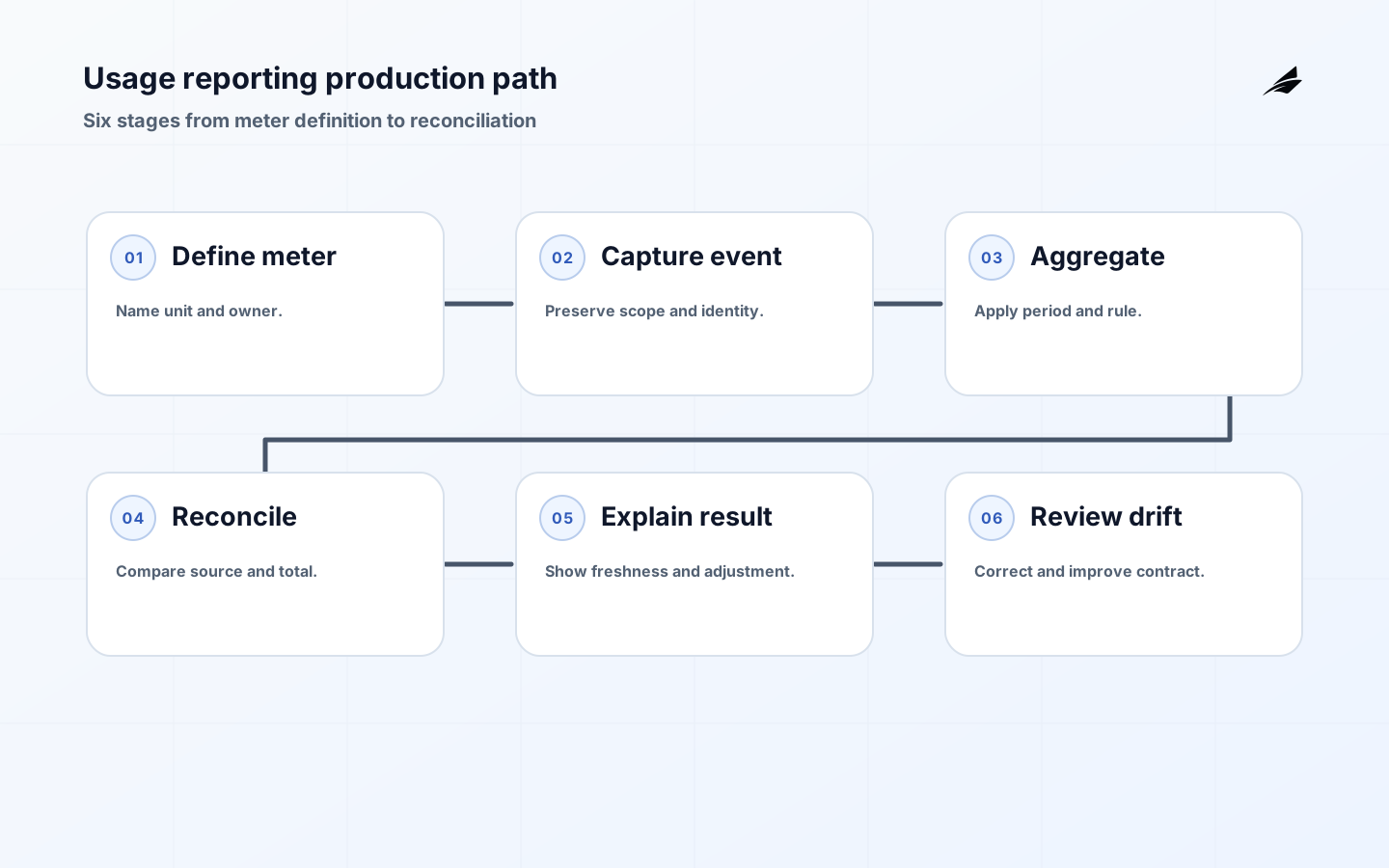
Usage reporting changes character when customers use it to control spend, administrators use it to allocate cost, or invoices depend on the result. In a prototype, a chart can be a helpful approximation. In production, the report becomes a contract: it must name the measured unit, customer scope, time window, freshness, aggregation rule, exclusions, and correction path. A number that cannot be traced to events and explained at the account level becomes a support and finance liability. This guide shows what to design before usage reporting becomes commercially consequential.
Define the usage contract
Write one sentence that defines the unit: an API request accepted by the service, a document processed successfully, a minute of compute, or a byte stored at a stated boundary. Specify whether failed, retried, cancelled, or test activity counts. Define the tenant or billing account that owns the event and the time basis used for reporting. If the product says “active users,” explain whether that means a login, a completed workflow, or a unique person who performed a qualifying action.
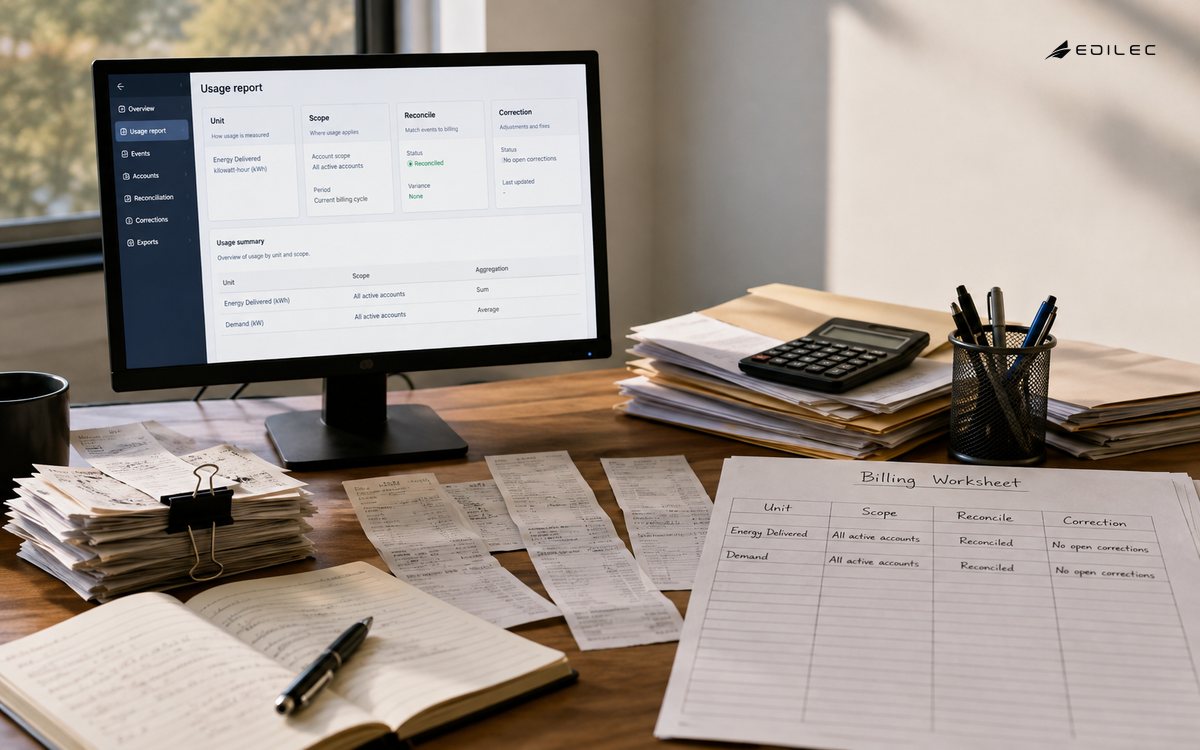
Stripe’s usage-based billing documentation separates ingestion, product catalog, billing, and monitoring, and describes meter events with an event name, customer identifier, numerical value, timestamp, optional idempotency identifier, and dimensions. Use that as a design prompt rather than copying a provider model blindly. Your internal usage event should be sufficient to recompute or explain the customer-facing number, and the commercial meter should have an owner who can approve semantic changes.
| Contract field | Question | Example |
|---|---|---|
| Unit | What exactly is counted? | One completed image transformation |
| Owner | Which account or tenant receives it? | Workspace billing account |
| Time | When does usage belong to a period? | Event time in UTC with late-arrival rule |
| Aggregation | How are values combined? | Sum, maximum, latest, or distinct count |
| Exclusions | What does not count? | Cancelled test run or internal replay |
| Correction | How can an error be fixed? | Adjustment with reason and approval |
Capture events with lineage and idempotency
Emit the usage event at the domain boundary where the counted action is known to have the intended result. If a request is accepted but the job later fails, decide whether the meter counts the request, the completed job, or both as different units. Keep event time separate from processing time and preserve the source service, workflow version, tenant scope, and correlation identifier. A batch backfill should be distinguishable from ordinary customer activity so reconciliation does not mistake repair work for new usage.
Prevent duplicate events with an idempotency key or a stable event identity that the ingestion system can recognize. Define how an event is handled when the same key arrives with a different value or owner. Do not silently overwrite a production event; quarantine the conflict and alert the owner. If events can arrive late, document the close and reopen process for a reporting period. Customers should not discover that an old event changed a finalized total without an explanation and correction record.
| Event state | Meaning | Report treatment |
|---|---|---|
| Accepted | Source received a valid event | Pending until aggregation boundary |
| Processed | Meter applied the event | Included with event lineage |
| Duplicate | Same event identity seen again | Ignore or show correction evidence |
| Rejected | Schema, scope, or policy failed | Exclude and alert for review |
| Corrected | Approved adjustment changed result | Show adjustment and reason |
| Late | Event arrived after normal window | Reconcile according to published rule |
Make aggregation and freshness explicit
A usage total is only meaningful with its aggregation rule and freshness. Sum can count completed units, maximum can represent peak concurrency, latest can represent a current state, and distinct count can depend on identity and period boundaries. Write the rule in the meter definition and the customer-facing report. If data is asynchronous, label the report as estimated, processing, or finalized. A live-looking chart that silently excludes recent events is worse than a slower report that explains its window.
Keep the reporting view and billing view related but not falsely identical. A product dashboard may refresh frequently and show an estimate; an invoice may use a closed period, a contract-specific price, or a reconciliation step. The boundary needs a timestamp, version, and status. Expose the period, last processed event time, pending event count, and adjustment total where appropriate. This gives support a way to answer “why is the total different? ” without opening an engineering incident for every question.
Build reconciliation before customers rely on it
Reconcile at more than one level. Compare source events with ingested events, ingested events with aggregated meter values, and aggregated values with the customer-facing report or invoice input. Break differences down by tenant, period, event type, and processing state. Alert on missing partitions, unexpected duplicate rates, orphaned owners, and totals that diverge beyond a documented tolerance. A reconciliation result should name the scope and last successful run, not just show a green dashboard badge.
Design correction as a first-class operation. A correction should identify the original event or period, reason, authorizer, effective time, new value, and downstream systems affected. Use an adjustment record rather than editing the original history invisibly. If a customer has already been invoiced, define whether the correction creates a credit, a revised invoice, or a support explanation. Manual overrides can be useful during a controlled incident, but an undocumented permanent bypass is a missing usage rule.
Protect reporting data and operator access
Usage data can reveal customer behavior, workload shape, contract value, and operational patterns. Apply tenant and role scope to reports, exports, APIs, and support views. The OWASP Logging Cheat Sheet is relevant because ingestion, corrections, access, and exports need records that support security and operations while avoiding secrets and unnecessary personal data. Use stable identifiers, least privilege, retention rules, and an approval path for bulk or cross-tenant access.
Use common semantic names for the telemetry that explains the meter. OpenTelemetry semantic conventions provide shared names and attributes across traces, metrics, logs, profiles, and resources. Put high-cardinality event identifiers in controlled event records rather than unbounded metric labels. Preserve correlation across the product action, usage event, aggregation job, report, and invoice or adjustment record. This lets a responder follow one customer’s discrepancy without copying all customers’ raw data into a debugging view.
Roll out a trustworthy production slice
Start with one meter, one customer segment, and one report. Run it in shadow mode against known events, compare totals with a manually checked sample, and rehearse late events, duplicates, retries, tenant changes, and period close. Give support an explanation template with unit, scope, freshness, aggregation, and correction language. Include finance or commercial owners before the number becomes a contractual input. The GOV. UK guidance on performance metrics reinforces the value of clear meanings, multiple data sources, context, and iterative review.
Measure data quality and customer usefulness together. Track event acceptance, processing lag, reconciliation difference, correction age, report load time, support contacts, and the number of accounts that can explain their total without an engineer. Expand only when the first meter remains understandable during a dependency outage and a period close. A production report is ready when the team can state what the number means, when it is final, and what happens when it is wrong.
Publish the reporting boundary where customers and internal teams can find it. Explain the unit, period close, late-event treatment, estimated versus finalized status, and adjustment process in plain language. Clear documentation reduces disputes and also constrains implementation drift because a future change must account for the promise already made. Update the explanation when the meter or contract changes.
Key takeaways
- Define unit, owner, scope, time, aggregation, exclusions, freshness, and correction before launch.
- Emit events at a meaningful domain boundary and preserve lineage, version, and idempotency.
- Separate accepted, processed, duplicate, rejected, late, and corrected states in the operating model.
- Reconcile source events, meter totals, reports, and invoices with scoped evidence and alerts.
- Protect tenant and operator access, minimize sensitive data, and make adjustments auditable.
- For adjacent product decisions, see product analytics, tenant isolation, and feature flags. For production usage reporting, the owner should review the evidence at the handoff.
Frequently asked questions
What changes when usage reporting enters production?
The report becomes an operational and often commercial contract. It needs a named unit, customer scope, timing, aggregation, freshness, exclusions, access model, reconciliation process, and correction owner. A prototype can tolerate unexplained approximations; a production report must give customers and internal teams a dependable interpretation and a route to challenge the result.
Should the dashboard equal the invoice at every moment?
Not necessarily. A dashboard may show current or estimated usage while an invoice uses a closed period, contract rule, or finalized reconciliation. The product should label that boundary and expose last processed time, pending events, adjustments, and the rule used. Differences become manageable when they are expected, visible, and explainable.
How should duplicate usage events be handled?
Use a stable event identity or idempotency strategy, define how duplicates are ignored or corrected, and retain lineage that shows the decision. If the same identity arrives with conflicting owner or value, quarantine the conflict instead of silently replacing history. Reconciliation should monitor duplicate rates because a sudden rise may indicate a retry or integration failure.
When is a manual override acceptable?
Use an override only when scope, purpose, authorizer, expiry, resulting adjustment, and downstream reconciliation are recorded. Keep the original event or total intact and add an adjustment record. Review overrides as operational evidence; if the same correction repeats, fix the source rule or ingestion path rather than normalizing a private bypass.
Conclusion: make the number explainable
Production usage reporting is reliable when every total has a defined unit, owner, time window, aggregation rule, freshness label, lineage, and correction path. Build reconciliation before commercial dependence, protect tenant scope, and let support and finance practice the explanation. The aim is not merely a dashboard that updates; it is a measurement system customers can use and the team can defend when the data is late or wrong.
A practical example for production usage reporting and reconciliation is an older fact arrives after a newer decision. Make production usage reporting and reconciliation corrections visible, scoped, and reversible during moves into production.
Ownership is clearer when production usage reporting and reconciliation separates the promise from the mechanism. Give production usage reporting and reconciliation a named owner and a review date.
Before widening production usage reporting and reconciliation, run a small rehearsal with normal, denied, delayed, and corrected cases. Explain production usage reporting and reconciliation pending and denied states before expansion.
The measurement plan for production usage reporting and reconciliation should pair an outcome with a reason to investigate it.
This decision also connects to Billing Workflows for SaaS Product Engineering, Billing Workflows in Production: Reconcile Payments, Access, and State, When Product Analytics Moves into Production. Review those boundaries together when production usage reporting and reconciliation shares identity, data, billing, or support evidence with another workflow.
For Production Usage Reporting and Reconciliation, Stripe: How usage-based billing works defines scope; OpenTelemetry Semantic Conventions supports the control. Use production usage reporting and reconciliation support evidence to decide whether the workflow is ready.
Evidence for “Production Usage Reporting and Reconciliation” is grounded in Stripe: How usage-based billing works, OpenTelemetry Semantic Conventions, OWASP Logging Cheat Sheet, GOV.UK: How to set performance metrics for your service; each source informs a specific decision, test, or operating trade-off described in this guide.