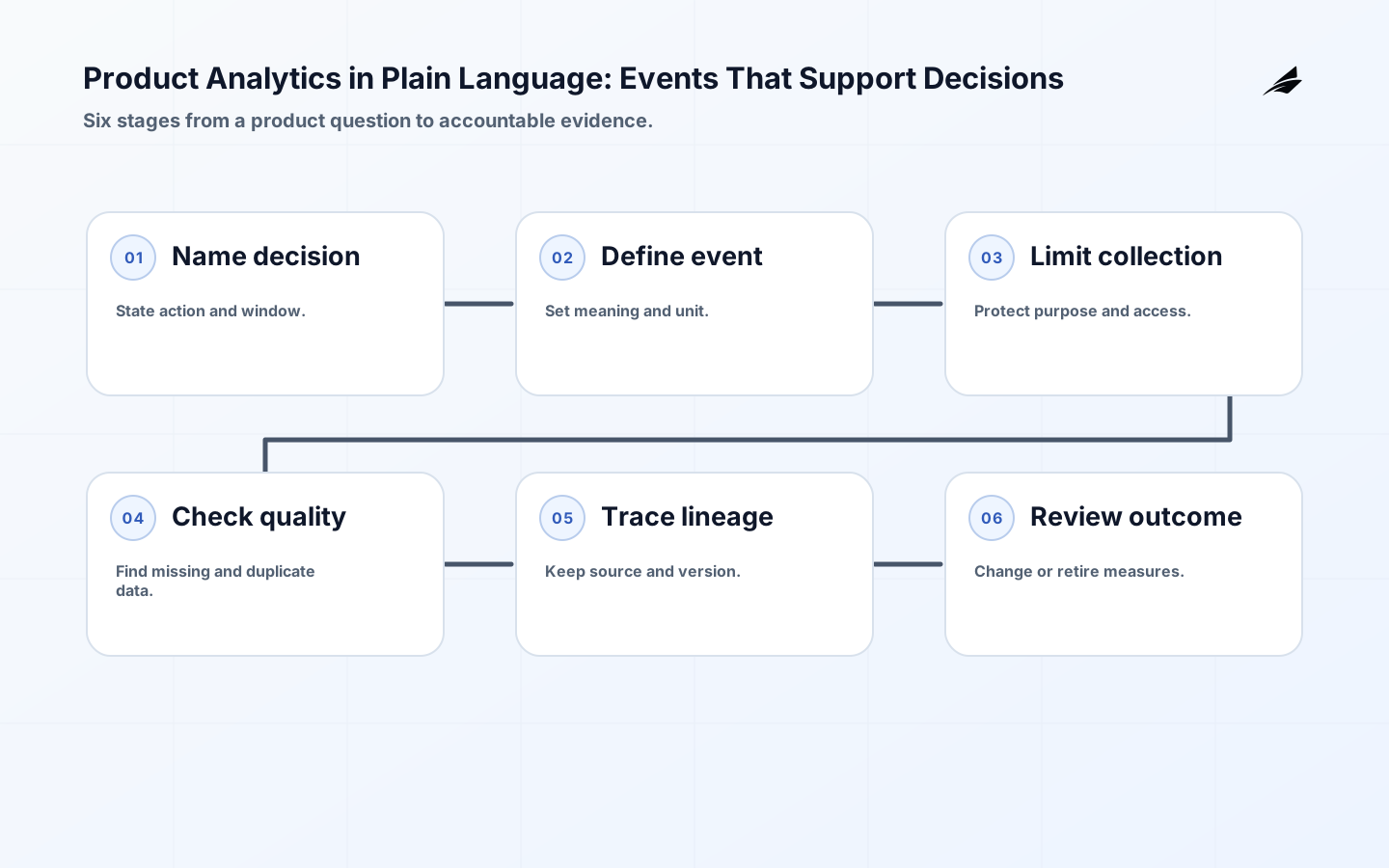
Product analytics is useful when it reduces uncertainty about a product decision. A chart showing more activity is not automatically evidence that customers received more value. Teams need an event contract that says what happened, who or what produced the event, which properties explain the occurrence, how privacy is protected, and what quality level is required before anyone acts on the result. NIST describes its Privacy Framework as a voluntary tool for identifying and managing privacy risk, while W3C provenance concepts help explain how a result was derived. Use those ideas to build analytics that a product manager, engineer, and operator can interpret together. The related product analytics production guide shows how the same discipline changes after release.
Begin product analytics with a decision, not an event list
Start by naming the decision the measurement will inform: whether a setup journey reaches a first useful outcome, whether a release reduces a known obstacle, or whether a capability is reliable enough to expand. Define the population, time window, denominator, and action that follows a change in the signal. If no one can say what would change after the number moves, defer collection. This step prevents a tracking plan from becoming a permanent catalogue of curiosity. It also gives engineering a target for instrumentation: only events and properties that support the decision need to become part of the first contract.

| Planning element | Example decision | Contract detail |
|---|---|---|
| Question | Do new teams reach the first shared report? | Success event and allowed time window |
| Population | Workspaces that completed account setup | Eligibility rule and exclusion reason |
| Unit | One workspace journey | Stable workspace and journey identifiers |
| Action | Improve the import step if completion falls | Named owner, review cadence, and guardrail |
Define an event contract people can implement consistently
An event is a business occurrence, not merely a UI gesture. Give it a stable name, a human definition, an event time, a producer, a schema version, identity rules, required properties, and an explicit duplicate policy. Distinguish an attempted action from a completed outcome; a button click does not prove a file imported or a report was understood. Keep property names meaningful and bounded. For example, use a controlled outcome such as importcompleted or importrejected with a reason code, rather than embedding an entire error message in an ungoverned string. Version changes that alter interpretation and publish the old and new meaning together during migration.
Preserve provenance from source action to reported result
W3C PROV-DM describes provenance in terms of entities, activities, agents, derivations, and responsibility. You do not need to build a full provenance graph for every dashboard, but you should retain enough lineage to answer a practical question: which service or client produced this event, which transformation counted it, which release was active, and which definition was in force? Attach a schema version and source reference to the analytical record. When a number changes after a backfill or a filter correction, the reviewer should be able to distinguish a real customer change from a new calculation.
Set privacy and retention boundaries before collection
Purpose limitation is easier when it is decided before implementation. For each event, document why it is collected, who can inspect it, how long raw detail is needed, what can be aggregated, and how a person or account can exercise an applicable deletion or access process. Avoid putting free-form customer text, secrets, or unnecessary identifiers into event properties. Use a stable internal key only when it supports the approved purpose, and separate operational correlation from analysis identity when they do not need the same audience. A privacy review is not a veto on measurement; it is a way to make the product question and data boundary honest.
| Risk | Design response | Review evidence |
|---|---|---|
| Unclear purpose | Tie event to a named product decision | Decision record and owner |
| Excessive detail | Use controlled properties and redact free text | Schema review and sample payload |
| Identity spread | Separate analysis key from operational trace context | Access map and retention rule |
| Stale data | Aggregate or delete raw detail when no longer needed | Retention job result and exception log |
Measure quality as part of the product analytics system
The W3C Data Quality Vocabulary provides a useful language for attaching measurements to data quality dimensions. Select the few dimensions that can change the decision: completeness of required fields, consistency of identifiers, timeliness, uniqueness, and validity of controlled values. Set tolerances rather than pretending every event must be perfect. A missing optional property may be harmless; a missing workspace key can make an entire funnel untrustworthy. Quarantine or mark records that fail material checks, then show the affected scope to the analyst instead of silently dropping it. Quality metadata should travel with the dataset or report where possible.
Use observability context to explain operational behaviour
OpenTelemetry defines common structures for traces, metrics, logs, context, and semantic conventions. Product analytics does not need to copy every technical attribute, but it benefits from a deliberate bridge: a business event can carry a correlation key that lets an engineer inspect the request path, while sensitive operational details remain outside the analyst's view. Keep the bridge stable and documented. When a conversion drop follows a release, compare the product event with latency, error, and version signals rather than assuming the customer changed behaviour. Technical telemetry explains system conditions; product analytics explains the outcome and both should retain their own appropriate context.
Implement the smallest trustworthy slice
Choose one journey and one decision for the first release. Write a contract, instrument the producer, validate payloads, ingest with a replayable path, and build one report with visible data-quality status. Test retries, offline clients, clock differences, consent changes, partial completion, and schema rollout. A duplicate event should not turn one completed task into two conversions; a late event should be handled according to the chosen time basis, not silently moved into a more convenient day. Keep an owner for the event definition and an owner for the implementation so a dashboard does not outlive the people who understand its assumptions.
Review analytics with decisions and samples
A weekly number review should include the definition, denominator, data-quality indicators, notable changes, and a small sample of underlying records. Ask whether the signal moved because of customer behaviour, a release, a source outage, an identity change, or a query alteration. Record the decision made and the next check. If a metric has not informed an action for several review cycles, retire it or lower its collection cost. This keeps product analytics connected to product work instead of allowing dashboards to become an unexamined inventory of past questions.
Make one analytics review reproducible
A useful review starts from the question and recreates the result from a defined population. Write the query or transformation version, list the exclusions, inspect a few source records, and compare the result with an independent signal when one exists. If the measure depends on a join, show the grain on both sides and describe what happens to unmatched records. If the measure depends on a time window, state the event clock and late-arrival rule. These details are not busywork: they are the difference between a number that can guide a decision and a number that merely looks precise. Give the reviewer a route to challenge the definition without requiring production access to raw customer data. When the review finds a gap, change the contract, test, or explanation that caused it and note which historical reports may be affected. Reproducibility lets a small team maintain useful analytics as people and systems change.
A small event catalogue is easier to govern when each entry includes a definition, producer, required fields, example payload, privacy classification, quality check, owner, and retirement condition. Analysts can then tell whether a missing value is an expected edge case or a broken producer. Engineers can test the same contract in the client, service, and pipeline. The catalogue should be close enough to implementation to stay current, but its decision purpose should remain understandable to people who do not write the instrumentation.
Key takeaways
- Define the product decision, population, unit, time basis, and response before naming events.
- Treat event meaning, identity, provenance, and duplicate behaviour as part of the contract.
- Collect the smallest useful data set with a documented privacy, access, and retention boundary.
- Expose material quality failures instead of hiding them inside a clean-looking chart.
- Connect business events to technical context with a deliberate correlation bridge, not accidental identity reuse.
- For related planning, See the plain-language guide to onboarding flows and the feature flags security review. Apply the rule to analytics before widening the rollout.
Frequently asked questions
Are clicks good product analytics events?
They can describe intent or an attempted action, but they rarely prove an outcome. Pair an interaction event with a server-confirmed or otherwise reliable completion event when the decision depends on success.
How should identity be handled?
Use the least identifying key that can answer the approved question, define account and person relationships explicitly, and keep operational trace context separate when analysts do not need it. Document merge, deletion, and anonymous-to-known transitions.
What makes a dashboard trustworthy?
A trustworthy dashboard states its definition, time basis, population, source, freshness, quality status, and owner. It also gives a route to inspect a representative record or reconciliation result when the number matters.
Conclusion: let analytics earn its authority
Product analytics becomes dependable when an event has a purpose, a stable meaning, a privacy boundary, a quality check, and a provenance trail. Start with one decision that can change a product action. Make the smallest data path observable, review it with real examples, and retire what no longer helps. The result is not more instrumentation for its own sake; it is a body of evidence that teams can use without guessing what the number really means.
For product analytics in plain language, test a duplicated request before treating the first release as complete. Measure product analytics in plain language outcomes alongside correction effort.
A practical example for product analytics in plain language is an operator loses access during a handoff. Reconcile product analytics in plain language changes against the original record.
Ownership is clearer when product analytics in plain language separates the promise from the mechanism. Treat product analytics in plain language exceptions as evidence for the next decision.
Before widening product analytics in plain language, run a small rehearsal with normal, denied, delayed, and corrected cases. Use product analytics in plain language support evidence to decide whether the workflow is ready.
This decision also connects to The Plain-language Guide to Onboarding Flows, The Plain-language Guide to Product Support Tooling, Feature Flags Security Review: Controls for Safe Runtime Change. Review those boundaries together when product analytics in plain language shares identity, data, billing, or support evidence with another workflow.
For Product Analytics in Plain Language, NIST Glossary: Data Processing defines scope; OpenTelemetry Specification supports the control; PROV-DM: The PROV Data Model clarifies evidence; Data Quality Vocabulary guides recovery. For product analytics in plain language, record the state, evidence, and recovery path.
Evidence for “Product Analytics in Plain Language: Events That Support Decisions” is grounded in NIST Glossary: Data Processing, OpenTelemetry Specification, PROV-DM: The PROV Data Model, Data Quality Vocabulary; each source informs a specific decision, test, or operating trade-off described in this guide.