The Plain-language Guide to Onboarding Flows
Onboarding flows should help a new person or account reach a meaningful first outcome, not merely finish a sequence of screens. The distinction matters because progress can be genuine even when a step is skipped, and a completed form can still leave the customer unable to use the product. Treat onboarding as a stateful product workflow: it has a starting condition, required and optional evidence, clear ownership, exits, and a recovery path. The flow also needs to work when a user returns later, switches devices, receives an invitation twice, or requires assistance. Those conditions reveal whether the product is guiding work or simply counting clicks.
Define the onboarding flows boundary
Define the first successful outcome before choosing the checklist. For an account product it may be inviting a teammate and completing one shared task; for a regulated service it may include verification before access is granted. List the states that matter: not started, in progress, waiting on another person, verified, activated, blocked, and abandoned. Store progress at the server when it affects access or support, rather than trusting only browser state. Decide which steps may be deferred and what risk changes when they are. This avoids a familiar failure: the team raises completion by hiding a prerequisite, then learns later that new customers cannot safely finish their intended work.
| Decision area | Question to settle | Evidence to retain |
|---|---|---|
| Authoritative records | Which account state, invitation, verified identity, completion evidence, consent, and support context establish the current state? | Source, steward, effective time, and correction path. |
| Protected actions | Who may perform start, save progress, verify, invite, activate, skip, and recover? | Policy version, actor, target, and decision result. |
| Exception route | When may the normal rule be bypassed? | Named approver, reason, compensating control, and expiry. |
| Recovery | How is a wrong or incomplete result corrected? | Runbook, owner, verification signal, and review date. |
Model onboarding flows as accountable decisions
Make the flow accessible, interruptible, and truthful about its state. WCAG 2.2 is a practical reference for input assistance, focus, target size, and accessible authentication. It supports a better product outcome as well as broader access: a user should understand what is required, why a check failed, and how to continue without restarting. Separate enrollment data from authorization. An email confirmation or company-domain match can contribute evidence, but the service should still authorize the requested capability at its protected boundary. Keep optional profiling separate from essential setup so a customer can make progress without being pressured to disclose unnecessary information.
- Give each consequential onboarding flows decision a business owner and a technical owner.
- Keep source facts, derived state, and human overrides distinguishable in records and logs
- Version rules and interfaces so a disputed result can be reproduced for the relevant time
- Limit sensitive context to the roles and services that need it, then test denied paths deliberately
- Use time to first value, blocked-state age, duplicate-account rate, assistance demand, and recovery success as operating signals, not as a substitute for reviewing representative cases.
Build and test the first onboarding flows path
Pilot the smallest onboarding path with real new users and a support observer. Test invitation expiry, duplicate links, delayed verification, a returning user with incomplete work, a required-field correction, an account that already exists, and a member who lacks authority to complete an organization step. Instrument meaningful milestones and failure reasons, but do not log sensitive answers just to explain a funnel. OpenTelemetry can help correlate a client or service failure to the technical path, while product events explain the customer journey. Combine both in a support view that shows current state, next legitimate action, and whether an operator may intervene.

| Release step | What to exercise | Exit evidence |
|---|---|---|
| Representative input | Use ordinary and adverse examples involving account state, invitation, verified identity, completion evidence, consent, and support context. | Expected result and owner-reviewed test record. |
| Dependency behavior | Simulate delay, retry, duplicate delivery, or unavailable context for start, save progress, verify, invite, activate, skip, and recover. | Visible state, containment choice, and recovery action. |
| Permission boundary | Attempt the action with an authorized, unauthorized, and recently changed actor | Server-side decision and audit event match expectations |
| Operational handoff | Ask a second operator to investigate a realistic failure without private context | Runbook works, escalation is reachable, and status is explainable |
Run a Onboarding Flows operating review
Before expanding onboarding flows, convene the business owner, engineering owner, support representative, and the person responsible for the source records. Walk one routine case and one uncomfortable case from account state, invitation, verified identity, completion evidence, consent, and support context through start, save progress, verify, invite, activate, skip, and recover. For onboarding flows, review control for onboarding flows during normal handling.
Measure onboarding flows with context
Measure time to first value, completion of the meaningful outcome, step-specific recovery, assistance requests, repeated attempts, and abandonment by state. Segment carefully: a change in acquisition channel, plan, or verification requirement can change the population without changing the flow quality. Review recordings or direct research only under an appropriate consent and retention policy. Qualitative evidence is especially useful when a user completes the flow but misunderstands the product's next action. A healthy onboarding flow lowers unnecessary effort while preserving the checks that protect other users, account data, and contractual commitments.
Control Onboarding Flows failure modes
The risky paths are often quiet: an expired invite retains access, a user is trapped after a verification vendor delay, a support agent bypasses a required check without a record, or a browser retry creates duplicate accounts. Use stable invitation and account identifiers, idempotent create operations, and a visible blocked state with an accountable queue. RFC 9110 helps frame which retries should be safe; the application must still make its create and activation semantics explicit. When a manual override is needed, record who approved it, why, what compensating review remains, and when the temporary condition expires.
Onboarding Flows: Use the underlying references
This guide is grounded in Web Content Accessibility Guidelines 2.2, NIST Privacy Framework, OpenTelemetry Specification and RFC 9110: HTTP Semantics. For onboarding flows, a delayed result should remain distinguishable from a denial.
Onboarding review is most useful when it includes people who did not finish. Recruit a small sample of new users, recent completers, and people who contacted support or abandoned a blocked state. Ask them to describe the goal they thought the flow was serving and the point at which their expectation diverged from the product. Compare those accounts with the stored state and technical trace. The review often distinguishes a genuine policy requirement from a poorly timed request for information. It can also show that a seemingly optional step is necessary for a downstream teammate. Capture those findings as changes to state rules, copy, accessibility, or support routing, then test the revised flow again. A lower screen count is not automatically better; the real standard is a safe, understandable path to the customer's first useful result.
Key takeaways
- Onboarding flows work best when its decision boundary and record authority are explicit.
- Design corrections as visible, attributable actions rather than silent edits to a current-state field
- Pilot one consequential path with normal, adverse, and recovery cases before expanding scope
- Review operational signals alongside examples, because aggregate numbers can hide a broken boundary
Onboarding flows: Onboarding flows FAQ — guide to onboarding flows workflow
Should onboarding be linear? Only where order is genuinely required. Show dependencies clearly, but let users complete independent setup in the order that fits their work. What is the best completion metric? The first verified customer outcome, not simply the last screen. How should support help? Give staff a bounded view of state and a documented intervention path. They should be able to resend, unlock, or explain an action without seeing private data or granting themselves permanent authority. Rehearse that support path before a large acquisition campaign.
Make onboarding flows supportable at the handoff
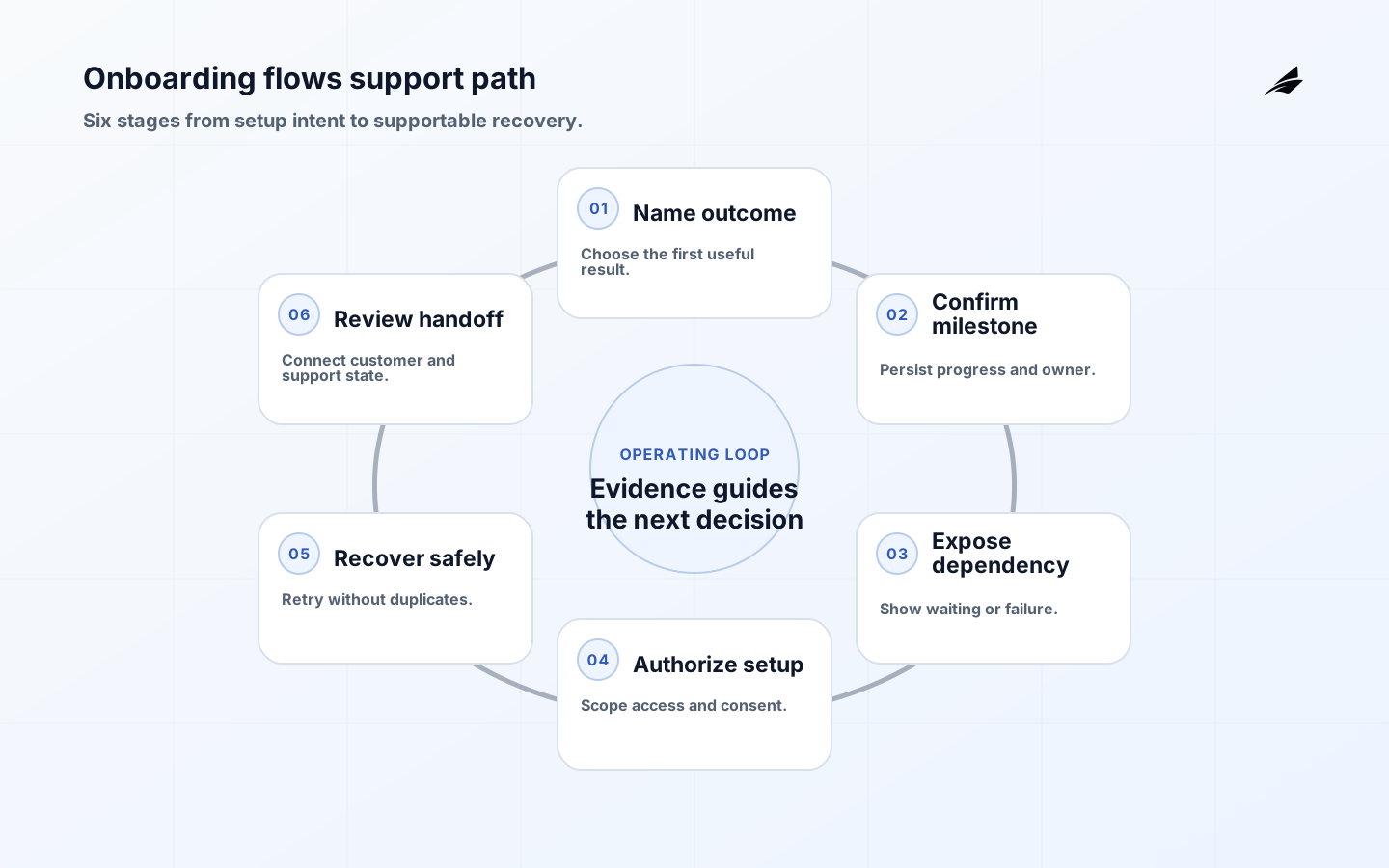
A supportable onboarding flow makes the next action clear to the customer and to the person who must help when that action fails. For example, an invited administrator may verify an email, choose a workspace, connect a data source, and wait for an import. Persist each confirmed milestone with its timestamp, owner, and blocker reason. If the import stalls, the customer should see whether the connection is waiting, failed, or needs consent; support should see the same state with enough evidence to act.
Treat recovery as part of the onboarding flows design. A retry should not create a second workspace, duplicate an invitation, or repeat a billable connection. Use an idempotency key for the command, a correlation identifier for the trace, and a visible status that survives refresh. When an external dependency is unavailable, preserve the last confirmed milestone and explain the next safe step instead of presenting a generic success message. Related operating patterns include workspace models, admin consoles, and product analytics.
How many steps should onboarding flows contain?
Use the fewest steps needed to reach a meaningful customer result, then defer optional setup. Each step should have a clear completion signal and a recovery path.
What should happen when a dependency is down?
Keep the last confirmed state, identify the dependency, offer a safe retry or contact path, and make the interruption visible to support and operators.
Should an onboarding flow ask for every detail up front?
Usually not. Ask for information when it changes the next decision, and explain why a permission or data field is needed.
For the plain-language guide to onboarding flows, a good handoff ends with observable evidence rather than a verbal promise.
The smallest useful improvement to the plain-language guide to onboarding flows is often a sharper boundary, not another feature. Reconcile onboarding flows changes against the original record.
During a measured rollout, track whether onboarding users reach the next step with the expected consent, access, and recovery information.
During a dependency failure, verify that the onboarding flow explains the interruption and provides a clear recovery path.
For onboarding flows, review measurement for onboarding flows during a dependency failure. For onboarding flows, review evidence for onboarding flows during normal handling.
For onboarding flows, review control for onboarding flows during a tenant boundary. For onboarding flows, review recovery for onboarding flows during normal handling.
Conclusion
Onboarding flows earn trust when progress reflects real readiness, interruptions are recoverable, and a human can explain the next legitimate
Evidence for “The Plain-language Guide to Onboarding Flows” is grounded in Web Content Accessibility Guidelines 2.2, NIST Glossary: Data Processing, OpenTelemetry Specification, RFC 9110: HTTP Semantics; each source informs a specific decision, test, or operating trade-off described in this guide.