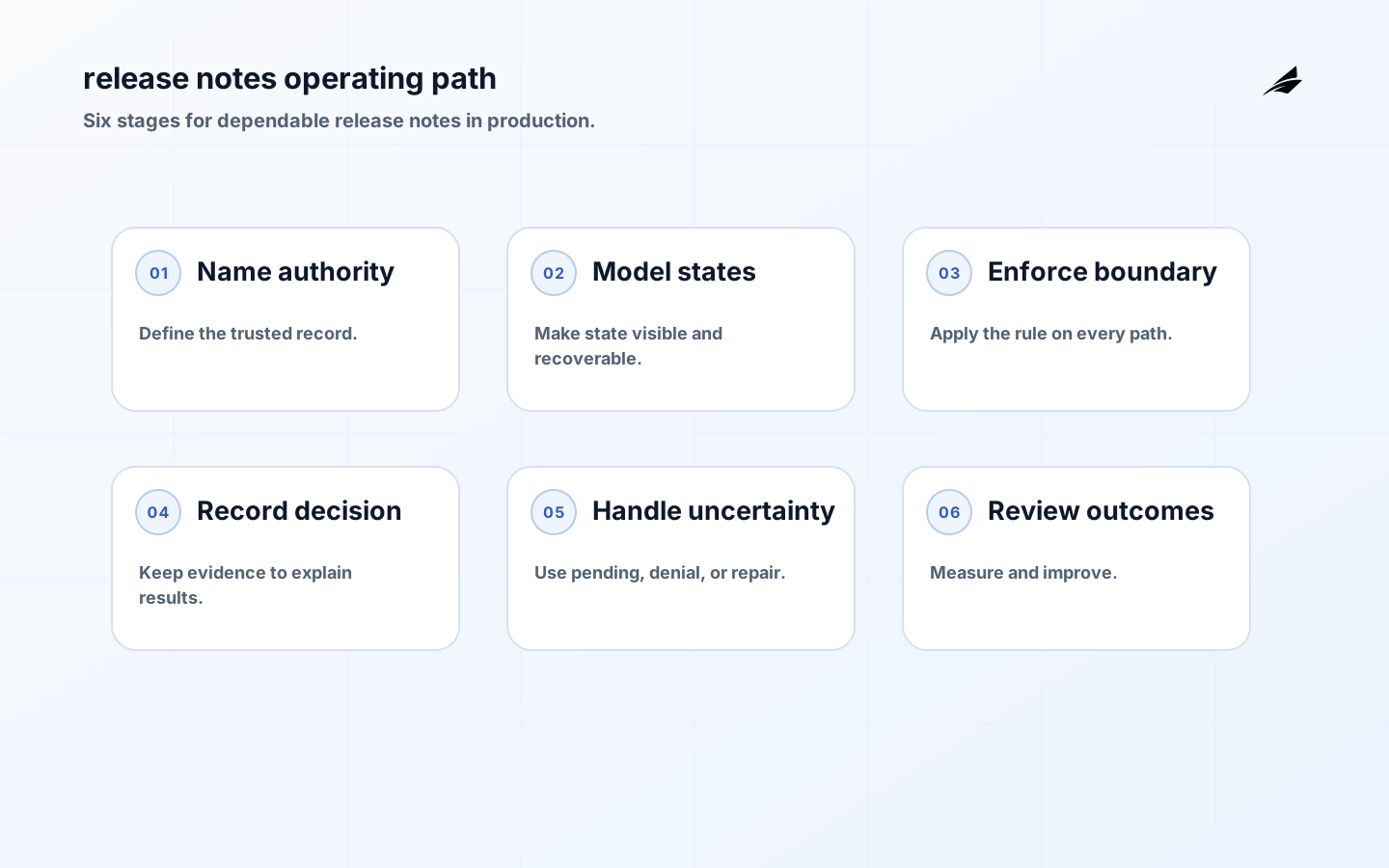
Release notes look like content, but once customers rely on them they become part of the product's operating surface. A note can explain a change, set an expectation, direct a customer to a new workflow, or create a support obligation. Production publishing therefore needs more than a rich text box. It needs a source of truth for what shipped, a clear audience, an accountable publisher, a revision history, and a way to correct an inaccurate statement without erasing what people previously saw.
Validate release notes through a complete operating case
Use this production transition guide to validate release notes with one complete operating case before widening the scope. Delivery teams should trace one customer journey from first intent through an authorized state change, durable value, support visibility, and a measurable product outcome. Begin with the customer job, tenant and user identity, entitlement, workflow state, support history, and release decision, cross each policy and dependency boundary, and finish in a durable state that a customer or operator can recognize. Record the expected state at every handoff, who may change it, and which evidence proves that the next step was justified. This walkthrough gives product, engineering, security, and support a shared acceptance case instead of allowing each team to assume that another layer owns the transition. Use representative roles, realistic timing, and the constraints that exist during an ordinary operating day.
The production transition guide should also test a second release notes case that deliberately challenges the design. Include a missing entitlement, repeated action, delayed integration, incomplete onboarding step, or support intervention. The purpose is not to demonstrate that every dependency always succeeds; it is to prove that the service can stop safely, preserve useful evidence, and expose the next responsible action. Review completion state, time to value, exception reason, support action, release cohort, and recurring product use together so the team can distinguish a policy refusal from bad input, a software defect, a delayed dependency, or an operator decision. A useful result is specific enough for a support or incident owner to act without reconstructing the entire journey from unrelated logs and messages.
Turn both cases into release evidence for release notes. Keep the input conditions, expected states, observed result, decision owner, and unresolved exceptions in one reviewable record. Define the recovery action in advance: return the tenant to a clear state, preserve the customer record, route the right support action, and confirm that normal work can resume. Re-run the same cases after a material policy, interface, data, model, infrastructure, or entitlement change so that improvements do not silently weaken an earlier control. For this production transition guide, readiness means that the normal path is usable, the failure path is understandable, and ownership remains visible after launch rather than ending when implementation work is declared complete.
- Choose one representative release notes journey and state the customer or operator result in plain language.
- Capture the customer job, tenant and user identity, entitlement, workflow state, support history, and release decision as evidence, with a named owner for each consequential handoff.
- Exercise a missing entitlement, repeated action, delayed integration, incomplete onboarding step, or support intervention before broader exposure and verify that the safe state is visible.
- Review completion state, time to value, exception reason, support action, release cohort, and recurring product use after release and assign every unresolved exception to a person and date.
Use a release-note evidence review
Release notes become an operating control when each statement can be traced to a shipped change, an affected audience, and a correction owner. Use this review to keep publication aligned with the product state customers actually receive.
| Review area | Evidence to inspect | Publication decision |
|---|---|---|
| Change inventory | Merged change, release artifact, feature state, migration, and known limitation. | Include only behavior available to the stated audience. |
| Audience impact | Plan, role, region, platform, tenant cohort, and required customer action. | Make scope and prerequisites explicit rather than implying universal availability. |
| Publication timing | Deployment completion, rollout percentage, support readiness, and documentation status. | Publish when the described experience and help route are both available. |
| Correction path | Retraction trigger, correction owner, customer notice, and version history. | Correct misleading notes without erasing the record of what changed. |
Key takeaways
- Treat a release note as a published product record, not an informal announcement.
- Connect each claim to a shipped capability, known limitation, and responsible owner.
- Model draft, scheduled, published, corrected, and withdrawn states explicitly.
- Deliver notes to the right audience without exposing private rollout details.
- Make corrections visible while preserving the original publication history.
- Measure whether readers understand and complete the affected customer task.
Tie every note to shipped reality
Start with the change that customers can actually use, not with an internal ticket title. Identify the release or capability, availability date, affected plans, rollout boundary, prerequisites, limitations, and support owner. A note for a gradual rollout should say what is available now and what remains unavailable. If an interface change depends on migration, permissions, or a new workflow, name that dependency in plain language. The author may write the prose, but engineering and product owners should confirm the behavior before publication.
| Content field | Question to answer | Why it matters |
|---|---|---|
| Change | What can the reader do now? | Separates benefit from internal activity. |
| Audience | Who receives this and who does not? | Prevents irrelevant or sensitive disclosure. |
| Timing | When does availability begin, and is delivery gradual? | Keeps expectation aligned with rollout. |
| Action | What should the reader do next? | Turns explanation into useful adoption. |
| Limit | What is not included or still changing? | Reduces support surprises. |
Give publication a real lifecycle
A useful lifecycle distinguishes draft, review, scheduled, published, corrected, and withdrawn. Each state needs a permitted actor and a clear transition. A scheduled note should not appear in an in-product feed before the feature is available to that audience. A withdrawn note should remain discoverable to internal operators with the reason and replacement, while the public surface can show a concise correction or removal message. Keep the publication timestamp separate from the change's effective timestamp so historical reading remains honest.
Set authority without slowing useful updates
Publishing permission should be narrower than editing permission. The author can prepare a note; the capability owner confirms the behavior; a designated publisher decides whether the audience and timing are correct. For security, privacy, pricing, or breaking workflow changes, add the appropriate specialist review. The OWASP Authorization Cheat Sheet is a helpful reference for keeping authorization server-side and explicit. The NIST Secure Software Development Framework reinforces the value of integrating review and traceability into normal delivery.
Deliver the right message to the right audience
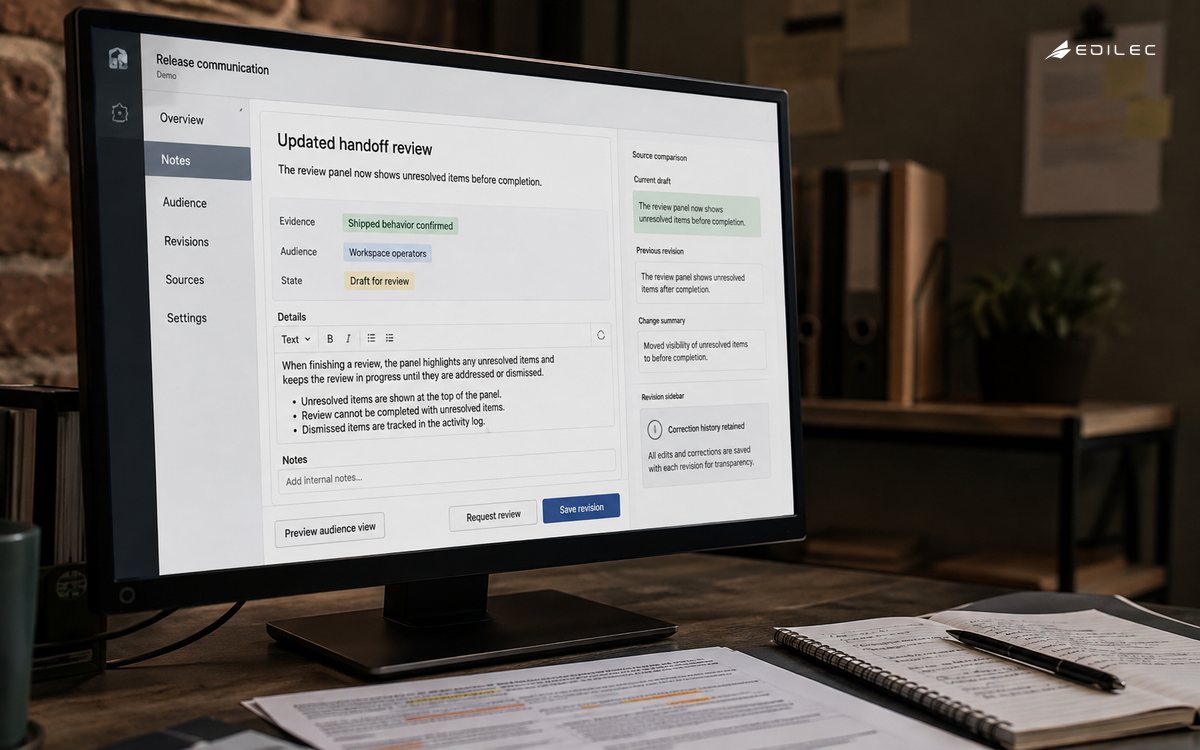
Audience is part of correctness. A note for administrators may mention configuration steps that are meaningless to end users. A note for one contract tier should not imply that every account can use the feature. Resolve audience eligibility on the server, and apply it consistently to feeds, email, search, exports, and public archives. Use stable identifiers for plans and tenant segments rather than trusting a filter supplied by the browser. If the audience is uncertain, delay publication or choose the narrower audience.
Write for decisions and actions
A production note should answer five practical questions: what changed, who can use it, when it applies, what the reader should do, and where to get help. Use a short opening, concrete verbs, and examples that match the shipped interface. Do not promise a result that depends on a future rollout. Add accessibility information when interaction or navigation changes. Link to stable product documentation when a reader needs a longer procedure, and make the link useful even after the note leaves the front page.
Make corrections accountable
A corrected note should preserve the fact that a correction occurred. Store the original content, correction time, reason, approving owner, and replacement text. On the public surface, explain the material difference without exposing internal blame or sensitive detail. The OWASP Logging Cheat Sheet can guide the treatment of publication records: collect enough context to investigate, protect the records, and avoid unnecessary personal data. OpenTelemetry documentation can help connect a note publication to feed delivery, email dispatch, and any resulting product interaction.
Separate revisions from replacements
Minor wording improvements and material corrections should not have the same treatment. A typo can be fixed while retaining the publication identity. A change to availability, pricing, permissions, or customer action needs a visible revision marker and a new review. Store a stable note identifier alongside revision identifiers so links remain useful and readers can tell whether they are viewing the current version. Keep rendered feeds, email payloads, and archives tied to the revision that was actually delivered.
Plan for the moment when a release is rolled back. The note may already be in an inbox, bookmarked, or quoted in a support conversation. Do not silently edit the old statement to imply that the capability was never available. Add a concise status update, explain the temporary change, and link to the current guidance. Give the owning team a mechanism to stop further delivery while the corrected message is reviewed.
- Keep stable links even when a note gains a new revision.
- Mark material changes with the date and reason for correction.
- Reconcile in-product, email, and archive versions after an update.
- Provide current guidance when a shipped feature is temporarily unavailable.
Operate the publishing path
Monitor failed publication, delayed delivery, duplicate messages, broken links, audience mismatches, and notes that remain scheduled after the underlying rollout changes. Give each alert an owner and a response. Reconcile the release-note catalogue with shipped capabilities periodically, especially when a feature is disabled or renamed. Keep a quiet route for urgent corrections so a publisher can stop distribution, update the record, and communicate the change without deleting evidence.
Test communication failures
Test a note published before its feature, an audience filter that returns the wrong plan, a broken documentation link, a duplicate email, a changed capability name, and a rollback after publication. Check whether a reader can distinguish available, limited, and planned behavior. Verify that an operator can find who approved the note, what the customer saw, and which correction path remains open. Communication is part of the recovery plan when a release changes direction.
Make distribution durable and interruptible
A published note may travel through an in-product feed, email, a public archive, an account digest, or a support link. Give each delivery a durable message identifier and record the audience decision that produced it. Queues should tolerate retries without sending a duplicate when the original delivery completed but its acknowledgement was lost. If a message is delayed, the system should re-check whether the feature is still available and whether the reader remains eligible before delivery.
Provide an interrupt path for a note that is wrong, premature, or no longer safe to distribute. Stopping future delivery does not remove copies already seen, so pair the stop with a correction record and current guidance. Test the path with a scheduled message, a partially delivered campaign, and a reader who opens an old link after the correction. The publishing team should know exactly which surfaces need updating and which records must remain for investigation.
Keep the publication record usable for people who were not present at launch. A support agent should be able to open the note, see its audience and revision, compare it with the current capability, and find the owner for a question. That simple path reduces contradictory explanations across support, documentation, and customer success.
Frequently asked questions
Should notes publish before a rollout begins?
Only when the message clearly describes what is planned, who may receive it, and when the capability will be usable. For a customer-facing change, publishing ahead of availability can create confusion unless the audience and timing are controlled.
What should be measured first?
Measure delivery success, qualified readership, completion of the described action, support questions about the change, and correction frequency. Readership alone does not prove understanding; pair it with the customer outcome the note is meant to enable.
For delivery teams working on release notes, this operating signal should connect customer outcomes, tenant state, entitlements, release controls, support actions, and operating cost to evidence an accountable owner can inspect. For adjacent decisions, continue with Edilec's Multi-tenant SaaS Architecture: Production Boundaries That Hold and Feature Flags in Production: Safe Release and Rollback. In this production review, move beyond the operating signal only after the owner can show the accepted result, the exception path, and the signal for another review.
Conclusion
Release notes become dependable in production when they are tied to shipped behavior, governed by accountable owners, targeted to the correct audience, and easy to correct without rewriting history. Treat publishing as a product capability with its own state, evidence, and recovery path. Clear communication then supports adoption instead of creating another source of operational uncertainty.