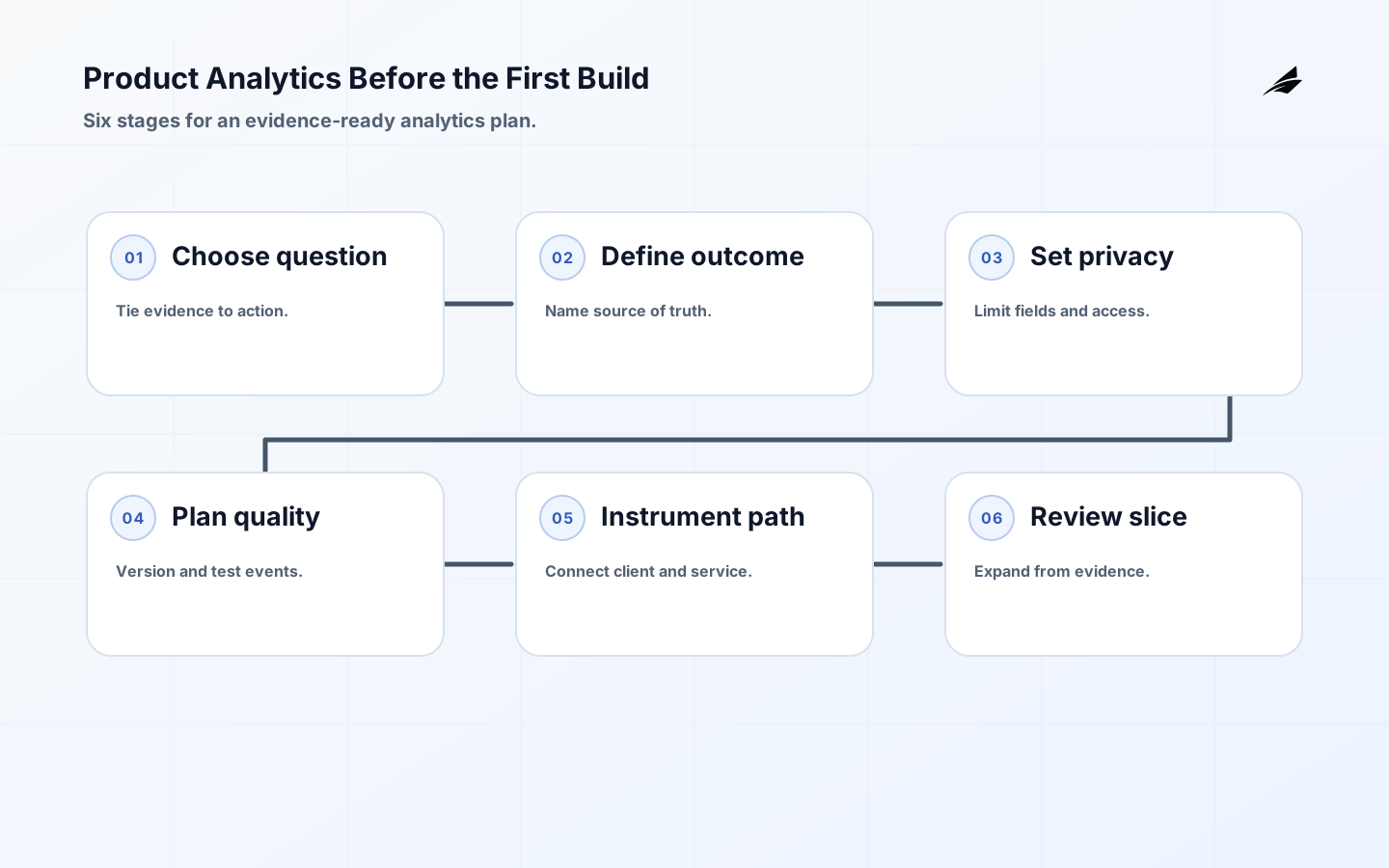
Product analytics decisions before build matter because the tracking model becomes expensive to change once customers, dashboards, experiments, and support routines depend on it. A team can instrument hundreds of events and still fail to answer whether a user reached value, whether a workflow is safe to change, or whether a release caused harm. Start with a decision register: the question, the owner, the population, the action that may follow, and the evidence that would change the plan. Then design the smallest event and outcome model that can answer it. NIST’s Privacy Framework is useful for making privacy risk part of planning rather than a late review, while OpenTelemetry provides a disciplined language for context and signals.
Choose questions that can change a decision
Good analytics questions are bounded. “Do users like the product?” is too vague. “Which new workspace administrators complete the first shared project within seven days, and where do they stop?” has a population, action, and time window. Include the decision owner and the likely intervention: change onboarding, clarify permissions, improve performance, or stop a feature. If no one can say what they would do with the answer, the question is not ready. Keep qualitative evidence in the plan too; analytics can show where behavior changes, but interviews, support tickets, and session review may explain why.
| Planning choice | Concrete example | Why it matters |
|---|---|---|
| Question | Where does first-project setup stall? | Creates a useful investigation |
| Population | New workspace administrators | Avoids mixed cohorts |
| Action | Simplify the invite step | Connects evidence to work |
| Decision threshold | Drop-off above agreed level | Prevents arbitrary reactions |
Model outcomes before interface events
Define the business outcome or server state first, then decide which client and service signals help explain it. A button click may be useful diagnostic context, but a created project, completed import, or successful invitation is closer to the decision. Record actor, account or tenant, object, event time, source, version, and result. Distinguish an attempt from success and a success from durable use. If a flow crosses services, use a correlation approach; W3C Trace Context describes a standard way to carry trace context across boundaries. Keep analytics identifiers stable enough for analysis but avoid turning personal identity into a universal key without a justified need.
Decide the privacy boundary early
Write down which fields are necessary, who may access them, how long they remain, and how a user or customer’s rights and expectations affect the design. Prefer coarse context when it answers the question. Do not record message bodies, free-form notes, exact locations, or identifiers merely because they are easy to capture. Separate product measurement from security investigation and support evidence when retention or access differs. A privacy review should have a named owner and a decision record, not just a checklist approval. NIST’s framework helps teams identify and govern privacy risk, but the product must make the practical trade-off visible.
| Data choice | Safer default | Question to resolve |
|---|---|---|
| User identifier | Scoped pseudonymous ID | Who needs re-identification? |
| Free text | Classified outcome or redaction | Is raw text necessary? |
| Location | Coarse region or site | What resolution changes the decision? |
| Retention | Bounded period by use | What action needs historical data? |
Define quality and source of truth
Before implementation, define required fields, allowed values, event identity, expected volume, freshness, late-arrival behavior, and correction policy. Decide which system proves the outcome. A client event can tell you that a user tried to submit; a server record can tell you whether the transaction completed. Do not let a dashboard query quietly reconcile incompatible definitions. Create an event version and a test fixture for normal, duplicate, delayed, rejected, and corrected records. The smallest useful quality dashboard should show collection health, missing fields, duplicates, schema errors, and coverage of the target outcome.
Plan instrumentation across the system
Analytics is not only frontend tracking. Plan signals at the client, API, worker, database, integration, and support boundaries. OpenTelemetry separates traces, metrics, and logs so each can answer a different question: where did a request travel, how often does a condition occur, and what decision or error was recorded? Use trace context where it helps link a user-visible action to backend work, but do not confuse a trace with a business event. Write the minimum fields each layer should add and the access controls around them. This makes the first build easier to test and easier to operate.
Build a narrow first slice
Choose one decision and follow it from user action to stored outcome to review. Include the failure path: no network, rejected permission, duplicate submission, partial import, or background job delay. Give the slice a named metric owner and a support owner. Do not build an analytics warehouse, experimentation platform, and executive dashboard before the team has proven one useful loop. A small slice reveals whether the event names are understandable, whether the data joins, whether privacy controls are practical, and whether the resulting evidence actually changes product work.
Key takeaways
- Choose a question and decision owner before defining an event list.
- Model server outcomes and user intent separately.
- Decide privacy, access, retention, and source of truth before implementation.
- Test quality, duplicates, delay, failure, and correction in the first slice.
- Build one evidence loop that can change product work before expanding scope.

The OpenTelemetry Logs Data Model helps make event context explicit, and W3C Trace Context supports linking work across service boundaries. Use the NIST Privacy Framework to structure privacy decisions, the OWASP Logging Cheat Sheet to constrain evidence, and NIST SP 800-53 to connect controls with ownership. A first slice should apply these ideas only where they support a named decision.
Frequently asked questions
Should teams choose an analytics tool before defining events?
No. Tool choice matters, but the decision, outcome model, privacy boundary, and operating owner should shape the tool requirements.
What is the smallest useful analytics MVP?
One decision, one bounded population, one authoritative outcome, a small event contract, quality checks, and a review routine that can change the roadmap.
Are traces the same as product analytics events?
No. Traces describe request paths and performance context; product events describe behavior or outcomes. They can be correlated but should not replace one another.
Conclusion
Before the first analytics build, decide what a person will do differently when the evidence is available. A question such as “are users engaged?” is too vague to guide instrumentation. A better brief names the user or team, the decision, the expected outcome, the time horizon, the acceptable uncertainty, and the action that follows. If no plausible action exists, the proposed measurement may be curiosity rather than product work. Define the outcome before listing interface events. Identify the authoritative system, the state that counts as completion, and the conditions that make an outcome invalid or incomplete. Client events can illuminate a path, but they rarely prove that a server-side task, payment, invitation, or workflow finished. Keep intent, attempt, success, failure, and abandonment distinct. This model prevents a convenient proxy from becoming the metric that drives a roadmap. Set a privacy boundary while the scope is still small. List the fields required to answer the decision, classify them, decide who may access them, and choose retention that matches the use. Avoid collecting a sensitive attribute merely because a tool makes it easy. Consider exports, support tools, logs, traces, backups, and derived tables, not just the event store. A narrow first slice is easier to explain to customers and easier to delete or correct when the assumptions change. The event contract should be short enough to review. Give each event a name with stable meaning, an owner, subject and object context, source and received times, schema version, and quality expectations. State which fields are required, how missing values are handled, and whether the event may be replayed. Write examples for normal, delayed, duplicated, and rejected records. This makes instrumentation a product interface rather than a collection of ad hoc tracking calls. Plan quality before implementation. Decide how coverage, freshness, duplication, schema drift, and reconciliation will be checked. Include a path for quarantined data and a person who can correct an interpretation. If a metric will influence activation or prioritization, test it against a known sample and compare it with the system of record. A useful plan says what evidence would disprove the hypothesis, not only what would confirm it. Build one vertical slice from the user action through collection, validation, storage, calculation, presentation, and review. Include the failure path: blocked network, delayed response, permission denial, duplicate event, changed schema, and deleted account. Ask someone outside the build team to answer the original question using the resulting evidence. Note where they hesitate, cannot find the owner, or mistake an estimate for a fact. Those observations are design input, not polish for later. Decide how the slice can change the roadmap. Set a review date, an evidence threshold, and a rule for stopping when the signal does not support the expected decision. Avoid using a broad event catalogue as a substitute for a clear learning loop. The first build should make it easier to reject a weak hypothesis, protect user data, and choose the next experiment. A strong pre-build analytics plan leaves behind a decision brief, outcome definition, privacy assessment, event contract, quality checks, and acceptance sample. It also records what is intentionally not measured. Those boundaries let the product team build with confidence because the system has a purpose, an owner, and a way to show when its evidence is not good enough. Continue the planning conversation with analytics in production, product analytics for growing teams, and tenant isolation before the first build. These related guides help the team test whether a proposed event can survive release, organizational growth, and customer-scope controls. They also make the cost of an apparently harmless field visible before it reaches a warehouse or support export. The useful output is a brief that another team can implement and challenge: one decision, one authoritative outcome, one privacy boundary, one quality test, and one reason to stop measuring.
The strongest product analytics plan starts with a decision and ends with an accountable review. Define outcomes, protect privacy, make quality observable, and build one narrow evidence loop. That foundation is more valuable than a large event catalog nobody can trust.