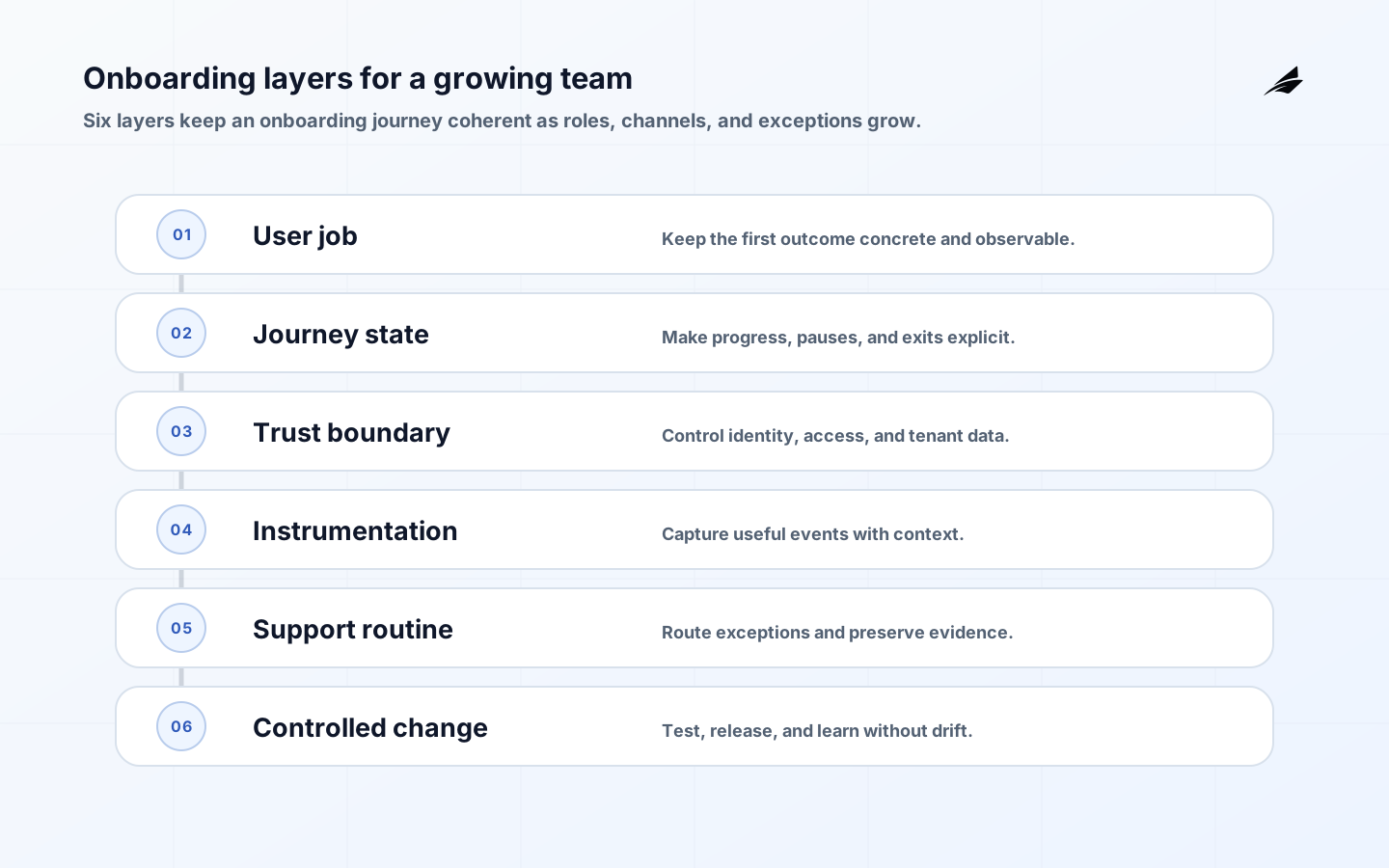
Growing teams rarely break onboarding by adding one obviously bad screen. They break it by adding reasonable local improvements that do not share a state model. Marketing adds a new source, product adds a checklist, sales adds an invitation path, engineering changes account creation, and support creates a manual recovery. Soon users can reach the same apparent destination with different permissions, missing context, or no clear way to resume. This field guide treats onboarding flows as a product and operating system: a user job, a state machine, a trust boundary, an evidence model, a support routine, and a controlled release path. WCAG 2.2 and OWASP authorization guidance are useful anchors because the experience must be usable and the outcome must be protected.
Keep the user job visible
Start each onboarding path with the job a person is trying to complete and the proof that it happened. A role-based path may need different first steps: an administrator creates a workspace, an operator connects a source, and a collaborator joins an existing project. Do not make everyone answer the same questions when their next decisions differ. Put the job in copy, progress, analytics, and support language so teams can discuss the same outcome. The onboarding decisions guide is helpful when a growing team needs to revisit assumptions rather than add another general-purpose step.
Make journey state explicit
Define states such as invited, started, identity verified, workspace created, setup pending, activated, blocked, abandoned, and completed. Store the state that matters to the domain, not only the page number. Every transition needs a trigger, actor, precondition, durable result, and next action. Make optional tasks distinct from required tasks. When a user returns on a different device or after a policy change, the service should explain what remains and why. This model also lets support distinguish a user who has not started from one whose integration is waiting for a provider. Avoid naming states after temporary UI copy; the data model should survive a redesign.
| Layer | Team decision | Operational evidence |
|---|---|---|
| User job | What result matters for this role? | Completed domain action |
| Journey state | What is true now and what is next? | Versioned transition and owner |
| Trust boundary | Who may read or change which resource? | Server authorization result |
| Evidence | What should product and support know? | Structured event with context |
| Recovery | What can resume, retry, undo, or escalate? | Runbook and resolved case |
Design accessible variation without fragmentation
Personalization can improve relevance, but it should not create untested copies of the flow. Use clear headings, associated labels, keyboard access, readable errors, visible focus, and status updates for every variant. WCAG 2.2 gives the team a shared baseline for interaction and content. Keep the semantic meaning of a stage stable even when questions change by role or plan. Test long names, translated text, zoom, small screens, screen readers, and slow input. Store the answers that affect future decisions with their purpose and version; do not make a support person infer whether a missing field is a user choice, a feature flag, or a failed save.
Build the operating model around exceptions
Assign owners for the flow definition, identity and access, data contract, dependency, support queue, and release. Give exceptions a small vocabulary: waiting for user, waiting for dependency, policy review, retryable, duplicate, expired, and resolved. Provide support with operation ID, tenant, current state, last transition, error category, and safe action. Keep secrets out of the view. Instrument stage transitions and outcomes with consistent names and attributes; OpenTelemetry semantic conventions help services agree on context even when teams use different languages. Review support cases for repeated friction. If a manual recovery happens often, it is evidence that the product state or dependency contract needs work.

| Exception | User experience | Team response |
|---|---|---|
| Dependency delay | Explain waiting and preserve progress | Monitor age and own escalation |
| Duplicate request | Show existing outcome | Use operation identity and idempotency |
| Permission change | Explain what changed | Reauthorize and protect tenant scope |
| Expired invite | Offer governed next step | Verify inviter and issue new access |
| Bad input | Point to correction | Retain safe values and reason |
Protect the trust boundary
Onboarding often creates access, so treat it as a security-sensitive workflow. Enforce authorization on the server for account, workspace, invitation, integration, and role operations. Apply least privilege and deny by default, and verify that object references cannot cross tenants. Record high-value changes with actor, target, time, reason, and result. Avoid broad support powers that bypass the same checks customers face; if break-glass access is necessary, scope it, expire it, and audit it. The onboarding production guide covers the retry and recovery consequences of these controls when multiple services participate.
Release and measure the flow
Treat onboarding changes as changes to a contract. Version the flow, schema, copy, permissions, and events that affect interpretation. Use feature flags or cohorts only when the state and support experience remain understandable. Before release, replay representative new, existing, partial, and failed users. Track first-value completion, time in each state, abandonment reason, recovery rate, support burden, duplicate effects, authorization denials, and post-onboarding use of the promised capability. Compare results by role, plan, device, and source. NIST’s secure development framework provides a useful reminder to include verification, release integrity, and vulnerability response in the delivery rhythm, not as a final audit.
Run a review cadence that leads to decisions
A weekly review can inspect new failures and support themes; a monthly review can examine state definitions, access changes, and outcome quality; a quarterly review can retire stale steps and reassess the first-value promise. Bring product, engineering, support, security, and a representative user perspective together. Ask which stage creates unowned work, which error is misunderstood, which permission is too broad, and which metric rewards activity rather than value. Keep a short decision record: observed evidence, chosen change, owner, expected result, and review date. This makes onboarding improvement cumulative instead of a series of disconnected experiments.
A practical field checklist
- Name the role-specific job and first valuable result.
- Maintain an explicit, versioned state model with resumable transitions.
- Test accessibility and content variation without changing semantic meaning.
- Authorize account, tenant, invitation, and integration actions on the server.
- Expose exception evidence and recovery ownership to support.
- Measure post-onboarding value and review changes with a fixed decision cadence.
Use a shared review cadence
Keep the cadence evidence-led. In the weekly exception review, group cases by stage, role, dependency, and customer consequence rather than by the team that received the ticket. In the monthly outcome review, compare first-value completion, time in state, recovery, support burden, and post-onboarding use. In the release review, replay existing and new paths with the same state and access checks. A stable event vocabulary lets the team compare variations without rebuilding the analysis every time. When a change improves a funnel step but increases blocked states or support contacts, treat that as a product regression even if the top-line completion rate rises. The onboarding production control guide is a useful companion for deciding whether the issue is state, dependency, authorization, or recovery.
A growing onboarding team benefits from a weekly exception review, a monthly outcome review, and a release review for changes to state, access, copy, or event definitions. Bring product, engineering, support, security, and a representative user perspective together. Ask which stage creates unowned work, which error is misunderstood, which permission is too broad, and which metric rewards activity instead of value. Keep a short decision record with observed evidence, chosen change, owner, expected result, and review date. The onboarding production guide provides a useful check on whether the team is handling retries, partial completion, and support visibility as product capabilities.
When a role, plan, integration, or experiment changes the path, replay representative existing and new customers. Check that state remains comparable, access remains scoped, events retain their meaning, and support can route an exception. Retire steps that no longer improve the first job. If a manual workaround becomes common, make it an explicit product decision with a durable state, not an undocumented support habit. This cadence keeps a shared onboarding model intact while allowing the team to learn from different audiences. Growth should add useful variation without creating a separate system for every acquisition channel.
Key takeaways
Keep the cadence evidence-led. In a weekly exception review, group cases by stage, role, dependency, and customer consequence rather than by the team that received the ticket. In a monthly outcome review, compare first-value completion, time in state, recovery, support burden, and post-onboarding use. In a release review, replay existing and new paths with the same state and access checks. A stable event vocabulary lets the team compare variations without rebuilding analysis. When a change improves a funnel step but increases blocked states or support contacts, treat that as a regression even if completion rises. The onboarding production guide helps decide whether the issue is state, dependency, authorization, or recovery.
A growing team should distinguish a shared platform from a shared experience. Reuse state, access, event, and recovery primitives while letting a role see only the questions and first task that matter. Review whether a new acquisition path changes the meaning of activation or simply adds an entry point. When it changes meaning, create a deliberate cohort and support view rather than mixing events silently. A useful release note names customer job, changed state, permission impact, support implication, and measure to watch. This keeps onboarding flexible without making the operating model impossible to explain.
Keep trial and onboarding analytics separate but joinable through a stable account or tenant identifier. The trial conversion field guide is useful when the team needs to connect first value, support friction, billing clarity, and later retention without merging unlike events.
Use WCAG 2.2 for accessible interaction, the OWASP Authorization Cheat Sheet for tenant and role boundaries, NIST SSDF for secure release practice, and OpenTelemetry semantic conventions for stable operational context.
- Growing teams need one coherent model across role-specific onboarding paths.
- State, access, evidence, support, and release controls should agree.
- Accessibility is part of the product contract, not a late visual pass.
- Exceptions reveal missing product boundaries and should become owned work.
- Measure whether onboarding leads to the promised job, not only whether it ends.
Frequently asked questions
Should every role have a different onboarding flow?
Not necessarily. Share the stable trust, state, and recovery model, then vary the questions and first task where roles genuinely differ. Reuse components and semantic stages so support and analytics remain comparable.
How many onboarding events should we create?
Create events for meaningful state transitions, outcomes, errors, and recovery decisions. Avoid a large catalogue of field-level interactions unless a specific product, support, or security question needs them.
Who owns onboarding after launch?
A product owner should own the journey outcome, but engineering, security, data, and support need named responsibilities for the boundaries they operate. Shared ownership should still have a clear decision-maker and escalation route.
Conclusion
Growing teams can keep onboarding coherent by treating it as layered product infrastructure: a clear user job, explicit state, protected access, useful evidence, owned exceptions, and controlled change. That model lets the flow evolve without making customers or support teams rediscover how it works after every release.