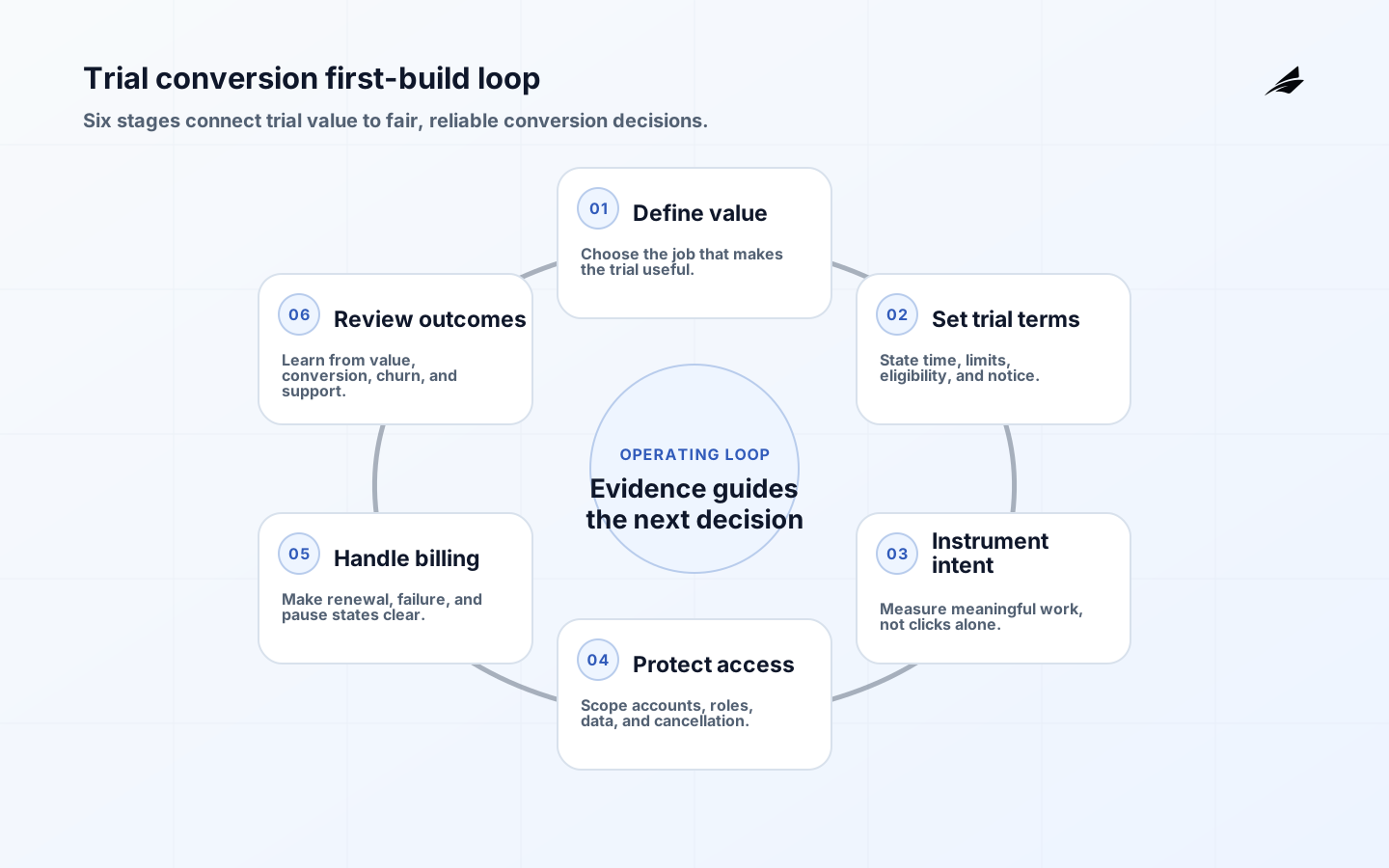
Trial conversion is not a button-colour problem. It is the result of a customer understanding a promise, reaching meaningful value, being able to continue safely, and making an informed choice about payment or cancellation. Before the first build, decide which job the trial should prove and what evidence shows that the job happened. Stripe’s trial documentation makes the billing transition concrete: a trial has a defined end, can generate lifecycle events, and needs a payment and communication strategy for what happens next. Product teams should connect that billing state to product access, authorization, support, and customer language. A high conversion rate is not healthy if people are surprised by a charge, cannot cancel, or never reached the promised outcome.
Define the value a trial should prove
Choose one meaningful job that a qualified customer can complete in the trial window. It might be creating a report, connecting a source, inviting a teammate, resolving a queue, or seeing a measurable improvement. Define the input, successful result, time to value, and reason a customer would continue. Avoid using login, page view, or feature click as the primary activation event. A trial should teach the team whether the product solves a problem, not whether a visitor can navigate a menu. If the job needs data, integration, or collaboration, design the path to that requirement rather than celebrating a shallow account creation.
| Decision | Weak proxy | Useful evidence |
|---|---|---|
| Activation | Logged in twice | Completed the first valuable job |
| Intent | Clicked pricing | Returned to a job, invited a collaborator, or configured a real source |
| Conversion | Paid after trial | Paid after reaching value with clear terms |
| Retention | Subscription active | Repeated the workflow and received outcome |
| Trust | Few support tickets | Clear terms, successful cancellation, and resolved issues |
Design the conversion contract
Write the trial terms as a contract the product can enforce and the customer can understand. State duration, start point, usage or feature limits, who is eligible, what happens at expiry, price and billing interval, payment-method requirement, cancellation path, pause or downgrade behaviour, and what data remains after the trial. Make the exact trial end time and timezone unambiguous. If the trial can be extended or converted early, define who may do so and which record is authoritative. Use the field guide to trial conversion as a companion for connecting these terms to the operating routine. The conversion contract should survive retries, plan changes, and support intervention without creating contradictory states.

Model access and authorization around the trial
Decide which account, workspace, role, and resource states are eligible for trial features. Enforce them on the server. A client-side countdown or disabled button is not a billing or authorization control. OWASP’s authorization guidance is a practical reminder to use deny-by-default, least privilege, and checks close to the protected resource. Scope trial data to the correct tenant, prevent a user from reusing another account’s entitlement, and define how collaborators inherit or do not inherit access. When a trial expires, make the resulting state explicit: read-only, restricted, archived, paused, or cancelled. Customers need a way to retrieve their data or understand deletion, and support needs evidence of the entitlement and its history.
Instrument meaningful intent
Capture events that explain progress toward value: source connected, first record processed, collaborator invited, workflow completed, result exported, limit reached, payment method added, cancellation requested, and support recovery. Include tenant or account scope, plan, trial start and end, product version, operation identity, and outcome. Do not infer intent from a single click or collect sensitive content when a category is enough. The event catalogue should let a product manager compare cohorts without turning a customer’s usage into a vague score. It should also let support answer what the customer achieved and what blocked the next step. A clean event model prevents conversion reporting from diverging from billing and access records.
Handle billing and customer choice clearly
Billing is part of the product experience, not a downstream implementation detail. Stripe documents trial lifecycle events and the need to monitor transitions such as a trial ending and an invoice being created. Subscribe to the events that matter, make handlers idempotent, and reconcile webhook state with the billing authority rather than assuming delivery order. Show customers the trial end, upcoming charge or required payment step, current plan, and cancellation or downgrade route. If a payment fails, preserve the customer’s data and explain the state and recovery options. Do not let a transient webhook delay remove access or charge twice. The product should be able to display whether an entitlement is active, pending, paused, past due, or cancelled and why.
| State | Customer-facing meaning | System requirement |
|---|---|---|
| Trialing | Features available until a stated end | Entitlement with exact end time |
| Ending soon | Decision or payment action is approaching | Notice, event, and support visibility |
| Active | Paid access is available | Billing and entitlement reconcile |
| Past due | Payment needs attention | Grace policy and clear recovery |
| Cancelled or expired | Access or retention changes | Data policy, export, and audit record |
Test the uncomfortable path before launch
Test a trial that starts at the edge of a day, a duplicate signup, a payment method added late, a failed payment, a webhook arriving twice or out of order, an entitlement expiring while a user is active, a plan change, a cancellation, and a support-granted extension. Test tenant boundaries and a user attempting to access a trial resource after role removal. Verify the UI, API, billing record, entitlement record, email or notification, audit event, and support view agree. NIST’s Secure Software Development Framework is useful here because it treats secure design, verification, release, and response as an integrated lifecycle. The test record should identify what happened, what the system displayed, and which source was authoritative.
Choose a fair conversion measure
Report conversion with the denominator, eligibility rules, cohort window, and cancellation or refund period visible. Pair conversion with time to value, first-job completion, support burden, payment failures, cancellation clarity, and early retention. Compare customers who reached the intended outcome with those who did not. Review qualitative feedback for surprise, confusion, and missing capability. A smaller conversion rate with customers who understand the value and stay may be healthier than a high rate driven by a confusing renewal. Align product, finance, support, and engineering on the definitions before the first dashboard is built.
A practical pre-build sequence
- Name the customer job, value evidence, trial audience, and eligibility boundary.
- Specify duration, limits, billing transition, notice, cancellation, retention, and data export rules.
- Model account, tenant, role, entitlement, trial, invoice, payment, and support states.
- Define meaningful product events and reconcile them with the billing authority.
- Test duplicate, delayed, failed, cancelled, expired, extended, and unauthorized journeys.
- Launch only when customer choice, entitlement, billing, and recovery are explainable.
Review conversion as a customer decision
Make the contract testable with a timeline. Put trial start, first value, reminders, payment-method changes, exact trial end, invoice creation, charge attempt, entitlement transition, cancellation, and data retention on one page. Test a customer who converts early, one who does nothing, one whose payment fails, one who cancels before the end, and one who receives a documented extension. Confirm that product, billing, notifications, and support show the same state and that duplicate or delayed events do not create double charges or unexpected access. The field guide to trial conversion for growing teams can help connect this pre-build contract to the team’s later operating cadence. If the customer cannot tell what choice remains, the conversion design is not finished.
Before launch, walk through the trial as a customer who has not yet decided to pay. Show the promise, first value, exact end time, limits, upcoming charge or payment requirement, cancellation path, and data consequence. Then test the same path with a failed payment, a delayed billing event, a duplicate webhook, a role change, and a support extension. Product, finance, engineering, and support should be able to state which system is authoritative at every point. The field guide to trial conversion for growing teams is useful for turning this into a shared operating model. Record where the customer’s understanding differs from the internal state and fix the language or state boundary before optimizing the funnel.
Keep conversion measures connected to the job the trial promised. A paid invoice is important, but it is not the whole outcome. Track whether the customer completed the first useful workflow, returned to it, understood the terms, recovered a failed payment, or cancelled successfully. Segment the result by plan, role, data source, and support path. If a new experiment raises conversion while increasing surprise, refunds, or early churn, the evidence argues against expansion. A healthy review names the hypothesis, the eligible cohort, the customer consequence, the system change, and the next decision. That gives a growing team a safer basis for experiments than a single rate in a dashboard.
Key takeaways
Use the takeaways to inspect the customer’s decision, not to repeat the test script. Confirm that the promise names a real job, the trial state has an exact end, product and billing authorities reconcile, access remains scoped, and cancellation or recovery is understandable. Compare value completion, payment outcome, support burden, refunds, and early retention by eligible cohort. Treat a charge without durable use as a signal for investigation. Treat a successful cancellation as a valid customer outcome, not merely lost revenue. Before expanding an experiment, record the customer consequence, evidence, owner, rollback condition, and review date. This keeps conversion work accountable to trust and usefulness as well as revenue for the next release decision.
Onboarding is often the first conversion dependency, so define the handoff explicitly: which state proves setup, which state proves value, and which state grants billing entitlement. The onboarding production guide shows why partial setup and retry behaviour matter before a trial end date arrives.
For the product handoff, keep the user’s first valuable result visible beside the trial state. The onboarding decisions guide helps teams avoid treating account creation as proof that a customer has reached value.
The Stripe trial-period documentation grounds trial timing and lifecycle events; Stripe subscription management informs self-service and account operations; NIST SSDF supports secure design and verification; and the OWASP Authorization Cheat Sheet supports entitlement and least-privilege decisions.
- A trial should prove customer value, not just collect registrations.
- Write terms as enforceable states with clear customer language.
- Keep billing, entitlement, authorization, and product evidence reconciled.
- Use idempotent event handling and test out-of-order lifecycle events.
- Measure conversion beside value, trust, support, cancellation, and early retention.
Frequently asked questions
Should every free trial require a payment method?
There is no universal answer. Decide from fraud risk, customer expectations, conversion goals, billing complexity, and the need to notify or charge at trial end. Whatever you choose, make the consequence and cancellation path clear before the customer starts.
What if billing and product events disagree?
Choose the billing system as the authority for payment state and an explicit entitlement record for access. Reconcile asynchronously, keep conflicting evidence, and route ambiguous cases to support rather than silently granting or removing access.
Is a trial conversion rate enough to judge the experiment?
No. Pair it with value completion, time to value, retention, refunds, payment failures, support burden, and customer understanding. A conversion without durable value is an expensive false positive.
Conclusion
Before building trial conversion, decide what value means, how terms are enforced, which access is granted, how billing transitions are reconciled, and how customers can choose or recover. That foundation creates a fairer customer journey and a more useful growth signal than a funnel built around clicks and renewal surprise.