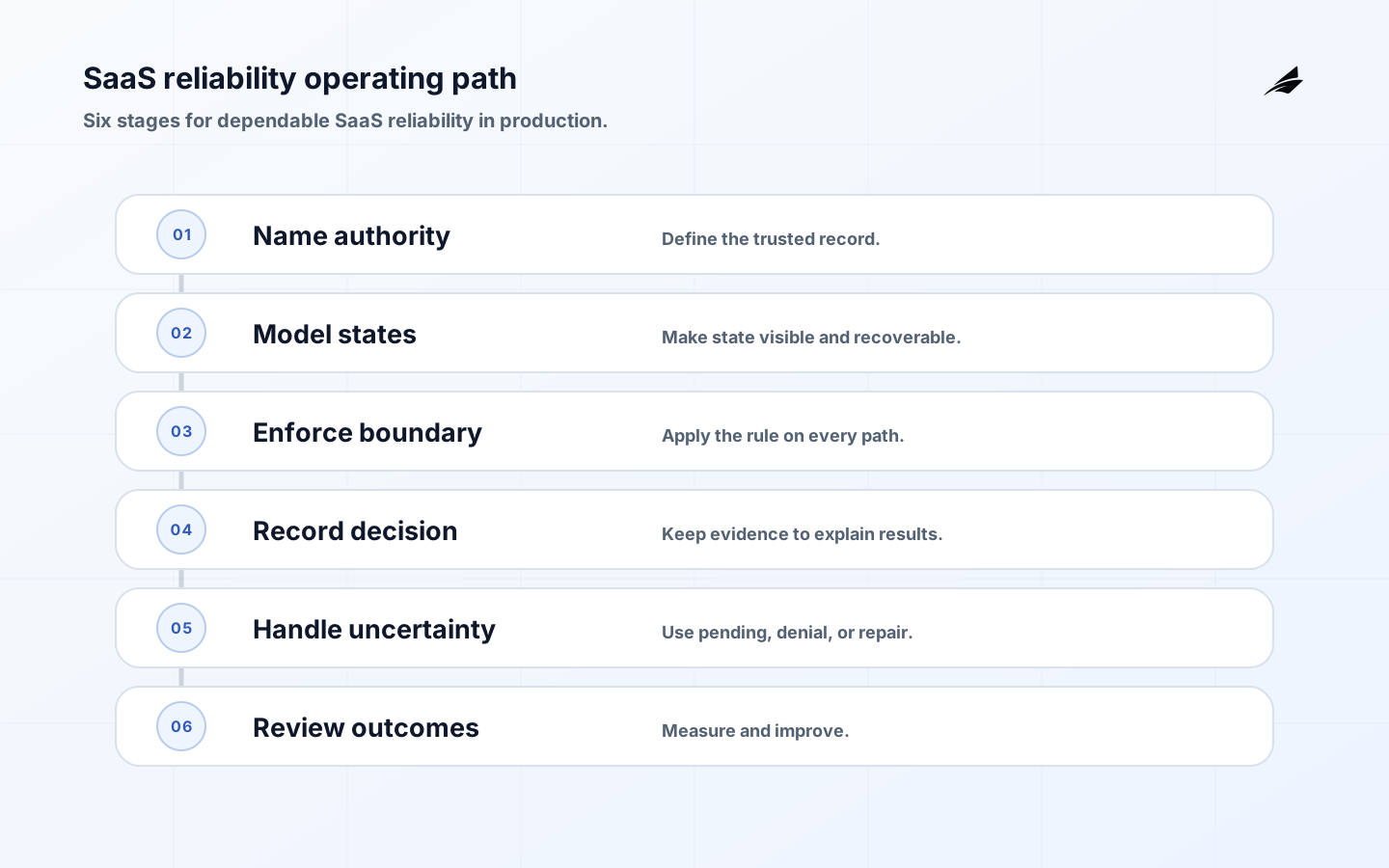
Reliability is often reduced to uptime, but customers experience a broader promise: their data remains correct, important actions finish or explain their status, access is consistent, and the team can recover when a dependency fails. Moving SaaS reliability into production means making those promises concrete across requests, background jobs, storage, integrations, deployments, and support. It also means deciding what the product should do when the best outcome is temporarily unavailable.
Key takeaways
- Define reliability in customer outcomes, including correctness and recoverability as well as availability.
- Map critical paths and their dependencies before choosing alerts or resilience mechanisms.
- Make state transitions durable and idempotent so retries do not create hidden damage.
- Use graceful degradation only when the degraded result is honest and safe for the customer.
- Give on-call and support clear authority, evidence, and recovery procedures for each important failure.
Define the reliability boundary
Start with customer journeys rather than infrastructure labels. Identify the actions whose failure matters: signing in, reading data, changing permissions, exporting records, processing an event, or completing a purchase. For each journey, define the acceptable result, the evidence that proves it, and the behavior when a dependency is unavailable. A response that loads quickly but shows stale permissions is not reliable for an administrator, just as a correct background job that gives no visible status is not reliable for a customer waiting on it.
Security and reliability meet at the decision boundary. The OWASP Authorization Cheat Sheet emphasizes server-side checks and careful failure behavior. A degraded mode must never bypass authorization because an identity or policy dependency is slow. Decide which facts may be cached, for how long, and which unknowns require a deny, a pause, or a review.
| Customer path | Failure to prevent | Reliable fallback |
|---|---|---|
| Read workspace data | Confidently showing a stale or partial view. | Label freshness and preserve the last known safe result. |
| Change a record | Duplicate or lost mutation after a timeout. | Return operation status and support a safe retry. |
| Run a background job | Silent queue loss or endless retry. | Persist the job state, attempt reason, and next owner. |
| Authorize access | Granting capability on an unknown policy state. | Fail closed and explain the temporary limitation. |
Map state, dependencies, and recovery
For every critical operation, identify the authoritative record, the dependent services, and the point at which progress becomes durable. A request may call an authorization service, write a database row, publish an event, and invoke a third-party API. If the process stops between those steps, the system should know whether it is safe to retry, needs reconciliation, or must wait for a human. A single “failed” flag hides too much information for dependable recovery.
Use explicit operation states such as accepted, running, completed, waiting, failed, and needs review when the customer needs to see progress. Store attempt count, last error class, next retry time, source version, and correlation ID. Idempotency keys protect customer requests; deduplicated event identifiers protect consumers; reconciliation jobs compare independent records. These controls complement one another because no single retry strategy can repair every cross-service disagreement.

Build for partial failure
Set timeouts at each dependency boundary and decide what the caller receives when one expires. Retries need bounded attempts, backoff, and an idempotent operation; otherwise a slow dependency can become a traffic amplifier. Use a circuit breaker or queue where it fits the failure shape, but do not treat a pattern as a substitute for a customer outcome. The important question is what data remains true and what action the customer can safely take next.
For writes, persist intent before asking a worker to perform a side effect. For reads, distinguish unavailable data from an empty result. For caches, record freshness and invalidate them when permissions or critical state changes. For third-party calls, retain the provider reference and reconcile when the response is ambiguous. A recovery process should be able to find operations that may have succeeded even when the initiating request ended with an error.
Recovery also depends on capacity choices. A bounded queue is useful only when the team knows what happens when it fills. Decide which work may wait, which work should be rejected immediately, and which customer-visible operations need priority. Protect databases and provider limits with backpressure rather than allowing every retry to compete with fresh traffic. Preserve the original request context so an operator can tell whether a backlog is harmless delay or a growing correctness risk.
Data durability needs an explicit promise as well. Define backup coverage, restoration ownership, and the point at which a customer can rely on a completed change. Test restoration with representative records and verify permissions after recovery. A backup that restores bytes but loses workspace scope, operation history, or encryption access is not a complete recovery for a SaaS product. Keep the procedure current by exercising it after meaningful storage or deployment changes.
When a dependency is optional, isolate it from the critical path and label the resulting limitation. When it is essential, give the customer a stable pending state and the team a way to reconcile later. This distinction prevents a generic availability screen from hiding whether the customer’s action was accepted, rejected, or simply not yet resolved.
Capacity planning should follow the customer promise as well. Identify the traffic or data shape that makes the core workflow unsafe, then choose a visible limit, queue, or graceful restriction before the system reaches it unexpectedly. Tell customers when a report is delayed or an export is temporarily unavailable, and preserve their request when doing so is safe. A clear limit is easier to operate than an unbounded promise that fails differently for each account.
Write down the human decision for an incident that affects only one customer or one workspace. Narrow impact can be easy to miss in a global signal, yet the affected customer still needs an owner, an explanation, and a correction.
Planned maintenance deserves the same clarity. State which actions remain safe, preserve accepted work, and give support a current status they can share.
| Failure shape | Product behavior | Engineering control |
|---|---|---|
| Dependency timeout | Show pending or unavailable, not false success. | Bounded retry and durable operation state. |
| Stale cache | Show freshness or require a trusted refresh. | Versioned invalidation on material changes. |
| Queue backlog | Set an honest expectation and preserve the request. | Age-based alert and a named recovery owner. |
| Ambiguous provider result | Avoid asking for a duplicate side effect. | Reconciliation by provider reference. |
Release changes with a rollback decision
A production release should identify the paths it changes, the signals that indicate harm, and the person who can stop or reverse exposure. Exercise migrations, queue consumers, feature flags, dependency outages, and old clients where relevant. A rollback may not undo a database schema change or a sent external event, so pair deployment reversal with forward repair and reconciliation. Document the order in which operators should contain, inspect, and restore the affected path.
Use telemetry that leads to action
Choose indicators that reflect the critical customer paths: successful completion, correctness checks, pending age, error class, queue age, dependency latency, and recovery time. The OpenTelemetry documentation provides a foundation for carrying trace context across services and relating metrics to logs. Instrument the boundary where the customer action becomes durable, not just the web request that starts it.
Logs should describe what happened and why without collecting secrets. Include stable resource IDs, operation state, dependency class, policy version where relevant, and correlation ID. The OWASP Logging Cheat Sheet is a useful reference for protecting sensitive records while preserving investigation value. An alert should state the condition, the owner, and the first safe action; an alert with no response path trains the team to ignore it.
Rehearse the failures customers will notice
Test deploys during queue processing, revoked permissions during a long request, storage nearing a limit, a provider returning success after a timeout, and a region or service becoming unavailable. Include clock skew, out-of-order events, duplicate delivery, expired credentials, and a customer returning after a degraded response. The goal is not to manufacture drama; it is to prove that the team knows which state is authoritative, who may intervene, and how the customer will be told the truth.
Frequently asked questions
Is reliability the same as uptime?
No. Uptime says whether a service responds, while reliability also includes correct data, authorized access, durable writes, useful status, and recovery after partial failure. A fast incorrect result is a reliability failure.
What should a small team do first?
Choose the few customer journeys whose failure would matter most, map their authority and dependencies, and add durable operation state plus actionable alerts. Then rehearse one recovery path before expanding instrumentation everywhere.
For delivery teams working on SaaS reliability, this operating decision should connect customer outcomes, tenant state, entitlements, release controls, support actions, and operating cost to evidence an accountable owner can inspect. For adjacent decisions, continue with Edilec's Multi-tenant SaaS Architecture: Production Boundaries That Hold and Feature Flags in Production: Safe Release and Rollback. In this production review, move beyond the operating decision only after the owner can show the accepted result, the exception path, and the signal for another review.
Conclusion
SaaS reliability becomes real when the product can tell the truth during an imperfect moment. Define customer outcomes, preserve state before side effects, make retries safe, degrade only within clear boundaries, and connect telemetry to a named response. Production maturity is visible in the recovery path as much as in the normal path.