Gateway Security for Connected Systems: A Field Guide
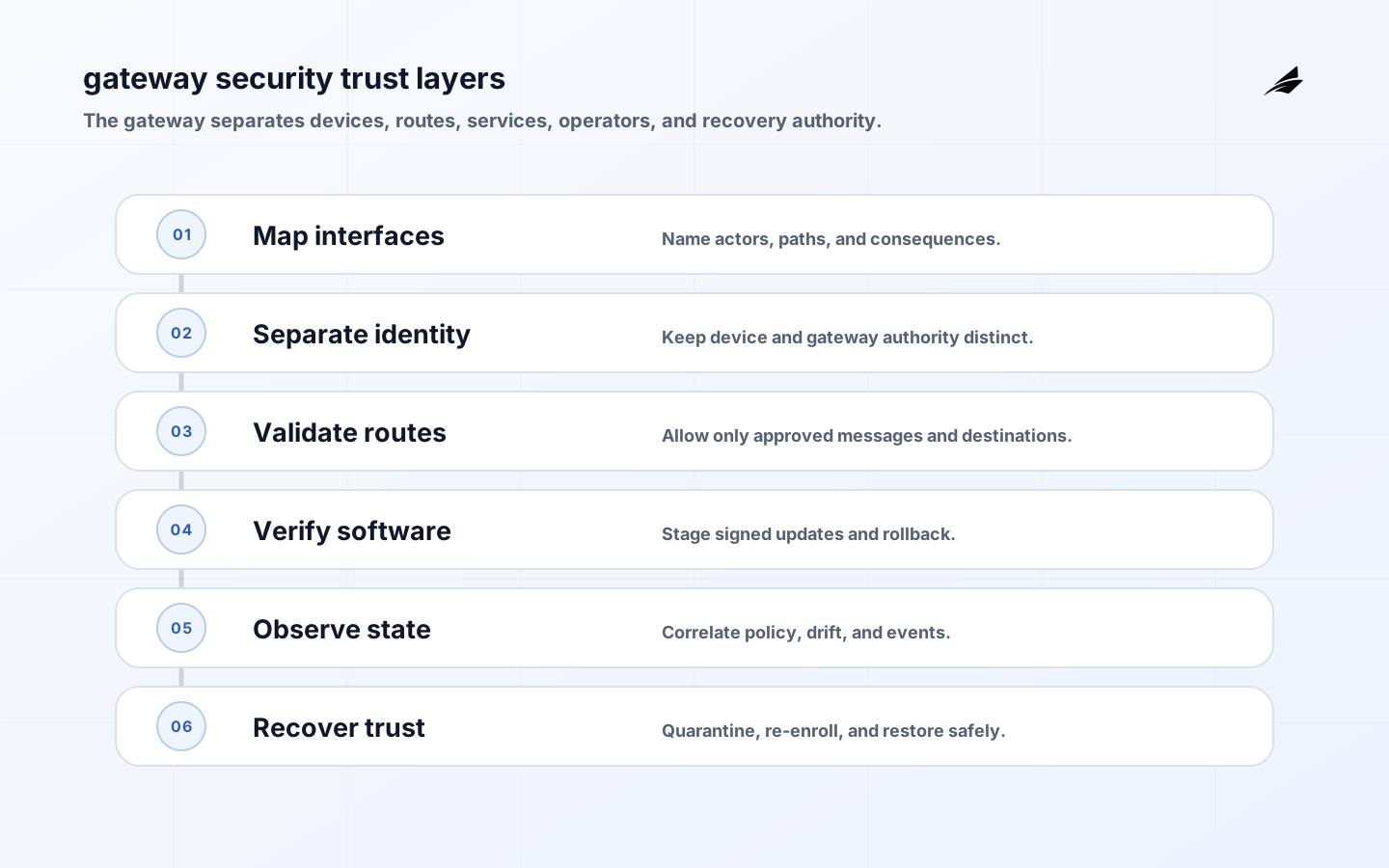
An IoT gateway is often the place where constrained devices, local networks, cloud services, and human operators meet. That makes gateway security a boundary-design problem rather than a single firewall setting. A secure gateway knows which devices it represents, which routes and protocols are allowed, which data may leave the site, which commands may enter, how updates are verified, and how an operator can recover it. The gateway should reduce unnecessary trust between zones while preserving the timing and availability the process needs. NIST SP 800-207 is a helpful reminder that access decisions should be explicit and based on identity, resource, policy, and observed conditions.
Map the gateway boundary before hardening it
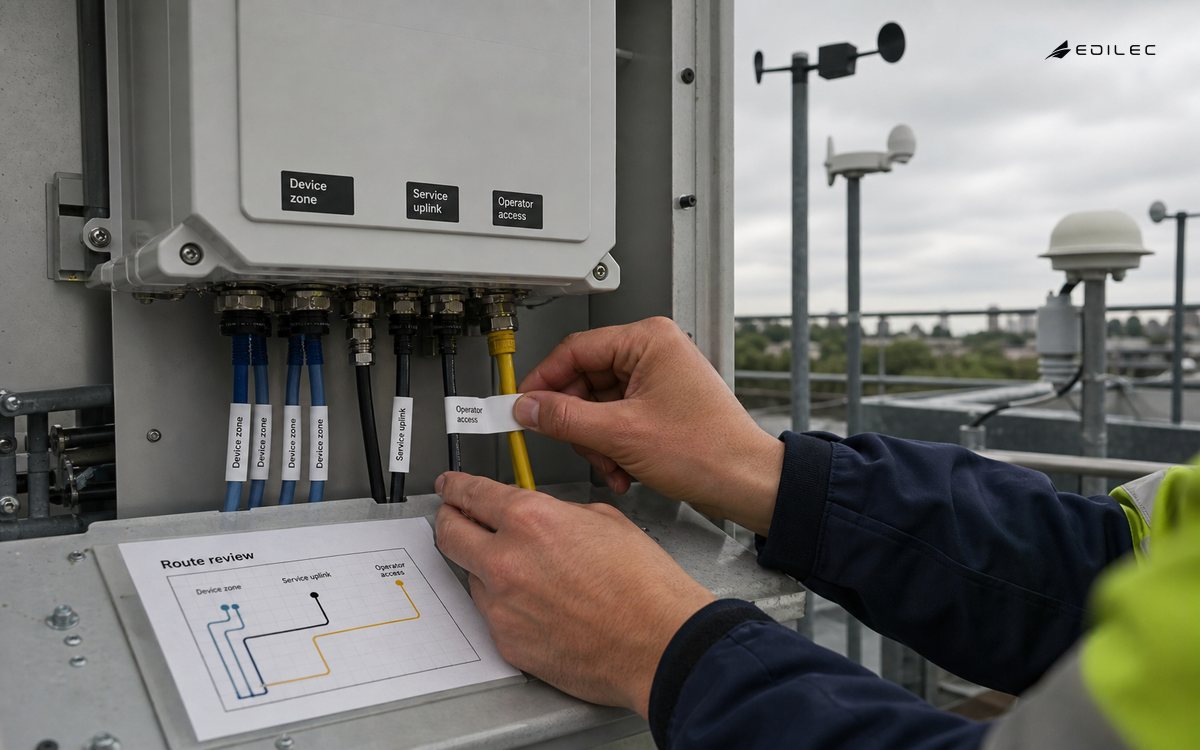
Inventory every interface: sensor bus, local management port, wireless link, upstream network, update channel, diagnostic service, and cloud connection. For each, name the actor, data direction, protocol, expected frequency, and consequence of compromise or outage. Do not assume that a gateway is trusted because it sits inside a plant or branch. A device on the local side can be compromised, a vendor support route can outlive the contract, and a cloud credential can be copied. Use network segmentation for connected systems to make the zone and allowed-path decisions explicit.
| Interface | Permit | Control and evidence |
|---|---|---|
| Device side | Only approved device identities and messages. | Enrollment record, protocol validation, and rejected-device events. |
| Upstream service | Only required endpoints and egress paths. | Destination policy, certificate status, and route logs. |
| Management | Named operators with time-bounded authority. | MFA or equivalent, approval, and session record. |
| Update | Signed artifacts from an approved source. | Version, signature result, rollout, and rollback status. |
Separate device, gateway, service, and operator identity
A gateway may authenticate a device without granting that device the gateway’s own authority. Keep identities separate and bind them to the narrow action or resource they require. The gateway should have its own credential, device identities should be individually traceable, and operators should use named accounts rather than a shared maintenance password. NIST’s IoT baseline calls attention to device identification, logical access to interfaces, software update, and cybersecurity state awareness. Translate those capabilities into checks that can stop a decommissioned or misassigned device before it reaches a business service.
Make routing and translation conservative
Protocol translation is a security decision because it can change message meaning, identity context, and error behavior. Validate message size, schema, units, timestamps, sequence, and allowed commands before forwarding. Do not forward arbitrary local addresses or let a device choose an upstream tenant from a payload field. Make the gateway reject unknown topics, methods, and destinations with a useful event. For commands, carry the original actor and authorization context or stop at the gateway until a service decision is available. A translation layer that silently widens reach is a hidden proxy, not a protective boundary.
Protect the gateway software supply chain
Gateway security degrades if updates are improvised. Define signed packages, trusted signing keys, version rules, staged rollout, health checks, rollback, and a recovery image. Test a failed download, power loss during install, a revoked signing key, and a gateway that cannot reach the update service. Include configuration migration in the test because a safe binary can still break routing or identity state. NIST SP 800-193 describes protecting platform firmware, detecting unauthorized changes, and recovering securely; its principles apply to the gateway’s boot and update path even when the device is not a server.
| Failure | Safe response | Proof of readiness |
|---|---|---|
| Unknown device | Reject business traffic and preserve diagnostic evidence. | Device identity and reason code in the event record. |
| Cloud unavailable | Queue only bounded, non-sensitive data and keep local safety behavior. | Offline duration, queue limit, and replay test. |
| Update failure | Return to known-good software and report state. | Rollback result and configuration compatibility test. |
| Credential compromise | Revoke, quarantine, rotate, and investigate scope. | Revocation latency and access review evidence. |
Observe security state, not just CPU and memory
A gateway dashboard that shows uptime but not identity failures or policy changes create false confidence. Monitor device enrollment and revocation, rejected routes, configuration drift, certificate age, firmware version, clock health, queue depth, unexpected egress, and administrative sessions. The OWASP Logging Cheat Sheet emphasizes event purpose, useful attributes, protection, verification, and operational use. Apply those ideas without logging secrets or raw sensitive payloads. Correlate gateway, service, and device events so an investigator can distinguish a local radio problem from a credential attack.
Respect operational technology constraints
In industrial environments, availability, timing, safety, and maintenance windows can be as important as confidentiality. NIST’s Guide to Operational Technology Security provides context for analyzing OT characteristics and security trade-offs. Do not deploy a control that causes a controller to fail safe in a way the process cannot tolerate, or that requires an untested reboot during production. Create a maintenance path, a local recovery mode, and a clear escalation route. Test segmentation and policy changes against a representative process, not only a synthetic packet generator.
Example: secure a plant gateway
Consider a gateway that receives vibration readings from a machine cell and sends them to an analytics service. Device enrollment establishes individual identities and permits only the sensor message schema. The gateway publishes outbound data to one approved endpoint and cannot accept arbitrary inbound connections. An operator may open a time-bounded support session after approval; the session is recorded and cannot modify the sensor route. If the cloud is unreachable, the gateway retains a bounded queue and keeps local collection running. If firmware verification fails, it boots the known-good image, exposes a recovery state, and alerts the plant owner. Each choice is testable without relying on the assumption that the gateway is inherently trusted.
Rehearse containment and recovery
Write a runbook for a lost gateway credential, unexpected outbound traffic, a compromised local device, an update failure, and a corrupted configuration. Define who can quarantine the gateway, who approves a replacement, how queued data is handled, and how the restored gateway is re-enrolled. Preserve the original evidence before wiping state when an investigation requires it. Recovery should return the gateway to a known configuration and a newly verified identity, not simply restore the last backup. Measure time to contain, time to restore a useful process, missed data, operator workload, and whether the runbook exposed an unowned dependency.
Key takeaways
- Every interface, actor, route, and consequence is named.
- Device and gateway identities are separate and individually revocable.
- Translation validates message meaning, not only packet format.
- Updates are signed, staged, recoverable, and tested with power loss.
- Telemetry includes policy, identity, drift, and administrative events.
- Containment and re-enrollment are rehearsed within operational constraints.
Frequently asked questions
Is a firewall enough to secure a gateway?
No. A firewall can limit network paths, but gateway security also requires identity, message validation, update integrity, operator controls, useful evidence, and a recovery path.
Should a gateway accept inbound cloud connections?
Usually prefer a narrowly controlled outbound pattern or a brokered management path, but the answer depends on the process and support need. Any inbound route needs explicit identity, authorization, scope, expiry, and monitoring.
Turn gateway controls into an operating contract
Write a gateway profile for each deployment class rather than relying on one universal image. A plant gateway may need local protocol adapters, a branch gateway may need intermittent-connectivity queues, and a building gateway may need strict limits on command paths. The profile should state interfaces, ports or endpoints, allowed device families, maximum message size, storage limits, update channel, time source, log destinations, and local behavior during cloud loss. Treat the profile as versioned configuration with an owner. A gateway should report which profile it is running and whether the observed configuration matches the approved one.
Use a threat model that follows the data and the action. Ask what happens if a local sensor lies, a gateway credential is copied, a management port is exposed, a cloud endpoint is redirected, or a queue is replayed. Map each threat to a control and a test: identity binding, message validation, egress allowlist, secure boot or update verification, rate limit, replay protection, or quarantine. The device provisioning guide helps make device identity and credential lifecycle concrete. Gateway security is strongest when a control has a named owner and a repeatable failure test.
Make diagnostics safe enough for real support. Operators may need signal strength, route status, queue age, certificate expiry, firmware version, clock drift, and last rejected message reason. They should not need raw private keys, full sensitive payloads, or an unrestricted shell. Provide read-only diagnostics by default, and make any elevated session time-bounded and visible. Correlate local events with upstream service events so an investigator can tell whether a failure began at the device, gateway, network, or consumer. A useful diagnostic surface reduces the temptation to solve every incident with broad remote access.
Review gateway security after changes to the surrounding system. New devices, new tenant routing, new remote support, new firmware, or a new cloud endpoint can invalidate an old assumption. Compare the approved route matrix with observed connections, check that retired credentials no longer work, and rehearse recovery with a replacement gateway. Link the result to protocol selection for engineering teams when message behavior changes, and to industrial dashboard production guidance when a gateway signal becomes an operator decision. Security review should follow consequence, not only component ownership.
A gateway replacement should be a designed workflow, not an emergency copy of a disk image. Register the replacement, verify its hardware or software identity, apply an approved profile, establish fresh credentials, and compare its routes with the previous gateway. Decide what happens to locally buffered data: preserve it with provenance, discard it under a documented rule, or replay it with duplicate protection. Keep the old gateway quarantined until its credentials and management sessions are closed. If a process cannot tolerate a replacement delay, document a local continuity mode and the person who owns the decision to use it. This turns a common operational event into evidence that the boundary really works. Device provisioning guidance provides the identity lifecycle companion.
Document the gateway’s minimum safe state. It should include the approved software version, trusted identity material, route policy, local fallback, time source, and diagnostic access rule. Define how an operator recognizes that the gateway has left that state and which action is safe first. A minimum state is more useful than a long list of settings because it gives responders a target during containment and replacement. Reconcile the state after every update or ownership change, and keep the evidence long enough to compare a new incident with previous behavior.
Conclusion: make the boundary visible and recoverable
A gateway earns trust through bounded behavior that can be inspected and repaired. Separate identities, conservative routing, verified software, operationally aware controls, and correlated evidence turn an ambiguous edge box into a managed system boundary. Design the failure path with the same care as the happy path, and gateway security becomes an operating capability rather than a collection of settings.