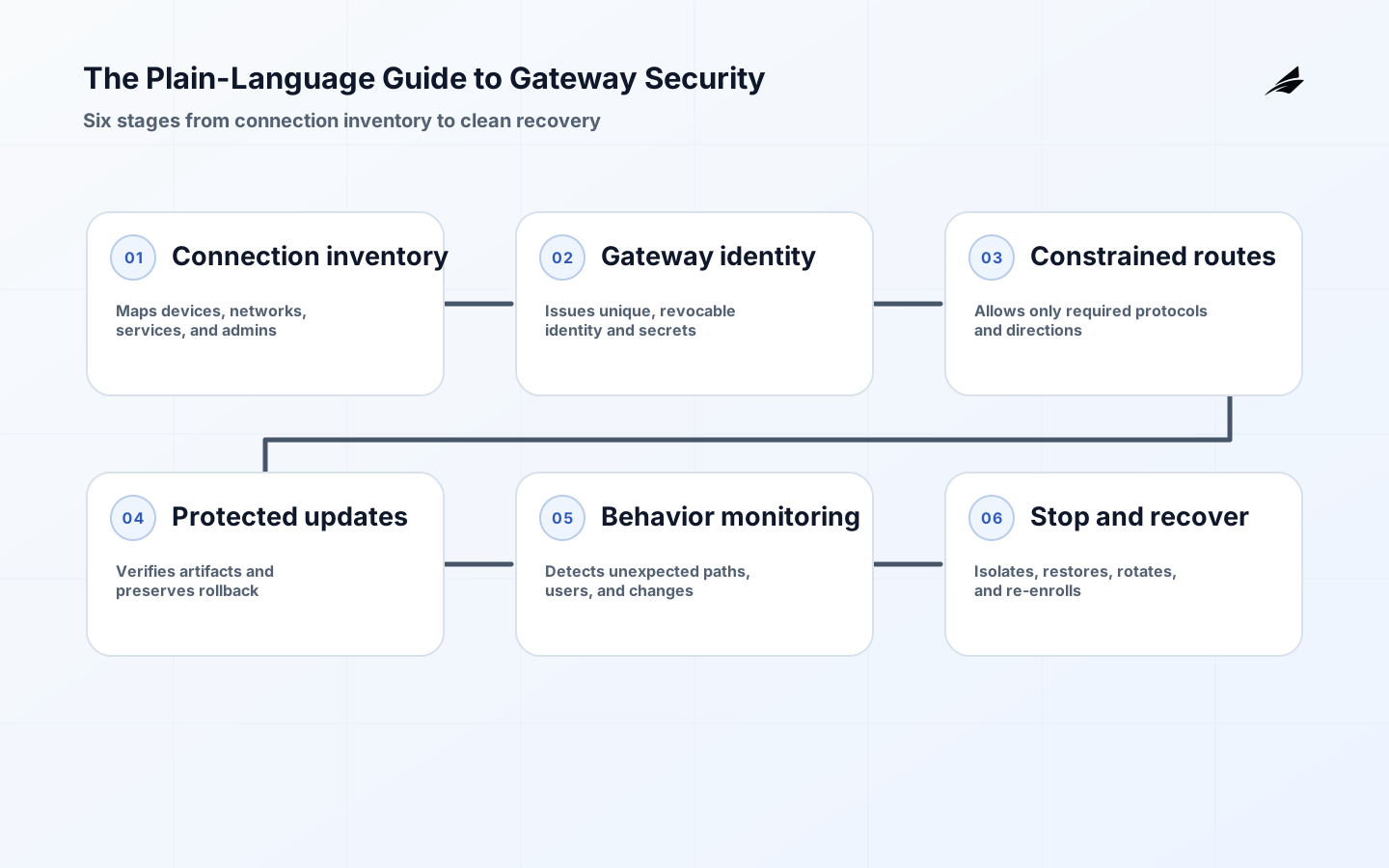
Gateway security is the set of controls that protects a device acting between field equipment and other networks. A gateway may translate protocols, buffer telemetry, run local analytics, and provide remote support access. That makes it valuable, but it also makes it a concentration point for risk. If its identity, configuration, or maintenance path is weak, an attacker or ordinary mistake can affect many devices at once. The aim is not to make a gateway inaccessible. It is to make every permitted connection, update, and administrative action deliberate, attributable, and recoverable.
Understand the Gateway's Role
Start by drawing the gateway's actual relationships. List the local devices and protocols it serves, the upstream services it contacts, the administrators who can reach it, and any supplier support route. Many deployments secure the cloud account while leaving a local web console, serial interface, default service, or shared maintenance credential unexplained. A gateway is not simply a small server: it may be installed in an exposed location, run for years, and bridge networks with very different safety and availability expectations.
Classify connections by purpose. Telemetry forwarding, remote diagnostics, software update retrieval, and command delivery should have separate rules and identities. This lets the team withdraw a risky support path without stopping data collection, or isolate a compromised device segment without losing the record of the incident. The gateway security practical guide is a useful companion when translating this inventory into a deployable operating procedure.
| Gateway surface | Question to answer | Control example |
|---|---|---|
| Local services | Which ports and consoles are required? | Disable unused services and restrict maintenance interfaces. |
| Upstream traffic | Which named services are needed? | Allow outbound destinations by purpose. |
| Administrator access | Who needs access, from where, and for how long? | Individual identity, MFA, time-bounded access. |
| Physical handling | Can the unit be replaced or reset locally? | Tamper-aware installation and replacement record. |
Give the Gateway a Verifiable Identity
Each gateway needs a unique identity that a service can authenticate and revoke. Avoid credentials copied from an installation sheet or embedded in a shared image. Prefer hardware-backed keys or certificates where the platform supports them, protect private material from routine export, and record the identity-to-asset relationship in inventory. Identity rotation must be designed before deployment; an expiring certificate is predictable maintenance, not an emergency. The replacement process should also retire the old identity so a removed unit cannot reconnect unnoticed.
Gateway security depends on trust decisions being narrow. A gateway should authenticate the service it contacts, and a service should validate the gateway identity, authorization, and expected software state before accepting sensitive traffic. This is close to the zero-trust principle of evaluating each request rather than treating network location as permanent proof. It is particularly important when mobile networks, supplier VPNs, or temporary field connections make network boundaries fluid.
Harden the Operating Image
Build a minimal operating image with only the packages, accounts, and drivers required for the assigned role. Set secure boot or equivalent integrity checks when the hardware supports them, protect configuration secrets, and apply a documented baseline configuration. Logging, time synchronization, and storage limits are part of that baseline. Without reliable time, an investigation cannot reconstruct sequence; without storage limits, logging itself can become a denial-of-service condition.
Updates need an authenticity check, a compatibility check, and a recovery plan. Verify the package signature before install, test a representative cohort, and preserve a known-good rollback route. Do not confuse an automatic update setting with a safe update program. Field conditions may include a weak link, a power interruption, or a device process that cannot stop during a particular shift. The device provisioning security review explains why the first trust state and the later update path must belong to the same lifecycle design.
| Lifecycle point | Required decision | Proof of completion |
|---|---|---|
| Build | Which image and configuration are approved? | Version, hash, and approving owner. |
| Install | How is local access protected? | Installation record and unique identity. |
| Update | What stops an untrusted or incompatible package? | Signature validation and cohort result. |
| Retire | How are keys and access removed? | Revocation record and asset disposition. |
Constrain Network Paths Without Breaking Work
Segment gateway traffic from business workstations and from control equipment unless a justified conduit is documented. Permit the few protocols and destinations the gateway requires rather than broad network reachability. A rule should name the functional reason and its review date. Operators need a tested way to perform urgent diagnostics, but that route can still use a jump host, individual authentication, session logging, and expiry. Convenience is not a reason for a permanent unrestricted tunnel.
Monitor for behavior that contradicts the role: a gateway reaching a new destination, authenticating with an unexpected identity, opening a dormant service, or repeatedly failing update validation. Tune alerts against the site reality so the on-call team can distinguish a planned supplier visit from an incident. When uncertain, preserve evidence first, limit the affected gateway's access, and use the documented local recovery route rather than improvising a broad network exception.
Roll Out With Operations in the Room
Pilot on a small, representative set of gateways that includes an awkward connectivity condition or an important local protocol. Ask the people who install and support the units to test certificate renewal, a failed update, lost upstream connectivity, and emergency access. Their findings shape a workable standard more than a lab-only checklist can. Record the time and authority needed for each recovery step; a control that takes four teams to approve at 2 a.m. May be technically correct but operationally fragile.
- Inventory every local, upstream, and administrative connection.
- Issue a unique revocable identity to each gateway.
- Reduce the image and close services that have no operational owner.
- Test signature validation, rollback, and certificate renewal before field scale.
- Restrict remote support by identity, route, duration, and audit trail.
- Rehearse isolation while preserving the local process's safe behavior.
Keep gateway security operable
Gateway security is the discipline of protecting the boundary where field devices, local networks, operators, and cloud services meet. The gateway may translate protocols, buffer data, enforce routes, host local workloads, and accept updates, so its compromise can widen the impact of a small device failure. Begin with the gateway's roles and trust relationships. Do not assume that a gateway is safe because it sits inside a plant network or because it authenticated once during installation.
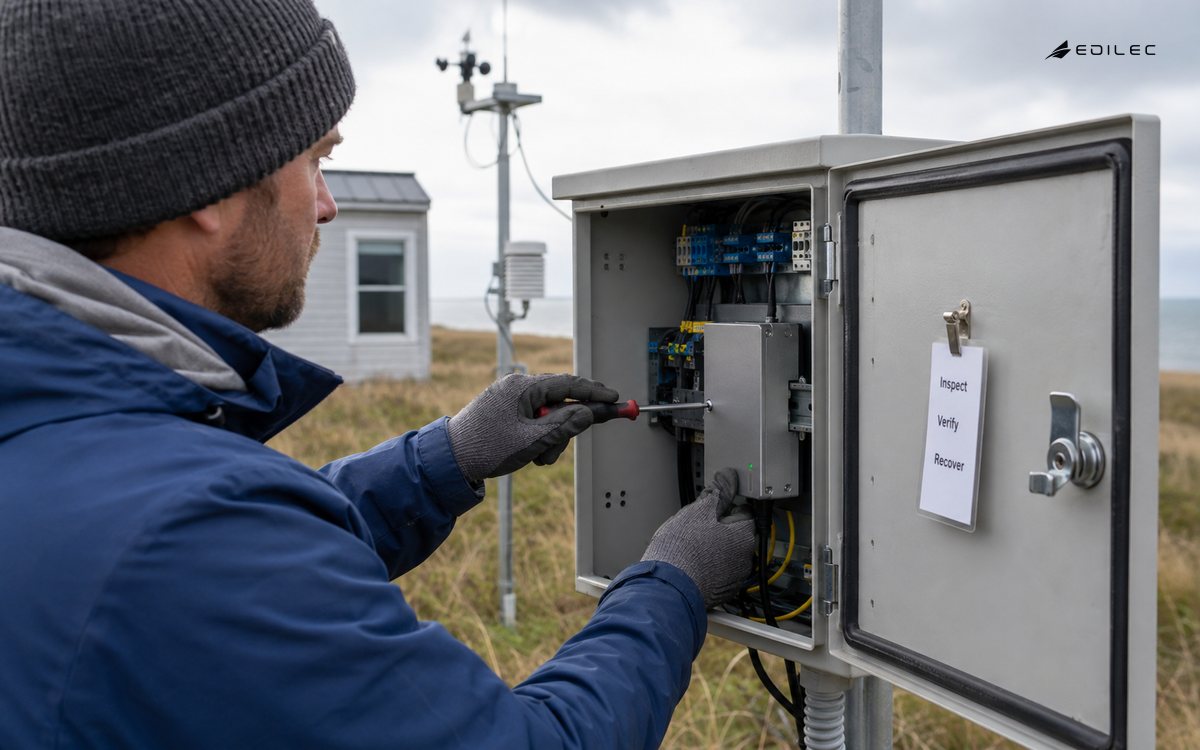
A practical review maps identities, inbound and outbound paths, administrative access, secrets, update authority, local storage, and recovery images. Test the gateway with a lost cloud connection, revoked credential, malformed message, full disk, failed update, and local operator handoff. The safe answer may be to keep a bounded local function running while blocking remote administration. Define that state in advance and record who can authorize isolation, restoration, and re-enrollment.
| Gateway surface | Control to verify | Evidence |
|---|---|---|
| Device identity | Unique, revocable credential | Enrollment and revocation test |
| Network path | Allowlisted route and protocol | Rule review and denied-flow test |
| Admin plane | Named users and least privilege | Access log and removal test |
| Update path | Verified artifact and rollback | Interrupted update exercise |
| Recovery | Known image and clean re-enrollment | Restore and credential rotation record |
Primary guidance for gateway boundaries
Use NIST SP 800-82 Rev. 3 for the operational boundary, NISTIR 8259A for device capabilities, NIST SP 800-213A to turn requirements into procurement and acceptance questions, and NIST SP 800-207 for explicit, continuously evaluated access. The local threat model and recovery exercise decide the final control set.
For related context, compare gateway security practical guide, gateway security in production, and device provisioning security, with the gateway boundary recoverable in mind. Use those perspectives to test the boundary described here while keeping the operating decision and owner in view while keeping the gateway boundary recoverable.
Key takeaways for gateway security
- A gateway is a trust boundary, not merely a protocol converter.
- Unique device identity and controlled administrative access are foundational.
- A minimal, measured image is easier to patch and investigate.
- Segmentation must leave operators a tested, accountable support path.
- Update and retirement controls are as important as first installation.
Review the gateway's dependencies as part of the threat model. An otherwise well-configured unit can still be exposed by an unmanaged name-resolution route, image registry, supplier remote-access tool, or time service that fails during an outage. For each dependency, record the expected destination, authentication method, outage behavior, owner, and change-notification route. This map helps responders distinguish a local incident from an upstream maintenance issue and identifies who can restore each path. It also makes it practical to decide whether the gateway should fail closed or continue a bounded local role when a dependency is absent.
Gateway security questions
Is cloud authentication enough to secure a gateway?
No. Cloud authentication protects one connection, but local services, physical ports, configuration storage, software integrity, and remote-support routes also need controls. Treat the gateway as a complete managed asset with a documented lifecycle.
How often should gateways be updated?
Use a risk-based cadence informed by vendor advisories, exposure, and operational windows. Critical fixes may require faster action, while routine changes should still pass staged validation. The essential requirement is knowing the installed version and being able to recover safely.
Conclusion: keep the gateway boundary recoverable
Gateway security becomes manageable when the team treats every unit as a long-lived boundary with an owner, a unique identity, a narrow network role, and a rehearsed recovery path. Build the lifecycle around those facts, then let scale follow the evidence from the pilot.
Authoritative References for gateway security boundaries
Use NIST SP 800-82 Rev. 3 for OT security context, NISTIR 8259A for IoT device capabilities, NIST SP 800-213A for device requirements, and NIST SP 800-207 for zero-trust concepts. Apply them with the site's safety, availability, and supplier constraints in view.