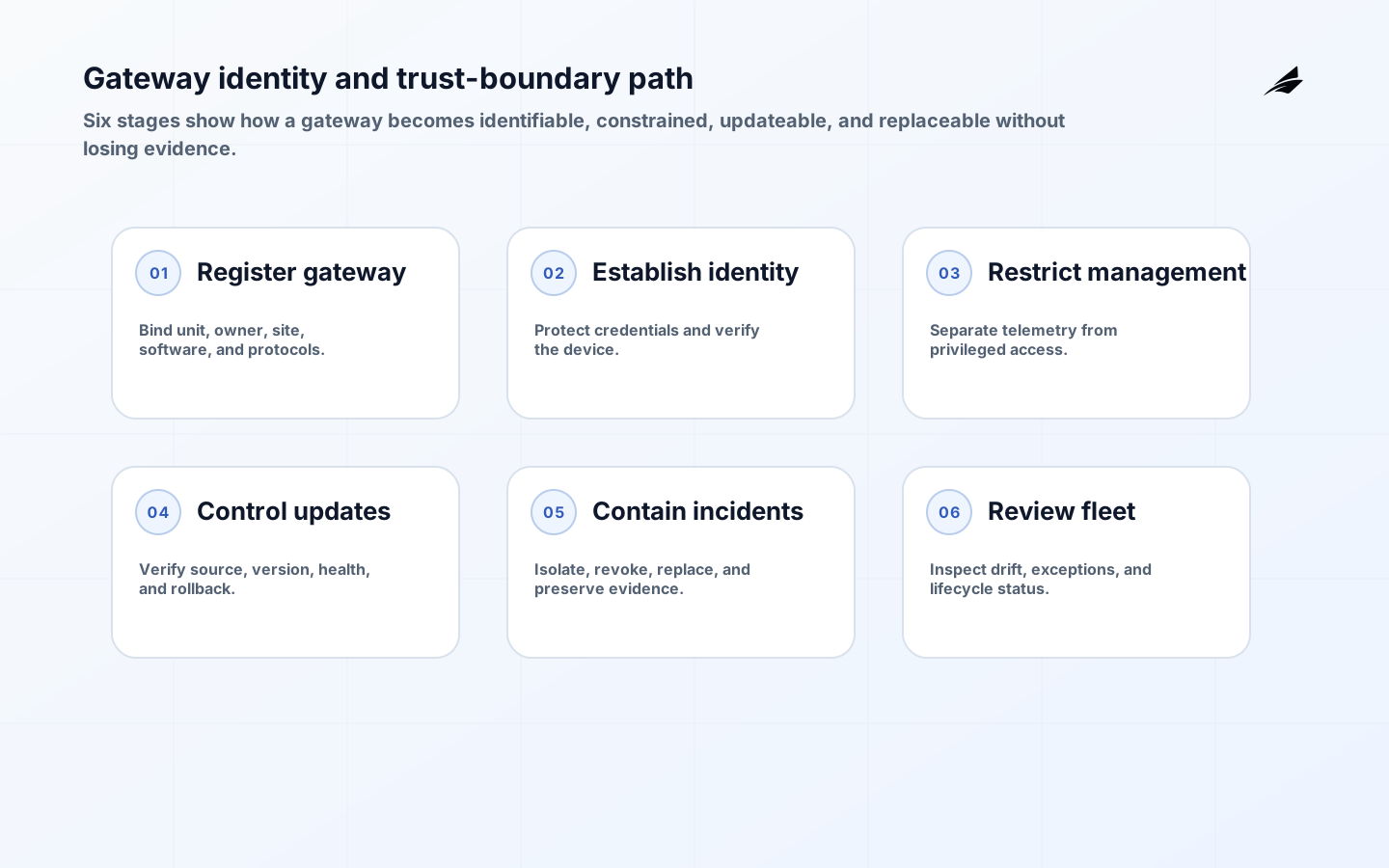
Gateway security starts with the gateway’s role as a trust boundary between field devices, local networks, cloud services, and people who maintain the system. The first build should make identity, allowed paths, update authority, and recovery behavior explicit.
Define the gateway trust boundary
Inventory every pathway through the gateway: local field interfaces, management ports, technician access, upstream broker connections, time sources, update delivery, and log export. For each path, document the initiator, identity, allowed action, data classification, and safe behavior when authorization fails. A gateway that can read a controller should not automatically be allowed to write to it; a vendor support session should not inherit a permanent route to production equipment. NIST SP 800-82 Rev. 3 is especially relevant because OT environments may require availability-preserving compensating controls where an IT-standard agent or update schedule is not feasible.
| Gateway surface | Decision to make | Evidence |
|---|---|---|
| Field protocol | Which commands are permitted versus observed only | Allowlist and protocol test |
| Remote management | Who may connect and for how long | Named session, approval, and audit log |
| Cloud egress | Which endpoints and identities are valid | Outbound policy and certificate inventory |
| Local storage | What can remain on the gateway after a fault | Retention rule and protected-data review |
Establish identity before onboarding
A serial number is an inventory clue, not sufficient proof that a device is the intended gateway. Use a unique device identity bound to the deployment record, with protected credentials or keys, a defined rotation process, and a way to revoke a lost or replaced unit. Enrollment should capture the model, hardware revision, approved software baseline, site, owner, and intended roles. Avoid shared installation credentials; they make an incident harder to scope and a retirement harder to complete. The record should also distinguish the physical gateway from the workload or service identities it hosts, because replacing one does not necessarily retire the other.
- Assign one accountable service owner and one local operational owner.
- Disable or remove services that are not part of the approved design.
- Use individual administrator identities and time-bounded support access.
- Restrict outbound destinations and validate certificates or trust anchors.
- Record the approved software, configuration, and protocol profile.
- Make lost, replaced, and decommissioned gateways revocation events.
Reduce management exposure
Management access deserves its own design because it changes the gateway’s authority. Prefer a brokered or jump-host path with strong authentication, logging, and scoped privileges instead of an internet-reachable administration interface. NIST SP 800-207 argues against treating network location as implicit trust; apply that idea to each connection, including a technician on a familiar site network. Set explicit session expiry, emergency-access approval, and break-glass review. If a legacy component cannot support a modern control, put the compensating restriction around it and document the residual risk rather than describing the exception as normal operation.
Plan secure update and restore behavior
A hardening baseline that cannot be updated safely will drift. Define how software images are authenticated, which versions are supported, when a deployment window is acceptable, what health signal proves a successful boot, and how a failed update returns to a known state. Back up configuration only when it can be restored without copying stale credentials or unsafe routes. Test the recovery procedure on representative hardware, including a disconnected site. Keep an immutable record of the image, configuration change, operator, time, and post-update checks; it is needed both for support and for a credible incident investigation.
Detect gateway security failures early
Collect the small set of signals that exposes misuse and loss of control: unexpected administration attempts, configuration drift, certificate failures, disabled logging, unusual outbound destinations, restart loops, and devices outside the supported baseline. The NISTIR 8259A is useful for assigning these signals across governance, identification, protection, detection, response, and recovery. Alerts should carry gateway identity, site, change history, and an owner who can decide whether isolation is safe. A noisy alert without a response route merely shifts uncertainty to the next shift.
| Failure case | Containment action | Recovery proof |
|---|---|---|
| Credential suspected exposed | Revoke identity and block management path | New identity enrolled and sessions reviewed |
| Configuration drift | Quarantine change for review | Approved baseline compared and restored |
| Update fails | Return to tested prior state | Boot, service, and data-path checks pass |
| Gateway offline | Preserve local safety behavior | Reconnect, reconcile buffer, and inspect cause |
Run a gateway security acceptance exercise
Commission a representative gateway using the exact process expected in the field, then verify its boundary from both sides. Attempt remote administration with an approved individual identity, an unapproved identity, an expired support approval, and the wrong network route. Confirm that logs identify the gateway, person or service, policy decision, and attempted action without exposing secrets. Compare the installed services, outbound destinations, certificate inventory, and configuration hash with the approved deployment record. If the gateway bridges field protocols, test that an observation path cannot be turned into a broader write path simply by changing a payload or connecting from an adjacent network.
Next, test the lifecycle. Apply a signed update during a suitable window, simulate a failure after the image transfer, and demonstrate recovery to a verified state. Replace the unit with a spare and prove the old credentials no longer work, the replacement receives only approved configuration, and buffered or audit data is handled according to the stated rule. Finally, isolate the gateway and confirm local equipment reaches its intended safe behavior. These tests are valuable because a paper hardening baseline can look complete while the real installation, emergency support route, or replacement process remains dangerously permissive.
Make the gateway a managed trust boundary
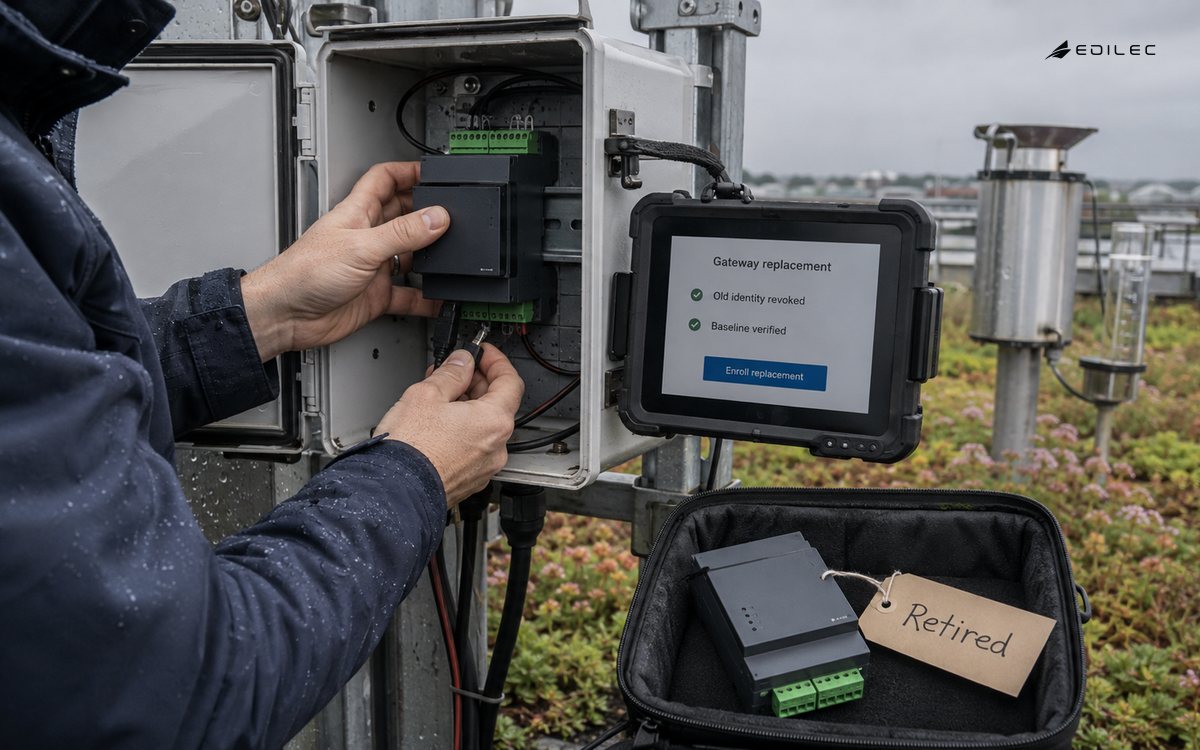
Gateway security is strongest when the gateway is treated as a managed identity and policy boundary, not as a small server that happens to sit near equipment. Record the gateway’s owner, location, software version, connected protocols, upstream destinations, and maintenance route. Bootstrap it with a unique identity, protect private credentials, and make replacement explicit: a field swap should revoke the old identity, enroll the new unit, and preserve enough evidence to explain the handoff. NISTIR 8259A frames device capabilities such as identification, configuration, data protection, logical access control, software update, and cybersecurity state awareness as practical requirements. Those capabilities should appear as acceptance tests in the procurement and rollout process, not as an assumption about a vendor’s product page.
For gateway enrollment decisions, compare Gateway Security: Engineering Notes, How Product Teams Should Think About Gateway Security, Gateway Security for Connected Systems: A Practical Guide; together they frame gateway enrollment, ownership, and recovery without asking the reader to infer the operating boundary.
- Inventory gateway identity, owner, location, software, and connected protocols.
- Use separate paths for telemetry and privileged management.
- Define bounded offline behavior for data, commands, and updates.
- Revoke, replace, and recover a gateway through a documented evidence trail.
Gateway security before the first build takeaways for operators
- Treat each gateway as a managed trust boundary with named owners.
- Map every management, field, storage, and cloud path before deployment.
- Use per-device identities, scoped privileges, and revocation-ready records.
- Minimize exposed services and make support sessions temporary and auditable.
- Test authenticated updates and restoration on representative hardware.
- Monitor drift and identity failures with a response owner attached.
Gateway-security questions for the first deployment
What makes a gateway a security boundary? Its identity, permitted protocols, management path, update authority, connected assets, and offline behavior must be explicit and independently reviewable. What should happen when a gateway is replaced? Revoke the old identity, enroll the replacement with a verified baseline, confirm its permitted routes, and retain the handoff evidence for the fleet record. What is a useful first security exercise? Test enrollment, credential rotation, signed update, cloud interruption, local safe behavior, isolation, and restoration on representative hardware with the operational owner present.
Keep a gateway evidence pack that travels with the fleet record. Include the approved role, field interfaces, software baseline, configuration fingerprint, device and administrator identities, trusted endpoints, support path, update history, replacement history, and known exceptions. During an incident, this pack lets responders determine whether the gateway is behaving as designed before making a disruptive change. During a rollout, it makes site variation visible. The pack should be maintained or refreshed through normal operations where possible; a spreadsheet maintained only at commissioning quickly stops being a dependable representation of the boundary.
Purchase and deployment reviews should require the same evidence. Ask whether the vendor can describe secure enrollment, supported update periods, vulnerability notification, credential recovery, log access, data deletion, and end-of-life handling. Then compare those answers with the organization’s actual site connectivity and maintenance capability. A gateway cannot be considered secure solely because its data sheet names encryption; its security depends on whether the deployed fleet can keep identities, software, configuration, and support access under control for its useful life.
Schedule a periodic recovery drill for one site. The drill should involve the operational owner, not only the platform team, because the relevant question is whether service and safety context survive the gateway event. Record the result, follow up on exceptions, and use the evidence when approving fleet expansion.
Where sites differ, record the difference as a controlled profile rather than an informal local tweak. A profile can name the approved ports, upstream endpoints, maintenance window, local safety dependency, and compensating control. Review its expiry and owner. This preserves a deployable standard while respecting the operational conditions that make a one-size baseline unrealistic.
Primary references for Gateway Security Decisions That Matter Before the First Build
The primary references for this operating decision are NISTIR 8259A, NIST SP 800-213A, NIST SP 800-193, NIST SP 800-57 Part 1 Rev. 5. Apply them with site procedures and sector requirements when checking the implementation for gateway enrollment.
Conclusion: keep gateway enrollment explainable
For gateway enrollment decisions, compare Gateway Security: Engineering Notes, How Product Teams Should Think About Gateway Security, Gateway Security for Connected Systems; together they frame gateway enrollment, ownership, and recovery without asking the reader to infer the operating boundary.