How Engineering Teams Should Think About Protocol Selection
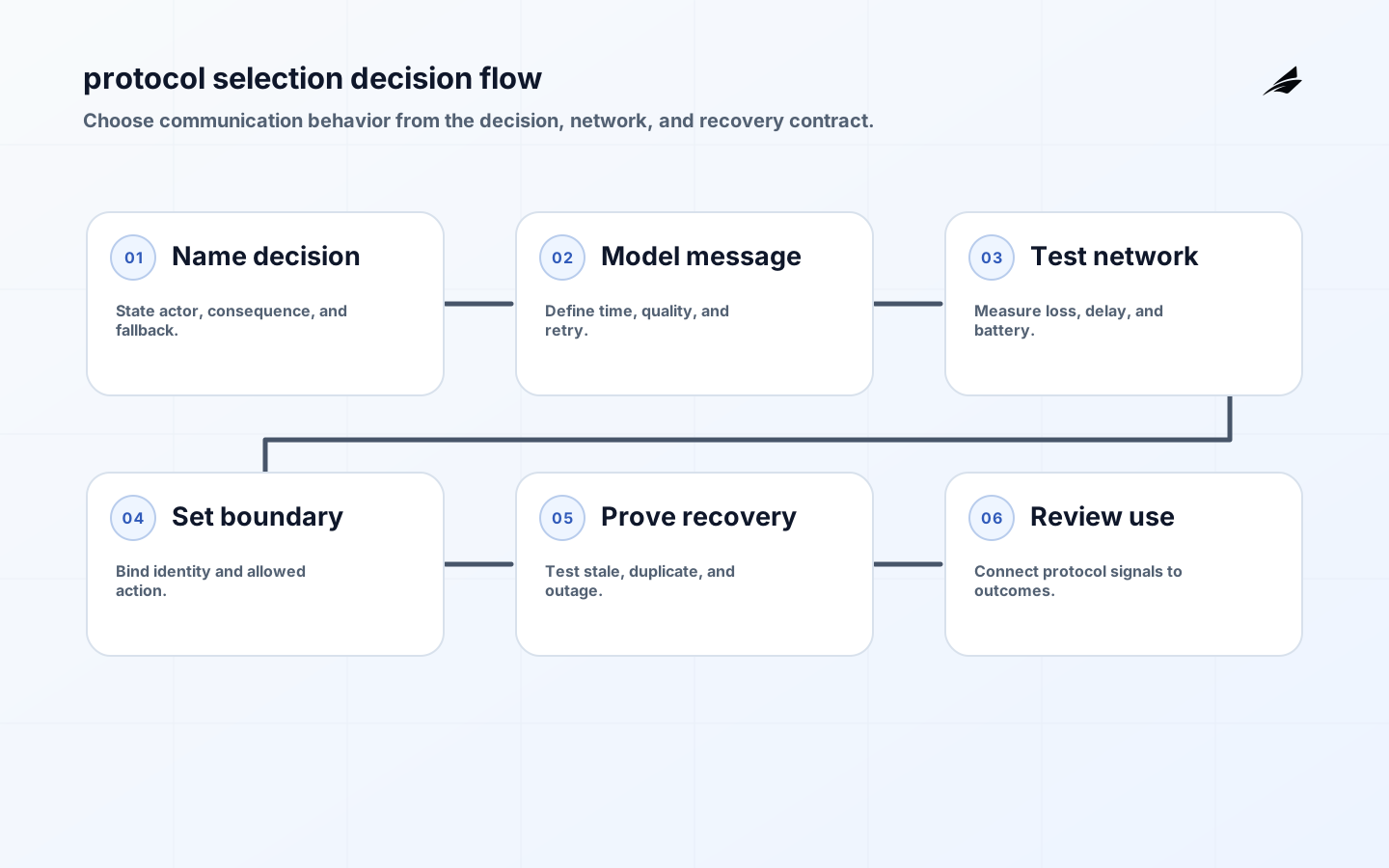
Protocol selection is a product and operating decision, not a contest between familiar acronyms. The right choice connects a real decision to a message contract, a network path, an identity boundary, and a recovery routine. A cold-chain system may need compact telemetry, intermittent connectivity, and a clear stale-reading rule. A building-control system may need commands, retained state, authorization, and a safe actuator state. Start with the consequence of delay, loss, duplication, or replay; then test which protocol behavior makes that consequence visible and manageable. The MQTT Version 5.0 specification and IETF CoAP specification are useful anchors because they describe wire behavior rather than product positioning.
Start with the decision the system must support
Write the first use case as a decision record. Name the operator, the asset, the expected input, the acceptable freshness, the consequence of a wrong answer, and the manual fallback. “Send temperature data” is too vague to select a protocol. “Keep a shipment within its approved range and alert a coordinator when evidence is stale” creates a testable boundary. Link this framing to IoT telemetry explained from first principles so units, timestamps, provenance, and quality are part of the conversation. Decide whether the interaction is telemetry, command, state synchronization, request-response, or a deliberate combination.
| Question | Why it changes the choice | Evidence to keep |
|---|---|---|
| What is the interaction? | Telemetry, command, state, and request-response have different contracts. | A message sequence for normal and failed paths. |
| How fresh must it be? | A trend can tolerate delay that a safety command cannot. | Freshness target, expiry rule, and stale state. |
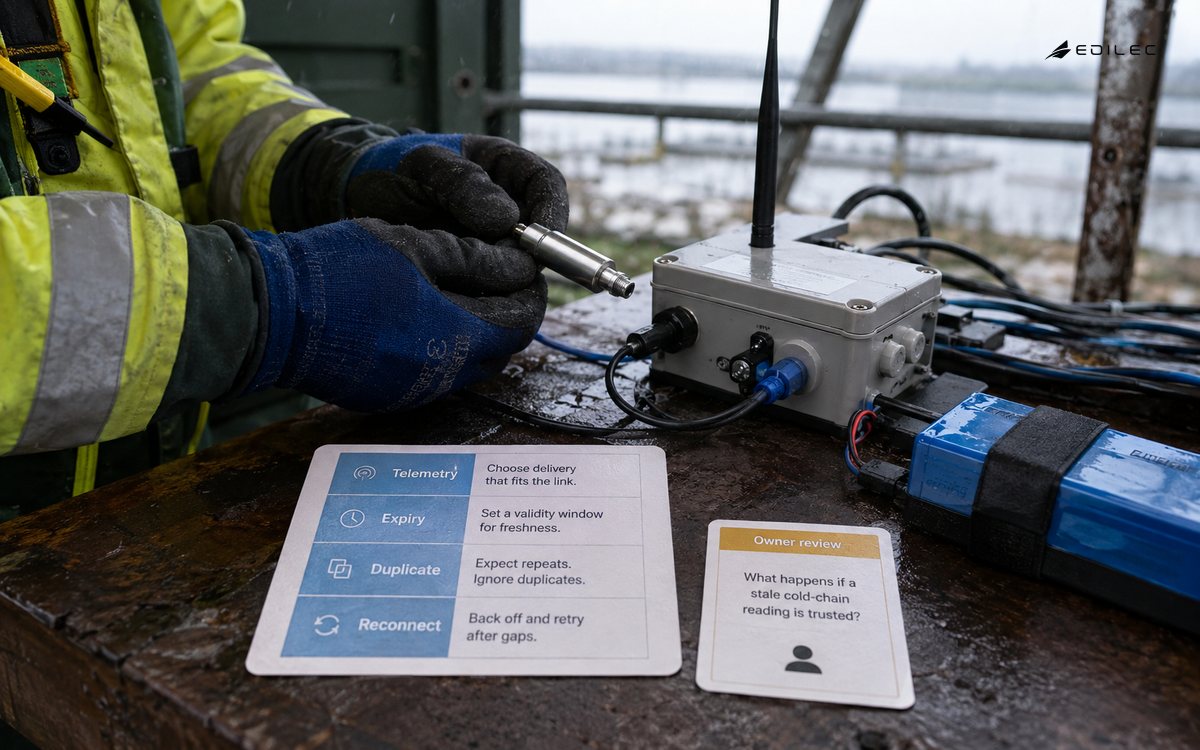
| What happens on duplication? | Retry behavior can repeat messages or side effects. | Idempotency key and consumer handling rule. |
| Who owns the boundary? | Transport cannot assign operational accountability. | Named owner for device, gateway, broker, and consumer. |
Match delivery semantics to consequence
MQTT 5.0 describes at-most-once, at-least-once, and exactly-once quality-of-service levels. Those levels are useful vocabulary, but they do not eliminate application design. At-least-once delivery still asks consumers to tolerate duplicates. Exactly-once protocol handling does not make an external payment or actuator effect reversible. For a humidity trend, at-most-once may be reasonable if the next sample arrives quickly. For a valve command, use a command identifier, expiry, authorization, acknowledgement, and a defined device state after timeout. Record the decision in the interface contract so product, support, and operations teams can reason about it later.
Test the network you actually have
A protocol that looks efficient on a lab network can become costly when devices sleep, roam, cross NAT boundaries, or share a lossy radio. CoAP is designed for constrained nodes and networks and provides a request-response model with discovery and proxying options. TCP provides an ordered, reliable byte stream, but the product still needs connection management, keepalive policy, reconnect backoff, and bounded queues. Measure handshake frequency, payload overhead, battery cost, reconnect time, gateway translation, and behavior during packet loss with representative traces before committing.
Make the message contract inspectable
A protocol choice is incomplete until the team can explain the message itself. Define a stable device or tenant identifier, schema version, source time, receipt time, unit, quality state, correlation identifier, and retention rule. Separate event time from ingestion time; otherwise a delayed reading can look current. Decide whether missing data is represented by absence, an explicit quality value, or a state transition. For commands, define authorization context, requested expiry, acknowledgement meaning, and whether a retry is safe. The contract should include examples of malformed, late, duplicated, and out-of-order messages, not only the happy path.
| Boundary | Design decision | Failure test |
|---|---|---|
| Device to gateway | How does the device authenticate and reconnect? | Expired credential and radio loss. |
| Gateway to service | Which topics, resources, or endpoints are allowed? | Unexpected route or tenant access. |
| Service to application | How is stale or replayed data interpreted? | Old payload with a valid signature. |
| Operations | Who can revoke, inspect, and recover? | Lost device or leaked key. |
Treat security as part of selection
Security is not a later library choice. NIST’s IoT device cybersecurity baseline gives a practical checklist around device identification, configuration, data protection, interface access, software update, cybersecurity state awareness, and device security. Map each capability to the protocol boundary. Decide how a device authenticates, how a service authorizes a topic or resource, how keys rotate, and what an operator sees when access is rejected. Use device provisioning security review when identity is still being designed. Prefer per-device credentials and narrowly scoped operations over one shared secret that cannot be contained.
Work through a concrete selection
Imagine 2,000 refrigerated containers sending a reading every 60 seconds over cellular coverage that may disappear for ten minutes. The product decision is whether a shipment remains within a contract range, not whether every sample arrives instantly. A brokered publish model may simplify fan-out, but the consumer still needs sequence numbers, source time, retained last-known state, a stale threshold, and a queue limit. A command to change the sampling interval needs a different contract from telemetry: it needs authorization, expiry, acknowledgement, and a safe default. Test the same decision with a request-response design and compare battery use, retry behavior, support tooling, and recovery evidence rather than comparing protocol names in isolation.
Measure the choice after launch
A good protocol decision remains observable after deployment. Track delivery delay, duplicate rate, rejected identities, queue depth, reconnect storms, schema failures, stale decisions, and operator overrides. NIST’s Cybersecurity Framework offers a useful vocabulary for identifying assets, protecting the boundary, detecting unusual behavior, responding, and recovering. Pair technical measures with business outcomes: fewer missed maintenance windows, faster investigation, or fewer manual checks. Review metrics after a representative incident or network change. If the protocol is technically healthy but operators cannot explain a stale command, the system contract still needs work.
Key takeaways
- The business decision, owner, consequence, and safe fallback.
- Freshness, ordering, duplication, replay, and offline behavior.
- A message contract with identity, units, time, quality, and version.
- Credential, authorization, update, and revocation responsibilities.
- Network measurements from representative devices and gateways.
- Operational metrics that connect protocol behavior to user outcomes.
Frequently asked questions
Is MQTT always better than CoAP for IoT?
No. MQTT can fit brokered publish and subscribe workflows, while CoAP can fit constrained request-response interactions and proxying. The decision depends on device limits, network shape, fan-out, commands, and recovery requirements.
Does exactly-once delivery prevent duplicate business effects?
No. An application must still make side effects idempotent, correlate retries, enforce authorization, and record the resulting state. Delivery semantics are one part of the business contract.
Turn the selection into an implementation record
Once a protocol is selected, publish a short implementation record that engineers can use during delivery and operators can use during an incident. Include the allowed client versions, connection limits, payload size limits, retry and backoff rules, queue behavior, clock requirements, and expected broker or endpoint response codes. State which assumptions were measured and which remain open. If a device sleeps for ten minutes, the record should say whether messages are queued, coalesced, discarded, or marked stale. If a command crosses a gateway, show where authorization is checked and where acknowledgement is created. This document prevents a vendor library default from becoming an accidental product contract.
Design the test harness around failure, not only throughput. Run a device with a slow clock, a gateway with a full queue, a consumer that restarts after receiving a message, and a service that returns an error after applying a change. Inject duplicate, delayed, malformed, and out-of-order payloads. Compare the resulting business state with the state operators expect. A protocol benchmark can report excellent latency while the product still loses the context needed to investigate a stale reading. Keep packet captures and application-level event records together so a support engineer can see both what crossed the wire and what the product believed it meant.
Plan the ownership boundary between the device team, gateway team, platform team, and product team. One team should own the client library and upgrade compatibility; another may own the broker or API; operations should own alert thresholds and recovery procedures. Name who approves a protocol extension, who can revoke a device, and who handles a consumer that falls behind. The device provisioning guide is a useful companion when the protocol depends on identity issuance, while gateway security guidance helps review the translation and boundary. Ownership is part of protocol selection because an elegant wire contract can still fail when no team owns its exceptions.
Review the choice when the product changes materially. A new actuator, new radio, new regulatory requirement, or new customer tenancy model can change the consequence of loss and the required authority. Do not switch transport simply because a newer protocol is fashionable; compare the new contract with the evidence from live operation. Retain the reason for the original decision, the measurements that supported it, and the conditions that would trigger reassessment. That record makes future architecture work faster because the team can distinguish a real changed constraint from a preference dispute.
Finally, treat protocol selection as a reversible decision with an explicit migration story. Define how a client version is retired, how a schema is introduced, how a broker or endpoint is drained, and how old and new consumers coexist. A migration should preserve business identifiers and timestamps so operators can compare readings across the boundary. Keep a compatibility test for the most important devices and a rollback condition that can be triggered by evidence such as rising stale decisions or duplicate commands. If the team cannot explain how to move from the selected protocol without losing authority or history, it has selected a technology but not yet designed an operable system. IoT telemetry guidance helps keep that history meaningful as the transport evolves.
Keep the decision record close to the code and deployment configuration. When a setting changes, the review should show whether it changes delivery, identity, freshness, or recovery semantics. This is especially important when a platform team replaces a broker, gateway library, or client SDK without changing the product feature name. A short, maintained contract lets reviewers ask the right question before a compatibility issue reaches the fleet.
Keep an explicit decision log for trade-offs that cannot be settled by a benchmark. Record why a small payload outweighed richer discovery, why a command needed stronger acknowledgement than telemetry, or why a constrained device required a gateway. Include the rejected alternatives and the condition that would make them reasonable later. This record gives new engineers a route into the architecture and gives operators context during an incident. It also keeps protocol selection connected to the product outcome instead of turning it into a permanent argument about preferred tooling.
Conclusion: choose a contract you can operate
The strongest protocol selection is the one an engineer can implement, an operator can diagnose, and a product owner can defend. Start with the decision, model failure, measure the real network, and keep identity, quality, and recovery visible. That approach may lead to different protocols at different boundaries, but it produces a connected system whose behavior remains understandable when conditions are imperfect.