Sensor calibration data is part of the measurement’s meaning, not an accessory field attached after a dashboard is built. If a pressure value changes a maintenance decision, the team needs to know which sensor produced it, which calibration or adjustment was in force, when that state became valid, and how uncertainty affects the decision. This guide treats calibration as an operational record: traceable, time-bounded, permissioned, and usable by both the system that evaluates telemetry and the person who must defend a result.
Tie Calibration Records to a Measurement Decision
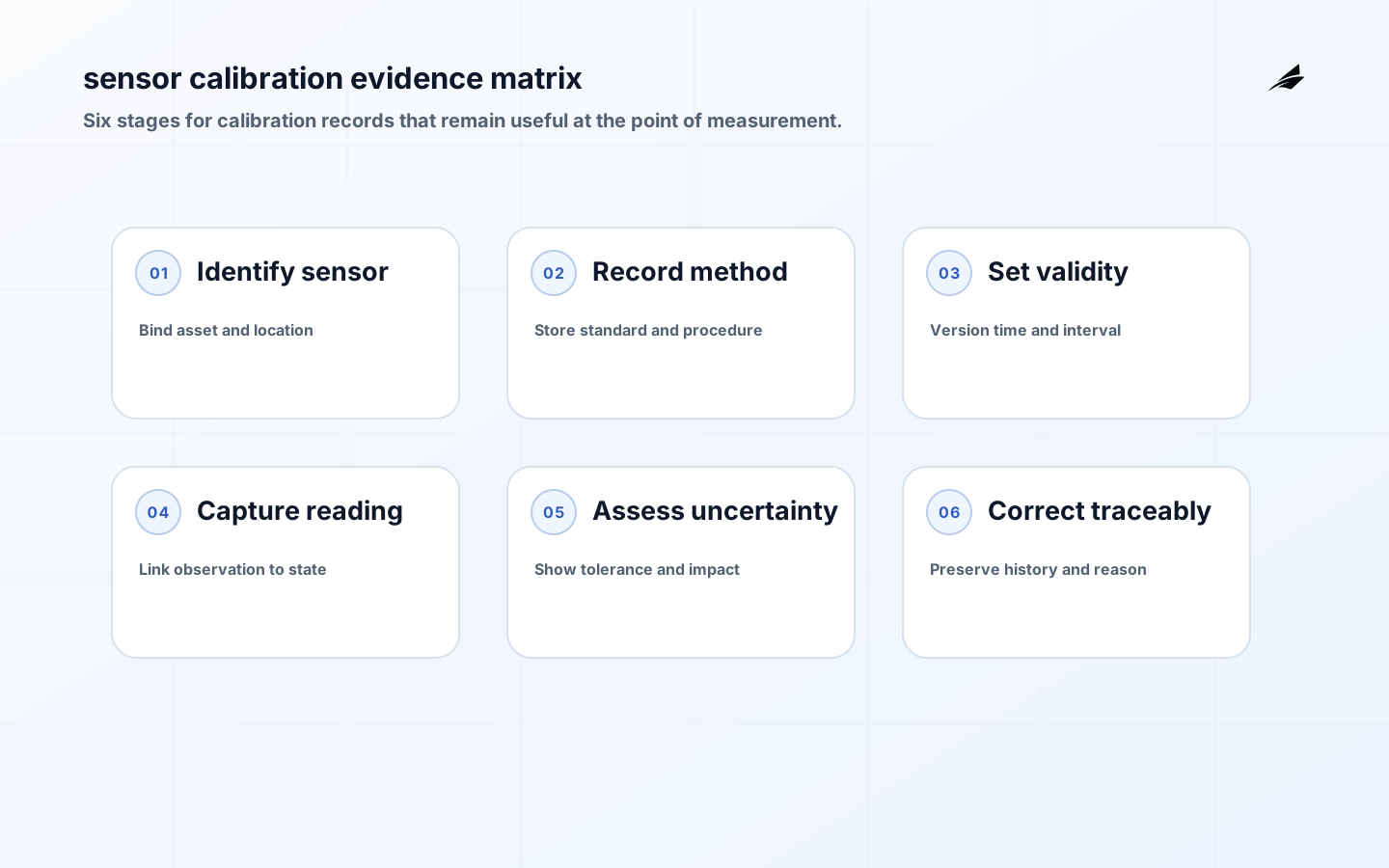
Create a measurement record that links each observation to a device identity, channel, engineering unit, calibration certificate or procedure, calibration date, due date, result, uncertainty where applicable, and the software scaling rule. Preserve the prior record when coefficients change so analysts can understand which values were produced under which configuration. NIST SP 800-82 Rev. 3: Guide to Operational Technology Security is a useful anchor for deciding which technical requirements belong in the product rather than in an improvised deployment — for the calibrated asset. Write a one-page operating statement before choosing components: name the physical or business outcome, the asset or client population, the decision supported, the acceptable delay, the accountable owner, and the condition in which the system must decline to act — at the measurement boundary.
| Design question | Practical answer | Evidence before launch |
|---|---|---|
| What is the unit of work? | Give each calibration reading, asset, service visit, or lifecycle transition a stable identifier. | A sample record can be traced from source to user action. |
| Who owns meaning? | One role approves field definitions, compatibility, and retirement of the contract. | An owner and change path appear in the runbook. |
| What happens when data is uncertain? | Represent calibration quality, time validity, and failure explicitly; never silently substitute a reading. | A calibration test should show the operator what happens when input is stale or invalid. |
| How is it recovered? | Use a scoped replay, certificate replacement, or coefficient reversal procedure with an accountable approver. | A rehearsal record captures the expected and actual result. |
Set Access and Validity Boundaries
Distinguish calibration, verification, adjustment, and drift monitoring in the data model. A field check may show that a unit is within tolerance without changing the conversion; an adjustment changes the relationship between signal and engineering value. Mixing those actions makes trends look smoother than they were and hides the reason for a change. The OGC SensorThings API Part 1: Sensing guidance is helpful here because useful evidence is structured, time-aware, protected, and retained for a stated purpose. Decide which identifiers and payload elements are sensitive, which parties need them, and what a support engineer may retrieve during an incident — when validity expires. A contract that names an owner but omits its access path is still incomplete — during a drift review.
Choose calibration-version compatibility rules according to the consequence of a changed unit or coefficient. Additive optional fields may be safe when consumers ignore what they do not understand; renamed fields, altered units, and changed authorization semantics need a migration — inside the certificate record. Maintain examples for normal, degraded, and rejected messages or requests — after a late calibration arrives. They make reviews concrete and prevent a documentation page from drifting away from deployed behavior — for a redundant sensor. For calibration records, it makes a changed unit or coefficient visible to analysts.
Protect the Calibration Evidence Chain
Quality flags should travel with the reading. A value can be plausible but out of calibration, substituted after a communications gap, or calculated from a stale configuration. Design consumers to display and filter these states rather than silently treating every numeric value as equally reliable. Apply the operational-technology principle in NIST SP 800-92: Guide to Computer Security Log Management: account for the physical process and safety consequence, not just the network topology. Review access as a chain of identity, policy, service exposure, and monitored action — before a corrected value ships. A secure transport channel matters, but it does not prove that the caller should perform the action or that the action was understood correctly — during maintenance handoff.
| Failure or change | Control to design | Operator evidence |
|---|---|---|
| Identity is revoked or replaced | When a certificate changes, retire the old scope, activate the new one, and preserve ownership history. | Revocation time, replacement identity, and successful policy evaluation. |
| Connection or power is lost | Use bounded local behavior, queue limits, and a safe rejoin procedure. | Last known state, queue age, and reconciliation result. |
| Contract changes | Version the schema or configuration and test compatible consumers first. | Change approval, deployed version, and validation outcomes. |
| A decision is disputed | Keep raw measurement context and the calibration action trail separate from mutable dashboard presentation. | Record identifiers, timestamps, operator, and before-and-after state. |
Turn Drift Signals into Maintenance Actions
Review overdue calibrations, repeated out-of-tolerance results, coefficient changes, missing certificates, and data received after a device replacement. Link exceptions to the maintenance work order and record who accepted the risk of continued use. That creates an auditable path from a questionable reading to a business decision. Do not treat one fleet-wide calibration threshold as meaningful for every asset and use case. Segment the measures by site, asset or client class, software version, and criticality — at the uncertainty threshold. A rising fleet-wide error rate calls for a different response than one intermittent unit at a high-consequence location — for the calibrated asset. Weekly review should end with a named corrective action, an owner, and a date to inspect the result — at the measurement boundary.
Rehearse Expiry, Drift and Late Records
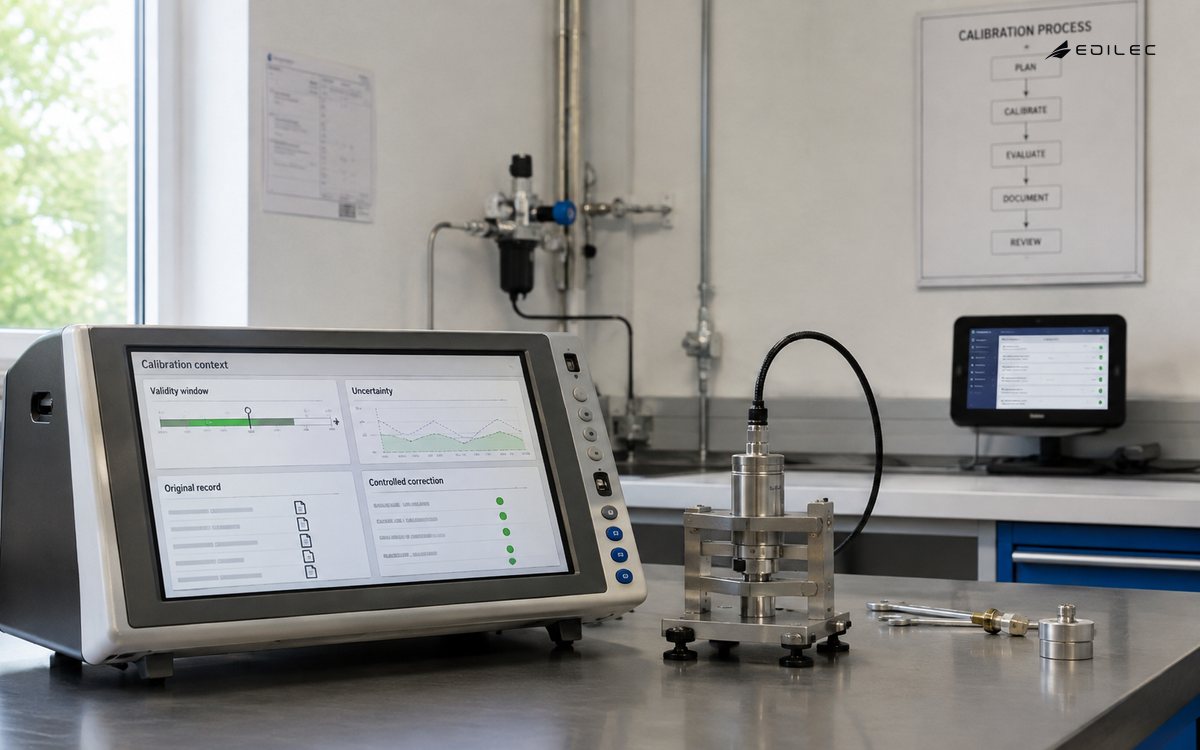
Choose one measurement with a consequential use, such as pressure that protects a process limit. Backfill only the lineage needed to interpret its current readings, then test a replacement sensor and a retrospective investigation. The pilot reveals whether the asset, quality, and analytics systems agree on identity and time. Use the rehearsal to decide what the system will do when reality is inconvenient, rather than leaving that choice to the on-call engineer — when validity expires. Capture screenshots or records from the user-facing surfaces as well as technical logs — during a drift review. A resilient design keeps the operational team informed without asking them to infer safety or data quality from a vague platform status message — inside the certificate record.
- Assign measurement, maintenance, and support owners for the first production calibration workflow.
- Run expiry, drift, and late-record scenarios against real identity, configuration, and measurement paths; do not test only the dashboard.
- Record the calibration decision, maintenance action, recovery step, and follow-up measure for each rehearsal.
- Use the related field-service guide to align calibration scope with the next connected capability.
Sequence the Calibration Rollout
First establish the inventory and contract, then instrument the smallest useful path, then introduce the decision or workflow, and only then broaden the population for sensor calibration data for connected systems: a practical guide. This sequence keeps calibration evidence interpretable before more devices add volume. It also provides a clean rollback point: a newly added consumer or rule can be disabled without deleting the source evidence — after a late calibration arrives. The device capabilities described in NIST IR 8259r1: Foundational Cybersecurity Activities for IoT Product Manufacturers reinforce why support, configuration, and lifecycle information need to be planned as part of the product — for a redundant sensor.
At each calibration stage, approve an exit condition that the maintenance team can verify. Examples include a reconciled identity inventory, a tested permission boundary, a qualified record visible to its user, a completed work item, and a reviewed recovery exercise — before a corrected value ships. Budget for documentation that a field worker or support colleague can use at the moment of failure — during maintenance handoff. For sensor calibration data for connected systems, that material is part of the operating system, not aftercare.
Key takeaways
- Sensor calibration data for connected systems is an operating capability, not merely a deployed component.
- Give calibration identities, validity contracts, quality states, and corrective actions explicit owners and durable evidence.
- Design the calibration degraded path before scale turns a small validity ambiguity into an expensive incident.
- Connect calibration work to a complementary device-provisioning decision and earlier planning guidance so the measurement model remains coherent.
Frequently asked questions
What is the first practical step for sensor calibration data for connected systems?
Pick one decision with a clear user and consequence, then trace the exact record, identity, rule, action, and evidence it needs — at the uncertainty threshold. For sensor calibration data for connected systems, a narrow path reveals missing ownership and quality information faster than a broad platform rollout.
Can Existing Tools Carry the Calibration Contract?
For sensor calibration data for connected systems, replacement is rarely the first move. Put the contract and operating controls around one path, integrate through stable boundaries, and use the evidence from that path to decide whether a platform constraint is material — for the calibrated asset. Replacement is a business decision, not a default response to an incomplete operating model — at the measurement boundary.
How should expired calibration records affect decisions?
Mark expired or uncertain readings visibly, retain the prior evidence, and require an explicit review or safe fallback before a consequential action.
Make calibration a first-class data contract
A measurement example
For a vibration sensor used to trigger maintenance, retain the device or asset identifier, calibration procedure, reference standard or certificate, adjustment coefficients, uncertainty or tolerance, technician or service identity, effective interval, environmental conditions, and approval state. A telemetry record can then be interpreted against the calibration version that was valid when the measurement occurred. If a correction is applied later, keep the original observation and publish the corrected interpretation as a new, traceable state. This prevents a dashboard refresh from rewriting history without telling the people who made decisions from it.
Calibration Signals That Need Attention
Monitor calibration expiry, measurements arriving without a valid calibration reference, sudden coefficient changes, repeated manual overrides, drift between redundant sensors, and gaps in the service or certificate record. Treat these as quality and operational signals rather than cosmetic metadata problems. When a sensor is out of tolerance, define whether the system holds the last trusted value, marks the stream uncertain, routes the asset to inspection, or stops an automated action. That policy should be visible to the consumer of the measurement.
- Tie each reading to a stable asset and calibration version.
- Store validity intervals and handle late-arriving calibration records explicitly.
- Keep uncertainty visible when it changes a business decision.
- Separate raw observations from corrected interpretations.
- Assign ownership for expiry, exceptions, and certificate evidence.
Calibration and Measurement References
Use NIST SP 800-82 Rev. 3: Guide to Operational Technology Security, OGC SensorThings API Part 1: Sensing, NIST SP 800-92: Guide to Computer Security Log Management, NIST IR 8259r1: Foundational Cybersecurity Activities for IoT Product Manufacturers as reference points for the control, data, accessibility, security, or operating semantics relevant to this decision. These references frame calibration controls; the measurement contract and asset record decide what the product must retain. They help the team name assumptions, choose evidence, and make a review concrete enough that another person can verify what the system is expected to do — when validity expires.
Further Reading on Calibration Evidence
For adjacent decisions, continue with Field Service Portals for Connected Systems: A Practical Guide, What Changes When Device Provisioning Moves Into Production, Sensor Calibration Data Decisions That Matter before the First Build, then compare the definitions, ownership boundaries, and recovery behavior before widening the implementation.
The record should also make uncertainty useful to the next decision. A maintenance rule may tolerate a different error range from a safety interlock, so retain the intended use and threshold alongside the calibration evidence. That context prevents one valid certificate from being treated as a universal guarantee.
Conclusion
Sensor calibration data for connected systems earns trust when people can explain what happened, who was allowed to act, what the data meant at the time, and how the system recovered. Build that accountable path for one consequential workflow, rehearse the uncomfortable cases, and expand from evidence rather than enthusiasm — during a drift review.