Device Provisioning for Connected Systems: A Field Guide
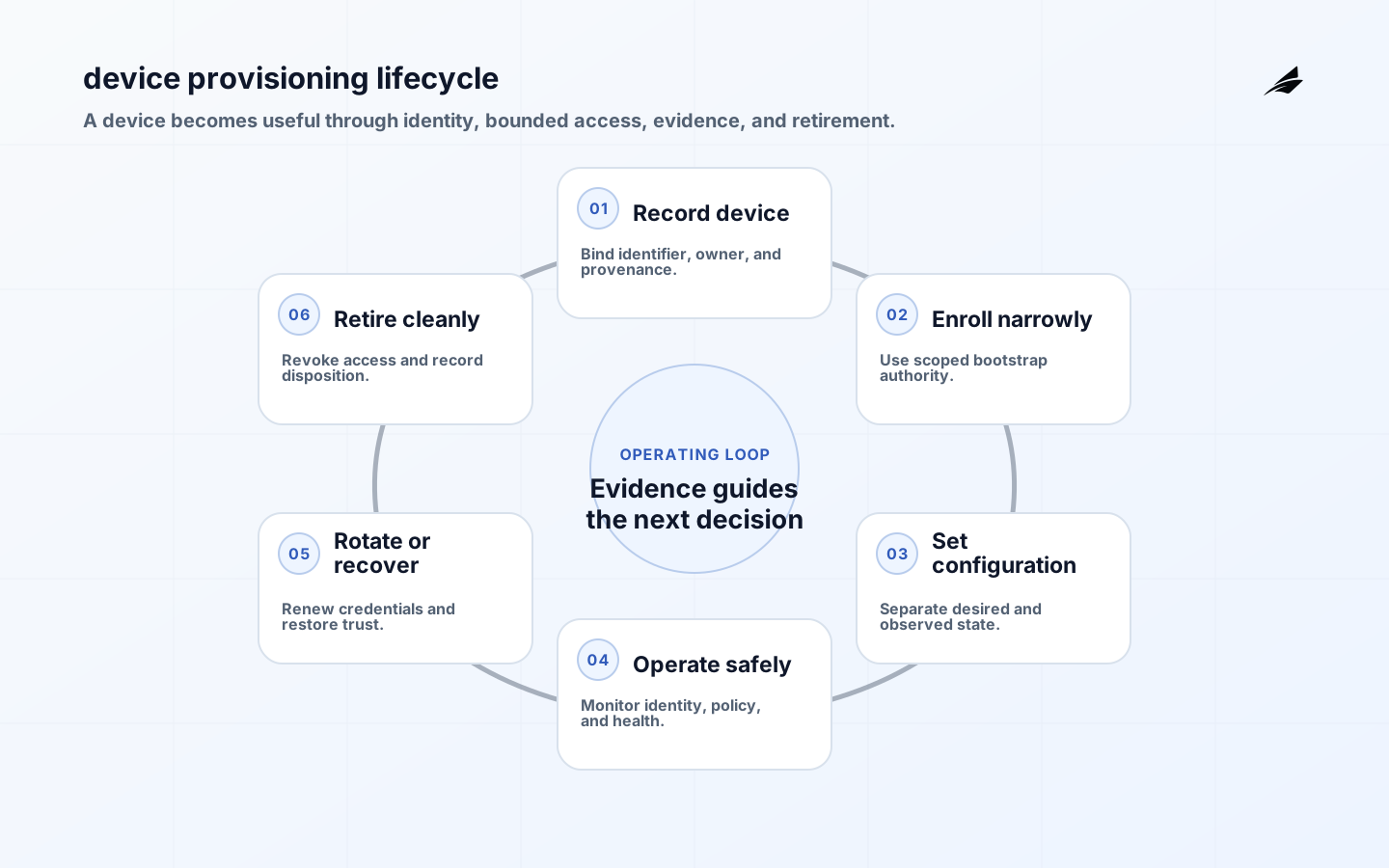
Device provisioning is the controlled transition from an untrusted or unknown device to an identified participant in a connected system. It is more than loading a certificate or entering a serial number. A durable provisioning design establishes identity, assigns ownership and configuration, limits first access, records evidence, supports rotation, and provides a safe retirement path. That matters whether the fleet is ten industrial gateways or 100,000 sensors. The NIST IoT device cybersecurity baseline treats identification, configuration, data protection, interface access, software update, and state awareness as device capabilities; use those capabilities as requirements for the whole lifecycle.
Define the provisioning boundary
First decide which system is authoritative for the device record. Capture a stable identifier, hardware or model family, manufacturing batch, owner, site, intended role, firmware state, credential status, and permitted data path. Separate facts known before shipment from facts learned during enrollment. A barcode or serial number can identify an object, but it is not by itself proof that the device presenting credentials is genuine. Set a rule for duplicates, missing records, and devices that arrive at the wrong site. Link the communication decision to protocol selection for engineering teams so the enrollment channel and the steady-state channel have explicit contracts.
| Provisioning question | Decision | Evidence |
|---|---|---|
| What is the device? | Choose a stable identifier and naming scheme. | Inventory record and attestation or manufacturing proof. |
| Who owns it? | Assign customer, site, operator, and support owner. | Approved ownership record and change history. |
| What may it do? | Bind role, data path, and command scope. | Policy version and effective permissions. |
| When is it ready? | Define checks for firmware, time, network, and credentials. | Enrollment result with failed checks visible. |
Give every device a usable identity
Prefer an identity that can be authenticated and revoked independently. A shared fleet password makes initial setup easy but makes investigation and containment difficult. Device certificates, hardware-backed keys, or an approved secure-element design can provide stronger separation, but the benefit depends on how issuance, storage, rotation, and revocation are operated. NIST’s SP 800-213 guidance is useful when translating device capabilities into organizational requirements. Write down the trust anchor, the issuing service, the allowed proof, the renewal window, the emergency revocation process, and the behavior when a device has no network access.
Make enrollment narrow and repeatable
Enrollment should create the smallest initial authority needed to reach the next verified state. A device may first be allowed to contact only a provisioning endpoint, retrieve time or configuration, and report evidence. After checks pass, the service can issue the steady-state credential and bind the device to a tenant, site, topic, or resource. RFC 8995 describes a standards-based approach to bootstrapping remote secure key infrastructures; even when your implementation differs, its separation of discovery, voucher or authorization evidence, and certificate enrollment is a useful design prompt. Keep enrollment idempotent so a retry does not create a second device or accidentally broaden access.
Treat configuration as governed state
A provisioned device still needs configuration: endpoint, reporting interval, time source, feature flags, safety limits, logging level, and update channel. Store desired state separately from observed state. Include a configuration version and a last-confirmed timestamp so operators can distinguish a device that accepted a setting from one that merely received a request. Do not let an enrollment workflow silently copy a broad default into every site. Use gateway security for connected systems when configuration crosses a gateway boundary, and define which settings require human approval or a maintenance window.
| State | Device behavior | Operator action |
|---|---|---|
| Unrecognized | No business data or commands; contact only enrollment service. | Check inventory, custody, and provenance. |
| Enrolling | Prove identity and receive scoped configuration. | Review failed checks and retry safely. |
| Active | Use steady-state credential and approved routes. | Monitor health, policy, and configuration drift. |
| Quarantined | Stop business access while preserving diagnostic contact. | Investigate, repair, re-enroll, or retire. |
| Retired | Reject credentials and erase or protect sensitive state. | Record disposition and close ownership. |
Plan updates and recovery before scale
Provisioning and update design are inseparable because the device must be able to receive and authenticate future software. NIST SP 800-193 focuses on protecting platform firmware from unauthorized changes, detecting changes, and recovering rapidly and securely. Define signed artifacts, version policy, rollback behavior, interrupted-download handling, staged rollout, and the minimum device state that must survive an update. Test power loss during installation, expired signing material, an unreachable update service, and a device that returns with an older firmware version. A device that can enroll once but cannot recover from a bad update is not operationally provisioned.
Keep evidence that supports support and incident response
Record who or what initiated enrollment, which identity proof was accepted, which policy version was applied, which credential was issued, which configuration was delivered, and what the device reported afterward. Protect sensitive values, but do not throw away the references needed to reconstruct the event. Make timestamps unambiguous and correlate device, service, site, and change identifiers. NIST’s Cybersecurity Framework gives a useful lifecycle for using the record: identify the fleet, protect access, detect drift, respond with quarantine or revocation, and recover into a known-good state. Support teams should be able to answer why a device was admitted without querying several unrelated systems.
Example: provision a remote temperature gateway
Suppose a gateway arrives at a distribution center and must connect sensors to a cloud service. The warehouse scans its custody label, but the gateway must still prove its device identity to a restricted enrollment endpoint. The service checks that the model and firmware are approved, binds the gateway to the correct site, issues a short-lived enrollment credential, and delivers only the network and time settings needed for the next step. After the gateway confirms the steady-state credential and sends a signed health record, it receives the sensor discovery policy. If it appears at a different site, has stale firmware, or repeats an identifier, it enters quarantine rather than receiving a best-effort configuration.
Design rotation and retirement as normal events
Credentials expire, ownership changes, devices move, and vendors lose access. Rotation should therefore be a normal state transition, not an emergency script known by one engineer. Support overlapping credentials for a bounded period, confirm the new credential before removing the old one, and make the process safe when the device is offline. Retirement should revoke access, close sessions or tokens where applicable, remove it from active routing, protect or erase local secrets, and preserve a disposition record. Report devices that remain active after a contract or site relationship ends. The system should make the wrong state visible without forcing operators to infer it from missing data.

Key takeaways
- A stable identity that is independently authenticatable and revocable.
- A narrow enrollment authority separated from steady-state permissions.
- Explicit desired and observed configuration with versions and timestamps.
- Signed software, staged updates, rollback, and power-loss recovery tests.
- Quarantine, rotation, transfer, and retirement paths that are repeatable.
- Evidence that links identity proof, policy, credential, configuration, and outcome.
Frequently asked questions
Is a serial number enough for device identity?
A serial number can identify an inventory record, but it does not prove that a network participant is the legitimate device. Pair inventory identity with cryptographic proof, controlled issuance, and revocation.
How should offline devices be provisioned?
Use a bounded bootstrap credential or approved transfer package with a short validity window, then complete server-side verification when connectivity returns. Make replay, duplicate enrollment, and wrong-site use fail safely.
Make provisioning repeatable for people and systems
A fleet team needs more than an enrollment endpoint. Give warehouse staff a clear custody step, installers a bounded setup experience, support a way to inspect state without reading secrets, and security a way to revoke or quarantine without waiting for a deployment. Use a state machine that makes impossible transitions visible: a retired device should not become active through a retry, and an unknown identifier should not jump straight to production. Keep the workflow idempotent at every boundary. A repeated scan should return the existing record or a clear conflict, not create an untraceable duplicate.
Separate evidence needed for operations from evidence that proves cryptographic identity. Operators need site, owner, firmware, last contact, configuration version, and support status. Security responders need credential issuance, revocation, attestation result, policy version, and access events. Both views should share a stable correlation identifier, but neither should expose private key material. Test role separation with a warehouse user, a support user, a security administrator, and an automated enrollment service. Each should see and change only the state necessary for the job. This division reduces the pressure to grant one broad fleet-management role.
Plan the steady-state message contract while provisioning is still being designed. A device that enrolls successfully but cannot report a useful health record is difficult to operate. Use protocol selection guidance to decide how identity, timestamps, sequence, quality, and acknowledgements travel after enrollment. Use gateway security guidance when a device is represented by an edge gateway. The enrollment record should state which steady-state routes and actions were granted, so a later policy review can compare intended authority with observed traffic.
Create an exception catalogue before the fleet grows. Include duplicate identifier, wrong site, missing custody record, failed attestation, expired bootstrap credential, offline device, unsupported firmware, clock error, and lost device. For each exception, specify whether the device is blocked, quarantined, allowed a diagnostic path, or sent to human review. Give the operator a reason code and a next action rather than a generic error. Review the catalogue after each rollout wave and turn repeated manual fixes into explicit product behavior. This is how provisioning becomes a reliable service instead of a collection of installer folklore.
Plan for fleet transfer as carefully as first enrollment. A device may move from a manufacturer to a distributor, from one customer site to another, or from a contractor to an internal owner. Each transfer should preserve the hardware identity while changing business ownership, routing, and support responsibility. Require approval for the change, invalidate permissions that no longer fit, and make the new owner visible in the service. Do not solve transfer by creating a second record or sharing the original credential. Compare desired and observed state after the move, then run a small health check before restoring normal traffic. This transfer path is where many otherwise sound provisioning systems reveal whether they truly understand identity, ownership, and authority. Protocol selection guidance can help verify that the new route still matches the device’s communication contract.
Make the provisioning dashboard useful without turning it into a broad control panel. Show identity state, owner, site, firmware, last contact, configuration version, and the reason for quarantine. Keep credential material hidden and require a separate authority for rotation or retirement. If a support user can explain the device state but cannot accidentally grant production access, the fleet has a safer operating boundary. See gateway security for connected systems when the device is represented through an edge layer.
Provisioning evidence also improves product decisions. If a fleet repeatedly fails because clocks are wrong, firmware is too old, or the local route cannot reach the enrollment service, the answer may be a product or deployment change rather than another installer instruction. Share those patterns with the team responsible for industrial dashboard production when device health becomes an operational signal. A trustworthy fleet record lets the team see whether a failure belongs to custody, identity, configuration, network, software, or the process using the device.
Conclusion: provision a lifecycle, not a first connection
Device provisioning succeeds when a team can explain how a device becomes trusted, what it may do, how that authority changes, and how it is removed. Identity, configuration, update, evidence, and recovery belong in one design. That is what lets a connected fleet grow without turning every exception into a manual security incident.