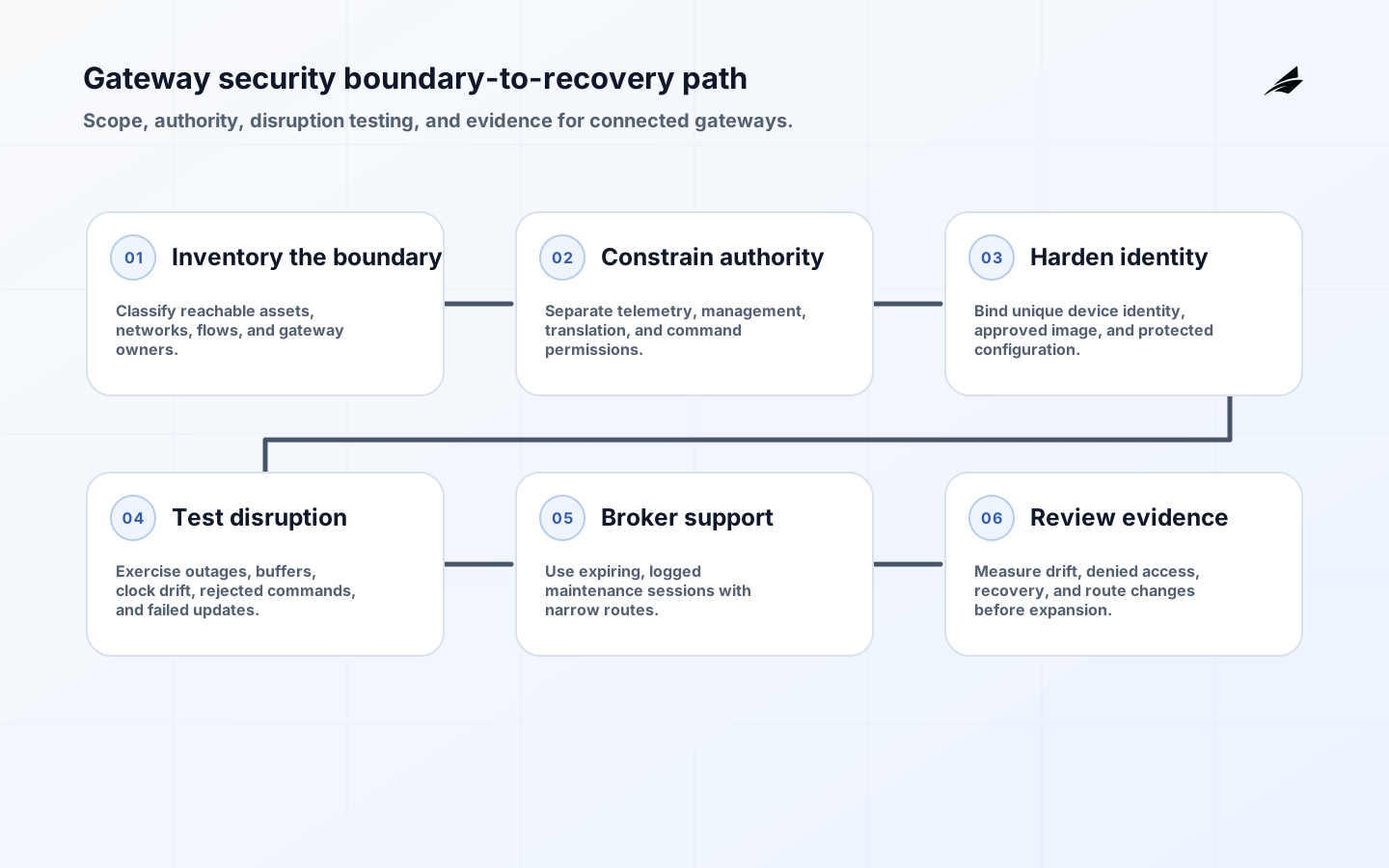
Gateway Security for Connected Systems: A Practical Guide is a practical guide for engineering teams. An edge gateway can translate protocols, buffer data, and sometimes reach equipment that enterprise systems cannot. That authority makes gateway security an operating concern. A unit collecting vibration readings has a different consequence from one allowed to write a controller setting, so inventory must make the difference visible. The aim is a capability people can operate, investigate, and improve, rather than a favorable demonstration in this gateway boundary.
Start with the gateway trust boundary
Classify each gateway by reachable assets, permitted actions, networks, data, and consequence of loss. Name local and platform owners separately. Permit only reviewed flows such as outbound telemetry and time-bound support, not direct inbound internet administration.
| Decision area | Question to settle | Evidence to retain |
|---|---|---|
| Outcome | Which decision does gateway security improve? | Scenario, owner, delay limit, and success measure. |
| Authority | Who may change or override the path? | Role rule, escalation route, and audit record. |
| Data | Which record is authoritative? | Identity, time rule, quality state, and lineage. |
| Recovery | What happens when a dependency fails? | degraded path, reconciliation rule, and support owner. |
Separate gateway traffic from administration
Build a hardened baseline with a minimal service set, unique identity, controlled configuration, and a way to compare observed settings with an approved version. Separate management, translation, and workload data where feasible. Bootstrap into managed identity instead of embedding long-lived credentials.
| Design choice | Practical rule | Operating signal |
|---|---|---|
| Identity | Use stable IDs instead of display names or shared credentials. | Duplicate, unmatched, or unauthorized records. |
| Time and state | Preserve time and explicit quality or status. | Late, stale, unknown, and conflicting items. |
| Change | Version policy, interfaces, and configuration. | Compatibility errors and drift. |
| Evidence | Keep source and reason near consequential decisions. | Traceability from a view to source data. |
Commission a gateway with proof
Make commissioning repeatable: bind the unit to a site, apply approved policy, verify software and certificates, and record acceptance evidence. Test cloud loss, local protocol loss, failed update, and support access. Sessions should be named, temporary, logged, and unable to create standing network routes.
- Write the gateway security contract in plain language, including delayed and disputed states.
- Assign operational and technical ownership before release.
- Use representative devices, sites, and network conditions in a controlled rollout.
- Capture configuration and approval evidence with stable identifiers.
- Test recovery from a missing dependency.
- Review the first operating cycle with the people who act on the result.
Control remote access and local exposure
Use protected management channels, least-privilege services, encrypted transport, and change logs. A VPN does not replace authorization or evidence. Minimize internet exposure, especially where a gateway sits near industrial assets.
Watch gateway health and drift
Track expected image and policy, certificate expiry, denied access, local-buffer pressure, drift, and restore time. The costly failure is a universal image with shared credentials and broad tunneling. Per-device identities and small conduits keep one gateway from becoming a fleet-wide entry point.
Record the gateway access decision
Before expanding gateway security for connected systems, write the decision record that a shift lead, engineer, and support owner can all read. In the case of a remote engineer needing a short maintenance session to a packaging-line gateway, state the trigger, the person or service allowed to assess it, the evidence needed before action, the latest useful time for that action, and the safe response when evidence is missing. The record should identify gateway identity, site, reachable assets, approved network conduits, software version, and session evidence. This is more than documentation: it prevents a dashboard label or integration default from quietly becoming policy in this gateway boundary. Ask each owner to explain what they would do with a late, contradictory, or unavailable input in this gateway boundary. Where their answers differ, resolve the rule before automating it. The resulting boundary gives product, operations, and security teams a shared basis for testing change instead of relying on a successful happy-path demonstration in this gateway boundary.
Rehearse a packaging-line maintenance case
Use a remote engineer needing a short maintenance session to a packaging-line gateway as a rehearsal, not as a story that remains in a planning document. Trace the identifier from the physical asset or source through the service that evaluates it, the interface where a person sees it, the action record, and the later evidence that confirms or disputes the outcome in this gateway boundary. Decide which facts may be cached, which must be current, and which user may make a temporary override in this gateway boundary. Make the screen state match the system state: queued is not accepted, stale is not current, and an acknowledgement is not proof that the underlying condition is resolved in this gateway boundary. This exercise exposes ambiguous names, missing handoffs, and incompatible time assumptions early in this gateway boundary. It also provides concrete acceptance tests that a delivery team can repeat at every release in this gateway boundary.
Release changes with a recovery trigger
A production release should declare its compatibility assumptions, rollout cohort, rollback condition, and evidence owner in this gateway boundary. For gateway security for connected systems, start with a representative set of sites, devices, or users rather than a convenient set of friendly testers. Verify that the record still preserves gateway identity, site, reachable assets, approved network conduits, software version, and session evidence after normal processing, degraded connectivity, a restart, and a version change. Rehearse the failure case in which a broad tunnel or shared credential grants access beyond the gateway's approved function. The recovery path needs a visible queue or case, a named decision-maker, and a rule for retrying, repairing, or rejecting the item in this gateway boundary. Do not use deletion to make monitoring look clean; preserve a safe diagnostic record and the reason for the outcome in this gateway boundary. This practice turns incidents into bounded operational work rather than a hunt through disconnected logs in this gateway boundary.
Review the gateway fleet by consequence
Review gateway security for connected systems with the people who carry its consequences, using configuration drift, certificate expiry, denied access, local-buffer pressure, and restore time. Compare the signals with real cases rather than looking only at averages. A low fleet-wide error rate can hide one site, firmware version, customer workflow, or technician route that repeatedly fails in this gateway boundary. Include changes, manual workarounds, unresolved exceptions, and near misses in the review in this gateway boundary. Decide whether each finding needs a contract change, better validation, a training update, a capacity adjustment, or no action, and record the decision in this gateway boundary. This cadence is how a connected capability remains understandable as assets, integrations, and responsibilities change in this gateway boundary. It also gives leadership evidence of whether the work is reducing uncertainty and rework, rather than merely producing more data in this gateway boundary.
Turn gateway security checks into operator work
Treat the gateway as a policy enforcement point with a narrow job description. A telemetry gateway may publish readings, buffer them, and receive signed configuration, while a maintenance gateway may expose a brokered session to one approved asset. Those are different profiles and should not share a role merely because the hardware is similar. Record reachable networks, protocol translators, local accounts, update channels, and permitted command classes. A useful inventory can answer which gateway can write to which controller, which identity authorizes the write, and how quickly that permission expires. If the answer depends on tribal knowledge, the boundary is not ready for production.
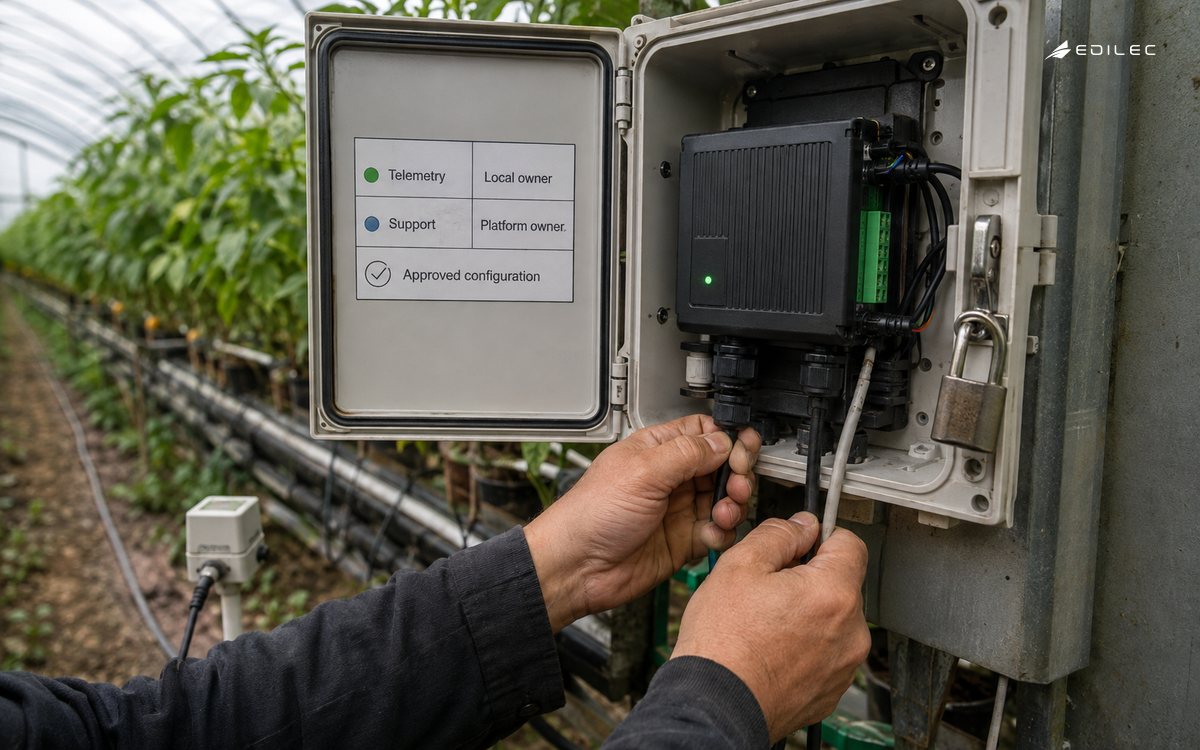
Commissioning should produce evidence, not just a green status light. Bind the physical unit, software image, site, and owner; verify the expected certificates and policy; then exercise the exact flows that the gateway will use. Test a normal telemetry message, a rejected command, a cloud outage, a full local buffer, a clock problem, and a failed update. Keep the result with gateway identity and configuration version. This gives support staff a way to distinguish an unavailable upstream service from an unauthorized local path, and it gives security staff a way to investigate without asking an installer to reconstruct the original setup.
Use a concrete maintenance scenario to expose hidden authority. Suppose a technician needs ten minutes of read-only access to diagnose a packaging-line sensor. The request should name the gateway, site, technician identity, target asset, purpose, approval, expiry, and evidence required before access is granted. The gateway should create a session record, limit the route, and close the permission automatically. If the plant connection is degraded, the safe response may be to collect diagnostics locally and queue the request rather than opening a broader tunnel. This small rehearsal is more valuable than a generic claim that remote support is secure.
Review gateway security as a service with measurable signals. Watch for configuration drift, certificate age, denied sessions, unexpected protocol use, buffer pressure, failed updates, time skew, and recovery duration. Segment the signals by site, firmware, gateway role, and support path; a fleet average can hide a single location with repeated exceptions. Each review should end with a decision: change the policy, fix the implementation, retire the route, train the operator, or accept the risk until a named date. The record should include who decided and what evidence would reopen the decision.
| Check | Evidence to capture | Decision if missing |
|---|---|---|
| Identity and ownership | Stable asset, service, site, and accountable owner. | Hold the action and route the exception. |
| Freshness and quality | Observation time, state, source, and known delay. | Qualify or reject the result according to risk. |
| Change and authority | Policy version, permitted role, approval, and expiry. | Do not widen access or automate the action. |
| Recovery | Tested degraded path, reconciliation, and named responder. | Keep the cohort narrow until recovery is proven. |
For adjacent implementation context, see event streaming guidance, the IT manager perspective, and IoT telemetry foundations. These references help separate the gateway security decision from neighboring concerns such as data movement, connected operations, and support in this gateway boundary. Use them to compare boundaries, not to copy a design: the right choice depends on the asset, consequence, timing, people, and evidence in the local workflow in this gateway boundary.
The official references should be read alongside the operating record. NIST OT Security keeps safety, reliability, and performance in view; NIST IoT requirements helps turn a device capability into a requirement; CISA exposure-reduction guidance supports removing unnecessary public reachability; and NIST zero trust architecture reinforces that location alone does not establish trust. Taken together, they support a practical rule: select the smallest capability that satisfies the named decision, make its authority explicit, test degraded behavior, and retain enough evidence to explain both normal and exceptional outcomes in this gateway boundary.
Gateway security: practical takeaways
- Start gateway security with a defined decision, not a generic platform objective.
- Preserve identity, time, ownership, and quality where meaning changes.
- Make exceptions and recovery visible to people who resolve them.
- Release in cohorts and test adverse conditions.
- Restrict authority to the smallest useful scope.
- Use operating signals to improve the contract, not merely a dashboard.
Gateway security questions operators ask
Which gateway facts matter first?
Define the operational decision, authoritative record, owner, acceptable delay, and safe degraded path before expanding gateway security.
How should a gateway change be introduced?
Gateway-security changes should proceed site by site because plant topology, remote-support arrangements, and firmware age vary. Compare the approved policy with the reported configuration after each deployment, then verify that maintenance access still uses the intended brokered path without opening an extra conduit.
How can a team prove gateway trust?
Gateway-security trust means an asset owner can see exactly which gateway has access to which local systems, how it is managed, and who changed its policy. Recovery is credible when the gateway can be restored to a known configuration without rebuilding privileges from memory.
Conclusion: keep gateway boundaries enforceable
Reliable gateway security for connected systems come from explicit boundaries and routine evidence. Build one path that retains context, assigns authority, and survives delay, change, and recovery in this gateway boundary. Revisit access exceptions after every incident and site change, because temporary routes and accounts have a habit of becoming permanent. Once the team can explain that path without guessing, expansion becomes an informed operational choice in this gateway boundary.
Primary references for gateway security
This guidance is informed by NIST SP 800-82 Rev. 3: Guide to Operational Technology Security, NIST SP 800-213: IoT Device Cybersecurity Requirements, CISA Internet Exposure Reduction Guidance, NIST SP 800-207: Zero Trust Architecture. Use current source material and the requirements that apply to the equipment, sector, and jurisdiction when finalizing an implementation in this gateway boundary.