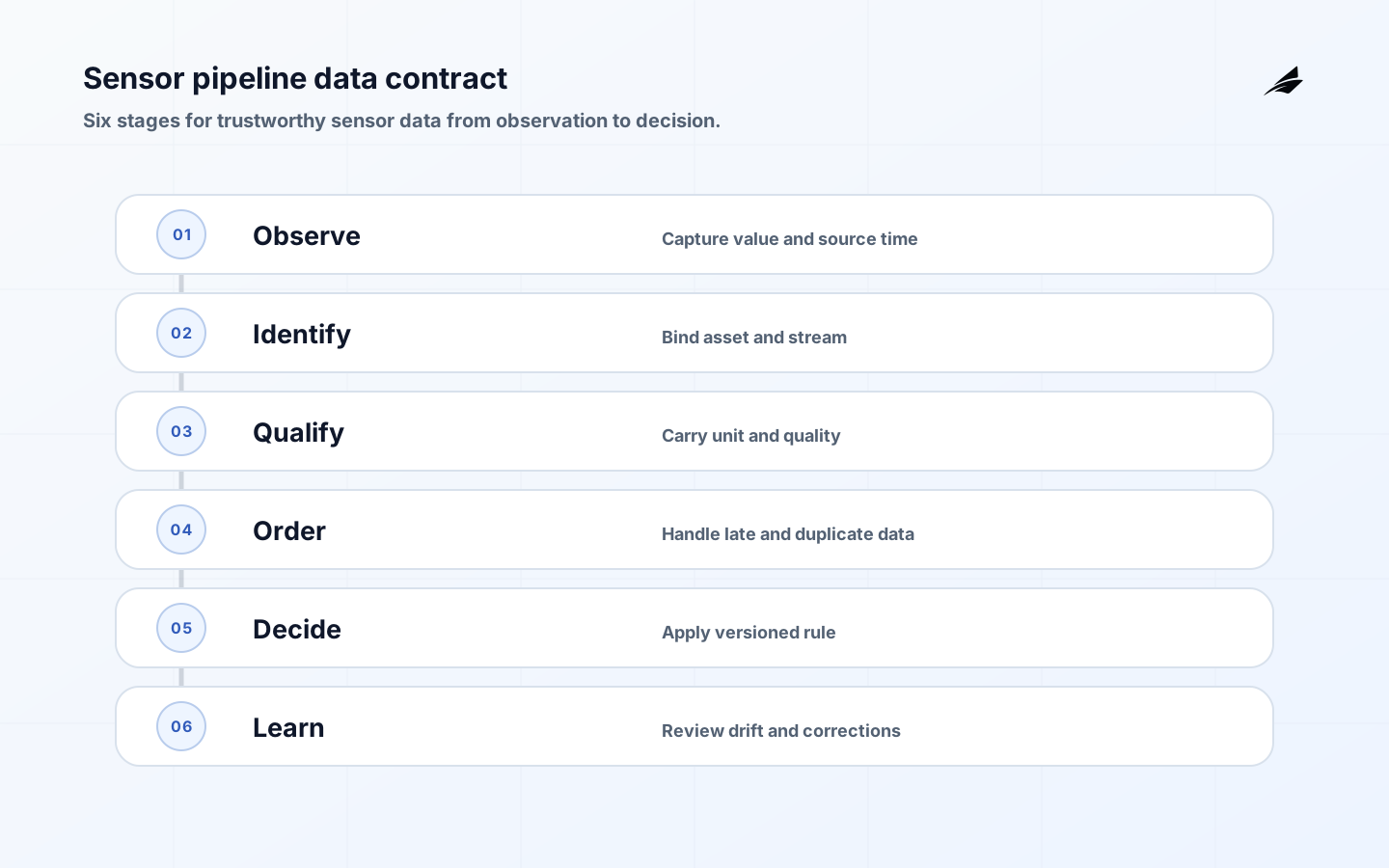
A sensor data pipeline is often described as ingestion, storage, and dashboarding. Production work starts where that diagram stops: records arrive late, devices are replaced, units change, a consumer is rebuilt, and a data correction must not silently rewrite the evidence used to make an earlier decision. Sensor data pipelines in production become useful when the team can preserve that context from the field boundary through the decision and the work that follows. For sensor data pipelines, this guide focuses on the operating design: ownership, data contracts, recovery, and evidence. For sensor data pipelines, it is deliberately more specific than a technology selection checklist because a production issue is usually an unclear responsibility or an untested exception.
Decide what the production pipeline must answer
Give every stage a contract for identity, schema, time, quality, ownership, retention, and error handling. Ingested records should retain their original form or a verifiable representation; normalized records should record the transformation version. This allows a later correction to be compared with, rather than confused with, prior output. NIST SP 800-92: Guide to Computer Security Log Management is a useful anchor for deciding which technical requirements belong in the product rather than in an improvised deployment. For sensor data pipelines, write a one-page operating statement before choosing components: name the physical or business outcome, the asset or client population, the decision supported, the acceptable delay, the accountable owner, and the condition in which the system must decline to act.
| Design question | Practical answer | Evidence before launch |
|---|---|---|
| What is the unit of work? | For sensor-pipeline reliability, a named observation, client, asset, visit, or lifecycle transition with a stable identifier. | A sample record can be traced from source to user action. |
| Who owns meaning? | One role approves field definitions, compatibility, and retirement of the contract. | An owner and change path appear in the runbook. |
| What happens when data is uncertain? | For sensor-pipeline reliability, represent quality, time, and failure explicitly; do not silently substitute a value. | For sensor-pipeline reliability, a test shows what an operator sees for stale or invalid input. |
| How is it recovered? | For sensor-pipeline reliability, use a scoped replay, replacement, or reversal procedure with an accountable approver. | A rehearsal record captures the expected and actual result. |
Set freshness, ownership, and retention boundaries
Separate raw, validated, curated, and serving datasets. Each has a different access pattern and lifecycle. A data scientist may need a broad historical raw set under controlled access, while an operator needs a small, timely, qualified view. Copying raw records into every destination makes correction and access control harder. The NIST SP 800-82 Rev. 3: Guide to Operational Technology Security guidance is helpful here because useful evidence is structured, time-aware, protected, and retained for a stated purpose. For sensor data pipelines, decide which identifiers and payload elements are sensitive, which parties need them, and what a support engineer may retrieve during an incident. For sensor data pipelines, a contract that names an owner but omits its access path is still incomplete.
For sensor data pipelines, choose compatibility rules that match the consequence of change. For sensor data pipelines, additive optional fields may be safe when consumers ignore what they do not understand; renamed fields, altered units, and changed authorization semantics need a migration. For sensor data pipelines, maintain examples for normal, degraded, and rejected messages or requests. For sensor data pipelines, they make reviews concrete and prevent a documentation page from drifting away from deployed behavior. For sensor pipelines, it keeps transformation changes distinguishable from source corrections.
Validate units, quality, and late-arrival behavior
Make replay a governed operation. Define the input range, transformation version, output namespace, approval, expected side effects, and comparison measure before pressing run. A replay that republishes an old alarm into the live workflow can create unnecessary work and degrade confidence in the system. Apply the operational-technology principle in OGC SensorThings API Part 1: Sensing: account for the physical process and safety consequence, not just the network topology. For sensor data pipelines, review access as a chain of identity, policy, service exposure, and monitored action. For sensor data pipelines, a secure transport channel matters, but it does not prove that the caller should perform the action or that the action was understood correctly.
| Failure or change | Control to design | Operator evidence |
|---|---|---|
| Identity is revoked or replaced | For sensor-pipeline reliability, disable the old credential, scope the new one, and preserve the ownership history. | Revocation time, replacement identity, and successful policy evaluation. |
| Connection or power is lost | Use bounded local behavior, queue limits, and a safe rejoin procedure. | Last known state, queue age, and reconciliation result. |
| Contract changes | Version the schema or configuration and test compatible consumers first. | Change approval, deployed version, and validation outcomes. |
| A decision is disputed | For sensor-pipeline reliability, keep source context and the action trail separate from mutable presentation data. | Record identifiers, timestamps, operator, and before-and-after state. |
Watch pipeline health through decision-ready signals
Monitor pipeline delay, failed validation, orphaned identities, transformation errors, duplicate rates, consumer freshness, retention failures, and lineage coverage. Investigate the pattern by device family and software version. Quality ownership belongs to the team that can change the cause, even when another team operates the platform. For sensor data pipelines, do not set a single universal threshold and call the system observed. For sensor data pipelines, segment the measures by site, asset or client class, software version, and criticality. For sensor data pipelines, a rising fleet-wide error rate calls for a different response than one intermittent unit at a high-consequence location. For sensor data pipelines, weekly review should end with a named corrective action, an owner, and a date to inspect the result.
Rehearse duplicates, gaps, and corrected readings
Choose one end-to-end query used in operations and trace it from device payload to displayed value. Exercise a late record, a duplicate, a calibration change, a consumer rebuild, and a correction. The resulting runbook should name which outputs change and which historical records remain unchanged. For sensor data pipelines, use the rehearsal to decide what the system will do when reality is inconvenient, rather than leaving that choice to the on-call engineer. For sensor data pipelines, capture screenshots or records from the user-facing surfaces as well as technical logs. For sensor data pipelines, a resilient design keeps the operational team informed without asking them to infer safety or data quality from a vague platform status message.
- For sensor-pipeline reliability, assign a business owner, a technical owner, and an on-call or support owner for the first production use case.
- For sensor-pipeline reliability, run fault scenarios against the actual identity, configuration, and data paths; do not simulate only the dashboard.
- For sensor-pipeline reliability, record the decision, action, recovery, and follow-up measure for each rehearsal.
- For sensor-pipeline reliability, use the related implementation guide to align this scope with the next connected capability.
Move from one trusted stream to a measured rollout
First establish the inventory and contract, then instrument the smallest useful path, then introduce the decision or workflow, and only then broaden the population for what changes when sensor data pipelines move into production. For sensor data pipelines, this order avoids collecting a large volume of poorly understood data. For sensor data pipelines, it also provides a clean rollback point: a newly added consumer or rule can be disabled without deleting the source evidence. The device capabilities described in NIST IR 8259r1: Foundational Cybersecurity Activities for IoT Product Manufacturers reinforce why support, configuration, and lifecycle information need to be planned as part of the product.
For sensor data pipelines, at each stage, approve an observable exit condition. For sensor data pipelines, examples include a reconciled identity inventory, a tested permission boundary, a qualified record visible to its user, a completed work item, and a reviewed recovery exercise. For sensor data pipelines, budget for documentation that a field worker or support colleague can use at the moment of failure. For sensor data pipelines in production, that material is part of the operating system, not aftercare.
Turn sensor data into a production data contract
A sensor pipeline is ready for production when its records retain enough context to support a decision, not merely when they arrive in a warehouse. Define the asset identity, observation time, receipt time, unit, quality state, calibration or firmware context, and handling for duplicates, late data, and corrections. The OGC SensorThings API is a useful interoperability reference for observations and datastreams, while NIST SP 800-92 keeps log planning and review in view. These references do not replace a domain contract; they help expose the fields a domain contract often forgets.
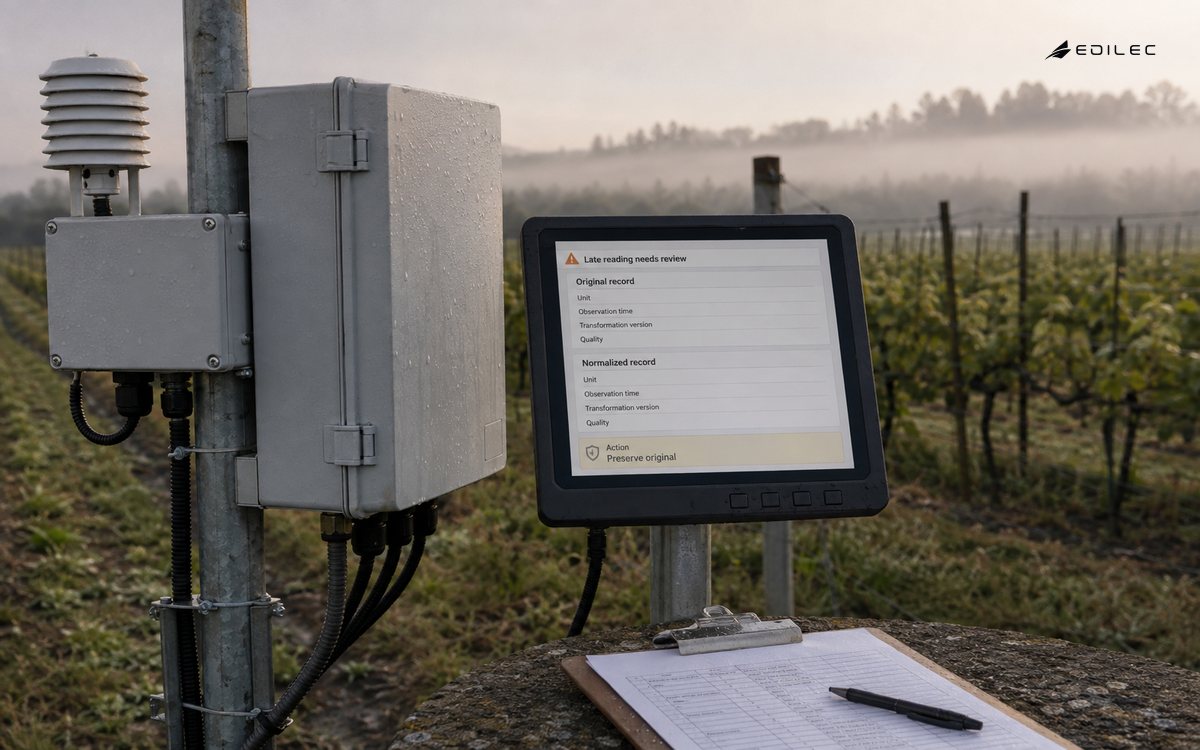
Example: late data in a maintenance decision
A vibration reading arrives six minutes late after a gateway reconnects. The pipeline should store it with its original observation time, mark its receipt delay, and let the maintenance rule decide whether late data can change an active recommendation. It should not overwrite a newer reading merely because the late packet arrived last. When a calibration correction arrives, keep the original record and publish a versioned interpretation. That preserves auditability and lets an engineer explain why a chart changed without rewriting history.
| Data condition | Pipeline treatment | Decision impact |
|---|---|---|
| Normal | Validate identity, unit, time, and quality | Eligible for the normal rule. |
| Late | Keep event time and receipt delay | Use only if the rule accepts late evidence. |
| Duplicate | Deduplicate by durable event identity | Avoid double counting or repeated action. |
| Corrected | Version the interpretation and reason | Recompute transparently where required. |
For the surrounding system, see What Changes When Device Provisioning Moves Into Production on device provisioning, What Changes When Device Identity Moves into Production on device identity, and MQTT Broker Operations for Connected Systems: A Practical Guide on MQTT brokers. They clarify where a data-quality problem begins and which layer owns the response.
Sensor-pipeline takeaways
- The production sensor pipeline is an operating capability, not merely a deployed component.
- For sensor-pipeline reliability, give identities, contracts, quality states, and actions explicit owners and durable evidence.
- For sensor-pipeline reliability, design the degraded path before scale makes a small ambiguity an expensive incident.
- For sensor-pipeline reliability, connect the work to a complementary production decision and the earlier planning guidance so the operating model remains coherent.
Sensor pipeline questions
What is the first practical step for sensor data pipelines in production?
For sensor data pipelines, pick one decision with a clear user and consequence, then trace the exact record, identity, rule, action, and evidence it needs. For sensor data pipelines in production, a narrow path reveals missing ownership and quality information faster than a broad platform rollout.
Must a sensor pipeline replace the current platform?
For sensor data pipelines in production, replacement is rarely the first move. For sensor data pipelines, put the contract and operating controls around one path, integrate through stable boundaries, and use the evidence from that path to decide whether a platform constraint is material. For sensor data pipelines, replacement is a business decision, not a default response to an incomplete operating model.
Conclusion: make sensor data dependable in production
Sensor data pipelines in production earns trust when people can explain what happened, who was allowed to act, what the data meant at the time, and how the system recovered. For sensor data pipelines, build that accountable path for one consequential workflow, rehearse the uncomfortable cases, and expand from evidence rather than enthusiasm.