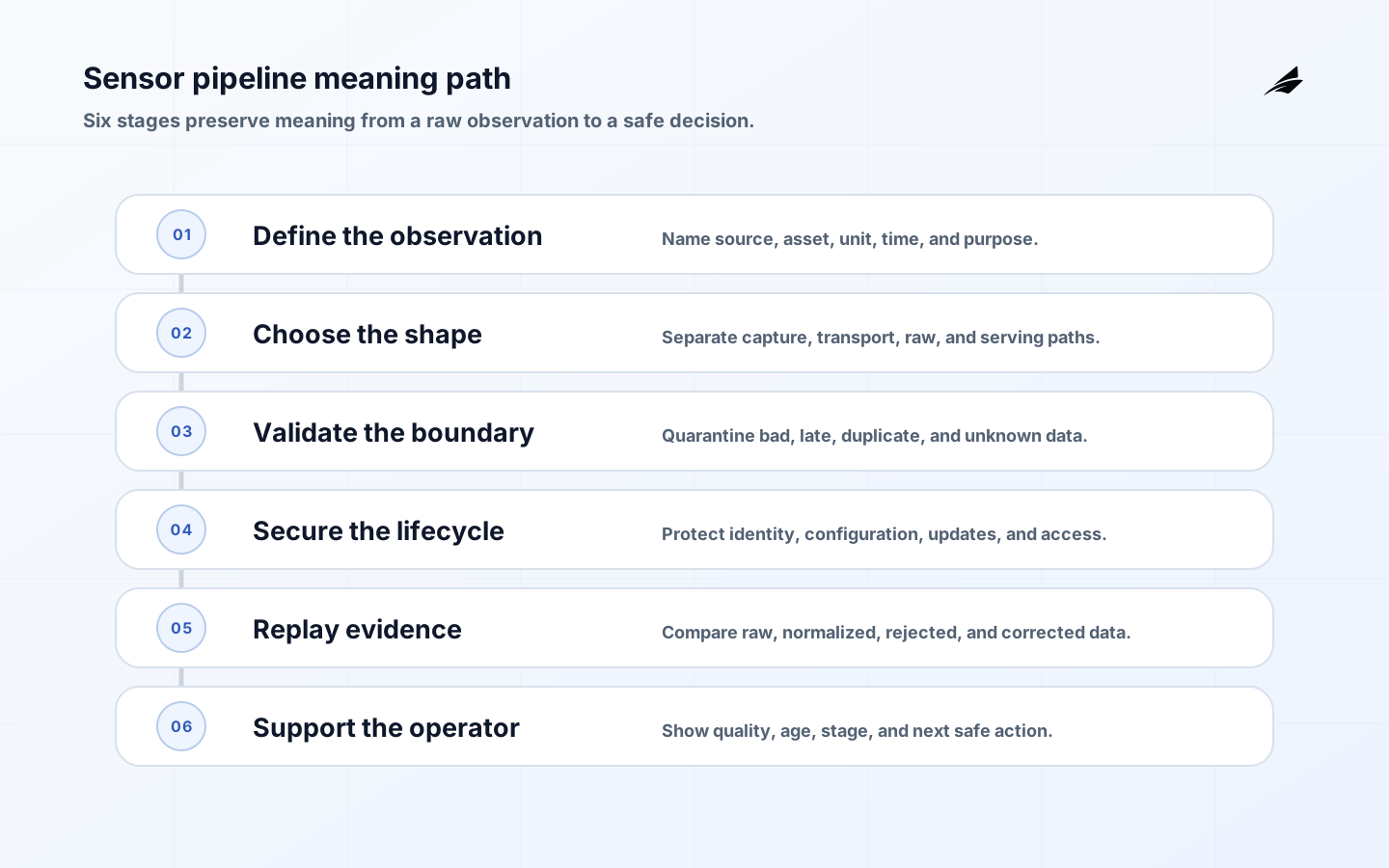
A sensor data pipeline is not a hose that moves numbers from devices to a dashboard. It is a chain of meaning-preserving decisions. A temperature value without sensor identity, asset association, unit, observation time, calibration context, and quality state is difficult to use safely. The same value can be valid for one machine and impossible for another; it can be current at the source but late at the consumer; it can be raw, estimated, or derived. IT managers should define the operational decision first and design the pipeline to preserve the evidence it needs. MQTT, Kafka, object storage, or a managed service can move data, but no transport chooses business meaning for the team.
Define the canonical observation
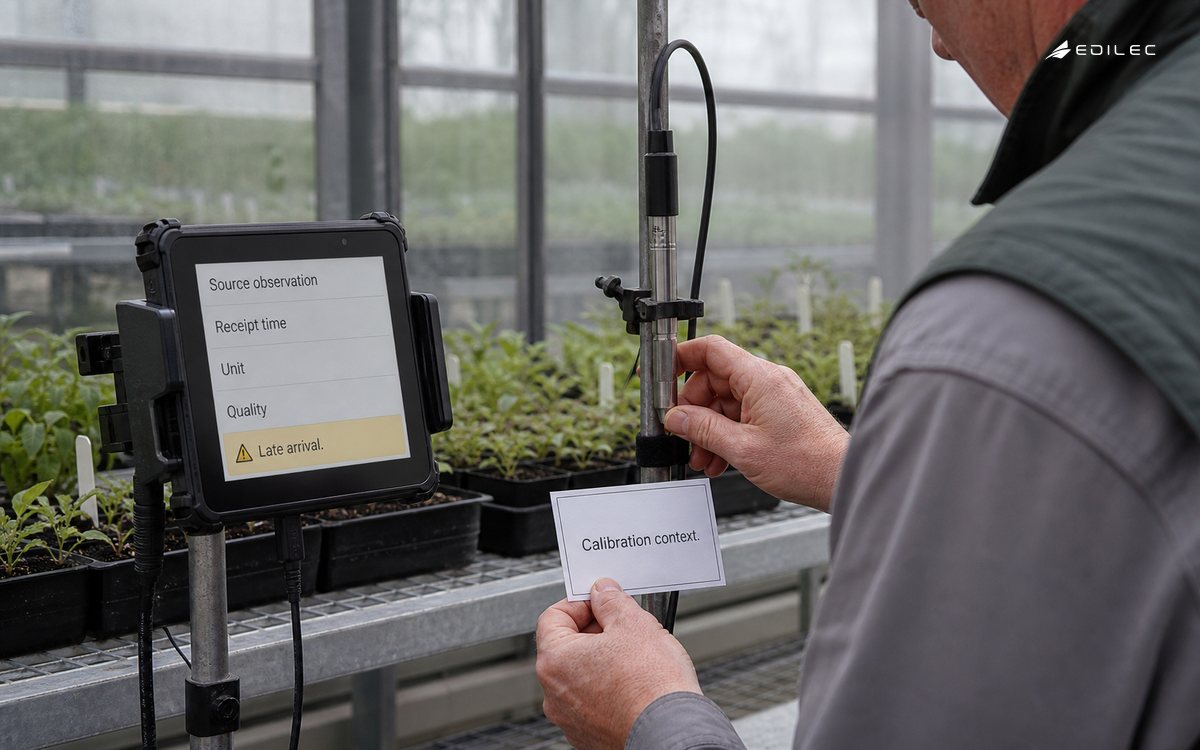
Write a contract for each signal that matters. Include durable device and asset identifiers, measurement name, unit, source event time, receipt time, sequence or observation identity, quality state, schema version, and firmware or configuration context when it affects interpretation. State expected range, sampling, maximum lateness, and response when absent or invalid. Keep source and processing time separate. A late event should remain visibly late instead of being shown as current. Name the authoritative record and the person who may correct it. This is the difference between a pipeline that stores data and one that supports a defensible decision.
| Field | Why it matters | Example rule |
|---|---|---|
| Asset identity | Connects reading to physical thing | Use durable ID, not mutable display name |
| Observation time | Preserves when condition was measured | Keep source and receipt time separately |
| Unit and scale | Prevents plausible wrong calculations | Reject unknown units and version conversions |
| Quality state | Shows whether action is safe | Use valid, suspect, stale, rejected, estimated |
| Observation identity | Supports dedupe and replay | Use device sequence or event ID |
Choose a pipeline shape that matches the work
Separate capture, transport, validation, durable raw storage, normalization, serving, and action. A low-latency alert may consume a validated stream while analysis uses a curated historical model. Do not force one store to serve control, support, and reporting when their freshness and retention differ. MQTT can fit constrained device connections; Kafka can fit replayable service events. Choose by message size, ordering, retention, offline behaviour, throughput, and operator skill. A managed service reduces infrastructure work but does not remove the need to make identity, schema, quality, and recovery visible. The event streaming guide is a useful companion because it treats delivery semantics as part of the data contract.
Validate at the boundary and preserve uncertainty
Validate authentication, schema, required fields, units, asset association, sequence, range, rate of change, and freshness. Choose reject, quarantine, flag, or accept-with-quality for each failure. Avoid silently replacing an invalid value with the last known value. A fallback can be useful for a specific decision, but it must be named and distinguishable from a measurement. Deduplicate with stable observation identity; timestamps alone are weak when clocks drift. Make validation outcomes queryable so support can say whether a missing value disappeared at the device, transport, or pipeline boundary.
| Failure | Safe handling | Evidence to keep |
|---|---|---|
| Malformed schema | Quarantine by version | Payload reference, schema, reason |
| Out-of-range value | Flag or reject by decision risk | Raw value, rule, asset context |
| Duplicate message | Keep one effect and record duplicate | Observation ID and first-seen time |
| Late delivery | Keep event time and apply policy | Event, receipt, watermark, outcome |
| Unknown asset | Stop downstream action | Identity, lookup result, owner |
Secure the device and pipeline lifecycle
NIST’s IoT device guidance places security capability across the product lifecycle. Give devices or gateways individual identities, protect credentials, control configuration, support updates and vulnerability response, and revoke assets that leave service. Protect messages in transit and enforce authorization at broker, gateway, and application boundaries. A pipeline may contain location, production, usage, or customer activity, so apply minimization, retention, and access rules to raw and derived data. Record changes to schemas, validation rules, calibration, and routing so an investigator can explain why two consumers saw different results.
Operate quality, replay, and correction
Define quality measures by source and asset class: completeness, lateness, duplicate rate, invalid rate, clock skew, sequence gaps, unknown-asset rate, and values with usable calibration context. Pair each measure with consequence. Build controlled replay before incidents force improvisation. Replay a normal event, a late event, a duplicate, an out-of-order sequence, and a schema change. Compare raw input, validation outcome, normalized output, served value, and action record. OpenTelemetry’s structured log model helps preserve time, severity, and correlation context, but domain fields remain the pipeline owner’s responsibility. Keep a correction record that links the replacement to the original rather than editing history invisibly.
Design the pipeline for operators
Support needs a view that identifies asset, last accepted observation, source and receipt time, quality, pipeline stage, configuration, and next safe action. Avoid a green heartbeat that hides a broken measurement path. Distinguish no data, stale data, invalid data, and data not yet evaluated. When a technician replaces a device, preserve old identity and end time while linking the new identity to the asset through an explicit interval. That prevents a replacement from looking like a measurement jump or duplicate source. Link the network observability guide when support also needs to trace the route that carried the observation.
A practical rollout plan
- Choose one decision and document its minimum trustworthy observation.
- Trace five real readings from device to action with source and receipt time.
- Publish schema, quality states, rejection reasons, and authority record.
- Test delay, duplication, loss, clock drift, replacement, and transformation changes.
- Give support a stage-by-stage view and replay or correction runbook.
- Expand signals only when each has an owner, retention purpose, and response.
Review a pipeline decision with real records
Choose one signal that can change real work and reconstruct its path from source to action. Inspect a normal record, a delayed record, a duplicate, an out-of-range value, and a device replacement. For each, write what the source claimed, what the pipeline accepted, what the consumer displayed, and what an operator was allowed to do. Include raw and normalized identifiers, transformation version, quality state, and the person who accepted or withheld the action. A data engineer may call a value valid because it satisfies schema while a maintenance lead calls it unusable because it is too old. The event streaming guide helps when the path crosses consumers with different lateness and replay needs.
Keep the result as a repeatable acceptance fixture. The next release should replay the same observations and show why the result changed, if it changed. If correction is needed, retain original evidence and link the new interpretation to it. If the source cannot provide a required field, make the gap visible instead of inventing a plausible default. Review the fixture with support and the people who carry the operational consequence. Their questions expose missing replacement rules, unowned quarantine queues, or a retention policy that prevents diagnosis. The goal is a pipeline that tells users when evidence is incomplete and gives them a safe, accountable response.
Also decide how the pipeline behaves when the meaning of a signal changes. A firmware update may alter sampling, a calibration may change a range, or a new asset hierarchy may change the name users see. Version the contract and keep the effective interval for each change. When backfilling history, identify which records were recomputed and which remain original observations. A support owner should be able to tell a customer that a value was late, corrected, or recalculated without pretending the original reading never existed. This is especially important when network observability shows that delivery was healthy but the source itself was misconfigured. The pipeline’s promise is not perfect data; it is honest evidence with a safe next action.
Agree how each consumer may use uncertainty. A maintenance view may show the last accepted reading with its age, while an automated rule may refuse to act after a freshness threshold. A report may revise a historical interval when late data arrives, while a real-time alert records the original decision and exposes a later correction. Put these policies beside the signal contract and test them with the same fixtures. When a device is replaced, make the identity boundary visible; when firmware changes a unit or sampling rate, publish the version and effective time. The pipeline is part of the product’s operating promise, so its support path deserves the same care as ingestion.
Make ownership visible at every handoff. The device owner should know how configuration and replacement affect the record; the platform owner should know how quarantine and replay work; the data owner should know which transformation is authoritative; and the operator should know how to withhold action when quality is suspect. A daily review can inspect the oldest late signal and the largest rejected category. A monthly review can remove unused fields, revise retention, and test a replacement fixture. These routines prevent the pipeline from becoming a one-way dependency that only its original builders can diagnose, and they make it easier to explain a corrected metric without rewriting history.
A useful acceptance record names the smallest trustworthy observation and the person allowed to act on it. Keep that record beside the schema and replay fixture. It protects the team from a common failure mode in which a pipeline is technically complete but no one can say whether the data is fit for the decision it feeds.
When the pipeline crosses a trust boundary, document the allowed route and the quality state that may cross it. The network segmentation production guide is useful for connecting data validation to the enforcement and recovery path.
Use the MQTT Version 5.0 specification for device delivery semantics, Apache Kafka documentation for durable event-log choices, the OpenTelemetry Logs Data Model for structured evidence, and NIST SP 800-213 for device cybersecurity requirements.
Key takeaways
- Preserve source meaning before optimizing transport or storage.
- Keep raw, validated, normalized, and derived data distinguishable.
- Treat quality and freshness as part of value.
- Make replay, correction, replacement, and revocation supportable operations.
- Measure fitness by decisions completed safely, not message volume.
Frequently asked questions
Should we keep every raw payload forever?
Usually not. Keep raw evidence for a period justified by troubleshooting, safety, contractual, or analytical needs. Apply access controls and document retention while keeping durable references and transformation evidence for longer-lived decisions.
How should a pipeline handle late data?
Keep original event and receipt times, mark the value late, and define whether downstream windows may revise. Historical reporting may accept correction while a real-time control may not.
What is the most important quality field?
There is no universal field. Asset identity, time, unit, and quality state are minimum context for many decisions. Choose the set by asking what a reviewer must know before acting on one value.
Conclusion
A dependable sensor data pipeline preserves meaning through change, delay, failure, and correction. Define the canonical observation, make quality visible, secure the lifecycle, and test replay with operators. That lets connected systems grow without turning measurements into unexplainable decisions.