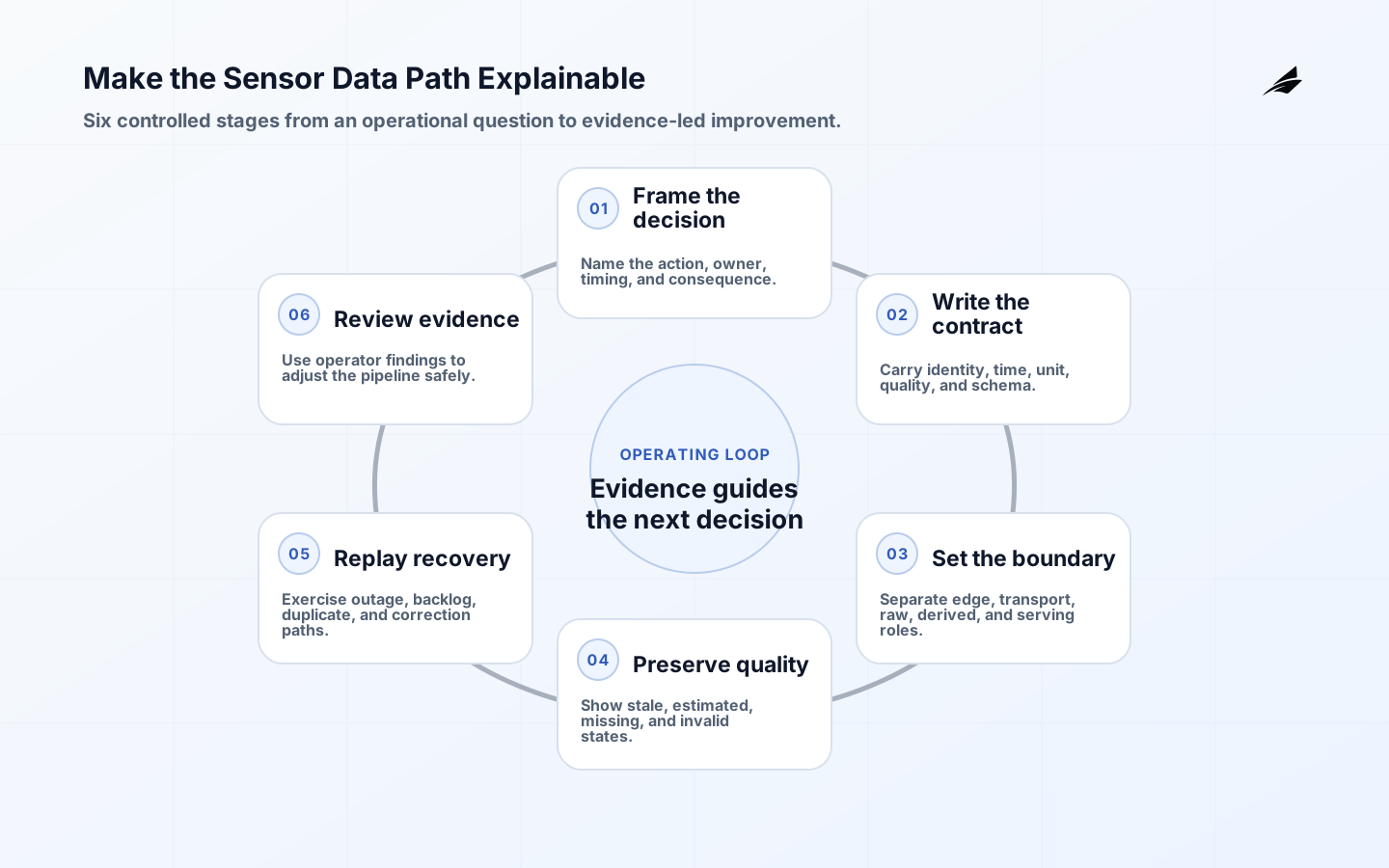
Sensor data pipelines are the controlled path between a physical observation and a decision someone is willing to make. A device reading is not automatically a fact: it has an identity, an observed time, a unit, a quality condition, and a route through which it may arrive late or twice. The practical goal is to preserve that meaning while moving data from constrained devices to storage, analytics, alerts, and operational tools. A well-designed sensor data pipeline architecture makes uncertainty visible instead of smoothing it away.
Start with the decision, not the stream
Begin with one decision that the pipeline must improve. A maintenance team may need to decide whether a pump deserves inspection; a cold-chain operator may need to decide whether a shipment is still within its handling envelope. State the action, acceptable delay, evidence required, and consequence of a wrong answer. Then work backward to the measurements. This prevents a team from collecting every available field and discovering later that no one knows which value is authoritative. IoT telemetry guidance for connected systems helps clarify the boundary between signal and operational meaning. To compare event and broker boundaries, read Event streaming context and MQTT broker context.
| Pipeline question | Decision to record | Useful evidence |
|---|---|---|
| What is observed? | Name the physical quantity and unit | Sensor type, calibration state, unit, range |
| When did it happen? | Separate observation time from receipt time | Device clock, gateway time, ingest timestamp |
| Can it be trusted? | Propagate quality rather than hiding it | Validity flag, missing reason, calibration result |
| Who may use it? | Set data and command authority | Owner, access policy, retention class |
Write a data contract that survives change
A data contract should be readable by the device engineer, analyst, and operator. Define a stable asset identifier, measurement name, numeric representation, unit, precision, event identifier, observed time, received time, schema version, and quality state. Do not use a display name as the primary identity because names change during a site reorganisation. A contract should also say what a missing sample means, whether a correction supersedes an earlier observation, and how long raw evidence remains available. The MQTT specification is relevant here because its message properties and delivery choices help transport context, but they do not decide the business meaning of a measurement.
- Keep event time and ingestion time as separate fields so late connectivity does not look like a current physical change.
- Give every source a versioned schema and a compatibility rule before adding a new consumer.
- Carry calibration, validity, and estimated-value states into downstream views instead of replacing them with null or a confident-looking number.
- Record the producer and pipeline version that transformed a raw observation.
- Define idempotency using an event identity or a deterministic observation key before a record can trigger work.
Choose the pipeline boundary deliberately
Split the path into stages with explicit responsibility: acquisition, edge buffering, transport, validation, durable raw storage, transformation, and serving. The edge should handle the conditions it can observe locally, such as intermittent connectivity and bounded buffering. The cloud or central service can handle broader correlation and replay. Avoid hiding a critical transformation in a dashboard query; a query that changes the apparent state should be versioned like application code. The boundary is also a security boundary: a device identity should not automatically grant access to every historical record or command topic.
Make quality visible at every handoff
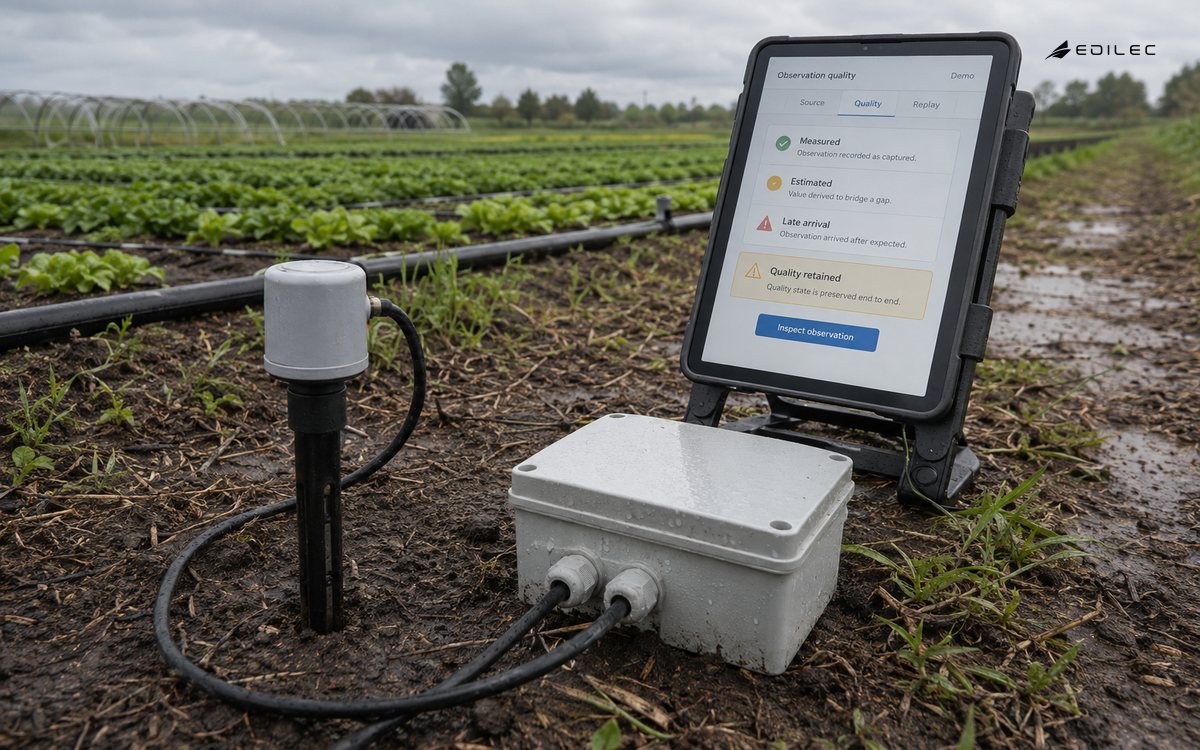
Quality is more than a validation pass or fail. A sensor can be in range but stale; a timestamp can be well formed but wrong because the device clock drifted; a value can be estimated during an outage and still be useful if the consumer knows it is estimated. Define quality states that operators can interpret and preserve them through aggregation. For example, a five-minute average should say whether it contains 100 percent measured samples, a mix of measured and estimated samples, or an insufficient sample count. This is where RFC 3339 timestamp guidance supports a practical contract, while the business team decides the freshness threshold.
| Failure condition | Pipeline response | Consumer behaviour |
|---|---|---|
| Late observation | Keep event and receive times | Place it in history and exclude from current-state logic when required |
| Duplicate delivery | Deduplicate by stable event key | Avoid creating a second ticket or command |
| Out-of-range value | Quarantine and retain original | Show an explicit quality warning |
| Missing interval | Record gap and cause when known | Do not draw a continuous line without a caveat |
| Schema change | Reject or route to compatibility handling | Protect existing consumers until migration is tested |
Build replayable recovery
Replay is a design capability, not a promise that every byte remains forever. Keep an immutable or append-oriented raw layer for a period that matches the business risk, then derive curated views from it with versioned transformations. When a parser defect is found, the team should be able to identify affected records, run a corrected transformation, compare outputs, and publish the new view without pretending the old result never existed. Test a disconnected gateway, a full buffer, a failed consumer, and an unavailable storage target. Document which stage may retry, which stage may drop, and who decides when a backlog is safe to release.
Operate with observability that answers questions
Track more than throughput. Operators need to know whether devices are connected, whether data is fresh, how much is being quarantined, how long transformation takes, and whether a downstream view is behind the raw stream. OpenTelemetry's observability primer explains why correlated traces, metrics, and logs are more useful than isolated counters. Add a correlation or event identifier that follows an observation through ingestion and transformation. Define alert thresholds in terms of the decision: a five-minute freshness breach may be urgent for a safety interlock and routine for a daily energy report.
Apply security and access controls
Protect the pipeline as a distributed system with physical consequences. Use unique device identity, least-privilege publish and read permissions, encrypted transport, bounded payloads, and lifecycle handling for replacement or retirement. NISTIR 8259A gives a useful baseline for device cybersecurity capabilities, while NIST IoT cybersecurity requirements help teams think through exposed services and insecure update paths. Separate telemetry from commands in both authorization and monitoring. A service that can read a pump temperature should not automatically be able to issue a pump command.
Pilot one real operating case
Choose a case with a measurable decision and a manageable number of devices. Capture a baseline for freshness, missing data, duplicate rate, storage cost, and operator effort. Then introduce realistic disruption: disconnect one gateway, skew a device clock, replay a batch, rotate a credential, and send an invalid payload. Acceptance should require both a correct normal result and a legible degraded result. If the operator cannot tell whether a value is measured, delayed, or estimated, the pipeline is not ready for expansion even if its average throughput looks good.
Make operational data choices explicit
Storage choice should follow the questions the team must answer. A raw object store or append-oriented log is useful for evidence and replay; a time-series view may make current readings easier to query; a relational record may be better for ownership and workflow state. These layers can coexist if the team states which one is authoritative for each purpose. Do not let a convenient dashboard cache become the only copy of an observation. Record retention, deletion, privacy, and access decisions with the contract so a later storage migration does not silently change what the data means.
Aggregation also needs a stated policy. A five-minute average, maximum, or last-known value can answer different questions, especially when samples are missing or estimated. Carry sample count, coverage interval, and quality summary into the aggregate. If a pump has one valid reading in an interval that normally contains sixty, the result should not look equivalent to a complete interval. Give consumers a freshness and sufficiency rule rather than asking each team to invent one in a query. That small discipline prevents conflicting operational views of the same asset.
Schema evolution should be treated as a controlled product change. Adding an optional field may be safe, while changing a unit, identifier, or interpretation is not. Keep a compatibility test that replays representative records through old and new consumers. Announce the effective time, provide a migration window, and preserve the producer version in the data. If a sensor changes from Celsius to Fahrenheit or a calibration method changes the meaning of a quality flag, the pipeline should make that change visible instead of presenting a numerically plausible but incomparable history.
A practical review asks three people to trace one observation: the engineer follows it from device to storage, the analyst checks the derived value, and the operator explains the decision it supports. Any disagreement identifies a contract gap. Repeat the exercise after an outage and after a correction. This review is more valuable than a generic architecture diagram because it tests the actual evidence path, including late data, quarantine, access controls, and the point at which an automated action is allowed.
| Review question | Healthy answer | Warning sign |
|---|---|---|
| Can we reproduce a view? | Raw record and transformation version are retained | Only a dashboard export exists |
| Can we explain a gap? | Missing reason or source state is visible | Nulls are silently interpolated |
| Can we change units safely? | Contract and compatibility tests cover migration | A label changes with no version |
| Can we limit access? | Purpose and owner define the read scope | Every consumer receives the raw stream |
Keep the decision record alive after the pilot. Record the chosen boundary, rejected alternatives, contract owner, recovery evidence, and the condition that would trigger a redesign. A pipeline grows safely when each new consumer can see the original meaning and quality rules instead of inferring them from a convenient query. That record also gives leaders a fair way to ask whether a new request belongs in the existing path or deserves a separate contract.
Sensor pipeline takeaways
- Tie sensor data pipelines to a decision, owner, time expectation, and consequence.
- Treat identity, event time, quality, and schema as part of the measurement contract.
- Separate raw evidence from derived views so a transformation can be inspected and replayed.
- Test offline, duplicate, stale, malformed, and unauthorized conditions before scaling the fleet.
- Measure freshness, quality, backlog, and recovery in the language operators use.
Sensor pipeline questions
Is a sensor data pipeline just a database ingestion job?
No. Ingestion is one stage. A pipeline also defines meaning, quality, ordering, security, transformation, replay, and the evidence a consumer may rely on. A database can store bytes while the pipeline establishes whether those bytes are current, duplicated, estimated, or safe to use.
How much raw data should a team retain?
Retain enough to investigate the decisions and failures that matter, subject to privacy, cost, and contractual limits. Set the period from recovery and audit needs, not from an arbitrary storage default, and record the retention decision in the data contract.
Conclusion: trustworthy sensor data
Reliable sensor data pipelines make the path from observation to decision inspectable. Start with the operational question, define the measurement contract, preserve quality and time semantics, isolate authority, and rehearse recovery while the scope is small. That discipline gives teams a pipeline they can extend without turning every new consumer into a new source of ambiguity.