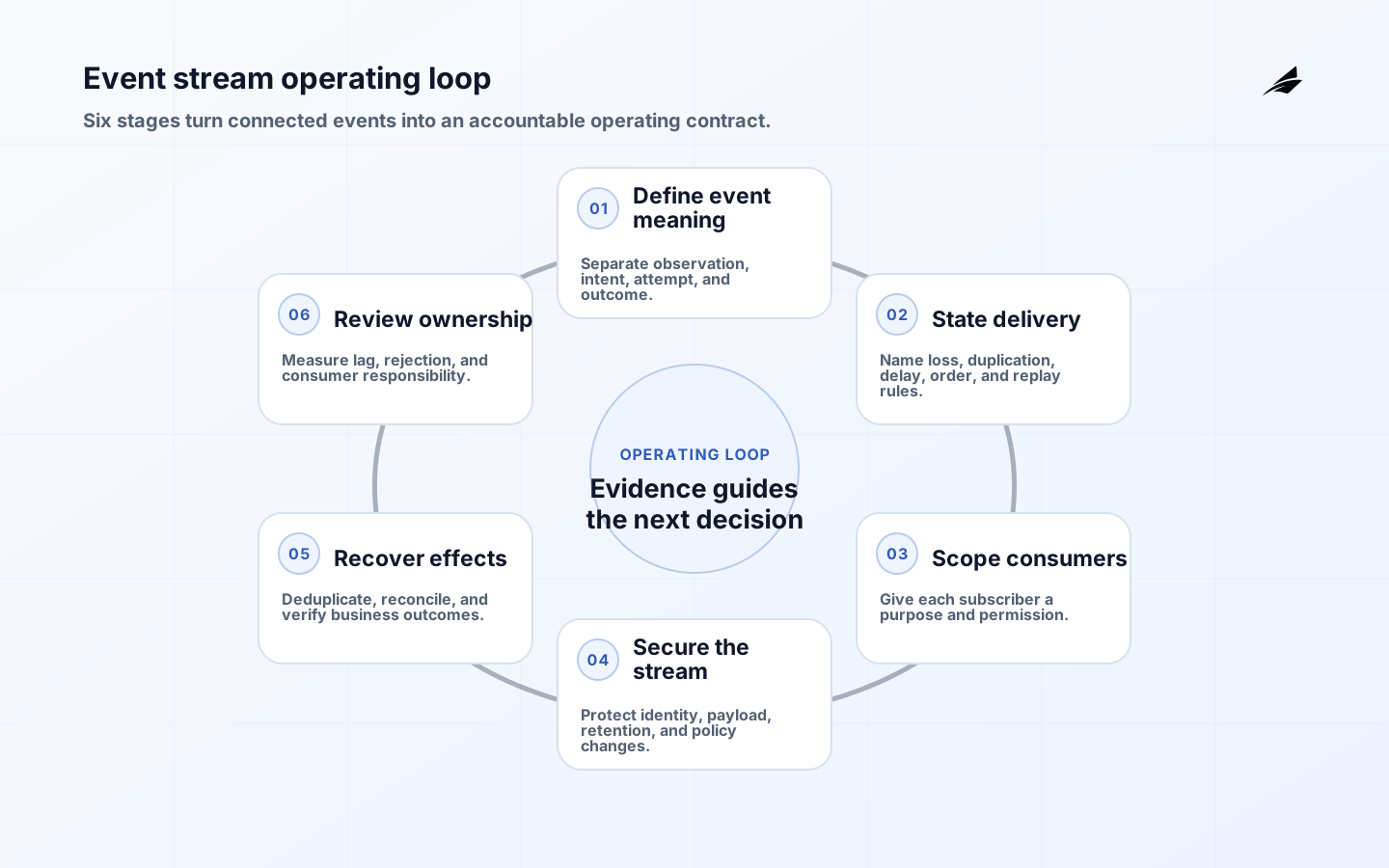
Event streaming for connected systems is the disciplined movement of observations, facts, and state changes where multiple consumers may need them at different times. The hard part is not pushing more messages. It is defining what an event means, when it becomes authoritative, how delivery can fail, and which consumers may cause an effect. A device reading, gateway status change, maintenance request, and command acknowledgement are not interchangeable. Give each a stable identity, source time, producer, schema, business subject, and outcome model. MQTT can fit device messaging and a durable event log can support replay, but the transport must not silently become the business rule.
Start with event meaning and authority
Write a catalogue for every event family. State trigger, producer, subject, authoritative record, consumers, retention, ordering requirement, and consequence of duplication or loss. Distinguish observation from request, attempt, result, and notification. inspection.requested means work was asked for; it does not mean the inspection happened. inspection.completed should carry evidence and a responsible actor. This prevents a consumer from treating a transient message as proof that a physical action completed. It also makes support concrete: the team can ask whether an event was never produced, produced but not delivered, consumed but rejected, or applied without a recorded outcome.
| Event type | Required context | Authority question |
|---|---|---|
| Observation | Source, asset, value, unit, source time, quality | Which reading is current? |
| Intent | Actor, target, reason, expiry, correlation ID | Who authorized the effect? |
| Attempt | Operation ID, policy, start and end state | Did the system try? |
| Outcome | Result, evidence, actor, time | What proves the effect? |
| Correction | Original ID, new value, reason, approver | Which record supersedes which? |
Make delivery semantics explicit
State whether a message may be lost, duplicated, delayed, or reordered; what ordering scope matters; how long a producer or consumer may be disconnected; and what happens on restart. MQTT offers defined quality-of-service and session behaviour, but a protocol acknowledgement is not proof that a downstream business action completed. A durable log can support replay, yet replaying a command event can be dangerous if the effect is not idempotent. Define an operation identity and deduplication record for state-changing consumers. For readings, accept duplicates and late observations and define a policy for windows and current-state views. Use sensor data pipelines for connected systems to keep event identity, source time, receipt time, schema, and quality together.
Design topics and consumers around ownership
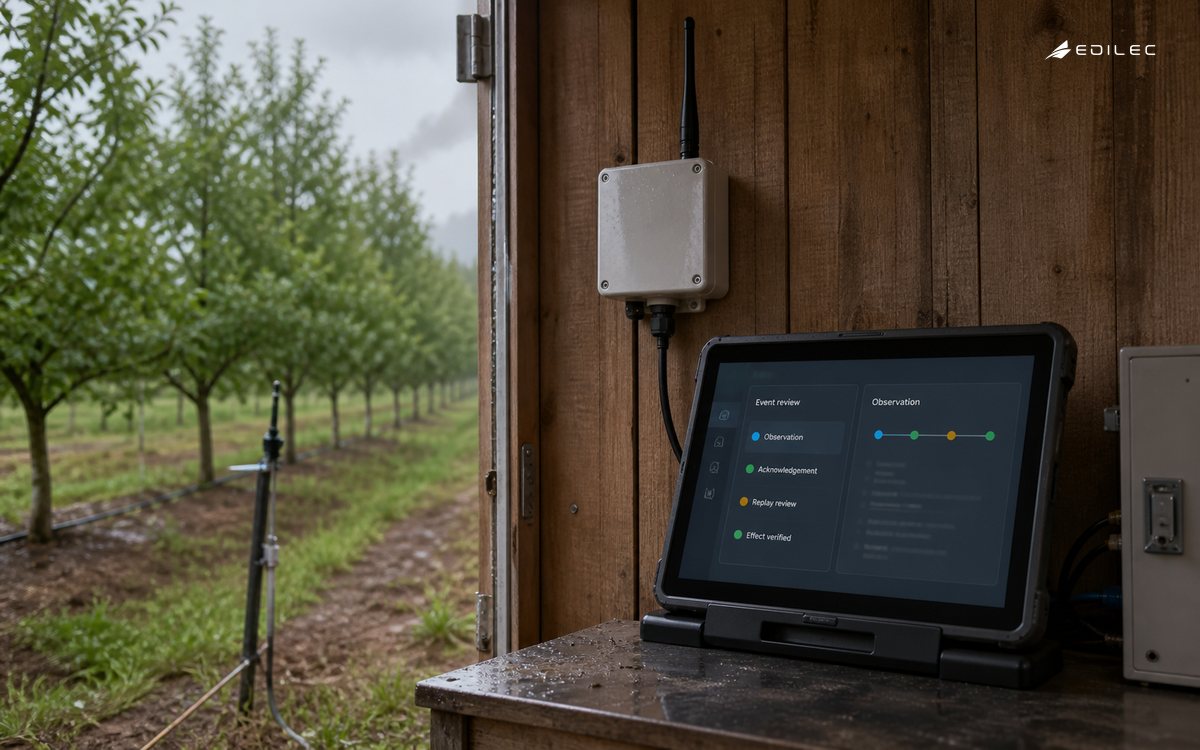
Topic names help operators locate a bounded stream, but names are not authorization or a complete contract. Define who may publish, subscribe, replay, transform, and delete. Separate high-risk commands from informational events and keep physical-control flows behind stronger policy and confirmation. Give consumers a purpose such as alerting, history, maintenance, billing, customer view, or audit. A consumer that changes a record should publish its outcome, not only log a local success. Keep quarantine and dead-letter paths visible and owned; otherwise a stream can appear healthy while important events accumulate outside the normal path.
| Consumer concern | Design choice | Review signal |
|---|---|---|
| Restart | Checkpoint with idempotent effect | Replayed records and duplicate effects |
| Backlog | Lag and retention policy | Oldest event age and impact |
| Bad event | Quarantine with reason and replay control | Rejected count by schema |
| Sensitive data | Scope, encryption, redaction, retention | Access review and exports |
| High-risk action | Separate channel and confirmation | Unconfirmed operations |
Secure the stream as a product boundary
Apply individual identities and least-privilege permissions to producers, consumers, operators, and replay tools. Protect messages in transit and at rest, and give consumers only the fields they need. NIST’s IoT manufacturer guidance encourages lifecycle thinking: devices and credentials need enrolment, configuration, update, monitoring, and retirement. A forgotten subscription or retained credential can expand the blast radius beyond the original service. Record policy changes, access grants, replay requests, and administrative actions. Keep clock and correlation conventions stable enough to reconstruct a cross-service event; a log that cannot be placed in time is a weak incident control.
Operate lag, loss, and recovery
Measure consumer lag in business terms, not only messages. An hour of telemetry backlog may be harmless for a daily report and dangerous for a service or safety decision. Track oldest event age, unprocessed high-risk events, rejection rate, retry count, duplicate effect count, producer silence, schema drift, and recovery time. Exercise broker loss, consumer restart, network partition, credential revocation, poison messages, clock skew, and partial replay. Verify what an operator sees while unavailable and how the team knows recovery has converged. NIST SP 800-82 matters here: reliability and safety can constrain retries and failover. A technically available stream can be unsafe if it repeats an uncertain command.
Choose when streaming is worth the cost
Streaming adds durable infrastructure, schema governance, access control, replay complexity, and on-call responsibilities. Use it when independent consumers, temporal ordering, replay, burst handling, or near-real-time reaction creates real value. A direct request-response integration may be better for one synchronous workflow with one authority. Start with one event family and two consumers. Demonstrate that producers can evolve without breaking consumers, a consumer can replay without duplicate effects, and an operator can find the authoritative outcome. The network observability guide is useful when the stream must explain the network path as well as the event state.
A practical event-stream rollout
- Catalogue the first event family and separate observation, intent, attempt, outcome, and correction.
- Define identity, schema, authority, retention, ordering, duplication, and loss rules.
- Build one producer, one informational consumer, and one state-changing consumer with different permissions.
- Test restart, delay, duplicate, reorder, poison event, replay, and credential revocation.
- Expose lag, oldest event age, rejected messages, and business uncertainty to support.
- Review every new consumer as an owner of an outcome, not only a subscriber.
Review the stream as an operating contract
Take one event from production and follow it through producer, broker, consumer, effect, and outcome. Repeat with a delayed event, duplicate, consumer restart, and policy change. The review should answer which record is authoritative, whether the event can be replayed, what happens if the effect already occurred, and where a human can intervene. Do not accept a lag chart as the whole answer. A queue can be short while a business result is unconfirmed; it can be long while a low-risk historical view remains healthy. Make consequence part of the stream vocabulary. The sensor data pipelines guide is useful when an event began as a measurement and its quality must survive transformations.
Use the review to decide which semantics are worth paying for. A high-risk command may need a separate channel, current-state check, human confirmation, and durable outcome record. A telemetry consumer may need bounded replay and a late-data policy but no synchronous acknowledgement. Record differences in the contract rather than hiding them in code. When a new team asks to subscribe, require it to name the question, fields, retention, permission, and owner. That keeps a stream from becoming an ungoverned data exhaust pipe and makes schema changes easier to evaluate.
Review producer and consumer evolution as a normal change, not an incident. Add a new schema field without assuming every consumer can read it; deprecate a field only after its consumers and replay fixtures are known. Check that a consumer’s checkpoint is meaningful after a partition move or deployment, and that a replay tool cannot use production credentials to create an unintended effect. Keep business outcomes separate from transport acknowledgements. When an event drives a work order or command, require the downstream system to publish a result that can be reconciled against the original operation. This gives support a path to resolve “did it happen?” without manually searching every service log.
For each event family, document the moment a consumer may tell a person that work is complete. That moment may be a database commit, controller acknowledgement, verified downstream record, or human review. Do not let a broker acknowledgement stand in for proof. Preserve correlation between request, attempt, outcome, and correction, and make the outcome searchable by support. When the same event arrives twice, the user should see one business result and an audit trail that explains the duplicate. When delivery is late, a consumer should revise a view under a stated rule or expose the correction without hiding the earlier decision. These are product choices as much as infrastructure choices.
Give stream operations a clear boundary with the rest of the product. The producer owns meaning and schema; the platform owns delivery and retention; each consumer owns its effect and checkpoint; the business owner owns consequence. Keep a replay fixture for the most important event family and run it after broker upgrades, schema changes, and consumer deployments. The network observability guide helps when lag or loss must connect to a service outcome rather than an infrastructure number. A stream is ready to scale when its failure modes are part of normal support work.
Keep a consumer contract small enough to review. It should name the event family, fields, permission, retention, checkpoint, idempotency key, failure route, and business owner. When those fields change, the owner can decide whether to migrate, replay, or stop consuming. That is safer than letting a topic become a hidden dependency.
When a stream crosses a network boundary, keep the event contract and policy contract aligned. The production segmentation guide helps teams test whether a delayed, denied, or replayed event has a safe operational outcome.
The MQTT Version 5.0 specification grounds device delivery semantics; NIST SP 800-92 supports event logging and retention; NIST SP 800-82 Rev. 3 frames OT reliability and safety; and NIST IR 8259r1 covers IoT product lifecycle activities.
Key takeaways
- An event needs meaning, authority, and evidence, not only a topic name.
- Protocol delivery guarantees do not equal completed business actions.
- Separate informational streams from high-risk commands and make effects idempotent.
- Measure backlog and recovery by the decision affected.
- Treat schemas, identities, replay, retention, and consumer ownership as one contract.
Frequently asked questions
Is MQTT enough for event streaming?
MQTT can provide an effective device messaging layer, but whether it is enough depends on retention, replay, consumer independence, ordering, and operations. Many systems use a device protocol at the edge and a separate durable stream or store downstream.
Do connected systems need exactly-once delivery?
Often the safer design is at-least-once delivery with stable operation identities, deduplication, and reconciliation. Exactly-once claims can hide the harder question of whether the external effect and its evidence agree after failure.
Should commands be replayed automatically?
Not by default. Replaying an informational event may rebuild a view; replaying a command may repeat a physical or financial effect. Require current authorization, a state check, and review where consequence is material.
Conclusion
Event streaming becomes dependable when it is treated as a shared operating contract. Define meaning, make delivery and authority explicit, separate high-risk effects, and rehearse recovery. The result is a connected system in which producers, consumers, and operators can explain what happened and what is safe next.