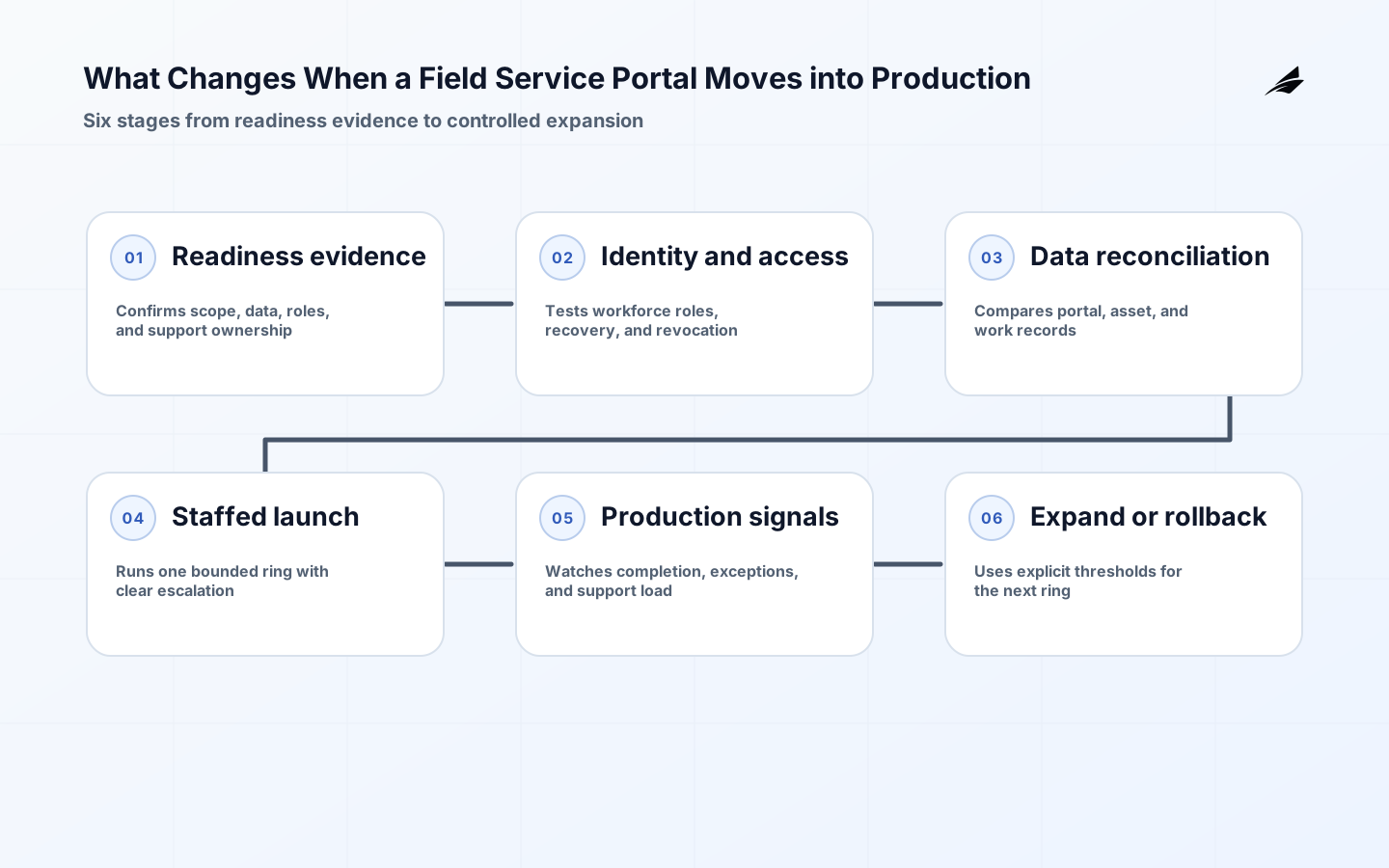
Field service portals become production systems when a technician depends on them at a customer site with limited time and imperfect connectivity. The screen is only the visible part. Behind it sit work orders, asset histories, parts, customer data, photos, approvals, and sometimes remote diagnostic access. A portal that cannot explain what a technician was permitted to see or change will eventually create disputes that support teams cannot resolve. The first deliverable should be a shared operating boundary for field service portals: a technician workflow that can complete work while protecting customer, asset, and service records.
Prepare the staffed production gate
Production changes a field service portal from an application into a service with consequences. A missed assignment can delay maintenance; a stale asset state can send a technician to the wrong location; an access mistake can expose site information. The launch plan therefore needs more than load testing. It needs a support roster, escalation path, data reconciliation, change freeze rules, user communications, and a clear answer to who can pause dispatch or revert a workflow when evidence becomes unreliable.
Use a controlled rollout with one region, asset class, or work type. Compare portal records with the system of record, observe completion and exception rates, and staff support during the first operating window. Keep the old route available until the new route has met its acceptance conditions across ordinary and difficult cases. Capture a launch decision in plain language: what is live, what is excluded, which signal can stop expansion, and who can authorize the next ring.
| Production concern | Launch evidence | Stop or rollback signal |
|---|---|---|
| Identity and roles | Joiner, mover, leaver tests pass | Unexpected privileged access |
| Work assignment | No unexplained duplicate or lost jobs | Queue divergence grows |
| Asset context | Location and status reconcile | Stale or conflicting state |
| Support | Named responder resolves rehearsed cases | No accountable escalation |
Production references to verify
Ground production controls in NIST SP 800-53 Rev. 5, use NIST IR 8259A to examine device and lifecycle assumptions, apply the NIST Cybersecurity Framework 2.0 to response and recovery, and use NIST SP 800-82 Rev. 3 to keep availability and safety in view. The production gate should record local acceptance evidence.
For related context, compare connected operations in production, network segmentation, and sensor calibration, with the production stop gate visible in mind. Use those perspectives to test the boundary described here while keeping the operating decision and owner in view while keeping the production stop gate visible.
Key takeaways for production field service
- Start field service portals with one accountable decision, not a broad platform promise.
- Preserve identity, time, source, quality, and ownership wherever facts cross a boundary during a production field-service gate.
- Test degraded conditions and recovery before expanding the rollout during a production field-service gate.
- Measure whether people can make and later explain the intended decision during a production field-service gate.
Define the decision boundary for field service portals
Start from the field decision: for example, may this technician close this work order, record a safety check, or request a replacement part? Define the authoritative system for the appointment, asset, entitlement, and completion record. The portal should display enough context to perform the task without replicating every back-office field. For each action, identify the actor, asset, customer scope, required evidence, and supervisor route when an exception is needed.
| Question | Decision to document | Evidence in operation |
|---|---|---|
| Purpose | Which action or review does this capability support during a production field-service gate? | Named owner and an observable outcome during a production field-service gate. |
| Authority | Which system or person may change the relevant state during a production field-service gate? | Actor, source, time, and production-policy record. |
| Failure | What is safe when required evidence is missing during a production field-service gate? | Visible pending, rejected, or manual-review state during a production field-service gate. |
| Recovery | How is an exception resolved and closed during a production field-service gate? | Case history and reconciliation result during a production field-service gate. |
Build an architecture that preserves meaning
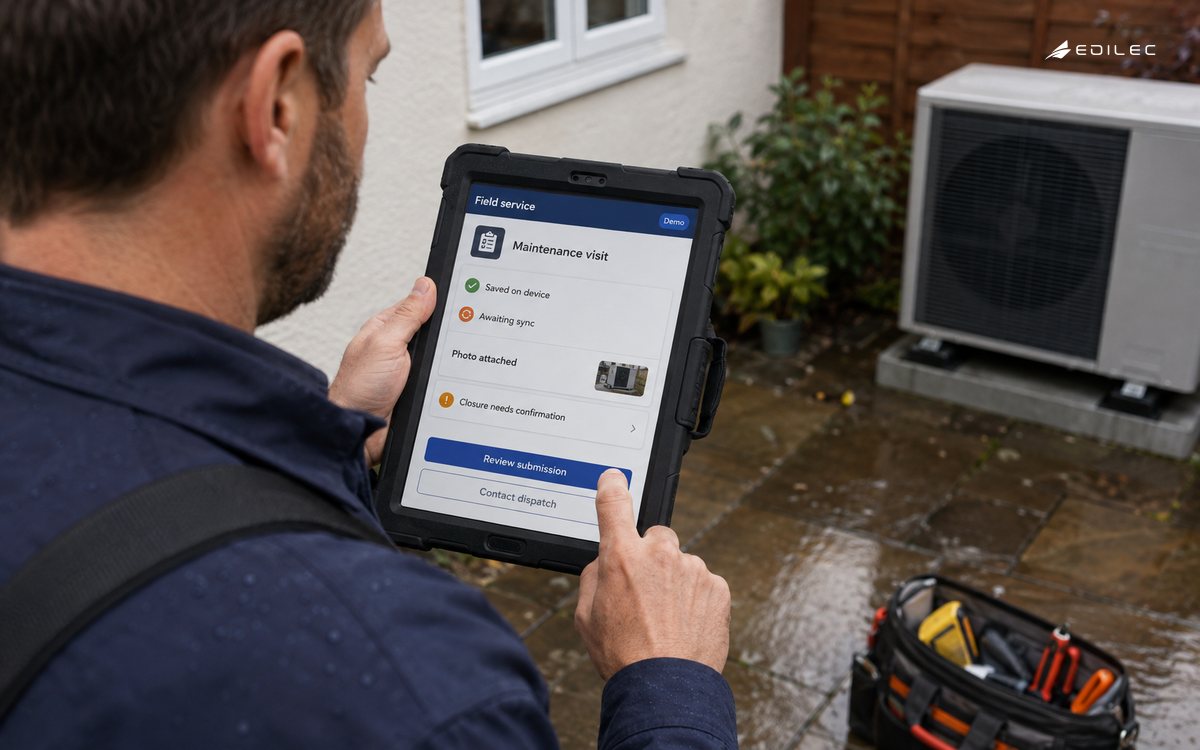
Design for explicit synchronization states. A job downloaded to a mobile device is a working copy, not a promise that it is current forever. Queue updates locally with identifiers, timestamps, and conflict rules; show the technician whether a submission is pending, accepted, rejected, or needs review. Keep sensitive documents and diagnostic actions behind scoped services rather than distributing broad credentials to the client. A small, stable API contract is easier to secure and evolve than a direct connection to several systems of record.
Apply controls that fit the operating risk
Use role and assignment-based authorization for every service call, not just for navigation. Require stronger verification for high-consequence actions such as changing bank details, bypassing a safety check, or opening remote access. Protect photos and attachments as customer data, define retention, and log material changes with the prior and resulting state. NIST control guidance is useful for mapping access, audit, and configuration expectations into an application that has both mobile and administrative users.
| Control area | Practical implementation | Review signal |
|---|---|---|
| Identity | Use unique, scoped identities for people, devices, and services during a production field-service gate. | Unexpected access, expired credentials, or orphaned accounts during a production field-service gate. |
| Change | Version schemas, configuration, and release approvals during a production field-service gate. | Rollback, incompatibility, or unreviewed drift during a production field-service gate. |
| Resilience | Define degraded behavior, buffering, and manual recovery during a production field-service gate. | Delayed work, queue age, or unresolved exceptions during a production field-service gate. |
| Evidence | Record material actions and data-quality status during a production field-service gate. | Ability to reconstruct a consequential decision during a production field-service gate. |
Release field service portals in bounded stages
Pilot with a team that handles ordinary jobs plus at least one difficult workflow: no signal, reassignment mid-visit, incorrect asset serial number, incomplete evidence, and a customer who disputes completion. Compare completed records with the source system and ask technicians which state labels helped or misled them. Deliver a short recovery playbook for support before expanding to another region or contractor group.
Measure the operating path, not just availability
Track first-visit completion with a quality check, offline submission age, conflict frequency, rejected actions by reason, time to resolve a technician exception, attachment upload failure, and customer disputes after closure. Product adoption alone is a weak signal. The portal is succeeding when it reduces rework while preserving evidence and control over customer-facing commitments.
Set acceptance criteria for field service portals
An implementation for field service portals should have acceptance criteria that an operator, engineer, and accountable owner can all inspect. Start with the stated outcome and write normal, degraded, and recovery examples before configuring production services at production rollout. A practical acceptance test takes a realistic job through download, offline evidence capture, reassignment, conflict resolution, and final customer-facing completion. Include a role that lacks the required entitlement, because a portal can look efficient in a demo while its authorization path forces unsafe workarounds in the field.
Keep the first release deliberately narrow during a production field-service gate. It is easier to compare a bounded path with its prior process, correct an unclear ownership rule, and teach a support team a real response at production rollout. Expansion should be based on evidence from the representative workflow, including exceptions, rather than on a count of integrated assets or enabled accounts at production rollout. For field service portals, this means choosing the smallest path that still exposes the relevant ownership, failure, and recovery conditions.
Assign ownership across the lifecycle
Service leadership owns the task flow, product teams own the application behavior, and support owns the exception route. Contractors and employees may share screens, yet their access lifecycle and assignment evidence should be separately reviewable.
Use a change record for forms, completion rules, customer content, and integrations. It should name affected regions, required field training, data migration or compatibility risk, and how the team will monitor disputes after release.
Design for the moments when field work diverges from the plan
A technician may arrive at an unlisted asset, discover an unsafe condition, or receive a work order that no longer matches the customer situation. Give the portal a bounded exception path with reason codes, required photos or notes, and a route to a dispatcher or supervisor. Do not let staff work around the system through personal messages, because the resulting evidence cannot reliably update the customer or asset record.
Treat portal content as controlled operational data
Parts catalogs, safety checklists, troubleshooting guides, and customer-facing statements change over time. Assign owners, effective dates, and a withdrawal route to this content. Review completion evidence and disputes with service leaders so the workflow evolves from real field conditions rather than from assumptions made at a desk.
Keep decision evidence usable
For field service portals, decision evidence should link the technician, assignment, asset, customer scope, submitted materials, approval path, and final source-system result. Time and location context can be useful when justified, but avoid collecting more personal data than the job requires. The aim is a defensible completion record: enough to resolve a dispute or reopen a task, without turning every field interaction into an uncontrolled archive.
Production field-service questions
What should the team decide first?
Should a portal work fully offline? It should support the minimum safe field workflow when connectivity is absent, but not every administrative action belongs offline. Decide which records can be cached, what expires, and which actions must wait for a fresh authorization or supervisor review.
What makes the implementation durable?
Can contractors use the same portal as employees? Often yes, but their tenant, assignment scope, device posture, and account lifecycle should be explicit. Contractor access should end predictably when the engagement or assignment ends, not when someone remembers to remove it.
Conclusion: make production recovery visible
A reliable field-service portal comes from a defined decision, explicit authority, controlled change, and evidence that survives a difficult day. Start with a technician workflow that can complete work while protecting customer, asset, and service records, prove the path under normal and adverse conditions, and use the findings to make the next release more dependable. That produces a capability that operations, security, and engineering can improve together instead of a system that only works while its original builders are nearby at production rollout.
Next review: observe a technician completing a job that includes an exception. The important question is whether the portal helps them preserve the right evidence without slowing a safe repair. Feed that observation into the workflow backlog alongside usage and completion metrics.
Authoritative sources
The guidance draws on NIST SP 800-53 Rev. 5, NIST IR 8259A: IoT Device Cybersecurity Capability Core Baseline, NIST Cybersecurity Framework 2.0, and NIST SP 800-82 Rev. 3: Guide to Operational Technology Security. Apply the requirements of the relevant equipment, sector, contracts, and jurisdiction before changing a live environment while keeping the production stop gate visible.