An edge gateway changes character in production: it is no longer only a protocol bridge, but a local decision point that may buffer evidence, enforce authority, and keep a site operating during a cloud or network failure. An edge gateway is often introduced to bridge a protocol or keep data moving when a cloud service is unavailable. In production it also owns local storage, configuration, identity, update state, and sometimes a decision near physical equipment. That combination makes the gateway a managed product, not a disposable adapter. Edge gateways in production become useful when the team can preserve that context from the field boundary through the decision and the work that follows. For edge gateway, this guide focuses on the operating design: ownership, data contracts, recovery, and evidence. For edge gateway, it is deliberately more specific than a technology selection checklist because a production issue is usually an unclear responsibility or an untested exception.
Name the gateway's local authority
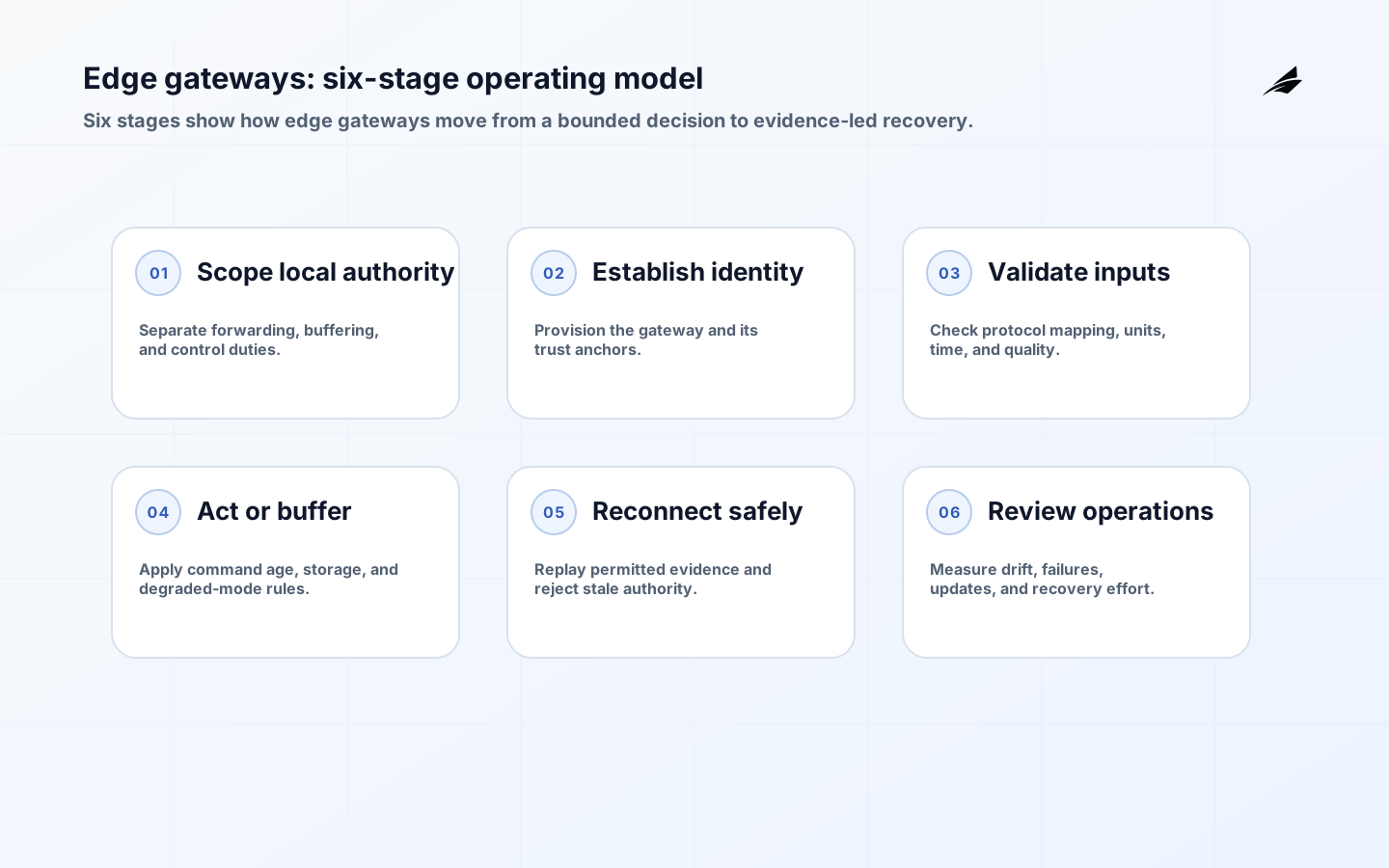
State the gateway’s local mission in observable terms. It might translate a device protocol, buffer telemetry for 72 hours, enforce an allowlist, or execute a bounded local rule. Do not let it acquire unrelated business logic simply because it is physically close; every added responsibility changes patching, testing, and recovery needs. NIST IR 8259r1: Foundational Cybersecurity Activities for IoT Product Manufacturers is a useful anchor for deciding which technical requirements belong in the product rather than in an improvised deployment. Write a one-page operating statement before choosing components: name the physical or business outcome, the asset or client population, the decision supported, the acceptable delay, the accountable owner, and the condition in which the edge gateway system must decline to act.
| Design question | Practical answer | Evidence before launch |
|---|---|---|
| What is the unit of work? | A named observation, client, asset, visit, or lifecycle transition with a stable identifier. | A sample record can be traced from source to user action. |
| Who owns meaning? | One role approves field definitions, compatibility, and retirement of the contract. | An owner and change path appear in the runbook. |
| What happens when data is uncertain? | Represent quality, time, and failure explicitly; do not silently substitute a value. | A test shows what an operator sees for stale or invalid input. |
| How is it recovered? | Use a scoped replay, replacement, or reversal procedure with an accountable approver. | A rehearsal record captures the expected and actual result. |
Bound buffering, commands, and updates
Version configuration independently from application code and record which version a unit has applied. A fleet needs a desired state, an observed state, a reason for difference, and a safe reconciliation path. Local secrets, certificates, and hardware identity should be replaceable without rebuilding the complete device image. The NIST IR 8259A: IoT Device Cybersecurity Capability Core Baseline guidance is helpful here because useful evidence is structured, time-aware, protected, and retained for a stated purpose. For edge gateway, decide which identifiers and payload elements are sensitive, which parties need them, and what a support engineer may retrieve during an incident. For edge gateway, a contract that names an owner but omits its access path is still incomplete.
Choose edge gateway compatibility rules that match the consequence of change. For edge gateway, additive optional fields may be safe when consumers ignore what they do not understand; renamed fields, altered units, and changed authorization semantics need a migration. For edge gateway, maintain examples for normal, degraded, and rejected messages or requests. For edge gateway, they make reviews concrete and prevent a documentation page from drifting away from deployed behavior. For edge gateways, it makes an altered local policy a deployable and reversible change.
Make local decisions inspectable
Design for constrained failure: full disk, bad cellular signal, incorrect time, failed power cycle, partial update, and unavailable management service. Decide what telemetry is dropped first, which local actions remain permitted, and how a field worker can establish safe recovery without bypassing normal identity and audit controls. Apply the operational-technology principle in NIST SP 800-82 Rev. 3: Guide to Operational Technology Security: account for the physical process and safety consequence, not just the network topology. For edge gateway, review access as a chain of identity, policy, service exposure, and monitored action. For edge gateway, a secure transport channel matters, but it does not prove that the caller should perform the action or that the action was understood correctly.
| Failure or change | Control to design | Operator evidence |
|---|---|---|
| Identity is revoked or replaced | Disable the old credential, scope the new one, and preserve the ownership history. | Revocation time, replacement identity, and successful policy evaluation. |
| Connection or power is lost | Use bounded local behavior, queue limits, and a safe rejoin procedure. | Last known state, queue age, and reconciliation result. |
| Contract changes | Version the schema or configuration and test compatible consumers first. | Change approval, deployed version, and validation outcomes. |
| A decision is disputed | Keep source context and the action trail separate from mutable presentation data. | Record identifiers, timestamps, operator, and before-and-after state. |
Use gateway signals to trigger action
Track fleet reachability, application health, storage headroom, configuration drift, certificate age, update status, reboot reason, and local queue age. Aggregate these by hardware revision and site. A healthy cloud dashboard does not establish that a remote unit is healthy or that its local evidence has been preserved. Do not set a single universal threshold and call the edge gateway system observed. For edge gateway, segment the measures by site, asset or client class, software version, and criticality. For edge gateway, a rising fleet-wide error rate calls for a different response than one intermittent unit at a high-consequence location. For edge gateway, weekly review should end with a named corrective action, an owner, and a date to inspect the result.
Rehearse disconnects, replay, and replacement
Put a representative pilot gateway through a physical and network fault rehearsal. Verify that it resumes its allowed local mission, reports its state when connectivity returns, and records enough evidence to explain the interval. The outcome should include a service kit and a documented replacement path. Use the rehearsal to decide what the edge gateway system will do when reality is inconvenient, rather than leaving that choice to the on-call engineer. For edge gateway, capture screenshots or records from the user-facing surfaces as well as technical logs. For edge gateway, a resilient design keeps the operational team informed without asking them to infer safety or data quality from a vague platform status message.
- Assign a business owner, a technical owner, and an on-call or support owner for the first production use case.
- Run fault scenarios against the actual identity, configuration, and data paths; do not simulate only the dashboard.
- Record the decision, action, recovery, and follow-up measure for each rehearsal.
- Use the related implementation guide to align this scope with the next connected capability.
Roll out one site path at a time
First establish the inventory and contract, then instrument the smallest useful path, then introduce the decision or workflow, and only then broaden the population for what changes when edge gateways move into production. For edge gateway, this order avoids collecting a large volume of poorly understood data. For edge gateway, it also provides a clean rollback point: a newly added consumer or rule can be disabled without deleting the source evidence. The device capabilities described in IETF RFC 8446: The Transport Layer Security Protocol Version 1.3 reinforce why support, configuration, and lifecycle information need to be planned as part of the product.
At each edge gateway stage, approve an observable exit condition. Examples include a reconciled identity inventory, a tested permission boundary, a qualified record visible to its user, a completed work item, and a reviewed recovery exercise. Budget for documentation that a field worker or support colleague can use at the moment of failure. For edge gateways in production, that material is part of the operating system, not aftercare.
Key takeaways
- Edge gateways in production is an operating capability, not merely a deployed component.
- Give identities, contracts, quality states, and actions explicit owners and durable evidence.
- Design the degraded path before scale makes a small ambiguity an expensive incident.
- Connect the work to a complementary production decision and the earlier planning guidance so the operating model remains coherent.
Edge gateway FAQ
What is the first practical step for edge gateways in production?
Pick one decision with a clear user and consequence, then trace the exact record, identity, rule, action, and evidence it needs. For edge gateways in production, a narrow path reveals missing ownership and quality information faster than a broad platform rollout.
Does this require replacing the current platform?
For edge gateways in production, replacement is rarely the first move. Put the contract and operating controls around one path, integrate through stable boundaries, and use the evidence from that path to decide whether a platform constraint is material. Replacement is a business decision, not a default response to an incomplete operating model.
Edge gateways connects to IoT telemetry for connected systems, device identity for connected systems, and product teams and device identity. Together these routes connect local authority to telemetry meaning, device trust, and the SCADA boundary without turning one component into an unowned control system.
Define the gateway authority boundary before scale
For implementation context, compare NIST SP 800-82 Rev. 3: Guide to Operational Technology Security, NISTIR 8259A: IoT Device Cybersecurity Capability Core Baseline, MQTT Version 5.0 Specification, and RFC 8446: The Transport Layer Security Protocol Version 1.3 when choosing the boundary and its evidence.
Define which decisions the gateway may make locally, which actions require a central service, and what happens when it cannot reach that service. A gateway that may only collect and forward data has a different risk profile from one that can issue commands, change setpoints, or admit devices. Write these boundaries before choosing deployment topology. The boundary should include the physical site, connected protocols, credential stores, update channel, local data retention, and the operators who can recover the unit.
Make disconnected operation deliberate and bounded
Buffering is useful only when the team knows how much data can be retained, how records are ordered, and whether stale commands are discarded. Put a maximum age on commands and a clear rule for telemetry that arrives late. If a gateway is allowed to continue local control, define the conditions and the safe state when local evidence becomes incomplete. Test power loss, clock drift, full storage, and repeated reconnects instead of treating reconnect as a single happy path.
Treat the gateway as a replaceable managed product
The gateway needs an inventory record, device identity, configuration version, update policy, log path, and owner. Configuration changes should be reviewable and reversible. Keep secrets out of general-purpose logs, and make sure a replacement unit can be provisioned without copying an old private key. Production readiness includes the support path for a site where the gateway is reachable only through a controlled maintenance window.
| Gateway responsibility | Production question | Evidence |
|---|---|---|
| Protocol translation | What meaning is preserved across the boundary? | Mapping version, units, timestamps, and rejected values |
| Local control | Which commands may run without central approval? | Policy, command age limit, and safe-state test |
| Buffering | What is retained during loss of connectivity? | Capacity, ordering key, retention, and replay result |
| Administration | Who may change configuration or recover the unit? | Role, approval, audit event, and rollback plan |
Choose the gateway response to each failure condition
Use a failure matrix that names the safe behavior before the site is under pressure. The central question is whether the gateway should continue, limit, hold, or stop a class of action.
| Failure | Default behavior | Review signal |
|---|---|---|
| Cloud unreachable | Continue bounded local work and buffer allowed evidence | Age of connection and buffer depth |
| Storage nearly full | Drop non-critical data only by policy and raise an alert | Capacity threshold and loss count |
| Credential invalid | Stop new privileged actions and retain diagnostics | Authentication failure and recovery owner |
| Configuration mismatch | Hold risky actions and roll back last known safe version | Version comparison and approval record |
Gateway practices to carry forward
- Define local authority, central authority, and degraded behavior explicitly.
- Test storage, power, clock, connectivity, credential, and configuration failures.
- Operate the gateway as an identifiable, updateable, auditable product.
Rehearse gateway disconnects and recovery
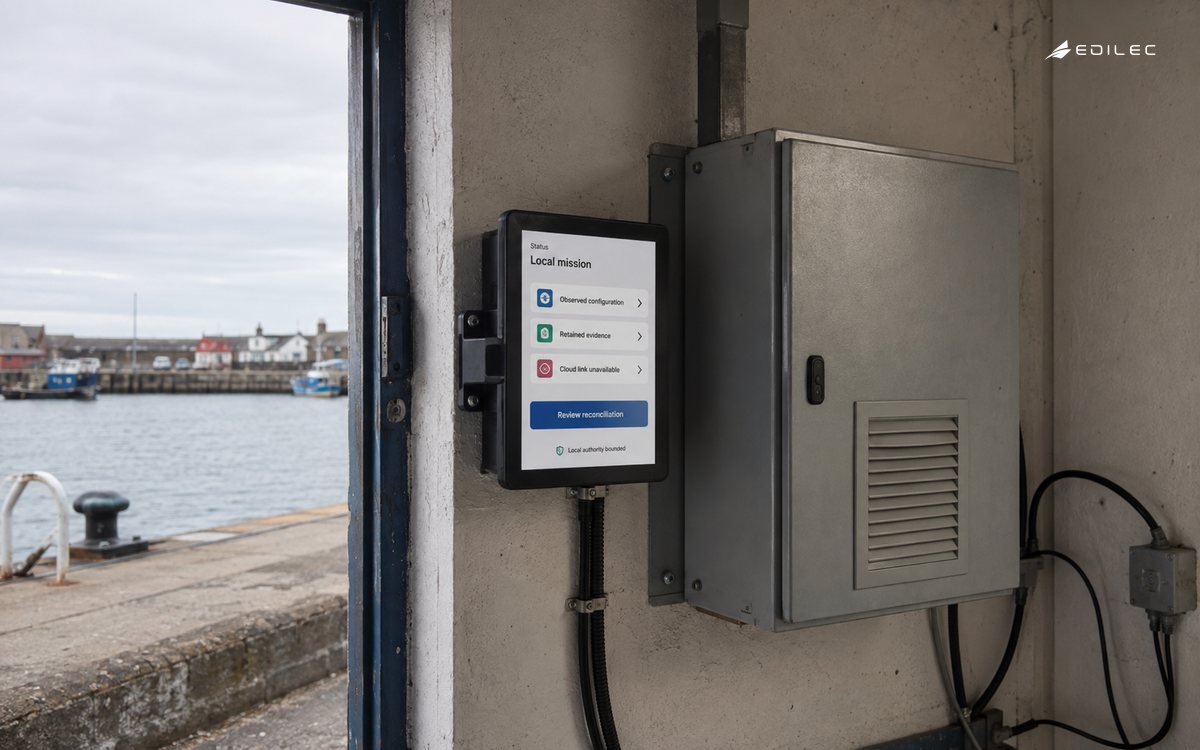
Rehearse a full disk, bad cellular link, clock error, failed power cycle, partial update, unavailable management service, and stale command with site operators. Confirm which local actions remain permitted, what evidence is retained, and who decides when control can resume.
Edge gateways FAQ
Should every gateway run local control? No. Give local authority only where latency or resilience requires it and where the safe state is testable. A forwarding gateway should not quietly acquire control responsibilities.
How should buffered telemetry be labeled? Keep source and observation times, add receipt time, and mark the quality or delivery state. Downstream users should be able to distinguish current data from replayed data.
What is the most important replacement test? Provision a clean unit, restore approved configuration, establish identity, replay only permitted data, and confirm that old credentials and stale commands cannot regain authority.
Conclusion
Edge gateways in production earn trust when people can explain what happened, who was allowed to act, what the data meant at the time, and how the system recovered. Build that accountable path for one consequential workflow, rehearse the uncomfortable cases, and expand from evidence rather than enthusiasm.