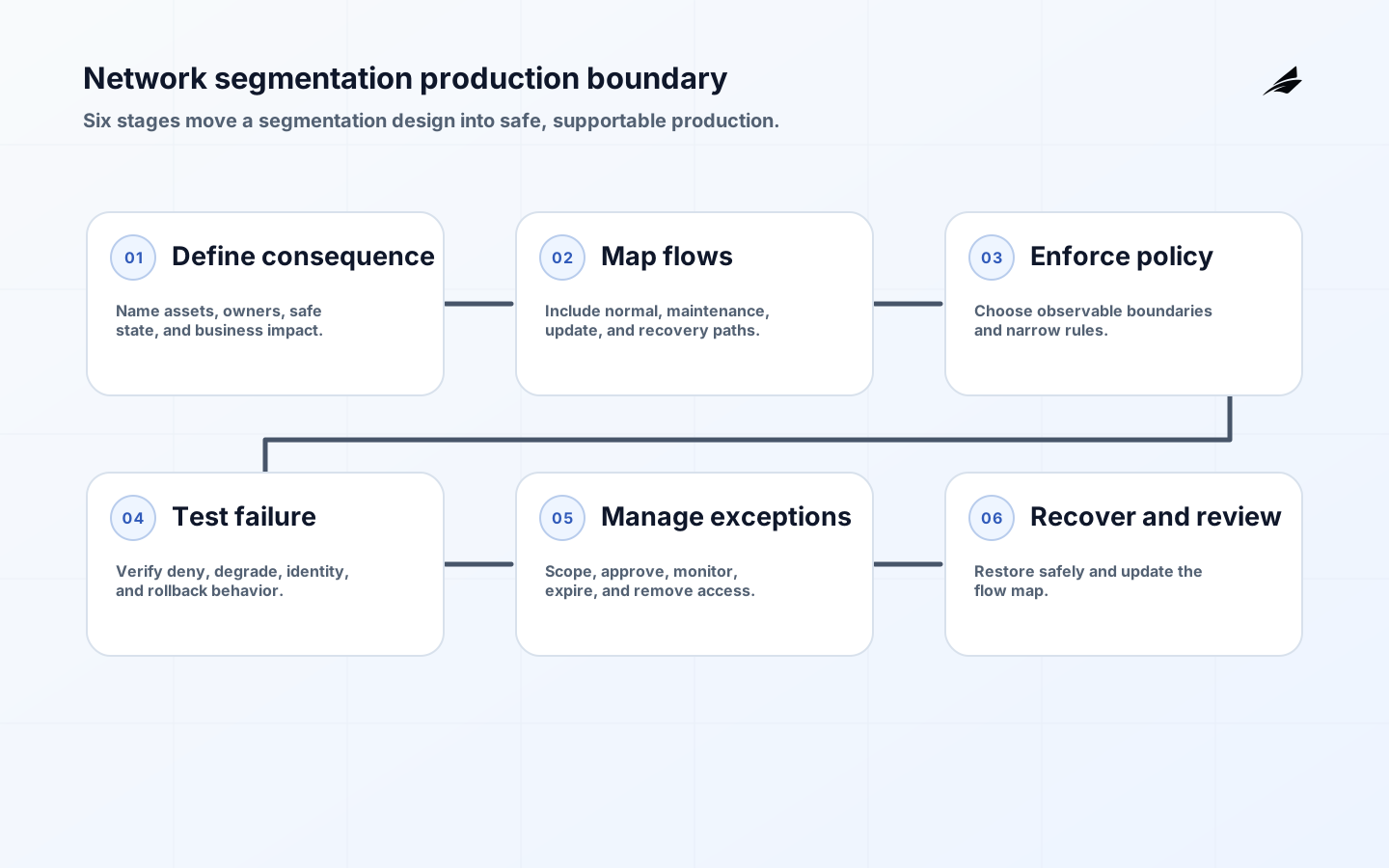
Network segmentation looks simple in a design document because the drawing has clean zones and arrows. Production is different. Segmentation changes which services can discover one another, which operators can reach equipment, how updates cross a boundary, where logs are collected, and what happens when a dependency fails. In OT and connected environments, a technically correct deny rule can interrupt safety, maintenance, or recovery work. NIST SP 800-82 emphasizes performance, reliability, and safety as well as confidentiality. The production question is whether the boundary enforces a justified communication policy while preserving a safe and supportable operating path.
Define the production outcome before the rule set
Write the risk and operating outcome in one paragraph. Perhaps a site gateway sends telemetry to a broker but never accepts an unsolicited command from analytics; a vendor path is time-bound and approved; or a controller continues local control when an enterprise service is unavailable. Name assets, users, services, physical consequences, and recovery owner. Include non-goals: segmentation will not replace device hardening, application authorization, identity governance, or safe operating procedures. The network segmentation decisions guide helps make those boundaries explicit before migration.
| Question | Decision | Evidence |
|---|---|---|
| What must communicate? | Named source, destination, protocol, direction | Approved flow record |
| What must never communicate? | Explicit deny and safe failure | Tested blocked path |
| Who may change access? | Role, approval, expiry, rollback | Change and access record |
| What happens when boundary fails? | Local, degraded, or isolated mode | Recovery exercise |
| How is result known? | Traffic, business, and safety checks | Acceptance evidence |
Map flows before enforcing zones
Build the inventory from observed and required flows, not only IP ranges. Record asset identity, location, owner, role, protocol, port, direction, frequency, sensitivity, timing, and consequence. Include management, identity, time synchronization, update, backup, logging, monitoring, and emergency paths. A flow unused during a normal shift may be essential during recovery. Validate the map with operators and technicians who know commissioning, maintenance, and replacement. Mark assumptions and unknowns instead of converting them into permanent allow rules. If a service address changes, authority should remain tied to asset and purpose rather than a stale label.

Choose enforcement boundaries that can be operated
Use zones, conduits, firewalls, routers, access proxies, one-way controls, host controls, and application policy according to risk and constraints. A zone is a management concept until an enforcement point observes and controls traffic. NIST’s OT guidance discusses levels, tiers, zones, and DMZs, but implementation still needs a current flow map and testable policy. Keep high-risk control paths physically and logically distinct where required. Avoid tiny segments that no team can troubleshoot. Every boundary needs an owner, change route, logging expectation, and failure mode.
| Boundary | Useful for | Production caution |
|---|---|---|
| Site or OT zone | Grouping assets with shared function | Same zone is not same trust |
| DMZ or conduit | Controlled exchange between areas | Define direction and inspection limits |
| Host or workload policy | Restrict service reachability | Verify actual enforcement layer |
| Identity or proxy | Time-bound user and service access | Keep emergency access expiring |
| Physical or one-way | High-consequence isolation | Test maintenance and recovery |
Test enforcement and failure, not just connectivity
Acceptance testing should prove allowed flows work, denied flows are blocked, and important work remains recoverable. Test normal telemetry, maintenance, update, backup restoration, time synchronization, monitoring, identity loss, broker loss, and site isolation. Test real source and destination identities, not a privileged host. Check asymmetric routes, stale rules, implicit return paths, DNS dependencies, and devices that fail open or closed unexpectedly. Capture traffic evidence with the business result. A successful connection does not prove that a message was authorized or processed; a blocked connection does not prove an operator has a safe alternative.
Operate exceptions and change as first-class work
Production produces exceptions: a vendor endpoint, old controller, diagnostic tool, replacement gateway, or deadline. Do not handle them with undocumented broad allows. Give each exception reason, affected assets, permitted path, owner, approval, expiry, monitoring, and rollback. Use policy templates for common patterns and make the default narrow. Review exceptions and remove those without a current owner. This makes segmentation improve over time rather than become a permanent record of every emergency. Network observability can help connect denied traffic to service impact and response.
Make boundary logs actionable
Log useful allowed and denied decisions with source and destination identity, policy version, protocol, time, action, reason, and change reference where available. Protect logs from alteration and limit payload collection. NIST SP 800-92 supports planning collection, analysis, retention, and disposal. Use logs to answer which site lost a required path, which rule denied an update, which identity repeatedly attempted access, and whether an exception was used. Group and rate-limit alerts while retaining evidence for investigation. Logging should help an operator choose the next action, not only prove that a firewall was busy.
Recover deliberately and review the boundary
Prepare a rollback narrower than disabling segmentation across the environment. Keep approved previous policy versions, an authorized break-glass route, local operating procedures, and a way to verify restoration did not create a bypass. During an incident, distinguish segmentation fault from attack, device failure, and dependency outage. Record who changed what, for how long, and what confirmed recovery. Incident-handling guidance is most useful as a rehearsal: name decision-maker, technical operator, safety owner, and communicator. Afterward update the flow map and remove temporary access. Use event streaming for connected systems when recovery must reconcile delayed or duplicated messages.
A practical segmentation rollout
- Choose one site or service path with a named operational consequence.
- Inventory assets, flows, owners, dependencies, emergency paths, and data classes.
- Observe a limited policy before enforcement where the platform allows.
- Test allowed, denied, degraded, maintenance, update, and recovery journeys.
- Publish exception and rollback rules with expiry, monitoring, and ownership.
- Review traffic, incidents, and operator feedback before expanding.
Review the boundary with the people who use it
Before extending segmentation to another site, review with an operator, network owner, security owner, support owner, and someone responsible for safety or customer impact. Walk through normal exchange, intentional deny, vendor session, update, broker outage, and rollback. Ask what each person sees, can change, and can prove. If the network team sees a clean deny while the operator sees a broken job, the policy needs a safer operating state or better context. If support cannot identify the asset, inventory and logging are incomplete. Use network segmentation decisions before the first build to trace a production exception back to its consequence.
Document the smallest corrective action and test it in the next window. It may be a narrower rule, local fallback, monitored conduit, better time source, or runbook that lets a technician continue without disabling policy. Keep temporary access separate and set its removal date while context is fresh. Review whether the change reduced risk without hidden reachability. This turns segmentation into evidence and improvement rather than a one-time migration. A boundary is mature when a new responder can operate it safely and explain its limits without contacting the original designer.
Include the business workflow in the acceptance record. For a telemetry-only path, confirm that the user sees a stale or unknown state rather than a current-looking value. For a control path, confirm that uncertain delivery cannot be mistaken for confirmed action. For remote support, confirm that the route expires and that the operator can continue safely when the support service is absent. Capture the test identity, policy version, device or site, observed logs, and business result. Those details make a future rule change comparable. They also help the team resist a common shortcut: broadening access because one dependency is difficult to map. The right response is usually a better contract, a narrower conduit, or a safe local mode.
Treat the first production period as a learning window with explicit limits. Review denied traffic by business consequence, not only count. A deny caused by a stale vendor rule differs from a deny showing an unexpected access attempt. Review allowed traffic for paths with no current owner. Check whether operators understand the difference between intentional site isolation and accidental route loss. Update runbooks with stable state, identity, policy version, and next action. The boundary should reduce uncertainty, not move it into another queue. That is why the network observability guide and segmentation review belong in one operating conversation.
Keep the acceptance record tied to a real site or service, not an abstract topology. Record who tested the flow, which asset and identity were used, what the enforcement point logged, and what the operator experienced. This makes a future rule change comparable and reduces the temptation to broaden access when the real problem is an undocumented dependency. A boundary is safest when its evidence is as concrete as its consequence.
Finally, define the success condition for rollback. Restoring a previous rule is not enough if queues, sessions, device clocks, or operator instructions remain in an uncertain state. Confirm the intended flow, reconcile work attempted during the interruption, and close the exception record. A sensor data pipeline may need to mark late or duplicate observations before its dashboard is trustworthy again. Keep this reconciliation step in the acceptance test so recovery is measured by a usable business result, not merely by traffic passing through the firewall.
That final reconciliation protects both operational continuity and the integrity of the security decision during recovery.
The NIST OT security guide grounds safety and reliability decisions; NIST IR 8259 keeps device lifecycle controls in scope; NIST SP 800-92 supports actionable logs; and NIST SP 800-61 provides incident preparation and recovery context.
Key takeaways
- Production segmentation is an operating change, not only a network change.
- Map required and recovery flows with operators before rules.
- Use an enforcement point that can be observed, tested, and owned.
- Treat exceptions, logs, rollback, and break-glass access as designed capabilities.
- Prove the boundary protects the consequence while preserving safe work.
Frequently asked questions
Does segmentation eliminate identity and application controls?
No. Segmentation controls reachable paths; identity and application authorization decide which actor may perform an action. Use the layers together and test the effective policy.
Should a new flow be allowed temporarily while investigating?
If necessary, make it explicit, scoped, monitored, approved, and expiring. Record reason and rollback. A broad temporary allow without an owner tends to become permanent.
How should OT teams handle a risky change?
Test in a representative environment, involve safety and production owners, define a local fallback, and schedule a reversible window. Acceptance should show security enforcement and operational continuity.
Conclusion
Network segmentation earns trust in production when policy is grounded in real flows, enforcement is visible, and failure is safe. Map the work, test the boundary, manage exceptions, protect evidence, and rehearse rollback. That turns segmentation from a diagram into a durable operating control.