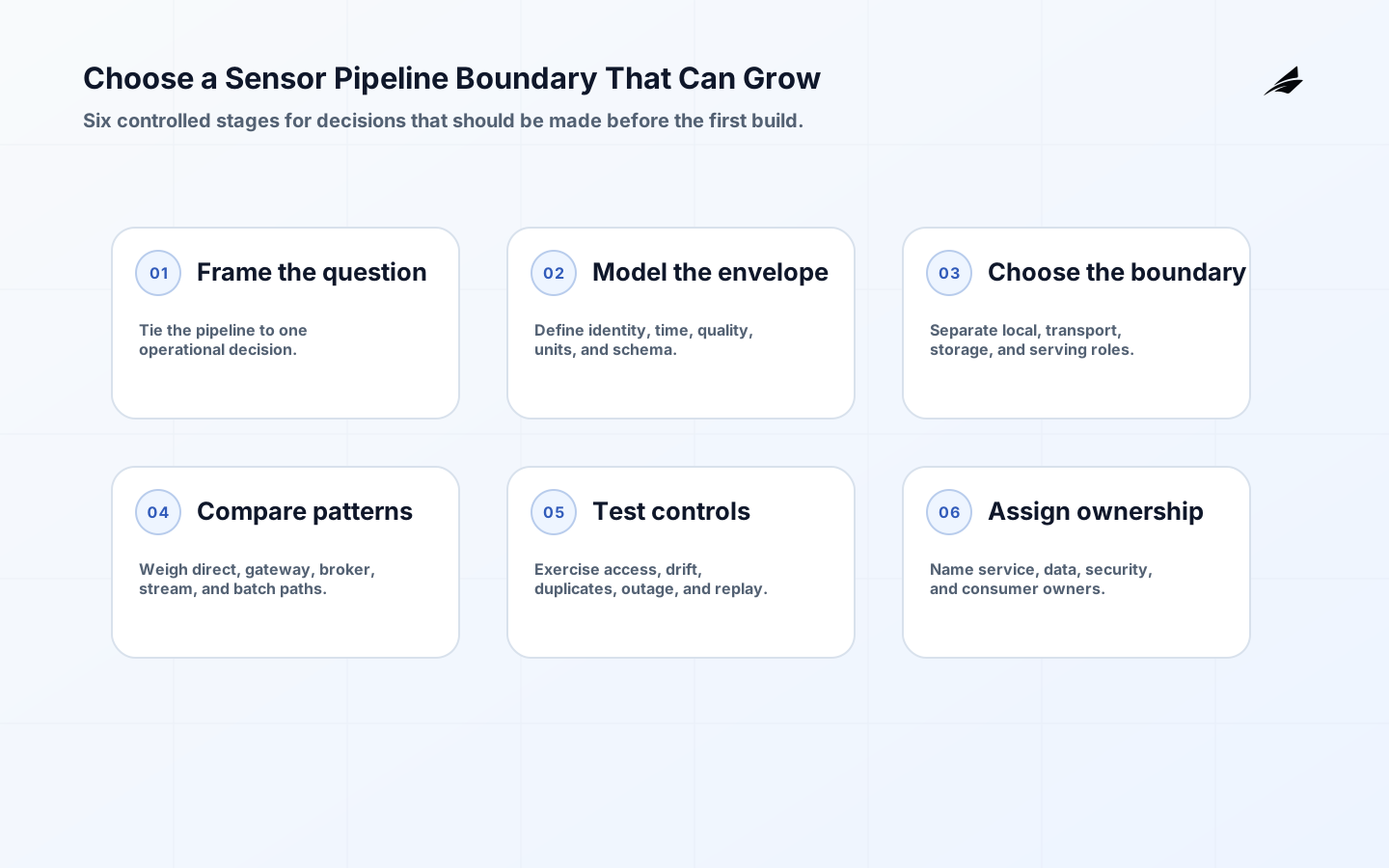
The first sensor data pipelines decisions shape every later dashboard, alert, and integration. Teams often begin with a transport or a storage product, then discover that no one agreed on time, identity, quality, authority, or recovery. An IT manager can prevent that drift by asking what operational decision the pipeline must support and what evidence makes that decision safe. The goal before the first build is not a perfect platform; it is a boundary that can be tested, owned, and changed deliberately.
Frame the operating question
Choose one workflow and describe its decision in plain language. “Collect temperature data” is too broad. “A warehouse supervisor can decide whether a refrigeration unit needs inspection within ten minutes, with the latest measured value and contact state visible” is actionable. Identify the actor, response time, acceptable uncertainty, and consequence of delay. Link the scope to device provisioning decisions when identity and ownership are part of the outcome. This statement becomes the test for architecture choices that would otherwise be argued by preference. Identity and offline concerns are covered in Device identity decisions and Offline synchronisation.
| Early choice | Question to answer | Evidence before build |
|---|---|---|
| Signal | Which observation changes a decision? | Named workflow and sample case |
| Time | Which clock controls freshness? | Event, receipt, and display-time rules |
| Identity | What remains stable when equipment moves? | Asset and device identity model |
| Quality | How is uncertainty shown? | Quality states and consumer examples |
| Recovery | What must survive an outage? | Offline and replay scenario |
Model the data envelope
Define the minimum envelope before choosing vendors. It should include asset identity, observation identity, measurement name, value, unit, observed time, received time, source status, quality state, schema version, and producer version. Decide whether a measurement is cumulative, instantaneous, or derived. Decide whether a late value updates current state or belongs only in history. NISTIR 8259A encourages clear device capabilities and lifecycle thinking; apply the same discipline to the data record that represents the device’s observation.
Choose the boundary before the product
Separate acquisition, edge buffering, transport, validation, raw retention, transformation, and serving even if the first implementation uses one service. This makes future changes visible. Decide what must run at the site when the wide-area network is unavailable and what can wait for central processing. Keep commands and telemetry in separate authority paths. NIST SP 800-82 Rev. 3 sharpens the treatment of segmentation, safety, and availability where IT and operational technology meet.
- Write the normal data path and the degraded data path on the same page.
- Assign an owner to every boundary and an authority to every transformation.
- Decide which raw evidence is immutable, append-only, or safely replaceable.
- Set payload, rate, storage, and retention limits before testing capacity.
- State which changes require migration, dual-read, or a rollback.

Compare architecture choices by consequence
A direct device-to-database path may be adequate for a small, low-consequence installation, but it can make replay, credentials, and schema changes harder. An edge gateway adds a useful place for buffering and protocol translation, but it creates another lifecycle and update responsibility. A broker can decouple producers and consumers, but it does not remove the need for topic authority, retention, and consumer recovery. Use the simplest architecture that satisfies the decision and its failure cases. MQTT Version 5.0 documents delivery options; select them from consequences, not labels.
| Pattern | Strength | Question before adoption |
|---|---|---|
| Direct ingestion | Few moving parts | How will retries and replay avoid repeated effects? |
| Edge gateway | Local buffering and translation | Who patches, monitors, and replaces it? |
| Brokered messaging | Loose producer-consumer coupling | Who owns topics, sessions, and retention? |
| Stream processing | Reusable derived views | Can transformations be versioned and replayed? |
| Batch landing | Simple historical analysis | What freshness does the decision require? |
Make controls testable from the beginning
Translate “secure” and “reliable” into observable tests. A device should authenticate with an identity that can be revoked, publish only to its allowed scope, and show a clear state when credentials expire. A pipeline should reject invalid payloads with a reason, handle duplicates without duplicate side effects, and show stale data rather than implying continuity. Use the NIST Cybersecurity Framework 2.0 to organise risk discussions, then write concrete checks for the selected workflow. Controls that cannot be tested will not survive pressure during launch.
Plan the first build around evidence
Build a thin vertical slice: a small set of devices, one complete contract, one raw store, one derived view, and one operator action. Instrument it before adding breadth. Capture freshness, missing intervals, invalid records, duplicate rate, processing lag, and operator effort. A pilot should include at least one realistic outage and a deliberate schema change. OpenTelemetry documentation offers vocabulary for the signal model, but the acceptance record should remain understandable to a support person who is not the pipeline author.
Assign ownership and review
Give the pipeline a service owner, data-contract owner, security owner, and operational consumer. These may be the same person in a small team, but the responsibilities must still be named. Set a review cadence for schema changes, device replacement, quality exceptions, and incident findings. Include the person who will receive a stale-data warning in the acceptance exercise. Ownership becomes real when the named person can approve a boundary change, explain the current state, and initiate recovery.
Resolve hard cases before launch
Ask what happens when a device moves sites, a gateway is replaced, a clock is wrong, a sensor is recalibrated, a tenant loses access, or an analyst needs to replay a month of data. Decide whether identity follows hardware, asset, or installation. Decide how corrections are represented and whether a derived report is rebuilt. These cases feel peripheral until they occur during an incident. Naming them early keeps a sensible first build from becoming a collection of undocumented exceptions.
Validate the first build with operators
Invite an operator to review a real record before the architecture is declared complete. Ask the person to identify the asset, decide whether the value is current, explain a quality warning, and find the safe response to a stale state. If the answers require an engineer to interpret internal fields, improve the contract or view. This usability test is architectural evidence because it checks whether the pipeline actually supports the decision named at the start.
Keep the first build reversible. Use a bounded device group, retain the original observations, and make it possible to stop a derived action without losing evidence. Define what happens to buffered data if the pilot is paused and how devices return to a known baseline. A reversible pilot lets the team learn from a real workflow without making an early architecture choice impossible to change.
Resolve first-build trade-offs
A central service can simplify operations, but it may make a site dependent on a wide-area link. A local gateway can preserve work during an outage, but it adds patching, inventory, and recovery responsibility. A managed platform can reduce undifferentiated work, but its limits and data-export path still need review. Compare these options against the same workflow and failure cases. The right decision is often the one that leaves the fewest unowned responsibilities, not the one with the shortest component list.
Choose the source of truth separately for physical state, configuration, ownership, and historical evidence. A device may be authoritative for its last measurement, a service for assignment, and a workflow system for a maintenance decision. Write those distinctions down. If two systems can both change the same state, define reconciliation and precedence before implementation. Otherwise a successful integration may create a durable disagreement that operators have to resolve manually.
Decide how much uncertainty the first consumer may accept. An analyst may use estimated values with a visible quality flag, while an automated command may require measured data within a strict age. Encode the rule near the consumer contract so it is testable. Do not place a universal “valid” flag on the source and expect every downstream user to interpret it correctly. Different decisions can share the raw record while applying different evidence thresholds.
Before coding, write one failure narrative in the form an operator will see: a device loses connectivity, the gateway buffers, the central service shows stale state, the device returns, and the backlog is reconciled. Identify each user-visible transition and the evidence behind it. This narrative exposes missing status states, unsafe replay assumptions, and notification gaps earlier than a happy-path demo. It also gives the team a practical script for the first acceptance exercise.
| Decision record field | Example answer | Why it matters |
|---|---|---|
| Authoritative owner | Asset service owns assignment; pipeline owns observations | Prevents conflicting edits |
| Allowed uncertainty | Reports may use estimates; commands may not | Matches control to consequence |
| Offline rule | Gateway buffers two hours and shows stale state | Makes degradation predictable |
| Change trigger | Unit or identity meaning requires a new schema | Protects historical comparability |
Make the first build intentionally observable. Keep a small sample of raw records, derived outputs, rejected inputs, and recovery events that a reviewer can inspect without production access. Use those samples in release tests after parser, device, or storage changes. A visible evidence set shortens incident diagnosis and makes it easier to show that the pipeline still fulfils its promise after the implementation evolves.
First-build decision takeaways
- Start with a decision and its acceptable uncertainty.
- Define identity, time, quality, schema, and authority before selecting infrastructure.
- Separate normal and degraded paths, including offline and replay behaviour.
- Turn security and reliability claims into acceptance tests.
- Pilot one complete workflow and assign ownership before expanding the fleet.
First-build questions
Which technology should we choose first?
Choose the smallest set of components that satisfies the named decision, data contract, failure cases, and operating responsibilities. Technology selection follows those constraints; it should not substitute for them.
How can an IT manager keep the first build small?
Limit the pilot to one decision, one site or asset class, one consumer, and one recovery exercise. Keep the raw evidence and contract reusable, but defer generalisation until the first operator can explain the result and the failure state.
Conclusion: a bounded first build
The important sensor data pipelines decisions happen before the first message is published. Define the decision, envelope, boundary, controls, failure cases, and owners, then build a narrow path that can produce evidence. That preparation gives the team room to scale without carrying ambiguous data and invisible authority into every later feature.