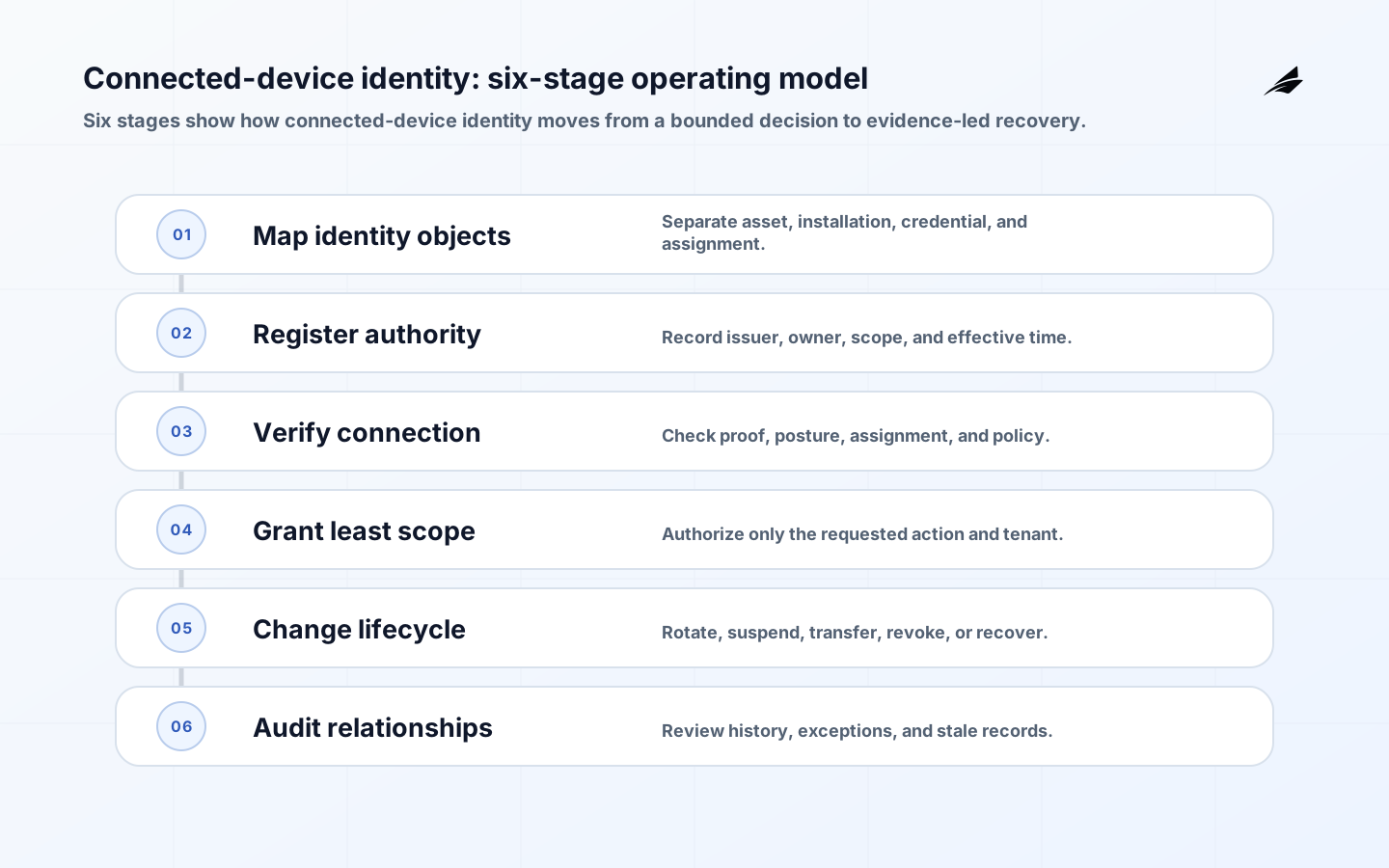
Device identity for connected systems is the combination of a distinguishable subject, a proof mechanism, an authorization scope, and a lifecycle record that can survive replacement and recovery. Device Identity for Connected Systems: a Practical Guide is for founders and product leaders who need a device fleet to be trustworthy after it leaves the factory who need device identity for connected systems to support an operating decision, not merely a technical diagram. The practical objective is to distinguish a specific device, authenticate it for a defined purpose, and retire or replace its trust without guessing. That requires a shared account of what the credential lifecycle system may do, what evidence it produces, and who decides when the normal path no longer holds.
The first useful credential lifecycle question is not which product to buy. For credential lifecycle, it is which real-world consequence the connected workflow must protect: a delayed field task, a misleading operator view, an unauthorized command, a lost record, or an avoidable outage. Making that consequence concrete keeps device identity tied to safety, service, and accountable work.
Set the decision boundary for device identity
Define the credential lifecycle promise in plain language before implementation. For this topic, the promise is to distinguish a specific device, authenticate it for a defined purpose, and retire or replace its trust without guessing. Name the reader of the outcome, the authoritative record, the acceptable delay, the person allowed to override the rule, and the point at which the credential lifecycle workflow must stop for review. For credential lifecycle, a boundary is valuable because it excludes attractive but unowned work from the first release.
Build the inventory around logical identifier, physical reference, credential origin, attestation or enrollment evidence, owner, authorized services, rotation event, and retirement state. This is more than documentation. For credential lifecycle, it lets an engineer, operator, or reviewer reconstruct why a particular behavior was allowed, rejected, or escalated. For credential lifecycle, in connected operations, small omissions become expensive when an incident occurs outside the people and network conditions assumed during a demonstration.
| Question | Decision to record | Evidence to retain |
|---|---|---|
| What outcome is protected? | distinguish a specific device, authenticate it for a defined purpose, and retire or replace its trust without guessing | A concrete scenario and acceptance condition. |
| What changes the risk? | whether a claimed device may perform a specific action now | A named threshold and accountable owner. |
| What constrains the system? | unique credentials, authenticated onboarding, scoped authorization, and lifecycle revocation | A reviewable rule and its effective period. |
| What proves the result? | a trace from manufactured unit through enrollment, normal access, ownership change, and revocation | A trace, test, or observed operating record. |
Connect identity records to the access decision
A workable device identity model uses a unique logical and physical identity anchored in protected credentials, a controlled onboarding path, least-privilege authorization, and lifecycle records that outlive any individual certificate. For credential lifecycle, draw the trust and responsibility boundaries before the technology choices harden. For credential lifecycle, the diagram should show where inputs become trusted, which state is authoritative, where a person can intervene, and how a later investigator finds the same context without relying on private knowledge.
A presented certificate or identifier is evidence of a claim, not proof of permission. Preserve the enrollment path, credential status, owner, scope, and revocation state used to make the access decision.
| Boundary | Good default | Question to challenge |
|---|---|---|
| Authority | Keep the accountable record and decision rule explicit. | Which component may make or reverse this decision? |
| Change | Use named approvals and a visible rollback or isolation path. | Can this change be explained during a busy operating period? |
| Exception | Make failure states visible to the responsible role. | Who sees this first, and what can that person safely do? |
| History | Retain the records needed to explain material outcomes. | Can the team reconstruct the path after a delayed report? |
Trace enrollment through authorization
For the first delivery, decide the device identifier before production; prevent shared credentials; enroll through a revocable process; and test replacement, transfer, and compromise workflows alongside initial onboarding. For credential lifecycle, treat the chosen slice as a learning instrument: include the normal path, a realistic degraded case, the visible status a user receives, and the support action that follows. For credential lifecycle, a narrow path with evidence is more useful than a broad integration whose behavior can only be guessed from infrastructure health.
Protected credentials, onboarding evidence, authorization scopes, and retirement records must follow the individual unit rather than an informal fleet label.
- Write the accountable outcome and the unsafe or unacceptable outcome beside it.
- Record logical identifier, physical reference, credential origin, attestation or enrollment evidence, owner, authorized services, rotation event, and retirement state for the first production path.
- Exercise an interrupted or degraded case before expanding scope.
- Show the relevant user the current state and the next safe action.
- Document the approval, correction, and communication path for a material exception.
Make revocation and replacement routine
The failure case to make tangible is this: serial numbers are treated as secrets, one credential represents a fleet, a returned device stays authorized, or an inventory cannot connect an observed network identity to a responsible owner. For credential lifecycle, treat it as a product and operations scenario, not solely a technical edge case. For credential lifecycle, specify what becomes visible, what is automatically contained, what may continue, and who decides when normal operation can resume. For credential lifecycle, that work prevents a reassuring green status from hiding a process that is no longer safe or complete.
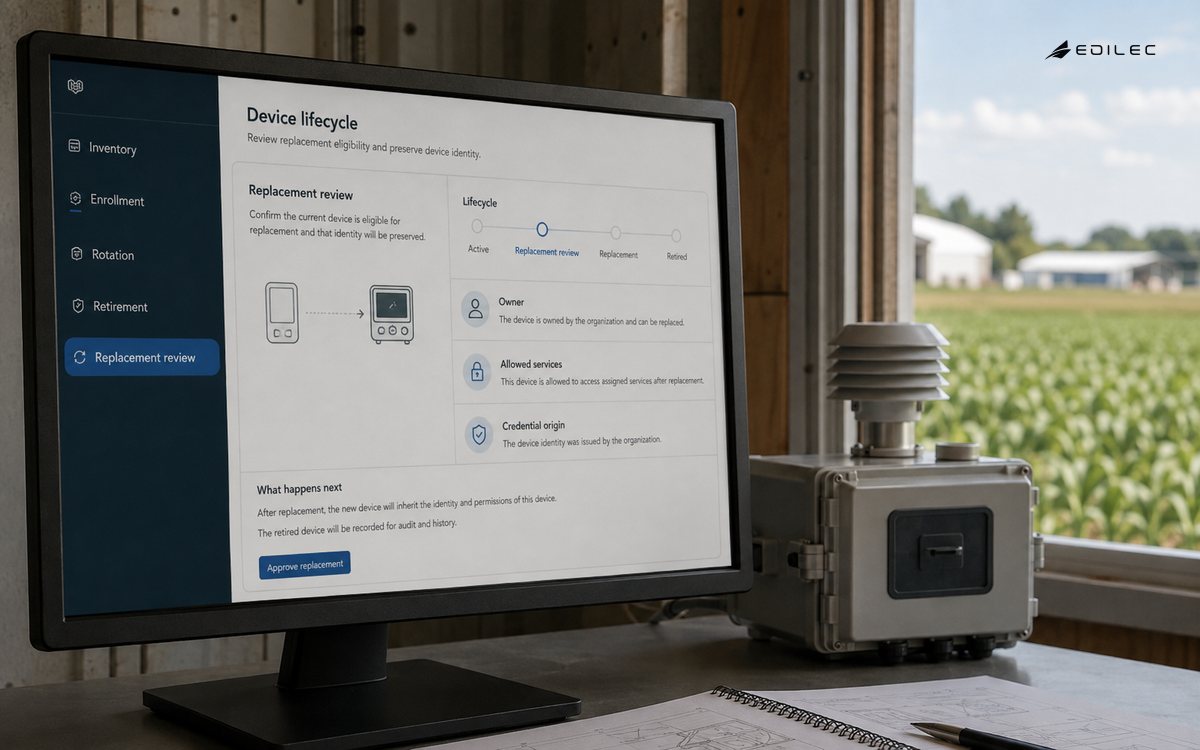
Identity recovery means revoking or replacing trust for the affected unit, tracing its recent actions, and ensuring a replacement cannot inherit access by accident.
Operate device identity from evidence
Track unknown-device attempts, enrollment failures, credential age, orphaned identities, authorization denials, and time to revoke a compromised unit. For credential lifecycle, establish a baseline before the first material change and annotate releases, maintenance, supplier changes, and unusual operating conditions. For credential lifecycle, metrics become useful when they connect technical behavior to a defined owner and a real consequence, rather than encouraging a team to optimize a graph that nobody uses to decide anything.
Review enrollment, transfer, and revocation cases alongside authentication totals. A healthy success rate can obscure orphaned devices that remain entitled to reach services.
| Signal | What it may indicate | Useful response |
|---|---|---|
| Unexpected change | Drift, misuse, or an unrecorded operational dependency. | Check ownership, recent changes, and the affected process. |
| Delayed outcome | Capacity pressure, a disconnected dependency, or an unclear handoff. | Trace the first delayed record and verify the recovery path. |
| Repeated exception | A weak rule, missing context, or a workflow that does not fit reality. | Improve the decision rule before automating around it. |
| Missing evidence | A blind spot in instrumentation or ownership. | Restore the record before declaring the condition resolved. |
Translate identity standards into control tests
This guide is grounded in NISTIR 8259A device capability baseline, NIST SP 1800-36, Trusted IoT Device Onboarding, ITU-T Y.3059 Trust Registry for Devices, NIST SP 800-57 key-management guidelines. For credential lifecycle, these materials inform the engineering vocabulary and controls discussed here; they do not replace local assessment of safety, legal obligations, device limitations, or process ownership. For credential lifecycle, read the primary guidance when a deployment needs exact protocol, security, or procurement requirements.
Here, the standards material is most useful for distinguishing unique identification, authenticated onboarding, scoped access, and lifecycle management across the device fleet.
Read identity choices alongside telemetry
These adjacent guides help connect device identity to architecture, field behavior, and operational ownership: IoT guide 0011, IoT guide 0005, IoT guide 0171. Read them as complementary decision aids; the right implementation still begins with observing the specific workflow and constraints in front of the credential lifecycle team.
Key takeaways for device identity
- Device identity is a commitment to distinguish a specific device, authenticate it for a defined purpose, and retire or replace its trust without guessing, not a configuration exercise.
- Start with one accountable path that includes real state, an exception, and a recovery decision.
- Keep authority, identity, freshness, and change history visible where people operate the workflow.
- Expand only after observed behavior shows that the promise holds under normal and degraded conditions.
Device identity FAQ
Is a MAC address a device identity?
It can help inventory a network interface, but it is not a sufficient trust mechanism because it may change or be imitated. Use protected credentials for authentication.
What happens when a device is transferred?
Record the ownership change, reassess authorization, and rotate or re-enroll credentials where the trust boundary changes.
Why keep lifecycle records?
They make incident response, support, warranty work, and retirement decisions possible without relying on informal device history.
Connected-device identity connects to product teams and device identity, IoT telemetry for connected systems, and edge gateways in production. Read these connected-operations guides together when identity, telemetry, and gateway authority meet at the same production boundary.
Operating pattern: connect identity records to access
For implementation context, compare NISTIR 8259A: IoT Device Cybersecurity Capability Core Baseline, NIST SP 1800-36: Trusted IoT Device Network-Layer Onboarding and Lifecycle Management, RFC 5280: Internet X.509 Public Key Infrastructure Certificate and CRL Profile, and RFC 7030 enrollment guidance when choosing the boundary and its evidence.
The first design decision is not which registry or certificate service to buy. It is what must remain distinguishable when a device is installed, moved, repaired, reimaged, resold, or retired. A device may need a hardware identity for traceability, an installation identity for software trust, and a customer assignment for authorization. Keeping those relationships explicit prevents the common error of overwriting a historical owner or treating a new credential as proof that the physical asset itself is unchanged.
Model the relationships that make identity trustworthy
Represent the links between device, credential, gateway, site, customer, firmware, and service account as records with effective times. The service should be able to answer which credential was active during a disputed event and which assignment gave it authority. Avoid embedding every relationship in a single opaque identifier. Stable references make migration and forensic review possible without changing the meaning of old telemetry.
Make the trust decision explainable during recovery
A connection decision should state which proof was checked, which policy version applied, which scope was granted, and why the result was allow, limit, or deny. This matters when an operator sees a device online but a business action still fails. Explainable decisions also make support safer: a person can correct a missing assignment without being asked to bypass verification or share a private key.
| Design choice | Recommended boundary | Failure to avoid |
|---|---|---|
| Hardware identity | Persistent reference to the physical asset | Using a mutable hostname as the only identity |
| Installation identity | Reference to the software instance or deployment | Reusing a credential after reimage without review |
| Assignment | Effective-time link to site, tenant, and owner | Relabeling delayed data under a new customer |
| Credential state | Issued, rotated, suspended, revoked, or expired | Treating a credential as valid indefinitely |
Select an identity response for each lifecycle event
The following matrix turns common lifecycle events into explicit decisions. Adapt the scopes to the risk of the connected process and keep the person who can approve recovery named.
| Event | Identity decision | Evidence |
|---|---|---|
| New installation | Issue scoped proof after registration | Registration, attestation, issuer, and policy version |
| Credential rotation | Accept the new proof and retire the old one | Rotation transaction and overlap window |
| Site or tenant transfer | Change assignment without rewriting history | Approver, effective time, and old scope |
| Suspected compromise | Deny authority while preserving investigation context | Revocation reason, incident reference, and recovery owner |
Credential lifecycle practices to carry forward
- Separate device subject, installation, credential, and customer assignment.
- Make every allow, limit, deny, rotation, and recovery decision inspectable.
- Preserve historical ownership and effective times instead of rewriting old evidence.
Exercise credential and assignment changes
Exercise enrollment, credential rotation, site reassignment, tenant transfer, suspension, replacement, and recovery with security, support, and field operations. Confirm that every change leaves an attributable record and that stale proof cannot regain authority.
Questions to answer during identity recovery
Can a serial number be the identity? It can be a reference, but it is not proof that the connecting party controls the expected device. Pair stable inventory data with a credential or attestation decision.
How should device identity support multi-tenant systems? Keep the device subject separate from tenant authorization and evaluate the current assignment at the time of the action. Historical readings should retain their original effective context.
What should support staff be allowed to do? Support may initiate a controlled recovery or view status, but high-impact changes should require approval, evidence, and a durable record.
Conclusion: make device identity accountable before expanding it
The durable test for device identity for connected systems is straightforward. Can the credential lifecycle team show the promised outcome, identify the authoritative record, recognize a known failure, and explain the next safe action to the person affected? For credential lifecycle, begin with that accountable slice, keep the evidence close to the work, and widen adoption only when the operating behavior earns trust.