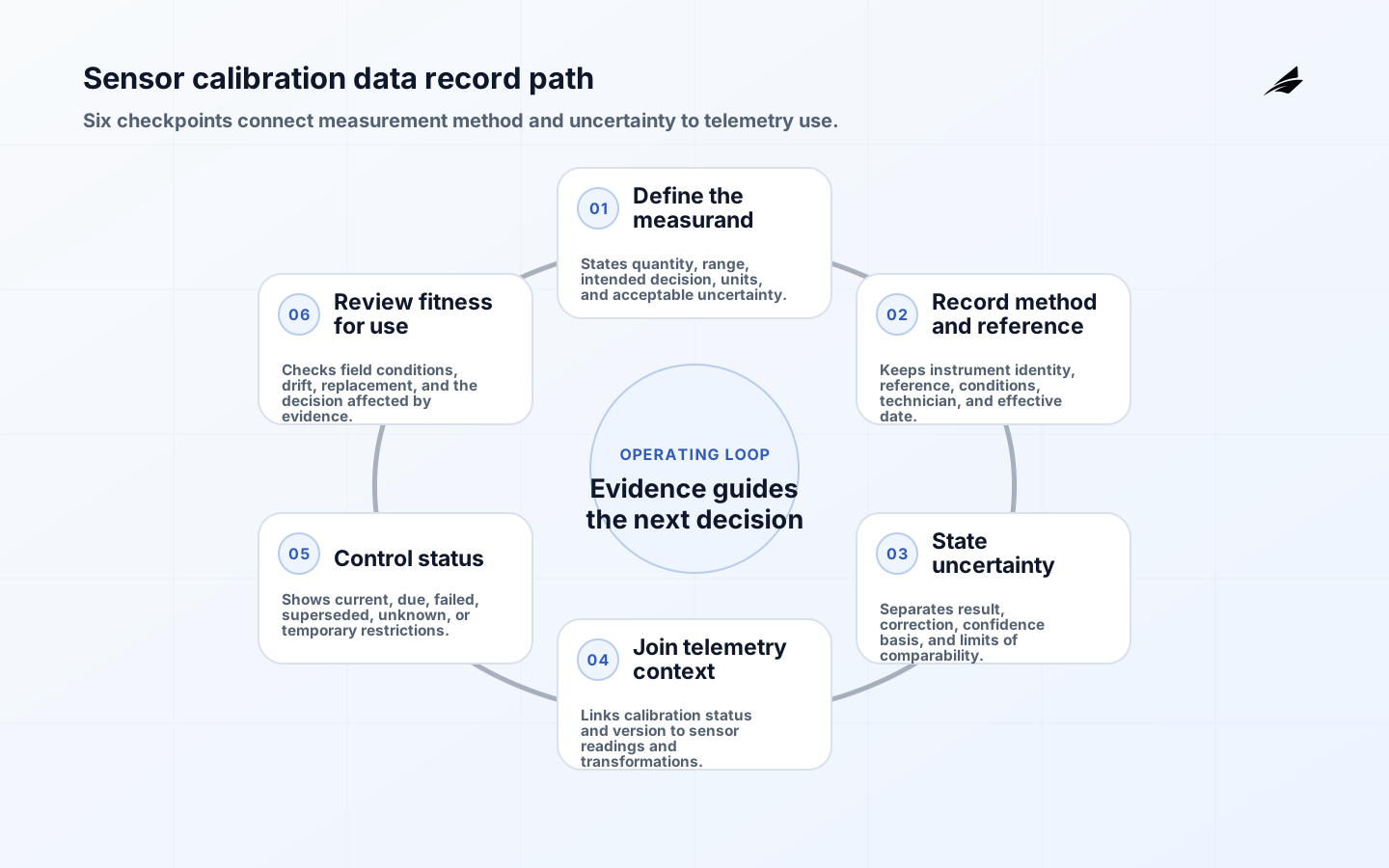
Sensor calibration data gives a team the context needed to interpret a measurement and assign confidence to it. A value without sensor identity, method, reference, date, conditions, and uncertainty may look precise while remaining hard to defend. NIST's Technical Note 1297 explains how measurement uncertainty should be evaluated and reported, and Handbook 44 shows how specifications and tolerances become operational requirements. Preserve calibration context with the reading, not in a forgotten attachment.
Define what calibration establishes
Calibration compares instrument response with a reference under a stated method and conditions. It may produce correction values, a relationship, pass/fail result, or uncertainty statement. It does not make every future field reading perfect. Temperature, installation, drift, loading, environment, and use may add uncertainty. Write measurand, method, range, units, reference, and intended use before selecting a record format.
Separate calibration from verification, adjustment, and validation. Adjustment changes instrument; calibration characterizes it; verification checks a criterion; validation asks whether the measurement process suits an operational purpose. Keeping words distinct prevents a passed check being treated as proof of unlimited accuracy.
Build a calibration record that can travel
Record sensor or instrument identity, model and revision, serial, method, reference, traceability, date, environment, points, result, uncertainty, correction, technician or laboratory, and next-review rule. Include certificate location and status current, due, failed, superseded, or unknown.
Use effective dates rather than replacing current value. A reading before adjustment needs old context; a reading after needs new. Preserve sensor-to-site relationship because mounting affects performance. This turns calibration data into operational lineage.
| Record element | Why it matters | Example |
|---|---|---|
| Sensor identity | Binds evidence to physical instrument | Stable ID, model, serial, revision |
| Method and reference | Explains how result was established | Procedure, standard, traceability |
| Result and uncertainty | Shows value and confidence | Points, units, correction, uncertainty |
| Effective status | Controls operational use | Current, due, failed, unknown |
Explain uncertainty without false precision
NIST TN 1297 describes components of uncertainty and reporting combined or expanded uncertainty. State result, unit, uncertainty basis, coverage factor or convention where applicable, and conditions. Do not hide uncertainty behind decimals or imply a certificate covers every field environment.

Tie uncertainty to decision. A monitoring threshold may tolerate wider interval than billing or safety measurement. If uncertainty overlaps action boundary, route result for review or use safer rule. Keep calculation or method available to authorized reviewers so decisions can be reconstructed.
Connect calibration to telemetry
Join calibration to telemetry by stable sensor identity and effective time. Measurement record should carry calibration version, correction or mapping, quality, and source. A transformation may apply correction, but preserve raw value and rule version. OpenTelemetry documentation helps software observability; calibration context remains a domain contract.
Test calibration expiry between readings, sensor move, correction update, and unknown state. Decide whether to publish, flag, quarantine, or stop using results. Do not back-apply a new correction to old readings without versioned reason and impact review.
Make status actionable
Operators need to see sensors due, overdue, failed, out of range, awaiting evidence, or under approved exception. Put status beside measurement workflow, not only laboratory system. A due date should trigger owner and action; it should not silently make every point invalid if policy permits grace.
Define what happens when sensor cannot be removed, reference unavailable, or calibration delayed. Use alternate sensor, conservative threshold, temporary label, or hold depending consequence. Record authority and expiry. A manual override without end condition becomes hidden change to measurement meaning.
| Calibration condition | Measurement treatment | Action |
|---|---|---|
| Current and in range | Use with recorded context | Continue monitoring |
| Due with approved grace | Flag and bounded policy | Schedule or replace |
| Failed or out of range | Quarantine or conservative mode | Investigate and assess |
| Unknown record | Do not claim confidence | Recover evidence or hold decision |
Use calibration as one quality input
Calibration is important but not sufficient. Combine it with sensor health, installation, range, rate, environment, communication, and maintenance. A current certificate cannot rescue a broken lead or out-of-range value. Quality should preserve each reason so reviewer distinguishes metrology from system failure.
When quality flags change, keep original and interpreted result distinct. A corrected value may be useful, but downstream users should know it was derived. Test missing certificate, mismatched identity, expired status, unit error, out-of-range, and uncertainty larger than decision margin.
Assign ownership and retention
Name owner for calibration policy, record integrity, field execution, inventory, quality rules, and exceptions. Define who may edit certificate link, approve correction, change interval, or declare sensor unfit. Retain by legal, contractual, safety, and investigation need, with access controls for site details.
NIST's Handbook 44 is useful when tolerances have regulated or commercial consequence. Even when it does not apply directly, requirements and evidence should remain explicit, current, and tied to device and use.
Compare calibration approaches deliberately
Laboratory calibration offers controlled conditions and detail but may create transport and downtime. Field verification is faster and closer to operation but may use less capable reference. In-situ comparison catches installation effects but needs stable comparison. A vendor certificate may suit one decision and fail another.
Choose method by risk, range, environment, consequence, and recovery time. Document what it can and cannot establish. Compare over time for drift, but do not infer trend from incompatible methods or changing conditions. The sensor calibration guide gives adjacent operating examples.
Review the calibration data path
Confirm identity, method, reference, units, conditions, result, uncertainty, effective date, status, and telemetry link. Test certificate mismatch, expired calibration, replacement, site transfer, correction update, and missing evidence. Ensure support user can explain status without editing record.
The right question is not “is this sensor calibrated?” but “is this result fit for this decision, under this context, with evidence we can retrieve?” Keep that question in product and operating review so calibration does not become a label disconnected from measurements.
A calibration record scenario
Keep the calibration certificate and operational interpretation connected but distinct. The certificate may describe a controlled test, while the application applies a correction, quality rule, or site-specific restriction. Store both and show which one governed a result. This lets a reviewer understand whether a disagreement comes from the reference, installation, transformation, or decision threshold.
Use effective time at the point of change. A sensor adjustment, replacement, relocation, or firmware scaling change should create a boundary in the telemetry stream. Historical data remains tied to the earlier context unless a documented reprocessing decision says otherwise. This avoids making drift or a correction look like a sudden physical event.
Calibration due status needs a policy owner. Define grace period, alternate measurement, conservative operating mode, and escalation by consequence. A low-risk environmental trend may continue with a flag; a measurement that controls release or payment may need a hold. Record the exception and expiry instead of letting a technician decide differently at every site.
Compare calibration history with operational behavior. A sensor that passes a controlled check but produces unstable field readings may have installation, interference, or environmental problems. Conversely, a sensor with a small laboratory deviation may still be fit for a broad operational threshold. Use the decision margin and field evidence together rather than treating certificate status as the only quality signal.
Corrections should be reviewable by people who use the result. Show raw value, corrected value, method or rule, calibration context, quality, and effective time. If a correction affects alerts, invoices, maintenance decisions, or customer reports, list the affected interval and owner for follow-up. This turns measurement quality into accountable work.
Retain enough provenance to support future comparison. Keep reference identity, method version, conditions, uncertainty statement, technician or laboratory, and record status. When a method or interval changes, explain why. Calibration data becomes more valuable over time when teams can distinguish genuine drift from changed procedure.
Give the measurement consumer a clear status vocabulary. Current, due, failed, estimated, corrected, and unknown should have consistent meaning across certificate view, telemetry, dashboard, and support ticket. A field worker should not translate laboratory language before deciding whether to continue work or escalate.
Include environment in field interpretation. A calibration performed in controlled conditions may not represent vibration, temperature, pressure, mounting, or contamination at the site. Capture relevant context and state when it falls outside the tested range. This helps engineers decide whether to adjust installation, method, interval, or threshold.
Use a change record when calibration rule or interval changes. State reason, affected sensors, effective date, approving owner, and expected effect on decisions. Link the change to quality rules and reporting so a later trend review can separate process change from physical drift.
Retain a route for independent review when a measurement is consequential. Make the evidence package accessible to an authorized reviewer without permitting edits to the original record. Independent review is especially useful when an exception, correction, or uncertainty interval crosses a release or safety boundary.
When a sensor is replaced, preserve the relationship between old and new identities and mark the transition in telemetry. Do not merge records merely because both occupy the same location. The distinction supports drift analysis, warranty questions, and a clear explanation of which instrument produced a consequential result.
For implementation detail, compare the sensor calibration data guide with the calibration data field guide and IoT telemetry for connected systems while preserving the same identity and effective-time rules across both.
A sensor record also depends on device capability and lifecycle. Review NISTIR 8259A alongside the calibration record when data protection, software update, or device state can change measurement trust.
Key calibration-data takeaways
- Preserve calibration context with identity and effective time.
- Separate calibration, verification, adjustment, and validation.
- Report uncertainty in language the decision-maker can use.
- Treat expired or unknown calibration as explicit quality state.
- Connect laboratory, field, telemetry, and correction records.
Frequently asked calibration-data questions
Does calibration guarantee an accurate field measurement?
No. Calibration characterizes a sensor under a method and conditions. Installation, environment, drift, handling, and use add uncertainty. The operational question is whether result is fit for intended decision.
How often should a sensor be calibrated?
Use risk, drift history, environment, manufacturer guidance, regulation, and consequence of error. Review interval when evidence changes; a calendar alone is not a measurement policy.
Conclusion: sensor calibration data in practice
Sensor calibration data gives measurements defensible context. Keep identity, method, uncertainty, effective status, and operational use connected so teams make safer decisions without mistaking a certificate for certainty.