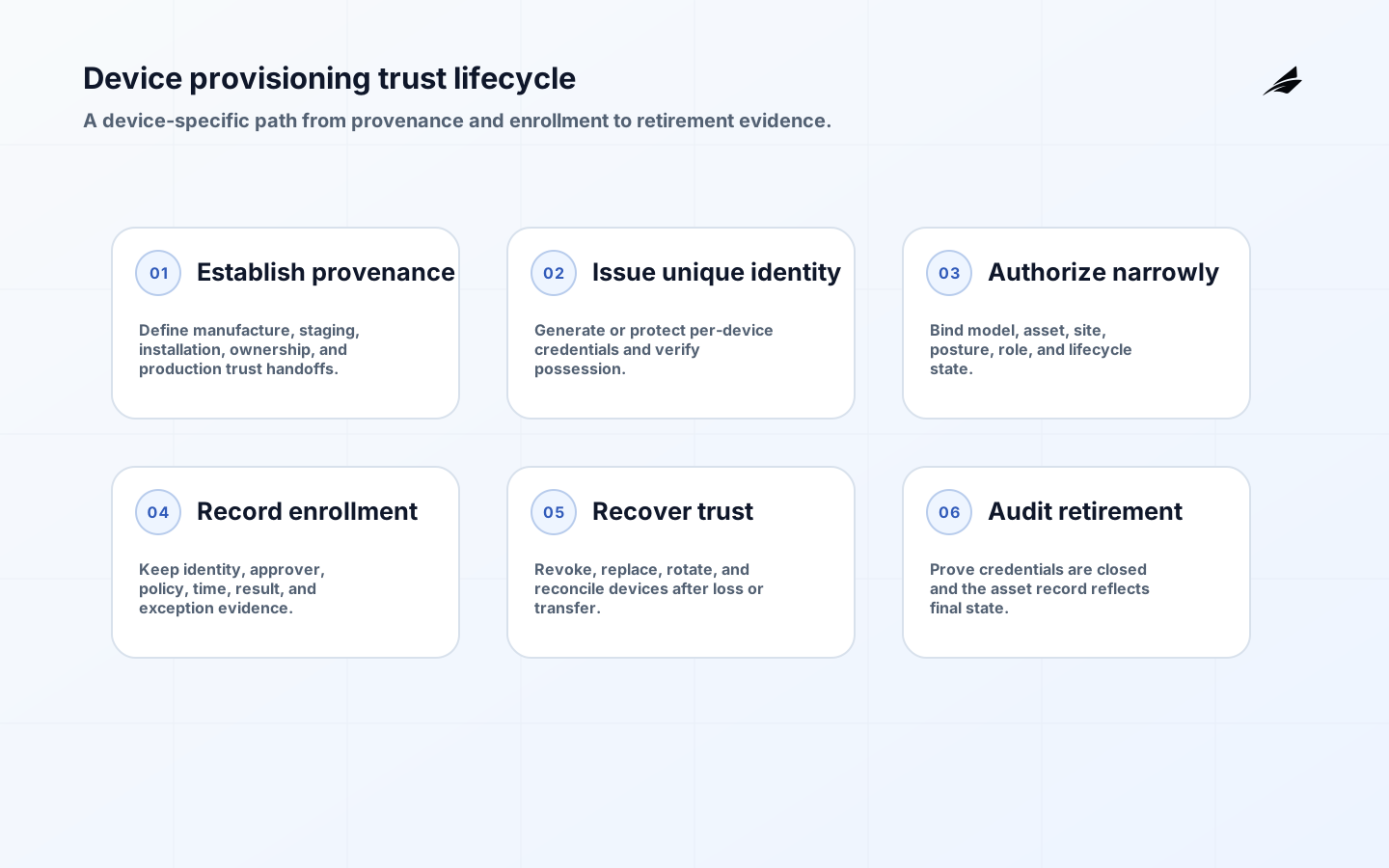
IoT device enrollment security protects the point where a device first proves its identity and receives authority to join a connected operation. This guide concentrates on provenance, trust anchors and ownership transfer. For the broader lifecycle and recovery overview, begin with the device provisioning security review, then use this page to examine the enrollment boundary in greater depth.
Establish device provenance before enrollment
Identify the root of trust and the moment it becomes authoritative. Depending on hardware and supply chain, this may be a protected key installed during manufacture, a credential added in a controlled staging area, or an enrollment ceremony performed by an installer. Document who can assert the device identity, how the platform verifies it, and what evidence is retained. Avoid shared bootstrap credentials that can enroll any unknown unit after one secret leaks. A unique initial identity enables an operator to approve, limit, rotate, or revoke one device without affecting a fleet.
The enrollment service should distinguish authentication from authorization. Proving that a device holds a valid key does not by itself establish that it belongs at a particular site or should publish on a particular topic. Bind the identity to an approved asset, deployment context, hardware or software state where available, and a narrow role. The device provisioning production guide explains how that policy becomes an operational onboarding flow rather than a one-time manufacturing script.
| Provisioning question | Required answer | Evidence |
|---|---|---|
| Identity | What unique key or certificate identifies the unit? | Identity record and issuer. |
| Authorization | What may it connect to or do? | Role, scope, and policy version. |
| Ownership | Who accepts the unit into service? | Asset and site assignment. |
| Recovery | How is trust changed after loss or replacement? | Revocation and re-enrollment record. |
Tie enrollment to the asset lifecycle
Provisioning must connect to real asset management. When a unit is received, installed, moved, repaired, replaced, returned, or retired, the trust record needs a corresponding state change. Keep a durable link among hardware serial number, cryptographic identity, approved software version, configuration, location, and responsible owner. A platform that regards a factory identity as permanently active will eventually allow an inventory-room, stolen, or retired device to reconnect unexpectedly.
Plan the exception paths. A technician may arrive with a replacement unit during an outage, an old device may be offline when revocation is required, or a supplier may need to stage a batch before site assignment. Define what can be pre-enrolled, what needs human approval, how long an unassigned state can exist, and which network access it has while incomplete. Quarantine is useful only when it is visible and someone owns its resolution.
Protect device credentials through rotation
Private keys and enrollment secrets should be generated, stored, and used in a way that limits extraction. Hardware-backed storage is preferable when available, but the operating procedure still matters: protect installer tools, prevent logs from exposing bootstrap material, and never reuse a credential merely because replacement is inconvenient. Establish expiry, renewal, revocation, and emergency rotation procedures before deployment. A certificate that cannot be renewed remotely or during a planned visit is a predictable source of outage.
Key management needs separation of duties. The person who installs a unit may not be the person who approves its production role; a supplier may be able to manufacture an identity without being able to authorize it at every customer site. Log issuance, enrollment attempts, policy changes, failed attestations, and revocations. Review unusual enrollment patterns and repeated failures, which can indicate a faulty production process or an attempted unauthorized device.
| Lifecycle event | Secure response | Do not do this |
|---|---|---|
| New installation | Authenticate then approve a scoped role. | Activate with a shared fleet credential. |
| Replacement | Bind new identity and revoke the old route. | Copy old keys onto the new unit. |
| Suspected compromise | Limit access, preserve evidence, rotate identity. | Wait for the next routine maintenance window. |
| Retirement | Revoke credentials and update asset state. | Assume powered-off means deauthorized. |
Deliver configuration under an approved identity
Provisioning often includes initial configuration: endpoints, site identifiers, permitted protocols, reporting interval, and update channel. Treat that configuration as a versioned, approved artifact. Verify it reaches the intended hardware, report the applied version, and provide rollback. Avoid embedding customer-specific secrets in generic firmware images or relying on an installer to type complex values into a local console. Configuration mistakes can create both exposure and incorrect telemetry, so the record must be traceable to the device and time.
Authorize the device for the minimum necessary service. A new unit may need to reach an enrollment endpoint and configuration service before it is trusted for normal telemetry or commands. Segment this onboarding route from production access. Once provisioned, remove bootstrap permissions and verify the expected policy is enforced. This limits damage if an initial credential is exposed and makes the platform's trust state easier to interpret during an investigation.
Test enrollment with adversarial field cases
Test more than the happy-path enrollment. Attempt to enroll a device with an expired credential, a revoked identity, the wrong site assignment, corrupted configuration, and a clock or network problem. Test replacement and retirement on representative hardware. Include installers and operations staff: a secure process that cannot be completed under field conditions will invite workarounds. Record the effort, required approvals, and recovery time, then simplify the procedure without weakening the trust decision.
- Issue or protect a unique identity for every device.
- Separate proof of identity from authorization for a site and role.
- Link enrollment state to the real asset lifecycle and owner.
- Use controlled, versioned configuration with a reported applied state.
- Plan renewal, revocation, replacement, and retirement before launch.
- Exercise failed enrollment and recovery with the teams that install devices.
Make provisioning evidence usable in operations
A secure device provisioning review begins before the device appears in the fleet. Define who creates or vouches for the initial identity, where the key or credential is generated and protected, how the platform verifies possession, and what binds the identity to an approved asset and site. A serial number can support inventory but cannot authenticate a device. Avoid one bootstrap secret that can enroll every unit. If manufacturing, staging, installation, and operation are separate trust domains, record the handoff between them and require an explicit state change before the device receives production permissions.
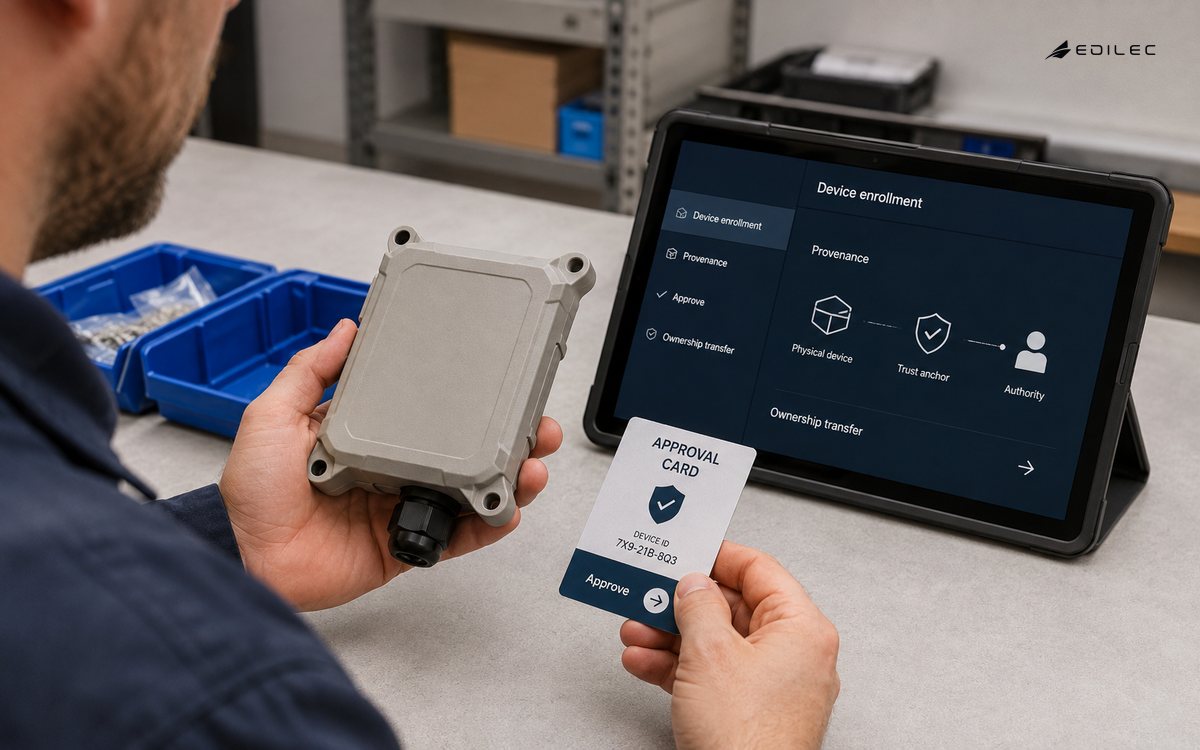
Separate enrollment from authorization. After a device proves it controls its credential, the platform should still check model, ownership, deployment context, firmware or posture where appropriate, and the role requested. Grant the smallest useful permissions for publishing, subscribing, configuration, and update. Keep a record of the identity, asset, approver or enrollment service, policy version, time, and result. If the enrollment is automated, create a human review route for mismatched ownership, unexpected site, duplicate identity, or a device that presents a valid credential with an unapproved profile.
Replacement and recovery are part of provisioning, not later administration. When a device is repaired, transferred, cloned in error, or suspected of compromise, revoke the old relationship, issue a new identity through the approved path, and reconcile its data and ownership. Test lost connectivity during enrollment, a repeated enrollment attempt, an expired certificate, a failed secure update, and a device that returns after retirement. The safe outcome should be a visible pending or blocked state, not a partial identity that gains broad access because an installer needs to finish quickly.
Measure provisioning quality with more than enrollment volume. Track time to approved identity, rejected attempts, duplicate assets, manual exceptions, credential age, failed rotations, orphaned devices, and time to revoke. Inspect a sample from manufacture through retirement and confirm that each transition has evidence. The operating team should know which account can approve an exception, which service can issue credentials, and how to prove that a retired device cannot rejoin. That is the difference between onboarding hardware and establishing a durable trust relationship.
| Check | Evidence to capture | Decision if missing |
|---|---|---|
| Identity and ownership | Stable asset, service, site, and accountable owner. | Hold the action and route the exception. |
| Freshness and quality | Observation time, state, source, and known delay. | Qualify or reject the result according to risk. |
| Change and authority | Policy version, permitted role, approval, and expiry. | Do not widen access or automate the action. |
| Recovery | Tested degraded path, reconciliation, and named responder. | Keep the cohort narrow until recovery is proven. |
For adjacent implementation context, see device provisioning in production, provisioning decisions, and gateway security in plain language. These references help separate the device provisioning decision from neighboring concerns such as data movement, connected operations, and support. Use them to compare boundaries, not to copy a design: the right choice depends on the asset, consequence, timing, people, and evidence in the local workflow in device enrollment.
The official references should be read alongside the operating record. NIST IR 8259A frames core device cybersecurity capabilities; NIST SP 800-213A helps specify requirements; NIST SP 800-57 Part 1 informs key-management decisions; and NIST OT Security connects identity and access controls to physical operations. Taken together, they support a practical rule: select the smallest capability that satisfies the named decision, make its authority explicit, test degraded behavior, and retain enough evidence to explain both normal and exceptional outcomes in device enrollment.
Device provisioning: review takeaways
- Provisioning creates a device's first trusted operational relationship.
- Unique identity enables narrow approval, rotation, and revocation.
- Authentication and authorization are separate decisions that both need evidence.
- Asset lifecycle events must update the trust record.
- A secure onboarding flow includes exceptions, field usability, and retirement.
Supply-chain evidence belongs in the review as well. Establish what the manufacturer, integrator, installer, and platform operator each attest to, and how a customer can verify that a received unit matches the approved hardware and software baseline. For higher-consequence deployments, record the custody transition from receipt through installation and capture any deviation from the expected image or enclosure. This does not require an elaborate ceremony for every low-risk sensor, but it does require a proportionate rule that stops an unknown device from receiving production authority merely because it has a familiar label. Review the rule whenever suppliers, hardware revisions, or enrollment services change.
Device provisioning questions
Can a serial number prove device identity?
A serial number is useful inventory information, but it is usually not proof that a connected unit is genuine. A cryptographic identity that can be verified and managed provides stronger authentication, while the serial number helps bind that identity to a physical asset record.
Can zero-touch enrollment remove human approval?
It can automate repeatable enrollment steps, but organizations still need policy for which device is allowed in which context and how exceptions are handled. Automation should make approval evidence clearer, not silently grant broad production access.
Conclusion: make device trust traceable
Secure device provisioning gives a connected operation a trustworthy starting point. Build identity, approval, configuration, recovery, and retirement into one lifecycle, then test it in the conditions installers and operators actually face. That investment makes every later connection easier to authorize and investigate.
Primary references for device provisioning
Consult NISTIR 8259A, NIST SP 800-213A, NIST SP 800-57 Part 1 Rev. 5, and NIST SP 800-82 Rev. 3 when defining device lifecycle, key-management, and OT security controls.