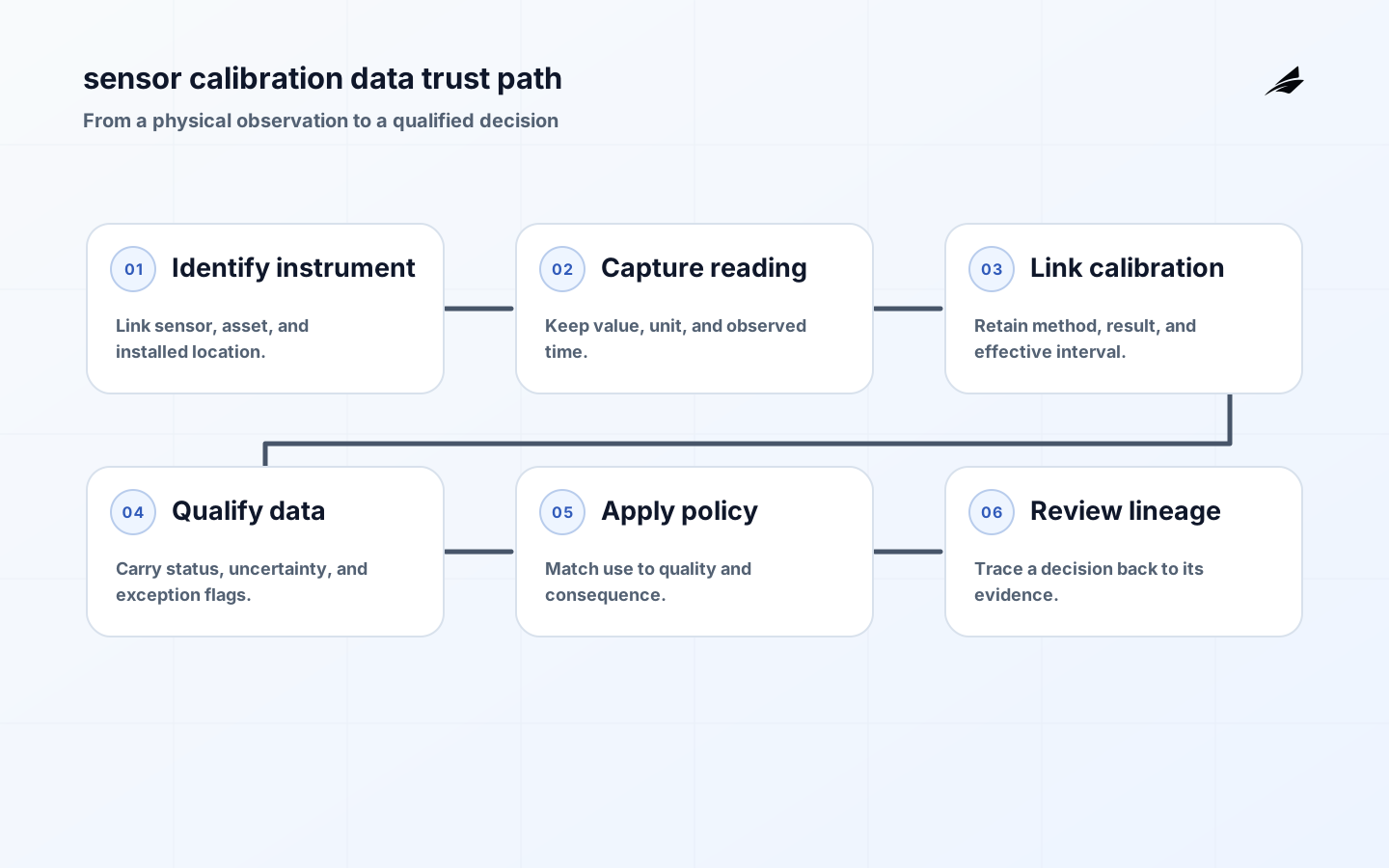
Sensor calibration data is the evidence that explains how much confidence to place in a reported measurement. A temperature of 4.2 degrees, a tank level of 62 percent, or a vibration amplitude is not self-explanatory: its usefulness depends on the instrument, range, unit, calibration method, reference standard, environmental conditions, and time since verification. CTOs should treat calibration as part of the data product. Without that context, a dashboard can be numerically precise while being operationally misleading, particularly when measurements trigger quality decisions, maintenance actions, or customer commitments.
Separate a Reading From Its Quality
The raw reading is an observation; calibration metadata describes the instrument's fitness to make that observation. Store the measurement value and unit with sensor and asset IDs, observed timestamp, configured range, calibration status, calibration due date, and a quality or uncertainty field where the engineering process provides one. Do not overwrite history when a calibration changes. A later calibration certificate can improve the interpretation of a period, but it cannot make a past value appear to have been measured with a different device or method. Preserve the lineage needed to revisit a decision.
| Approach | What it captures | When it fails |
|---|---|---|
| Value only | A number and timestamp | The team cannot judge unit, instrument, or reliability |
| Status flag | Pass, fail, or overdue state | A simple flag hides range, method, and drift evidence |
| Calibration record linked to reading | Certificate, dates, method, and asset relationship | Requires durable asset identity and data stewardship |
| Quality model with uncertainty | Measurement context and quantitative confidence | Needs domain expertise and disciplined downstream use |
Model the Measurement With Its Evidence
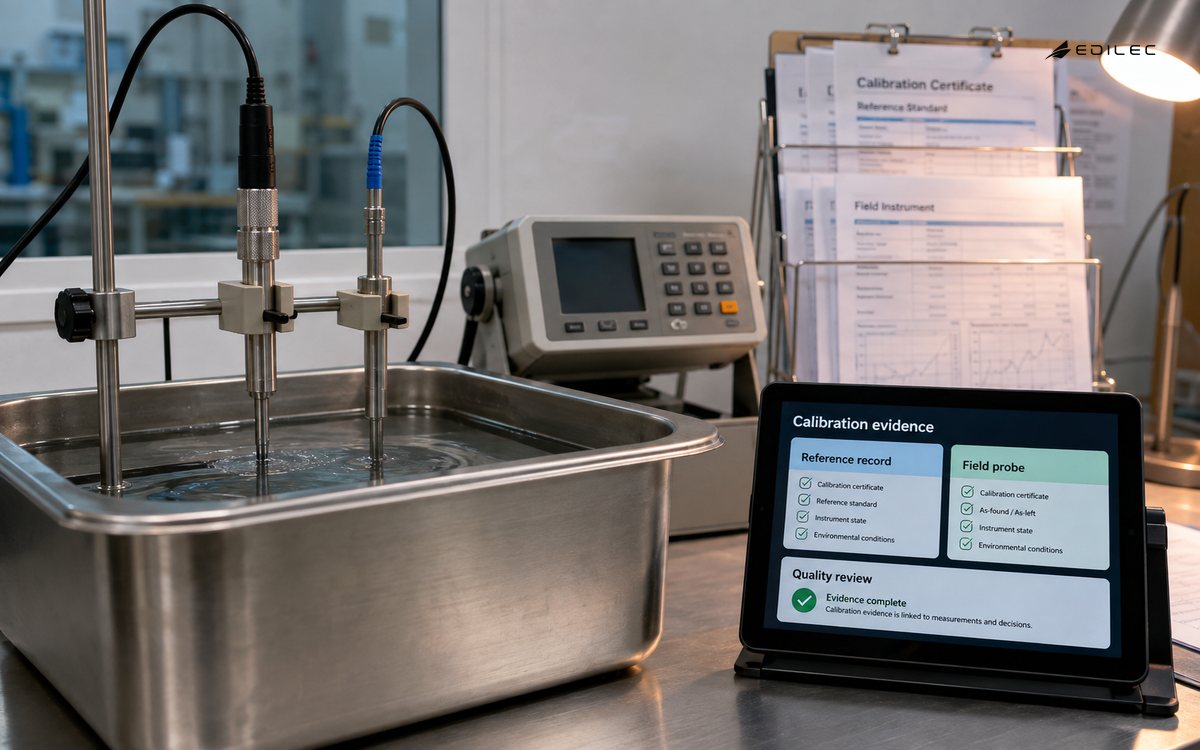
Use stable identifiers for the physical sensor and the installed location. Sensors move, are replaced, and can be temporarily bypassed; a location name alone cannot carry that history. A calibration event should identify the instrument, performed and effective times, reference equipment, technician or service provider, result, tolerance, next due date, and attached evidence location. The telemetry event need not include the full certificate. It should include enough versioned references that an analyst can join to the applicable calibration record and identify readings captured outside the approved interval.
- Normalize units at a defined boundary and retain the original unit when it matters for audit or diagnosis.
- Distinguish observed time, gateway receipt time, and calibration effective time.
- Flag an out-of-calibration reading; do not silently delete it from history.
- Use asset replacement events to end one sensor-to-location relationship and begin another.
- Make calibration evidence available to the role that investigates an exception, without exposing unnecessary technician data.
Choose a Quality Policy
The right policy depends on consequence. A comfort dashboard might show an overdue calibration badge and continue trending. A pharmaceutical storage alarm may need a documented assessment of all readings since the last known-good check. A safety interlock must be designed with its process-engineering requirements, not improvised from cloud telemetry. Make the policy visible in the application: who can acknowledge the condition, which consumers receive a degraded-quality flag, and whether automatic decisions are paused, bounded, or allowed with an escalation.
| Decision use | Suggested treatment of overdue calibration | Owner |
|---|---|---|
| Exploratory trend | Display a quality marker; retain the series | Data product owner |
| Maintenance prioritization | Allow ranking but require context before a work order | Reliability lead |
| Quality release | Hold or route for documented review | Quality manager |
| Automated control | Use an engineered fail-safe and explicit process policy | Control-system owner |
Test the Data Lifecycle
Run a tabletop exercise with a replaced probe, a late calibration upload, a unit mismatch, and a certificate that expires while a gateway is offline. Verify that a data engineer can trace a chart point to the sensor and calibration state in force at the time. IoT telemetry describes the event fields that carry this context, and sensor data pipelines explains how to keep quality flags through transformation rather than stripping them for convenience.
Start With the Costliest Measurement
Select one measurement whose error creates a measurable business cost: spoiled inventory, unnecessary dispatches, rework, energy waste, or a delayed investigation. Map the asset registry, calibration workflow, telemetry ingestion, report, and decision. That map usually reveals missing identifiers and handoffs sooner than a broad data-model workshop. Instrument overdue rate, percentage of readings with a resolvable calibration link, and time to investigate a suspect value. These are better rollout measures than the count of certificates uploaded.
Sensor Calibration Data FAQ
Should old readings be recalculated after calibration?
Only under a documented engineering or quality procedure. Preserve the original observation and calculation, then store any corrected interpretation with the rule, effective scope, approver, and reason. A casual overwrite destroys the evidence needed to understand what was known at the time.
Is calibration status enough for analytics?
It is a useful starting signal but not enough for high-consequence analysis. Analysts also need the instrument identity, unit, relevant period, range, and a link to the supporting record. The minimum model should match the decision's risk.
Key Takeaways
- Keep readings, instrument identity, and calibration evidence connected through time.
- Model quality explicitly rather than hiding it behind a cleaned number.
- Use different policies for exploratory analysis, quality release, and automated control.
- Test replacements, late evidence, and unit mistakes before relying on dashboards.
Conclusion
Trustworthy sensor data is not created by a charting layer. It comes from a durable chain between physical instrument, calibration evidence, telemetry, transformation, and decision. Build that chain around the measurement that matters most, and teams will know when a number is useful, uncertain, or unsuitable for action.
Run an Operational Review
Implementation Notes
Implement sensor calibration data as a sequence of observable releases. In the first release, keep the producer or source, identity registry, validation rule, one consumer, and support view connected end to end. Capture a baseline before switching users over: current completion time, recurring error, number of manual reconciliations, and the records that are difficult to explain. During a limited rollout, compare the new path with that baseline and look for unexpected gaps between the digital record and the physical or operational reality. A release that makes uncertainty visible is safer than one that reports success because traffic is flowing.
Configuration deserves the same discipline as application code. Version thresholds, mappings, topic or route permissions, asset associations, and retention rules; review changes with the owner of the affected workflow; and record when the new configuration became effective. This protects sensor calibration data from a common production failure: correct software interpreting a changed environment with an old assumption. Build a rollback that restores the previous known-good behavior, then test it with evidence that downstream consumers, users, and support tools see a coherent state.
Capacity planning is also a correctness concern. Estimate peak rather than average input, reconnect storms after a site outage, retained history, processing windows, and the time needed to catch up without making live work stale. Set quotas and backpressure behavior deliberately. If the system must shed load, define the least harmful data to defer and how an operator will know that it happened. Review cost alongside quality because an uncontrolled sensor calibration data design may become so expensive that teams disable retention or diagnostics precisely when they are needed for an incident.
Finally, give users an honest interface to system state. Show whether the latest information is fresh, whether an action is pending or confirmed, and who owns the next exception. Do not represent a queued request as a completed business result. Provide a stable case or correlation identifier that lets a technician, analyst, and support engineer discuss the same occurrence without copying opaque payloads into chat. These details turn sensor calibration data from infrastructure that only specialists can interpret into a dependable part of daily operations.
Sensor calibration data deserves a scheduled operating review because production evidence changes the design assumptions made during delivery. Review a representative week of normal activity and one difficult incident with the people who own the asset, service, security, and data responsibilities. Trace a record from its first observation to its final use. Check identity, timestamps, configuration or schema version, access decision, retry history, and the person who handled the exception. This is where a team discovers that a technically successful message had no business owner, an alert reached the wrong queue, or a recovered device quietly produced an older configuration. Record each finding as a concrete change with an accountable owner and due date. For Sensor Calibration Data: A CTO Guide to Trustworthy Measurements, that review is more valuable than a generic maturity score because it tests the actual route users depend upon.
Use a small scorecard that measures reliability and usefulness together. Count incomplete records, stale evidence, unassigned exceptions, manual workarounds, recovery time, and decisions later reversed because context was missing. Segment those measures by site, device class, software version, and workflow state so a broad average does not hide a troubled cohort. Then test a repair: replay an event or record, rotate an identity, restore a blocked integration, and confirm the person doing the work can explain the result. The aim is not perfect data or zero alerts. It is a sensor calibration data service whose limitations are visible, whose failures have a practiced route, and whose next improvement is selected from evidence rather than anecdote.